00191369-02.pdf - 第177页
User Manual HS-50 5 Single Functions Software Version S R.501.xx 12/99 Issue US 5.3 Single functions, Transpo rt 177 t I I t Refresh 5 The "Refr esh" function is used to ch eck whether th e ultras onic sensors …

5 Single Functions User Manual HS-50
5.3 Single functions, Transport Software Version SR.501.xx 12/99 Issue US
176
t IIt
Actuate stopper 5
This function is available in both "Processing area 1" and "Processing area 2" and can be used to
check the operation of each stopper as it is extended and then retracted. The function can be
executed either with or without a board.
Å Click the Actuate stopper button in "Processing area 1".
The stopper for processing conveyor 1 is extended and then returned to its original position.
Å Click the Actuate stopper button in "Processing area 2".
The stopper for processing conveyor 2 is extended and then returned to its original position.
PCB to processing conv. 5
This function is available in both "Processing area 1" and "Processing area 2" and can be used to
move a board which is on the input or intermediate conveyor to the appropriate processing con-
veyor, stop it there and clamp it. 5
Å Click the PCB to processing conv. button in "Processing area 1".
The board currently located on the input conveyor is moved to processing conveyor 1.
Å Click the PCB to processing conv. button in "Processing area 2".
The board currently located on the intermediate conveyor is moved to processing conveyor 2.
PCB to interm. conv. 5
This function is used to move a board from processing area 1 to the intermediate conveyor, to
stop it there and clamp it.
Å Click the PCB to interm. conv. button in "Processing area 1".
The board currently located on processing conveyor 1 is moved to the intermediate conveyor.
PCB to output conv. 5
This function is used to move a board currently in processing area 2 to the output conveyor. 5
Å Click the PCB to output conv. button in "Processing area 2".
The board currently located on processing conveyor 2 is moved to the output conveyor.
User Manual HS-50 5 Single Functions
Software Version SR.501.xx 12/99 Issue US 5.3 Single functions, Transport
177
t IIt
Refresh 5
The "Refresh" function is used to check whether the ultrasonic sensors for the whole of the trans-
port conveyor are adjusted correctly. To do this, position a board over one of the sensors. 5
The most recent states of the light barriers for the input conveyor (IC), processing conveyor 1
(PC1), intermediate conveyor (IC), processing conveyor 2 (PC2) and output conveyor (OC) are
displayed above the "Refresh" button. When you execute the "Refresh" function the current states
are queried and the results displayed (see Fig. 5.3 - 1
). 5
Å Position a board over the sensor for the required conveyor.
Å Click the Refresh button in the "Sensor state" area.
The sensors are updated and the result is displayed over the button.
There are two possible states for each sensor: 5
1 = The sensor has responded.
There is a board on this conveyor. 5
0 = The sensor has not responded.
There is no board on this conveyor. 5
Å Repeat the process for each of the transport conveyors, if necessary.
On 5
This function can be used to check the conveyors at both slow and high speed. The input conveyor
only travels at high speed. 5
NOTE
The conveyor must be empty before carrying out this function. 5
Å Click the PCB to output conv. button in "Processing area 2" to empty the conveyor.
Å Activate the "High speed" check box in the "Conveyor" area if the conveyor is to travel at high
speed.
Å Deactivate the check box if the conveyor is to travel at the slower speed.
NOTE
The input conveyor only travels at high speed. 5
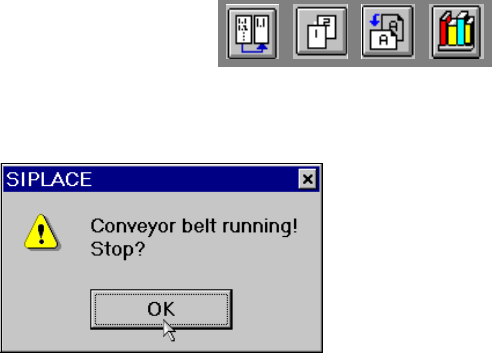
Å Click the On button. This opens the following dialog box.
5 Single Functions User Manual HS-50
5.3 Single functions, Transport Software Version SR.501.xx 12/99 Issue US
178
t IIt
5
The conveyors are traveling at the set speed.
All functions are locked. 5
Å Click the OK button in this dialog box if the operation is to be stopped.
The conveyors will be stopped and the dialog box closed.
All functions are then released.
5