SIPLACE D4-D4i 工程师手册_EN.pdf - 第48页
Overview Pneumatic Unit 3.7.1 Overview of Pneumatic Unit 48 Service Manual SIPLACE D4/D4i 3.7 3 . 7 P n e u m a t ic U n it Pneumatic Unit 3.7.1 3 . 7 . 1 O v e r v ie w o f P n e u m a t ic U n it Overview of Pneumatic …
Overview
3.6.1 Overview C&P12
Service Manual SIPLACE D4/D4i 47
3.6.1.7
3.6.1.7 Overview of Vacuum Supply
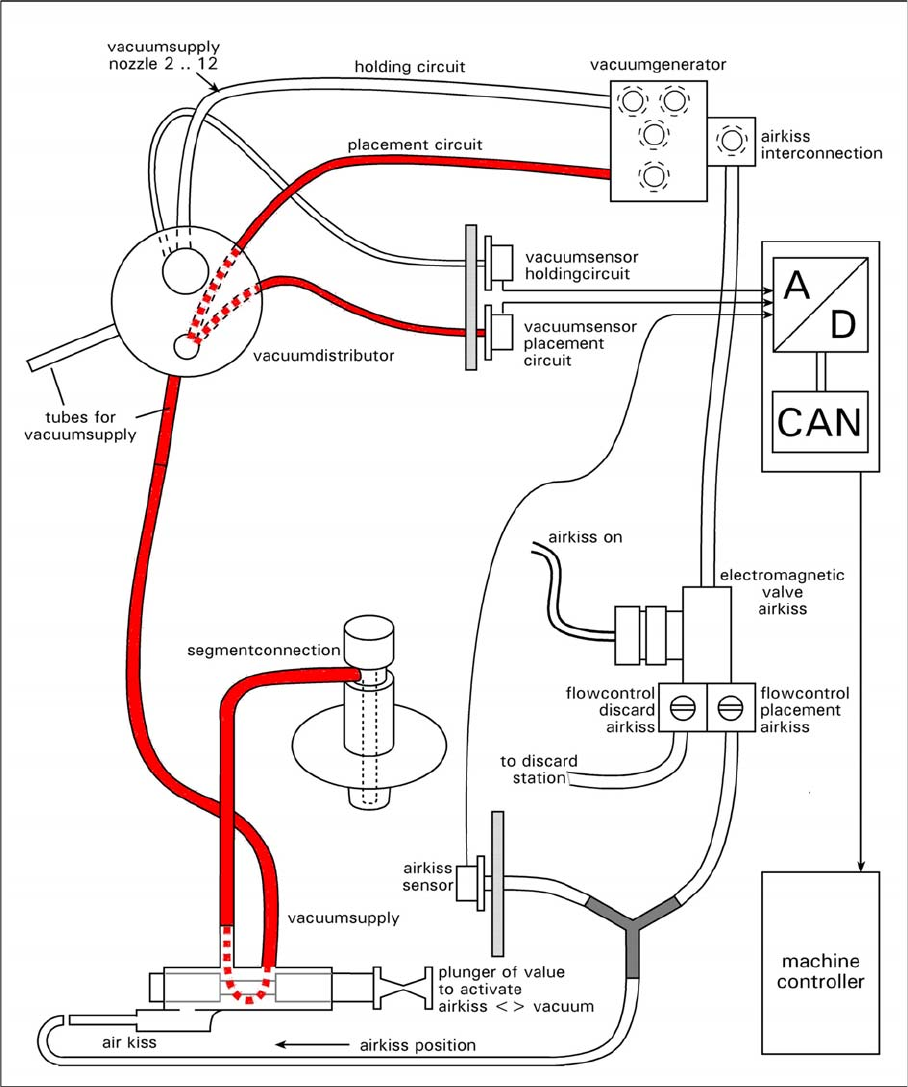
Overview of Vacuum Supply
General overview of the vacuum function
Overview
Pneumatic Unit 3.7.1 Overview of Pneumatic Unit
48 Service Manual SIPLACE D4/D4i
3.7
3.7 Pneumatic Unit
Pneumatic Unit
3.7.1
3.7.1 Overview of Pneumatic Unit
Overview of Pneumatic Unit
The pneumatic unit is a fixed installation inside the machine. The unit is accessible via a door and con-
tains the complete compressed air supply for all consumer devices.
3.7.1.1
3.7.1.1 Manometer Arrangement
Manometer Arrangement
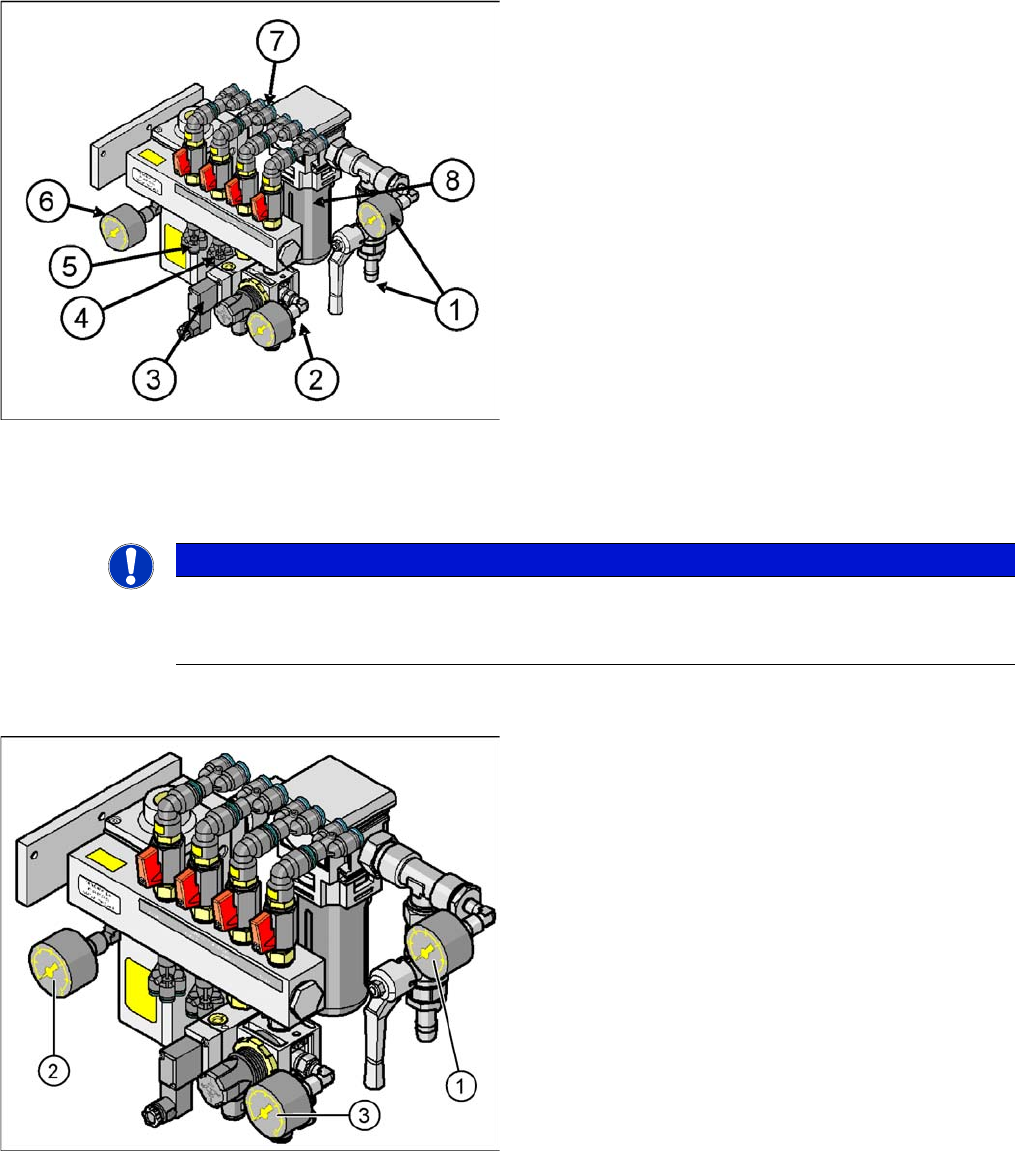
Pneumatic unit as rack unit (D4/D4i)
Legend
1. Main compressed air connection with shutoff valve
and manometer
2. 4x connection for bulkcase feeder with manometer,
manually adjustable (2.5 bar), location 1-4
3. 4x connection for cutters, location 1 - 4
2x connection for conveyor lifting table
4. 4x connection for nozzle changer
5. 4x connection for docking/undocking the changeover
table
6. Electronic control valve for incoming pressure ma-
nometer.
7. 4x connection for gantries 1 - 4, vacuum generation
C&P head with shutoff valves
8. Compressed air filter (you may need a special tool to
open this)
NOTICE
Different pressure
Observe the different pressure for the nozzle changer on the D4/D4i machine (5.1 +/- 0.1 bar),
which is significantly higher than that for the nozzle changer of the D1/D2/D1i/D2i machines.
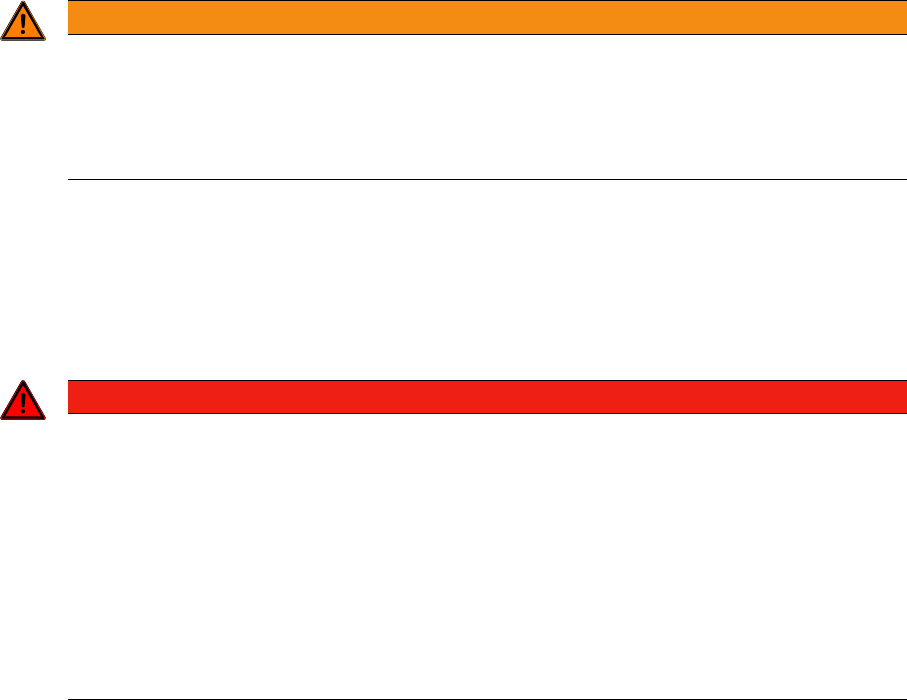
Main pneumatic unit: manometer arrangement (D4/D4i)
Legend
1. Manometer input pressure (5 – 10 bar)
2. Manometer regulated supply pressure 5.0 +0.1 bar
for placement heads
3. Manometer for reduced pressure 2.5 +/0.5 bar (man-
ually adjustable)
Service Work
4.1.1 Measuring Voltages on the Power Supply Unit Electrical System
Service Manual SIPLACE D4/D4i 49
4
4 Service Work
Service Work
4.1
4.1 Electrical System
Electrical System
4.1.1
4.1.1 Measuring Voltages on the Power Supply Unit
Measuring Voltages on the Power Supply Unit
4.1.1.1
4.1.1.1 Safety Instructions
Safety Instructions
4.1.1.2
4.1.1.2 Tools and equipment required
Tools and equipment required
▪ Digital voltmeter, class 1.5
Measurement range:
– AC voltage: 750 V
– Alternating current: 40 A
– DC voltage: 300 V
– Direct current: 30 A
– Resistance: 200 Ohm - 20 MOhm
▪ Test cable with test probes or terminals
▪ Circuit diagram folder SIPLACE D4 [00194752-xx]
▪ DIN 911 Allen key, size 6
▪ 3 mm key, double-bit, DIN 43668-J33 (00304191-xx)
4.1.1.3
4.1.1.3 Preparing the power supply unit for measurement
Preparing the power supply unit for measurement
The power supply unit and main switch are located in the machine base. In front of the unit there is a set
of safety doors which can be opened with the double-bit key.
The unit is fixed to the machine base using an M8 hexagon socket-head screw.
To measure the power supply, proceed as follows:
► Switch the placement system off at the main switch.
► Open the safety doors with the double-bit key.
► Loosen the M8 lock screw, fastening the underside of the unit at the front (see fig).
WARNING
Nonobservance of these safety instructions may cause injury to personnel and damage to the
machine!
The service work described in this manual may only be performed by specially trained service
technicians, with appropriate qualifications and expertise.
► Please observe the safety instructions in the Operating Manual for all service work!
DANGER
The machine is supplied with 3 x 400 V~ (or 3 x 204 V~ / 3 x 230 V~ / 3 x 380 V~ / 3 x 415 V~)
± 5 %, 50/60 Hz mains voltage.
Consequently, parts of the system carry potentially lethal voltages, even when it is switched off
at the main switch.
Incorrect handling of the machine can therefore result in death, severe injury or considerable
damage to equipment.
Measurements and repairs must always be carried out by appropriately qualified personnel.
► Always follow the safety instructions in chapter 2 of this manual.
► Always follow the applicable accident prevention and VDE regulations (particularly DIN EN
60 204 part 1) or the regulations specific to your country.