4H4CEPM.pdf - 第33页
Page 23 301 CM 444C-EPt-EdCl-014 Chip Data 3-4 Editing QFP Chip 1. Click on the radio button of “QFP .” • QFP switch is displayed. 2. Click on QFP . • [QFP Extension] window opens. 3. Enter the PinPitch and PlanPin. • Pi…
Page 22
PlanPin (Number of provisional pins)
ActualPin (Number of actual pins)
Pin No.
Missing pin information
Chip Data
4. Pin Information
∗∗
∗∗
∗ PinPitch
∗∗
∗∗
∗ ActualPin (Number of actual pins)
∗∗
∗∗
∗ PlanPin (Number of provisional pins)
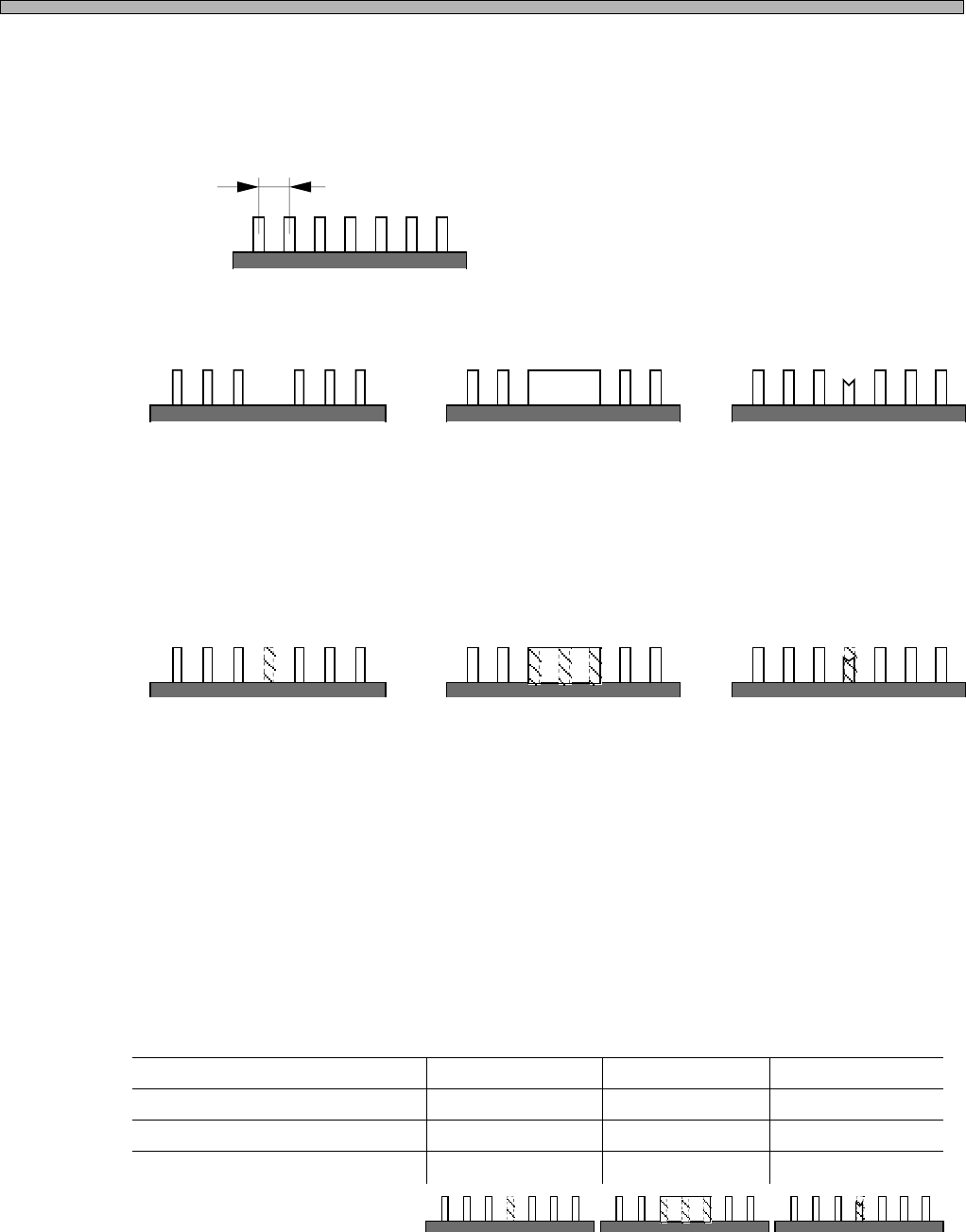
As to SOP, QFP, etc., leads of the same width are aligned at the same pitches generally.
But there are the following exceptions, too.
In such cases, the program must be set not to search for the tips of the leads at those positions
during image processing. Therefore, register the position where a lead does not exist as “missing
pin.”
When you register the position of the missing pin, the notion of “provisional pins” is used.
Suppose there are leads at the same pitches even when some leads are missing and so on, and
number the imaginary leads. This line of leads including imaginary leads is called “provisional pins.”
Among them, the leads which actually exist are called “actual pins.” ( “provisional pins” = “imagi-
nary leads” + “actual pins (the leads which actually exist)” )
Then, register the positions of the imaginary leads using the pin No.
When data is created, the position of the actual pin is represented by O and that of imaginary lead
is represented by ×. This data is called “missing pin information.” And the number of actual pins is
called “ActualPin,” that of provisional pins is called “PlanPin.”
444C-015E
Pitch
A lead is missing due
to the chip designing.
A radiation panel is
between leads.
A frame mark is
between leads.
1234567 1234567 1234567
Suppose there is an
imaginary lead at the
position of the missing pin.
Suppose there are imagi-
nary leads at the position of
the radiation panel.
Suppose there is an
imaginary lead at the
position of the frame mark.
444C-016E
444C-017E
1
O
7
6
2
O
3
O
4
×
5
O
6
O
7
O
1
O
7
4
2
O
3
×
4
×
5
×
6
O
7
O
1
O
7
6
2
O
3
O
4
×
5
O
6
O
7
O
4H4C-E-PMA01-A02-01
Page 23
301
CM
444C-EPt-EdCl-014
Chip Data
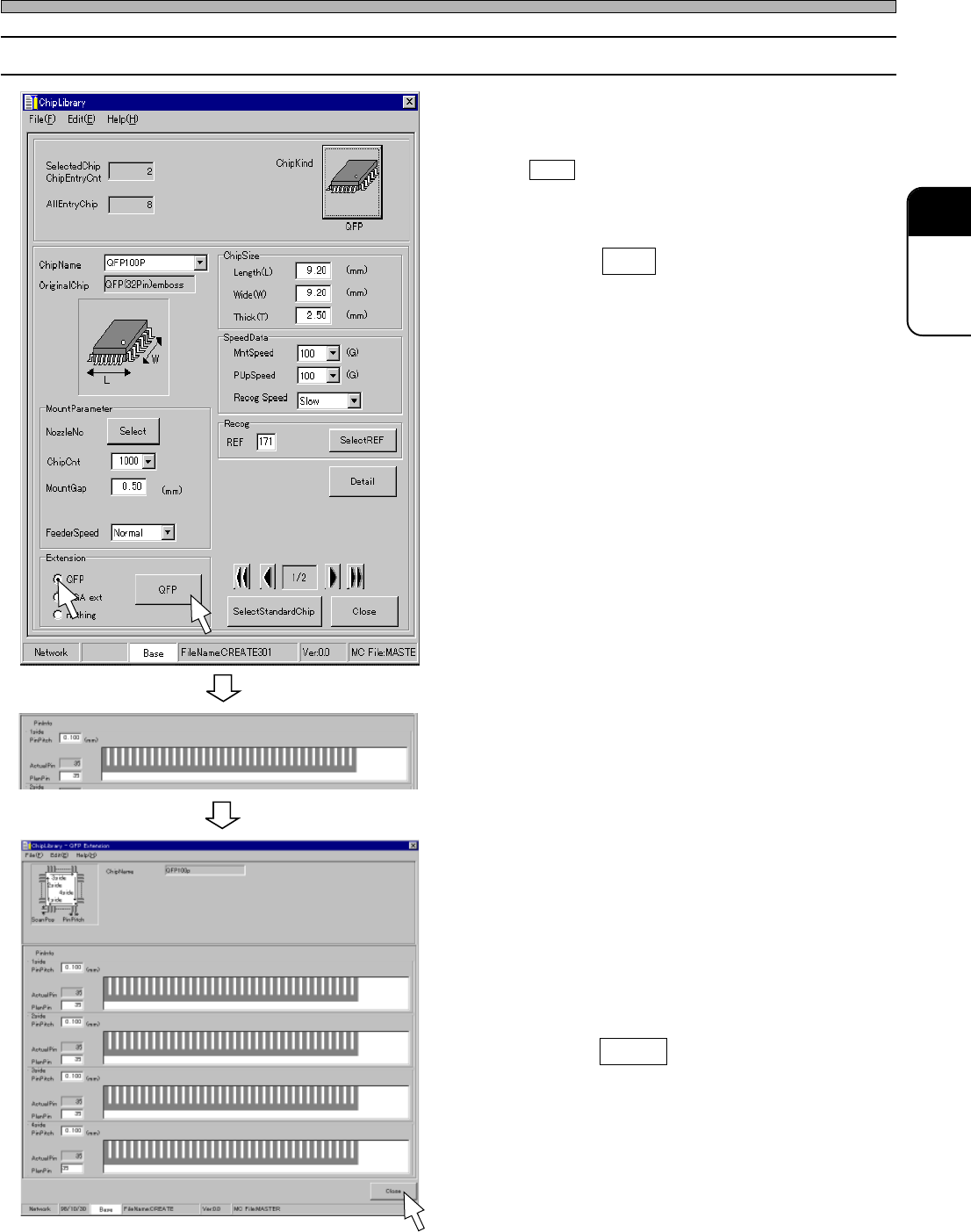
3-4 Editing QFP Chip
1. Click on the radio button of “QFP.”
• QFP switch is displayed.
2. Click on QFP .
• [QFP Extension] window opens.
3. Enter the PinPitch and PlanPin.
• Pins are displayed.
4. Repeat step 3. until you finish enter-
ing the information of 4side.
5. Enter the actual pins arrangement.
∗ When ActualPin is not the same as
PlanPin,click the missing pin position(s).
6. Click on Close .
• [ChipLibrary] window opens again.
444C-EPt-EdCl-014
4H4C-EPt-EdCl-008
4H4C-E-PMA01-A02-01
Page 24
Chip Data
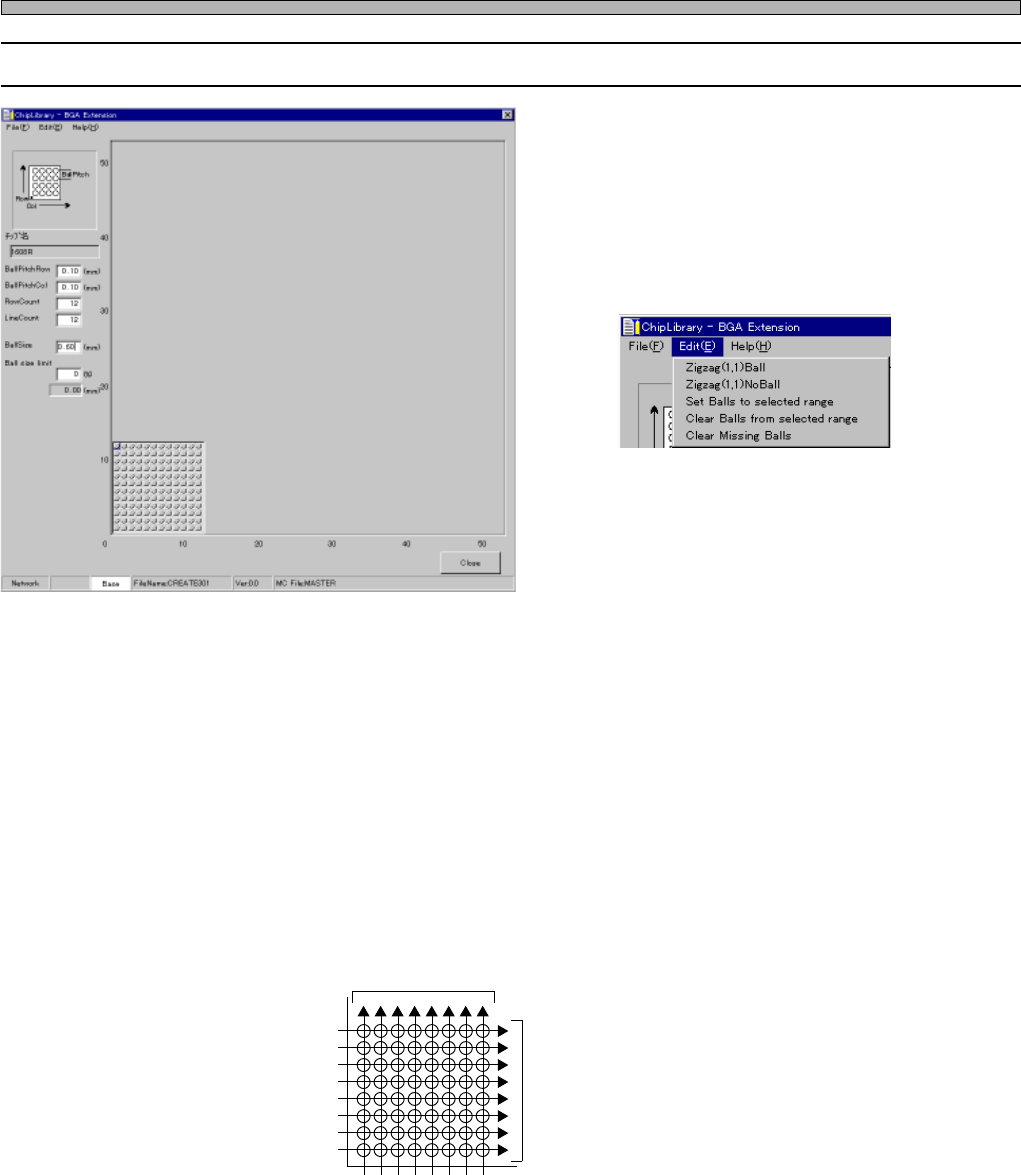
3-5 BGA Chip
1. Ball Pitch Line / Ball Pitch Row
2. RowCount / LineCount
3. Ballsize / Ball size limit
4. Zigzag Arrangement / Missing Balls
Setting
1. Ball Pitch Line / Ball Pitch Row
These show the line and row pitches of balls.
2. RowCount / LineCount
These show the number of balls per row and the number of balls per line.
The positions of the balls of BGA and CSP are indicated by the combination of the line No. and row
No. When you look down at the balls side of BGA or CSP with the index corner placed at the lower
left, a horizontal alignment is called “Row” and a vertical one is called “Line”.
3. Ballsize / Ball size limit
Ballsize : This shows the diameter of the part shining on the screen.
Ball size limit : This shows the percentage that the recognition on the basis of ball’s diameter is
OK. (The range of OK is Ballsize ± Ball size limit.)
Row No.
Line No.
Fig. 1
Line
Row
1 2 3 4 5 6 7 8
1
2
3
4
5
6
7
8
444C-EPt-EdCl-019
4H4C-EPt-EdCl-009
4H4C-E-PMA01-A02-01