HS50_advance_level 1_20200522_221201 (1).pdf - 第415页
Editi on 06/2002 S tudent Guide HS - 50 Advance d I 1 1 Pneumat ic Cutter and Emp ty-T ap e Duct 28 11.6.4 Exch angin g: Short-Str oke Cylin d e r and Artic ulated Joint o n Left / Right W ARNING W ear thi c k p rot ec t…

Student Guide HS-50 Advanced I Edition 06/2002
11 Pneumatic Cutter and Empty-Tape Duct
27
f the gap is incorrect, check:
– Was an incorrect holddown (with version < 03) installed ?
The holddowns match the version 04 cutters (= with tape deflector).
– Wasn’t the blade, tape deflector, etc., cleaned before installation ?
If the gap is OK:
à Carefully fold the cover plate (with cover plate holders installed) back over the tape deflec-
tor.
à Make certain that the edges are parallel, then screw the cover plate holder to the cutter (two
M4 screws each (see Fig. 11.4.2 -> 7, 9):
-> Do not pinch or put strain on the cables.
à Install the cover plate on the stationary blade (4 screws M4, see Fig. 11.4.2 -> 12, 13).
à Remove the parallel clamps from the cutter or dismantle the cutter from the mounting plate.
à Mount the cutter in the machine, as described in Section 11.6.1.2.
à Install the empty-tape duct assembly and check the entire length of the gap between the
leading edge of the tape deflector and the “empty-tape baffle, inside", as described in Sec-
tion 11.6.8.
à Perform the appropriate “Final Steps” (see Section 11.6.11).

Edition 06/2002 Student Guide HS-50 Advanced I
11 Pneumatic Cutter and Empty-Tape Duct
28
11.6.4 Exchanging: Short-Stroke Cylinder and Articulated Joint on Left / Right
WARNING
Wear thick protective gloves.
You might cut yourself on the blades and the tape deflector.
Never reach into the pneumatic cutter from below or into the empty-tape duct from above. 11
11.6.4.1 Removing the Short-Stroke Cylinder / the Articulated Joint
à Remove the cutter from the machine, as described in Section 11.6.1.
à Perform all steps up to and including “...loosening the screws fastening the articulated joint” (in
this case only on the faulty short-stroke cylinder), as described in Section 11.6.2.1.
– The mounting position of the stationary blade (= right-hand end remains on the right) must
be restored during installation.
– The movable blade is left installed.
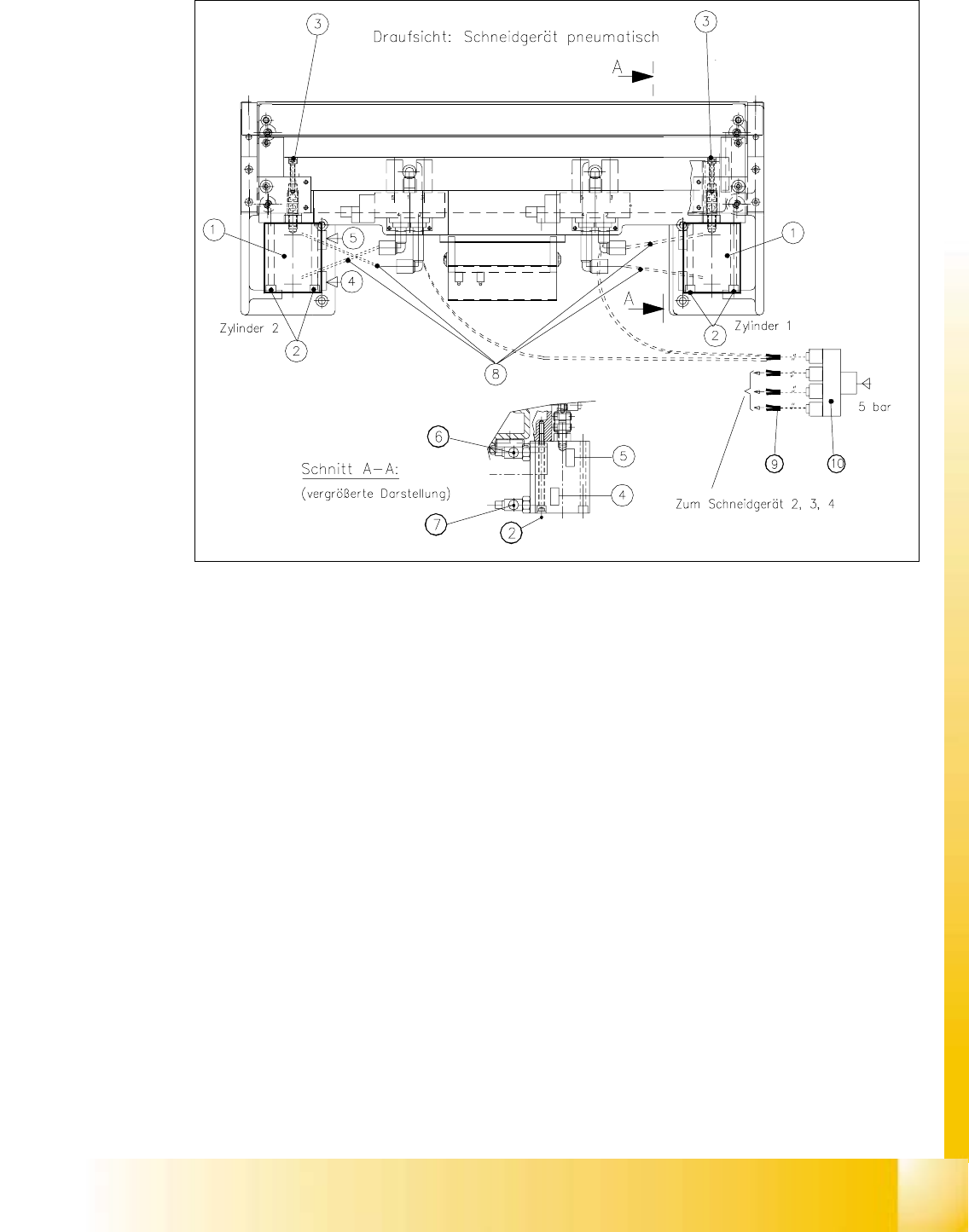
à Loosen the compressed air connections on the faulty short-stroke cylinder (see Fig. 11.6.3
-> 8).
à Using a fine-tip, water-insoluble marker, accurately mark the specified position of the proximity
switch on the faulty short-stroke cylinder.
à In addition, mark the allocation of the proximity switches to the faulty short-stroke cylinder (po-
sition front/back).
à Loosen the screws fastening the two inductive proximity switches to the short-stroke cylinder
(1 screw each: see Fig. 11.6.3 -> 4, 5).
à Loosen the screws fastening the faulty short-stroke cylinder (2 screws: see Fig. 11.6.3 -> 2)
and remove the cylinder, incl. the articulated joint screwed into it.
à Dismantle articulated joint from the cylinder by turning the open-end wrench (width across flats
10) on the surface indicated in Fig. 11.6.4 -> 3).
NOTE:
The threaded pin is secured with Loctite no. 243, so it takes somewhat more strength to loosen it.11
Student Guide HS-50 Advanced I Edition 06/2002
11 Pneumatic Cutter and Empty-Tape Duct
29
Fig. 11.6.3 Removing and Installing the Short-Stroke Cylinder
Key:
1. Short-stroke cylinders 1 and 2
2. Screws fastening the short-stroke cylinders: 2 socket hex head cap screws each, M5 x 65
3. Screws fastening the articulated joint (see also Fig. 11.6.4)
4. Proximity switch (for position cylinder moved in). Fastener: 1 cross-slotted screw
5. Proximity switch (for position cylinder moved out). Fastener: 1 cross-slotted screw
6. One-way restrictor (for running cylinder out)
7. One-way restrictor (for running cylinder in)
8. Allocation of the compressed air connections, air hoses
9. Y-socket union (in the cable pit)
10. Multiple-Y-distributor on the safety valve (5 bar from compressed air unit)