1OM-1086-002.pdf - 第150页
(5.4) How to make a screen recognition mark Method: • Engrave the screen recognition mark by half-etching and bury epoxy resin adhesive mixed with carbon powder into the grooves. • After curing the adhesive, finish the s…

(5) Material of Screen Plate and Setting of Screen Recognition Mark
(5.1) Material of Screen Plate
• It is recommended that a metal mask made of stainless steel or
full additive Ni should be used.
• The recognition may become unstable because the Cu-Ni metal
mask has strong gloss on its surface. Therefore, it is required to
reduce the gloss by delustering the mask surface (the range of
10 × 10 mm around the center of the screen recognition mark).
Consult our marketing department or sales agency for details.
Note: The screen recognition mark should make ample contrast
with the surroundings. (Prevention of False Recognition)
When the mask surface is honeycomb-processed, the area
(10 × 10 mm around the center of the screen recognition
mark) should not be processed into a honeycomb type.
(5.2) Position of Screen Recognition Mark
• It is recommended that the screen recognition mark be located
at the same position as the P.E.C. fiducial mark on the P.C.B.
• Use an etching positive film (a film used to make a screen plate)
equivalent to the conductive land positive film (a film used to
make a P.C.B.). (Improvement of Accuracy)
Note: Anything like a pattern similar to a screen recognition mark
should not exist in the designated window.
(5.3) Shape of Screen Recognition Mark
• It is recommended that the shape of the screen recognition mark
be the same as the P.E.C. fiducial mark set on the P.C.B.
A through hole and a pad mark are excluded.
• Refer to "Shapes, Sizes, and Materials of Fiducial Marks" for
the detailed information of the shape and size of the screen
recognition mark.
2. Specifications
0211-005 Chapter 2 1-19 Tg0582-PM-D1
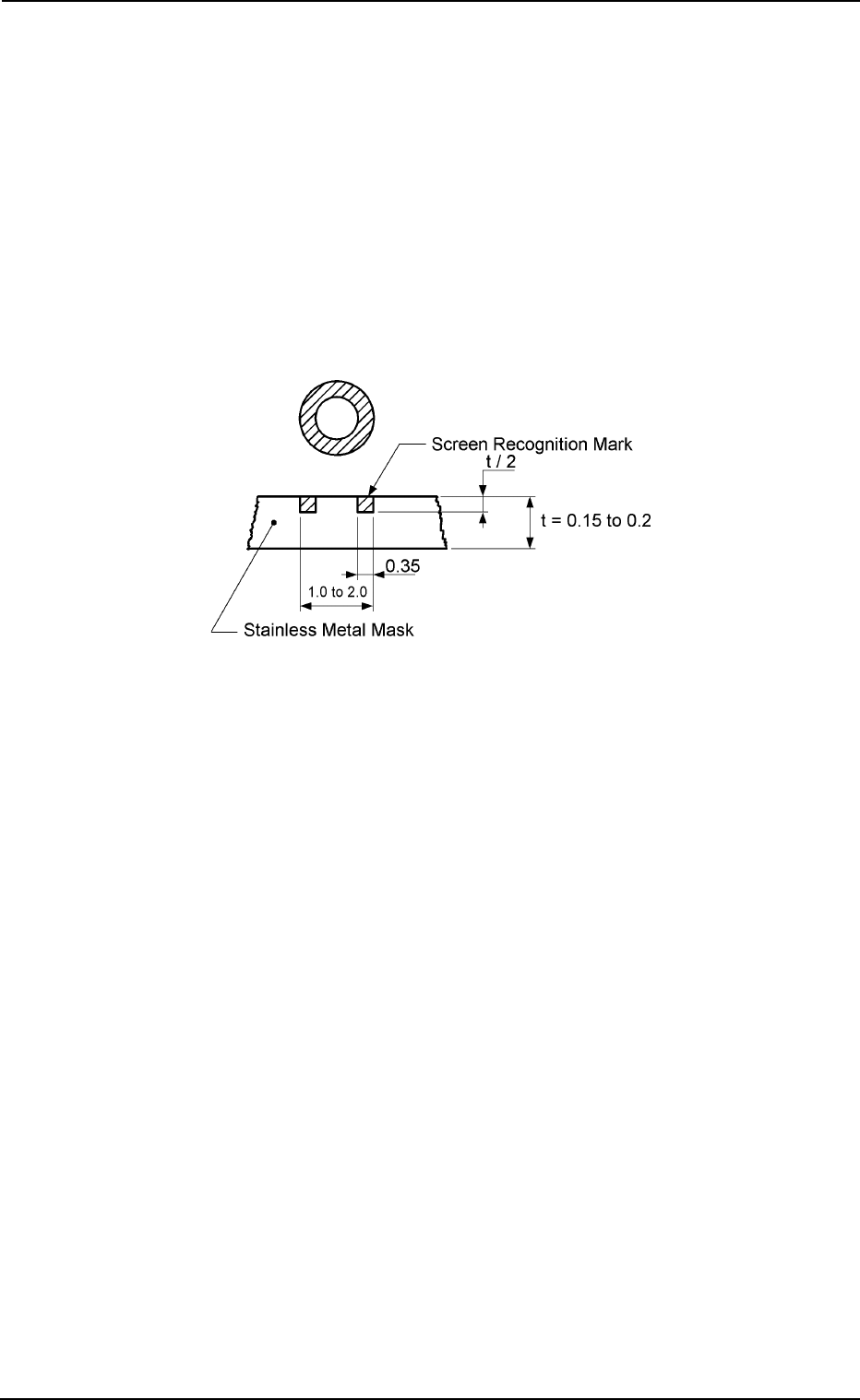
(5.4) How to make a screen recognition mark
Method:
• Engrave the screen recognition mark by half-etching and bury
epoxy resin adhesive mixed with carbon powder into the grooves.
• After curing the adhesive, finish the surface of the screen rec-
ognition mark and the upper surface of the mask such that both
surfaces become flush. ( against the surface)
Note: A punched hole can also be used as a screen recognition
mark if there is no solder paste around the hole.
Example:
Unit: mm
Fig. 2A5
Reference Material:
• Epoxy Resin/Sumitomo 3M/Base 1838B, Hardening Agent 1838A
• Carbon Powder/Nishimura Kokuen/Earthy Graphite, Particle Size 1.5
µm
0
-0.5
0211-005 Chapter 2 1-20 Tg0582-PM-D1
2. Specifications

0211-005 Chapter 2 1-21 Tg0582-PM-D1