Oxford-100-Manual.pdf - 第157页
System Manual Oxford Instruments Plasma Technology Plasma lab 3.2.10.2 Laser interferometry PC Signal Process Chamber Process chamber Time • In-situ etch rate monitoring • Endpoint does not require etch stop layer • Endp…
Plasmalab
Oxford
Instruments
Plasma
Technology
System
Manual
(2)
The
helium
setpoint
should be set
so
that
there
is
1-2 mTorr chamber pressure
with
a
wafer
in
place. This ensures
that
there
is
sufficient
cooling.
It
is
probably
best
to
work
at
as
high
a level
as
you
can
tolerate
if
there
is
any
doubt
over
cooling
efficiency.
3.2.9 Gases
with
low
vapour
pressure
Gases
with
a
low
vapour
pressure (e.g.
SiCI4,
BCI3)
present
unique
problems
for
the
gas supply system, e.g.
temperature
dependence
of
gas pressure, condensation
in
the
gas lines, and
low
line pressure.
To avoid
the
loss
of
line pressure
during
cold
weather,
it
is
recommended
that
gases
with
a
low
vapour
pressure are sited indoors, inside an extracted gas cabinet. However,
it
is
NOT recommended
to
deliberately
heat
the
gas cylinder (e.g. by using a
heatedjacket)
as
this
will
result
in
the
re-condensation
of
the
gas in
the
gas line
and/or
MFC,
since these areas are likely
to
be cooler
than
the
cylinder. The
presence
of
condensed gas
in
the
gas line
or
MFC
will
cause
loss
of
flow
or
severe pulsing
of
measured gas
flow.
Note
that
condensation problems can sometimes
be
observed even
without
direct
cylinder heating. This
is
usually
due
to
a
slight
temperature
difference
between
cylinder and
MFC.
In such
cases,
it
is
recommended
that
heating
tape
is
placed
around
the
MFC,
filter
and valve assembly
of
the
gas line
to
ensure
that
the
MFC
and
other
components are
kept
at
a
higher
temperature
than
the
gas cylinder. An
alternative
solution
would
be
to
use a
heated
MFC.
3.2.10
Endpoint
detection
techniques
3.2.10.1
Optical
emission
spectroscopy
Light
olp
Process
chamber
Reactive
species
Etch
time
Light
olp
Wavelength
•
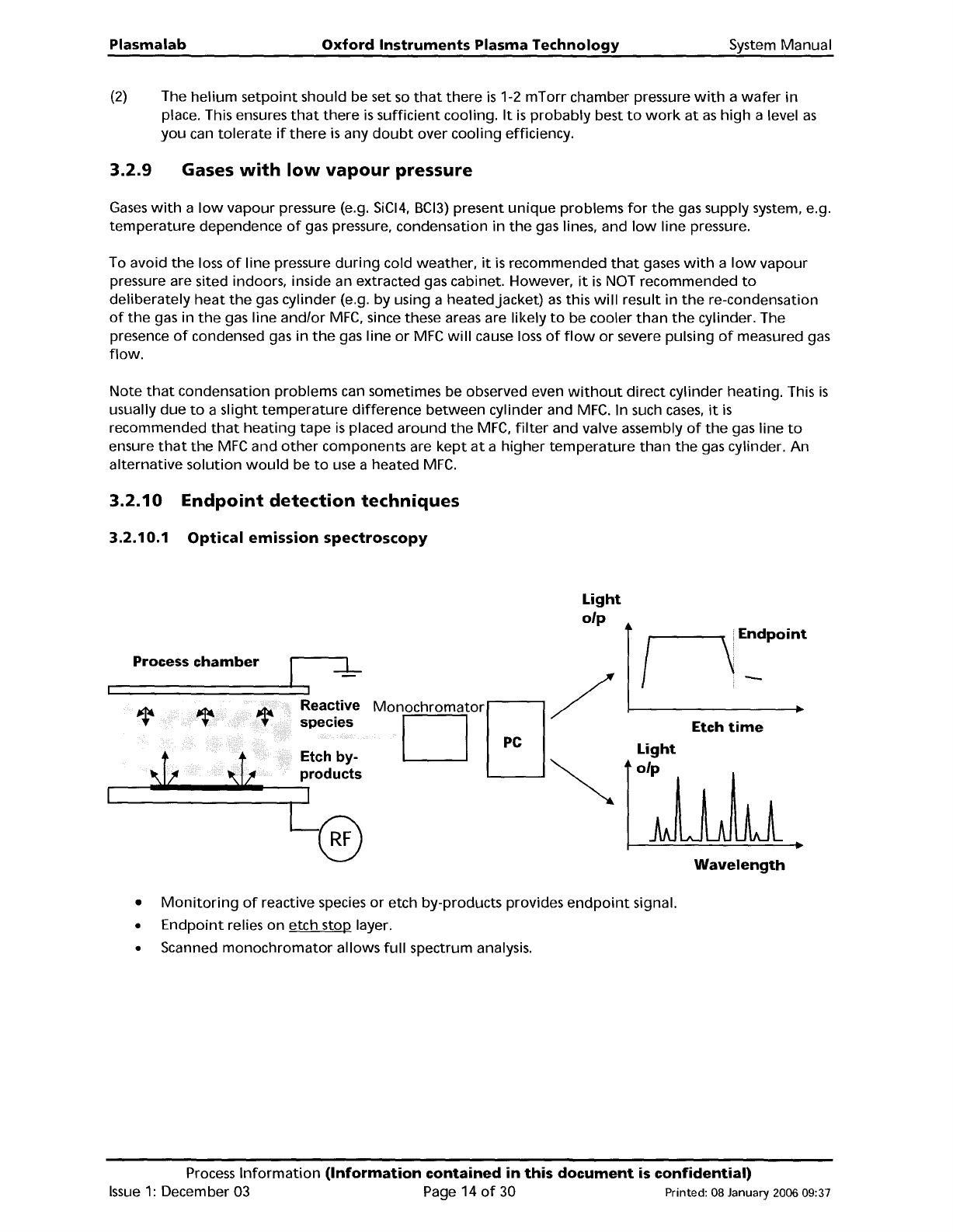
Monitoring
of
reactive species
or
etch by-products provides
endpoint
signal.
•
Endpoint
relies
on
etch stop layer.
• Scanned
monochromator
allows
full
spectrum analysis.
Process
Information
(Information
contained
in
this
document
is
confidential)
Issue
1:
December 03 Page 14
of
30 Printed: 08 January 2006 09:37
System
Manual
Oxford
Instruments Plasma Technology
Plasma
lab
3.2.10.2
Laser
interferometry
PC
Signal
Process
Chamber
Process
chamber
Time
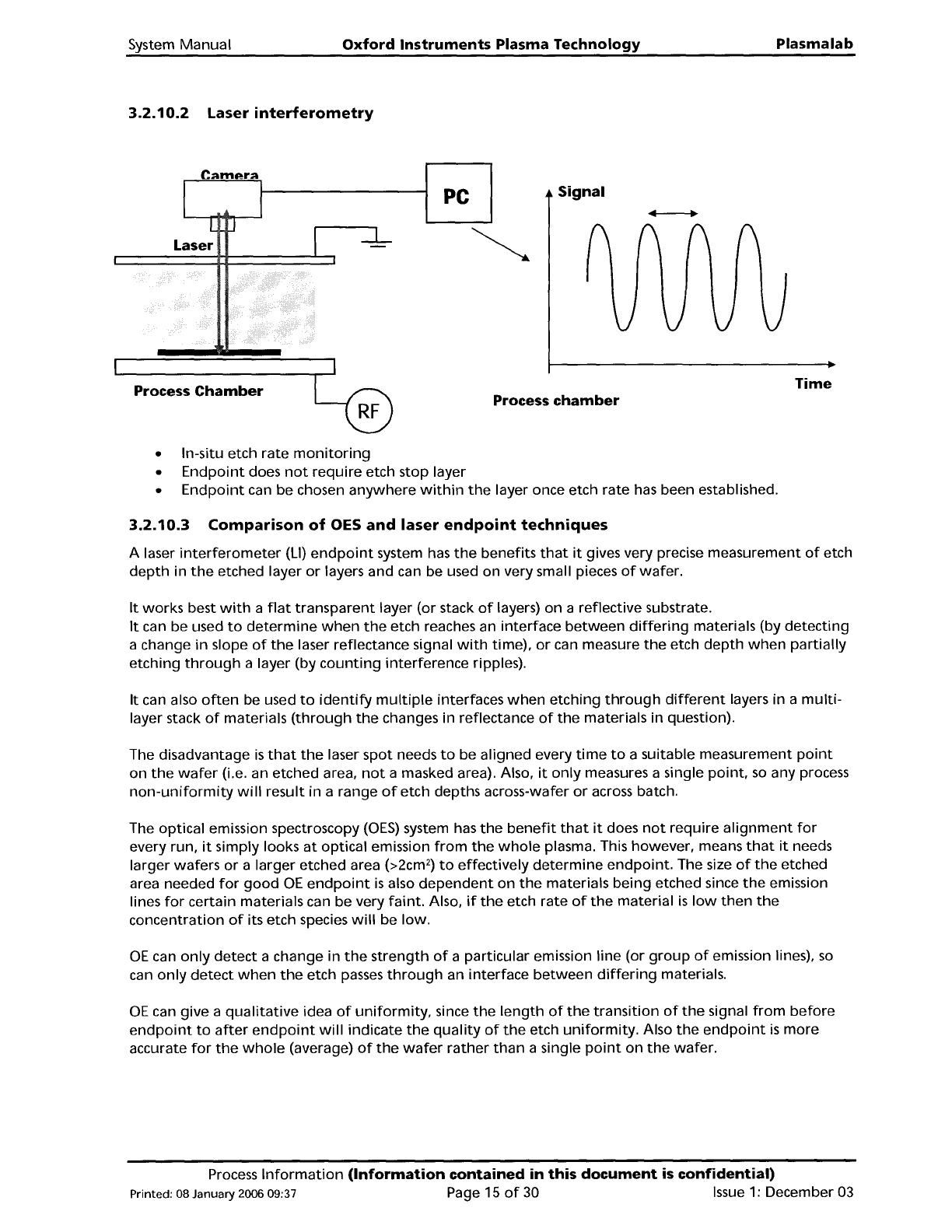
• In-situ etch
rate
monitoring
•
Endpoint
does
not
require
etch stop layer
•
Endpoint
can be chosen
anywhere
within
the
layer once etch
rate
has been established.
3.2.10.3
Comparison
of
OES
and
laser
endpoint
techniques
A laser
interferometer
(L1)
endpoint
system has
the
benefits
that
it
gives very precise measurement
of
etch
depth
in
the
etched layer
or
layers and can be used on very small pieces
of
wafer.
It
works
best
with
a
flat
transparent
layer (or stack
of
layers) on a reflective substrate.
It
can be used
to
determine
when
the
etch reaches an interface
between
differing
materials (by
detecting
a change
in
slope
of
the
laser reflectance signal
with
time),
or
can measure
the
etch
depth
when
partially
etching
through
a layer (by
counting
interference
ripples).
It
can also
often
be used
to
identify
multiple
interfaces
when
etching
through
different
layers in a
multi-
layer stack
of
materials
(through
the
changes in reflectance
of
the
materials in question).
The disadvantage
is
that
the
laser
spot
needs
to
be aligned every
time
to
a suitable measurement
point
on
the
wafer
(i.e. an etched area,
not
a masked area). Also,
it
only
measures a single
point.
so
any process
non-uniformity
will
result
in a range
of
etch depths across-wafer
or
across batch.
The optical emission spectroscopy
(OES)
system has
the
benefit
that
it
does
not
require
alignment
for
every run,
it
simply looks
at
optical emission
from
the
whole
plasma. This however, means
that
it
needs
larger
wafers
or
a larger etched area (>2cm
2
)
to
effectively
determine
endpoint.
The size
of
the
etched
area needed
for
good
OE
endpoint
is
also
dependent
on
the
materials being etched since
the
emission
lines
for
certain materials can be very
faint.
Also,
if
the
etch rate
of
the
material
is
low
then
the
concentration
of
its etch species
will
be
low.
OE
can
only
detect
a change in
the
strength
of
a
particular
emission line (or
group
of
emission lines),
so
can
only
detect
when
the
etch
passes
through
an interface
between
differing
materials.
OE
can give a
qualitative
idea
of
uniformity,
since
the
length
of
the
transition
of
the
signal
from
before
endpoint
to
after
endpoint
will
indicate
the
quality
of
the
etch
uniformity.
Also
the
endpoint
is
more
accurate
for
the
whole
(average)
of
the
wafer
rather
than
a single
point
on
the
wafer.
Process
Information
(Information
contained in this
document
is
confidential)
Printed: 08
January
2006 09:37 Page 15
of
30
Issue
1:
December 03
Plasma
lab
Oxford
Instruments Plasma Technology
System Manual
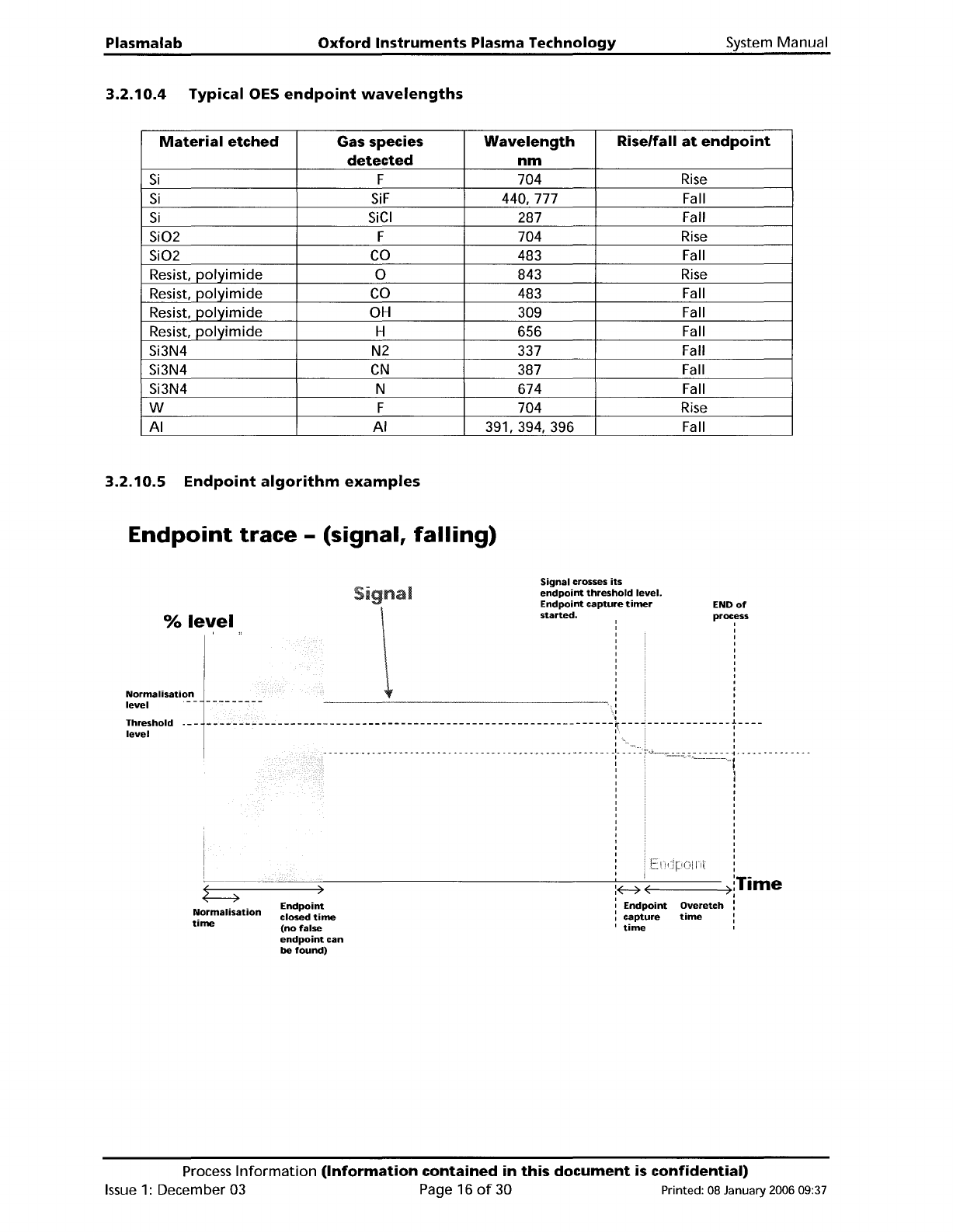
3.2.10.4
Typical
OES
endpoint
wavelengths
Material
etched Gas species
Wavelength
Rise/fall
at
endpoint
detected
nm
Si
F 704
Rise
Si
SiF
440, 777 Fall
Si
SiCI
287
Fall
Si02 F 704
Rise
Si02
CO
483
Fall
Resist,
polyimide
0
843
Rise
Resist,
polyimide
CO
483 Fall
Resist,
polyimide
OH
309
Fall
Resist,
polyimide
H 656
Fall
Si3N4
N2
337
Fall
Si3N4
CN
387
Fall
Si3N4 N 674 Fall
W F 704
Rise
AI
AI
391,394,396
Fall
3.2.10.5
Endpoint
algorithm
examples
Endpoint
trace
- (signal,
falling)
%
level
END
of
process
Normalisation
level
Threshold
level
Signal
crosses
its
Signal
endpoint
threshold
level.
Endpoint
capture
timer
l
~-
--I
.......
--------------------------------------------------------~---J-------------t----
I
',-
~
I
_______ , ,
__
" :
_·_-::··_.tc,
=.,_~~_-.::_~~.j
_
Normalisation
time
)
Endpoint
closed
time
(no
false
endpoint
can
be
found)
:~(
):Time
:
Endpoint
Overetch
I capture
time
I
time
Process
Information
(Information
contained
in this
document
is
confidential)
Issue
1:
December 03 Page 16
of
30 Printed: 08 January 2006 09:37