Oxford-100-Manual.pdf - 第259页
Equipment Manual Oxford Instruments Plasma Technology WARNING Plasmalab ICP 180 BEFORE PROCEEDING WITH ANY MAINTENANCE WORK, READ SECTION 1 • HEALTH AND SAFETY. 6.4 Changing the ICP180 dielectric tube This sub-section ap…
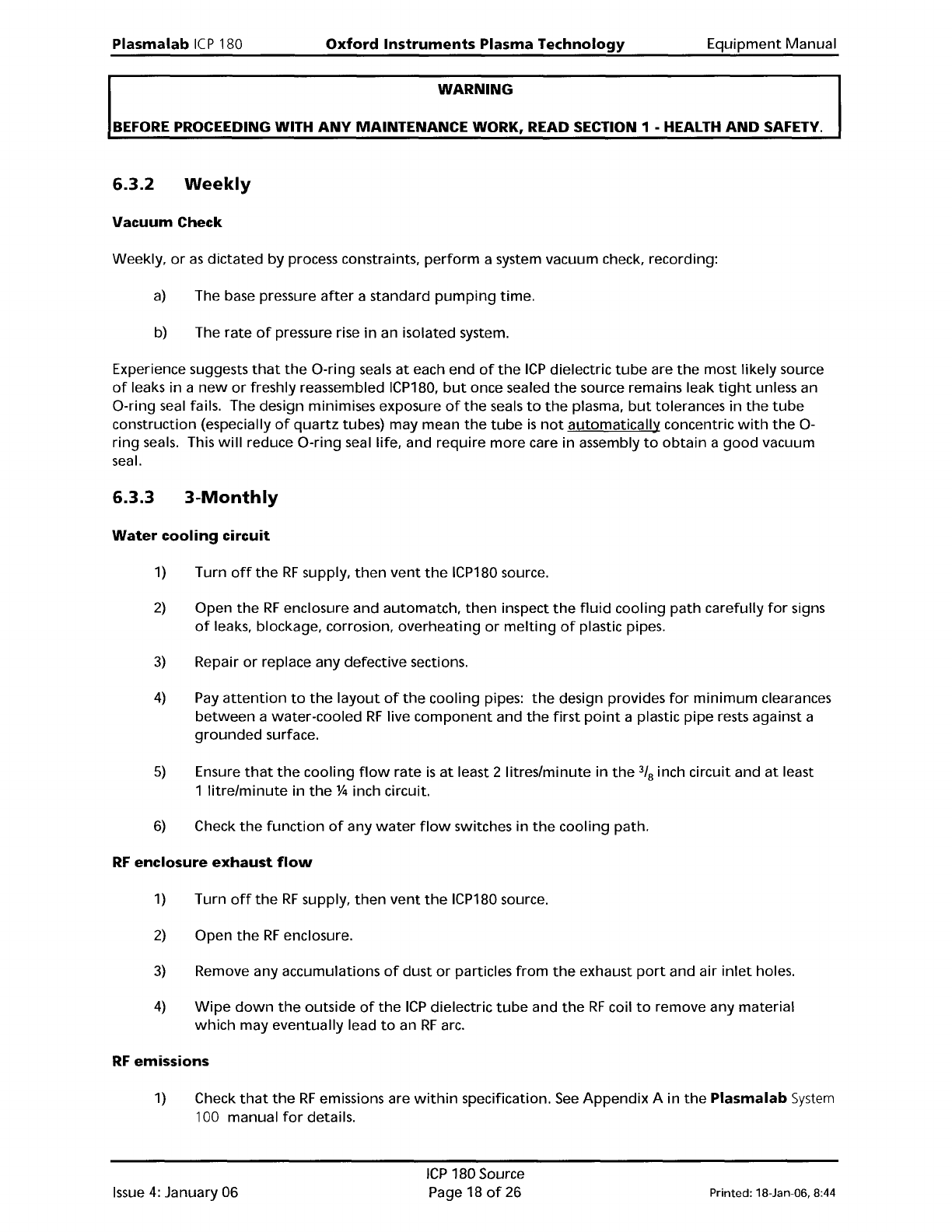
Plasma
lab
Ie
P180
Oxford
Instruments
Plasma
Technology
WARNING
Equipment
Manual
BEFORE
PROCEEDING WITH
ANY
MAINTENANCE
WORK, READ SECTION 1 - HEALTH
AND
SAFETY.
6.3.2
Weekly
Vacuum
Check
Weekly,
or
as
dictated
by
process constraints,
perform
a system vacuum check, recording:
a)
The base pressure
after
a standard
pumping
time.
b)
The
rate
of
pressure rise
in
an isolated system.
Experience suggests
that
the
O-ring
seals
at
each end
of
the
ICP
dielectric
tube
are
the
most likely source
of
leaks in a
new
or
freshly reassembled
ICP180,
but
once sealed
the
source remains leak
tight
unless an
O-ring seal fails. The design minimises exposure
of
the
seals
to
the
plasma,
but
tolerances
in
the
tube
construction (especially
of
quartz
tubes) may mean
the
tube
is
not
automatically
concentric
with
the
0-
ring
seals.
This
will
reduce
O-ring
seal life, and
require
more
care in assembly
to
obtain
a
good
vacuum
seal.
6.3.3
3-Monthly
Water
cooling
circuit
1)
Turn
off
the
RF
supply,
then
vent
the
ICP180 source.
2)
Open
the
RF
enclosure and
automatch,
then
inspect
the
fluid
cooling
path
carefully
for
signs
of
leaks, blockage, corrosion,
overheating
or
melting
of
plastic pipes.
3)
Repair
or
replace any defective sections.
4)
Pay
attention
to
the
layout
of
the
cooling
pipes:
the
design provides
for
minimum
clearances
between
a
water-cooled
RF
live
component
and
the
first
point
a plastic pipe rests against a
grounded
surface.
5)
Ensure
that
the
cooling
flow
rate
is
at
least 2 litres/minute in
the
3/
8
inch circuit and
at
least
1
litre/minute
in
the
% inch circuit.
6)
Check
the
function
of
any
water
flow
switches in
the
cooling
path.
RF
enclosure
exhaust
flow
1)
Turn
off
the
RF
supply,
then
vent
the
ICP180 source.
2)
Open
the
RF
enclosure.
3)
Remove any accumulations
of
dust
or
particles
from
the
exhaust
port
and air
inlet
holes.
4)
Wipe
down
the
outside
of
the
ICP
dielectric
tube
and
the
RF
coil
to
remove any material
which
may
eventually
lead
to
an
RF
arc.
RF
emissions
1)
Check
that
the
RF
emissions are
within
specification.
See
AppendiX A in
the
Plasma
lab
System
100 manual
for
details.
Issue
4:
January 06
fCP
180Source
Page 18
of
26
Printed: 18-Jan-D6, 8:44
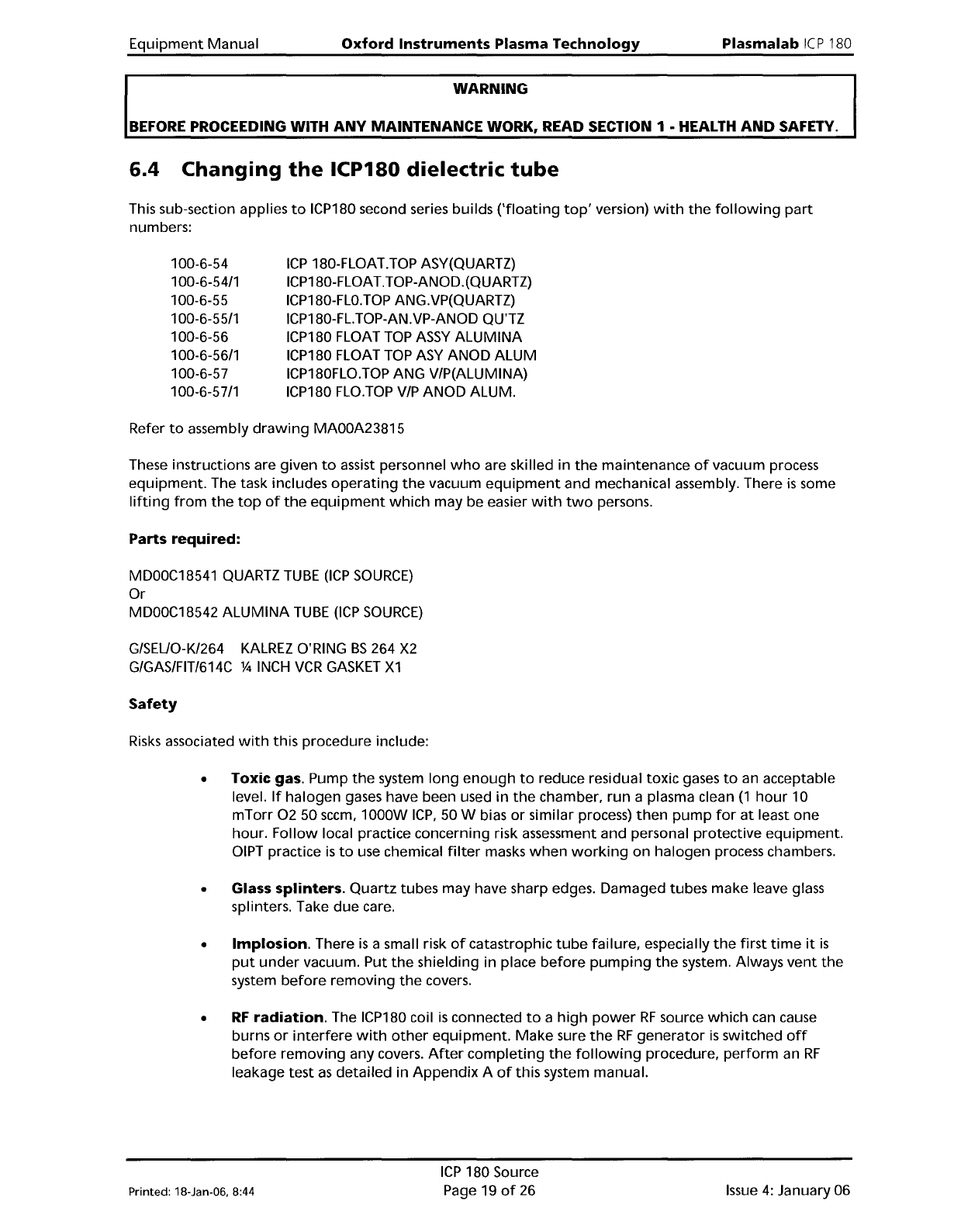
Equipment
Manual
Oxford
Instruments
Plasma
Technology
WARNING
Plasmalab
ICP
180
BEFORE
PROCEEDING WITH
ANY
MAINTENANCE WORK, READ SECTION 1 • HEALTH
AND
SAFETY.
6.4
Changing
the
ICP180
dielectric
tube
This sub-section applies
to
ICP180 second series builds
('floating
top'
version)
with
the
following
part
numbers:
100-6-54
100-6-54/1
100-6-55
100-6-55/1
100-6-56
100-6-56/1
100-6-57
100-6-57/1
ICP
180-FLOAT.TOP ASY(QUARTZ)
ICP180-FLOAT.TOP-ANOD.(QUARTZ)
ICP180-FLO.TOP
ANG.VP(QUARTZ)
ICP180-FL.TOP-AN.VP-ANOD QU'TZ
ICP180 FLOAT
TOP
ASSY
ALUMINA
ICP180 FLOAT
TOP
ASY
ANOD ALUM
ICP180FLO.TOP ANG V/P(ALUMINA)
ICP180
FLO.TOP
VIP
ANOD ALUM.
Refer
to
assembly
drawing
MAOOA23815
These instructions are given
to
assist personnel
who
are skilled in
the
maintenance
of
vacuum process
equipment.
The task includes
operating
the
vacuum
equipment
and mechanical assembly. There
is
some
lifting
from
the
top
of
the
equipment
which
may be easier
with
two
persons.
Parts
required:
MDOOC18541
QUARTZ
TUBE
(lCP
SOURCE)
Or
MDOOC18542
ALUMINA
TUBE
(lCP
SOURCE)
G/SEUO-K/264
KALREZ
O'RING
BS
264
X2
G/GAS/FIT/614C %
INCH
VCR
GASKET
X1
Safety
Risks
associated
with
this procedure include:
• Toxic gas. Pump
the
system
long
enough
to
reduce residual toxic gases
to
an acceptable
level.
If
halogen
gases have been used
in
the
chamber,
run
a plasma clean
(1
hour
10
mTorr
0250
seem,
1000W
ICP,
50 W bias
or
similar process)
then
pump
for
at
least
one
hour.
Follow
local practice concerning risk assessment and personal protective
equipment.
OIPT
practice
is
to
use chemical
filter
masks
when
working
on
halogen
process chambers.
• Glass
splinters.
Quartz
tubes may have sharp edges. Damaged tubes
make
leave glass
splinters. Take
due
care.
•
Implosion.
There
is
a small risk
of
catastrophic
tube
failure, especially
the
first
time
it
is
put
under
vacuum. Put
the
shielding in place
before
pumping
the
system. Always
vent
the
system
before
removing
the
covers.
•
RF
radiation.
The ICP180 coil
is
connected
to
a
high
power
RF
source
which
can cause
burns
or
interfere
with
other
equipment.
Make
sure
the
RF
generator
is
switched
off
before
removing
any covers.
After
completing
the
following
procedure,
perform
an
RF
leakage test
as
detailed
in
Appendix
A
of
this system manual.
Printed: 18-Jan-06, 8:44
ICP
180 Source
Page 19
of
26
Issue
4:
January 06
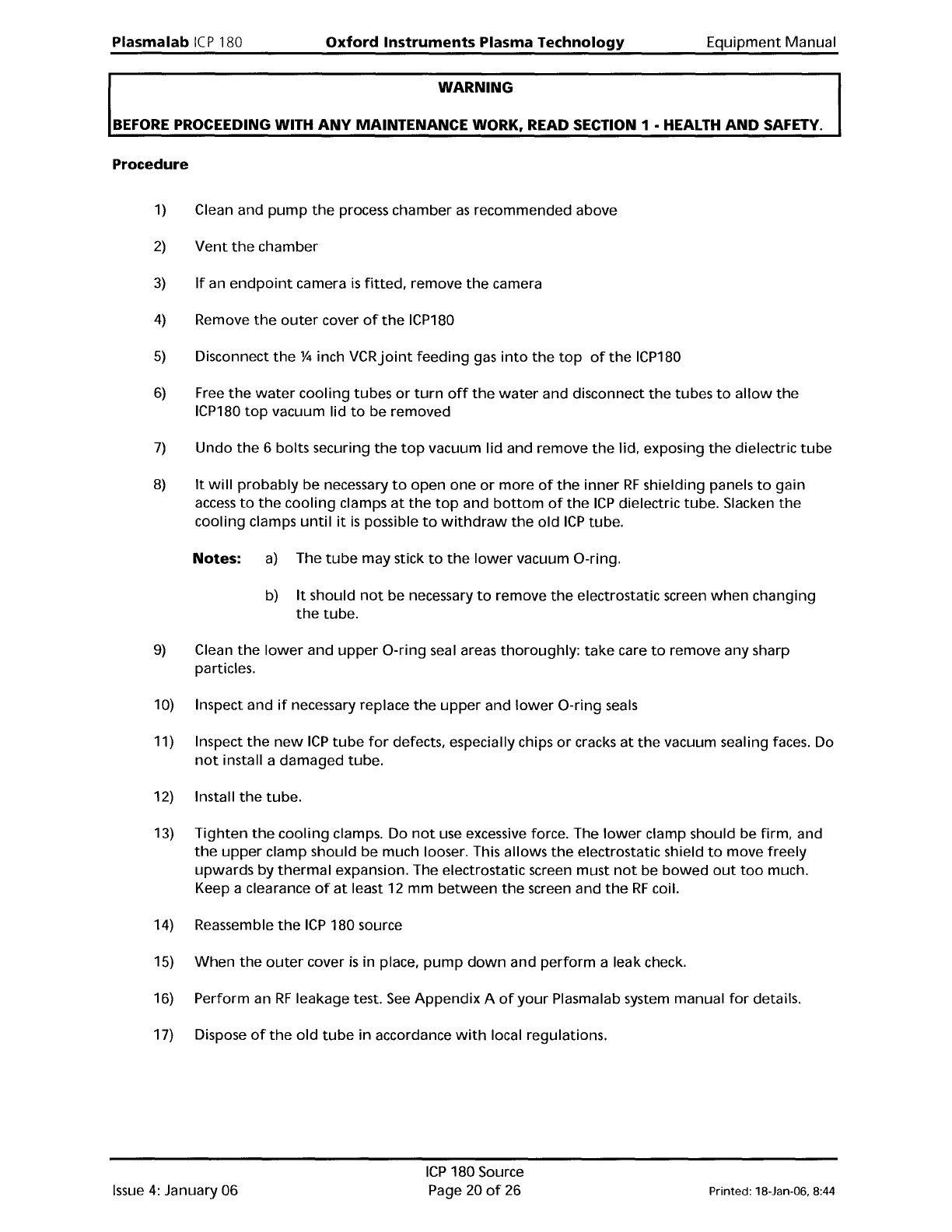
Plasma
lab
ICP
180
Oxford
Instruments
Plasma Technology
WARNING
Equipment
Manual
BEFORE
PROCEEDING WITH
ANY
MAINTENANCE WORK, READ SECTION 1 • HEALTH
AND
SAFETY.
Procedure
1)
Clean and
pump
the
process chamber
as
recommended above
2)
Vent
the
chamber
3)
If
an
endpoint
camera
is
fitted,
remove
the
camera
4)
Remove
the
outer
cover
of
the
ICP180
5)
Disconnect
the
% inch
VCRjoint
feeding
gas
into
the
top
of
the
ICP180
6)
Free
the
water
cooling
tubes
or
turn
off
the
water
and disconnect
the
tubes
to
allow
the
ICP180
top
vacuum lid
to
be removed
7)
Undo
the
6 bolts securing
the
top
vacuum lid and remove
the
lid, exposing
the
dielectric
tube
8)
It
will
probably
be necessary
to
open
one
or
more
of
the
inner
RF
shielding panels
to
gain
access
to
the
cooling
clamps
at
the
top
and
bottom
of
the
ICP
dielectric tube. Slacken
the
cooling
clamps
until
it
is
possible
to
withdraw
the
old
ICP
tube.
Notes:
a)
The
tube
may stick
to
the
lower
vacuum D-ring.
b) It should
not
be
necessary
to
remove
the
electrostatic screen
when
changing
the
tube.
9)
Clean
the
lower
and
upper
D-ring
seal areas
thoroughly:
take
care
to
remove any sharp
particles.
10) Inspect and
if
necessary replace
the
upper
and
lower
D-ring
seals
11) Inspect
the
new
ICP
tube
for
defects, especially chips
or
cracks
at
the
vacuum sealing faces. Do
not
install a
damaged
tube.
12) Install
the
tube.
13)
Tighten
the
cooling
clamps. Do
not
use excessive force. The
lower
clamp should be firm, and
the
upper
clamp should be much looser. This allows
the
electrostatic shield
to
move freely
upwards
by
thermal
expansion. The electrostatic screen must
not
be
bowed
out
too
much.
Keep a clearance
of
at
least 12
mm
between
the
screen and
the
RF
coil.
14) Reassemble
the
ICP
180 source
15)
When
the
outer
cover
is
in place,
pump
down
and
perform
a leak check.
16) Perform an
RF
leakage test.
See
Appendix
A
of
your
Plasmalab system manual
for
details.
17) Dispose
of
the
old
tube
in
accordance
with
local regulations.
Issue
4:
January 06
ICP
180 Source
Page 20
of
26 Printed: 18-Jan-06, 8:44