Oxford-100-Manual.pdf - 第16页
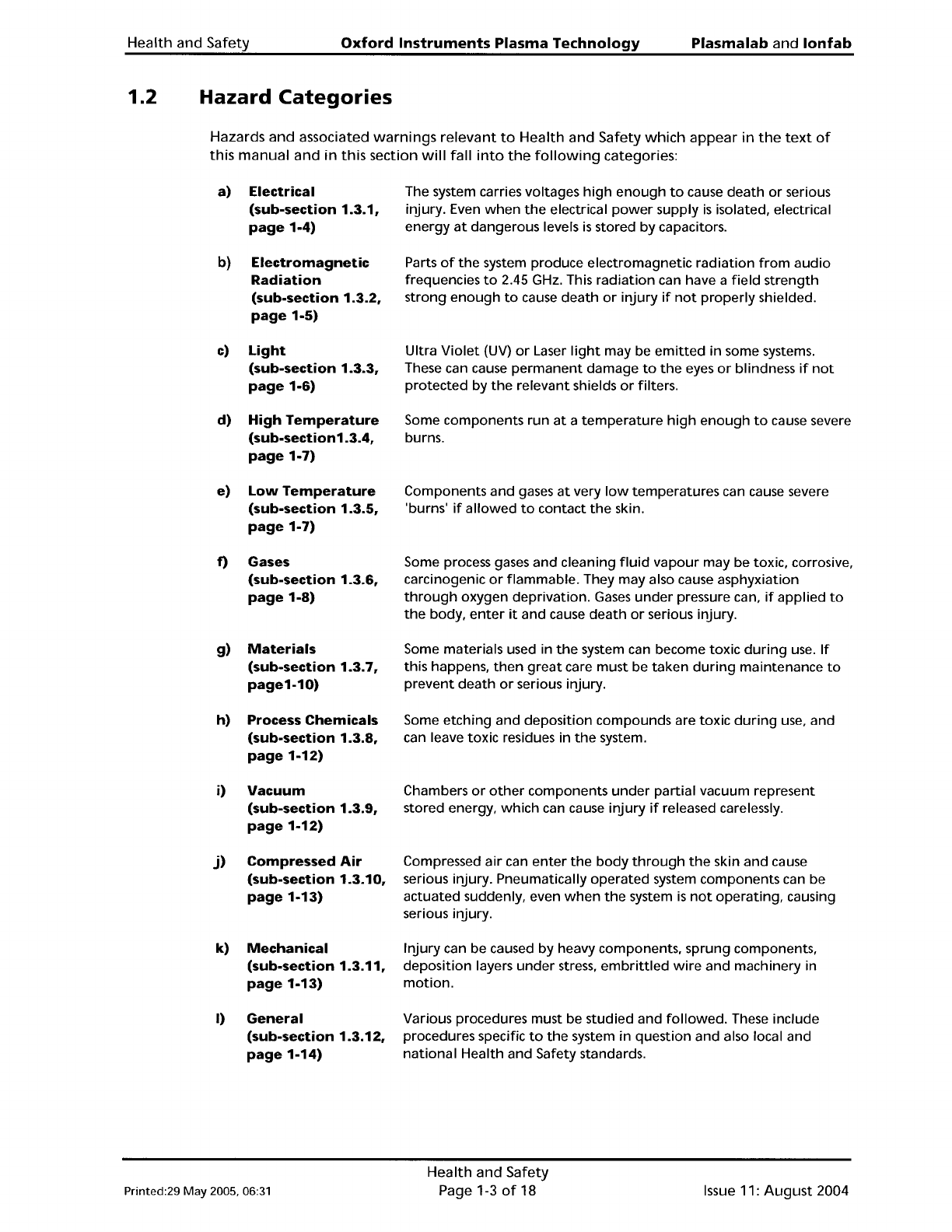
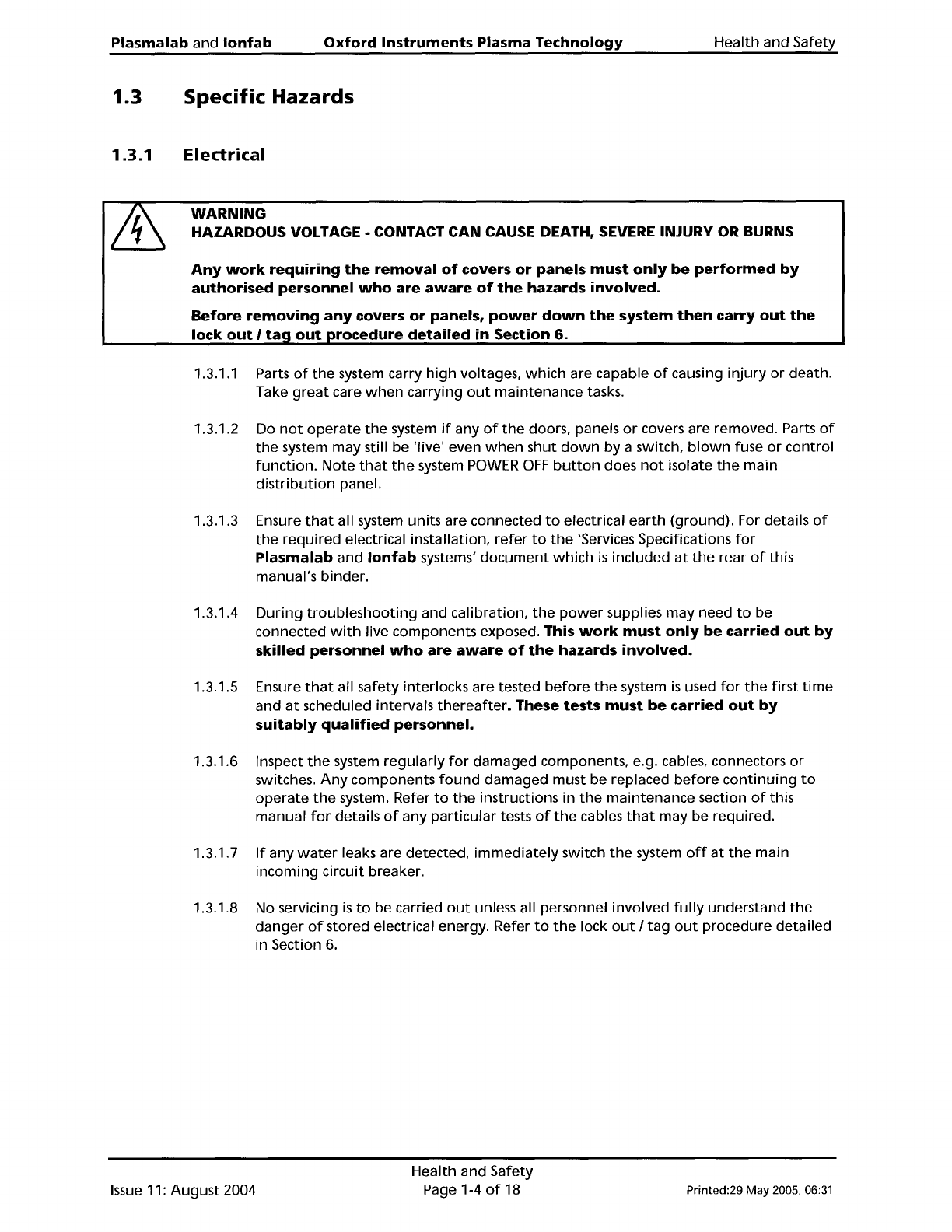
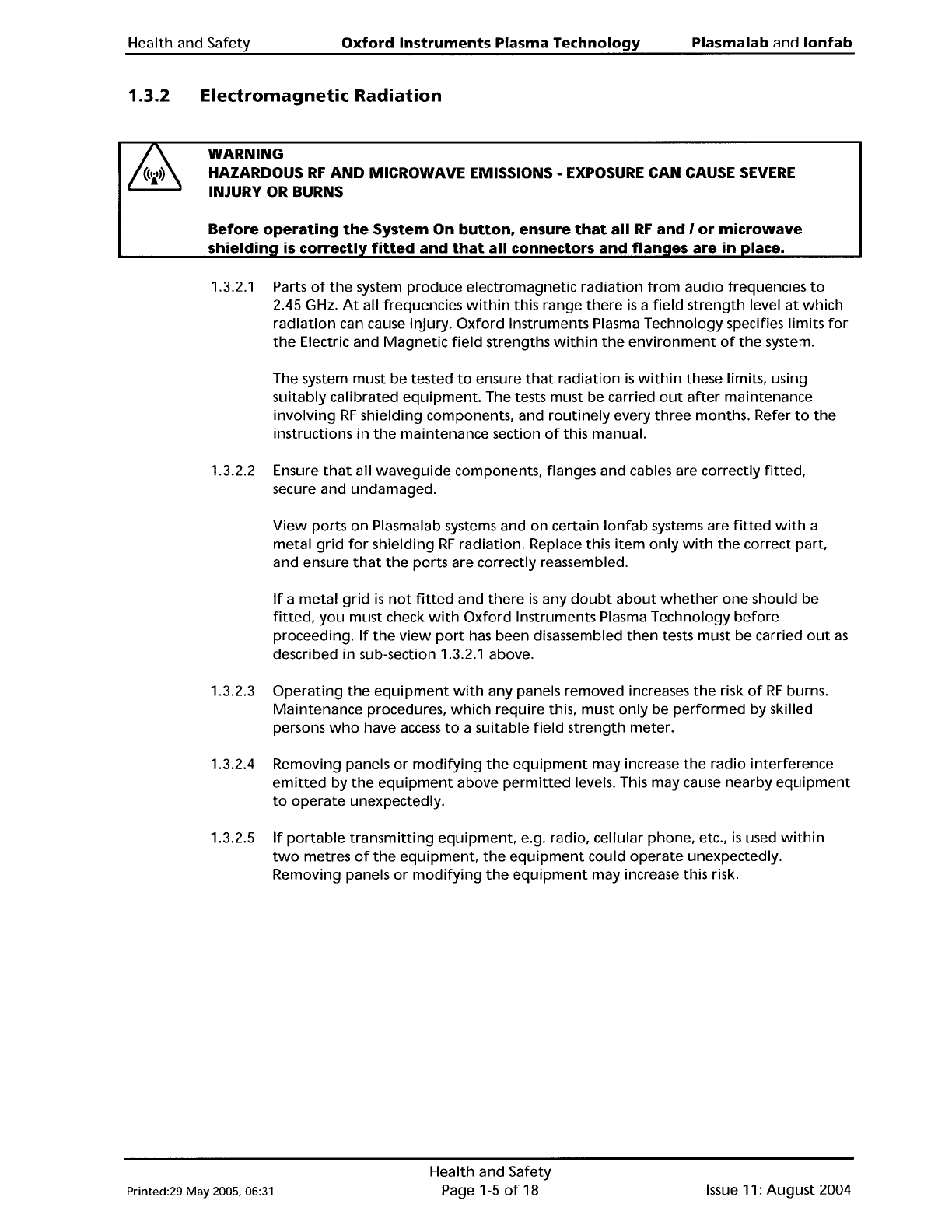
Plasma lab and lonfab Oxford Instruments Plasma Technology Health and Safety 1.3 1.3.1 Specific Hazards Electrical WARNING HAZARDOUS VOLTAGE· CONTACT CAN CAUSE DEATH, SEVERE INJURY OR BURNS Any work requiring the removal…
Health
and
Safety
Oxford
Instruments
Plasma
Technology
Plasma
lab
and
lonfab
1.2
Hazard
Categories
Hazards
and
associated
warnings
relevant
to
Health
and
Safety
which
appear
in
the
text
of
this
manual
and
in
this
section
will
fall
into
the
following
categories:
a)
Electrical
(sub-section
1.3.1,
page
1.4)
b)
Electromagnetic
Radiation
(sub.section
1.3.2,
page
1.5)
c)
Light
(sub-section
1.3.3,
page
1·6)
d)
High
Temperature
(sub.section1.3.4,
page
1.7)
e)
Low
Temperature
(sub.section
1.3.5,
page
1.7)
f)
Gases
(sub-section
1.3.6,
page
1-8)
g)
Materials
(sub.section
1.3.7,
page1-10)
h)
Process Chemicals
(sub-section
1.3.8,
page
1.12)
The system carries voltages
high
enough
to
cause
death
or
serious
injury. Even
when
the
electrical
power
supply
is
isolated, electrical
energy
at
dangerous levels
is
stored
by
capacitors.
Parts
of
the
system produce electromagnetic
radiation
from
audio
frequencies
to
2.45
GHz.
This
radiation
can have a
field
strength
strong
enough
to
cause
death
or
injury
if
not
properly
shielded.
Ultra
Violet
(UV)
or
Laser
light
may be
emitted
in some systems.
These can cause
permanent
damage
to
the
eyes
or
blindness
if
not
protected
by
the
relevant shields
or
filters.
Some components run
at
a
temperature
high
enough
to
cause severe
burns.
Components and
gases
at
very
low
temperatures can
cause
severe
'burns'
if
allowed
to
contact
the
skin.
Some process gases and cleaning
fluid
vapour
may be toxic, corrosive,
carcinogenic
or
flammable. They may also cause asphyxiation
through
oxygen deprivation.
Gases
under
pressure can,
if
applied
to
the
body,
enter
it
and cause
death
or
serious injury.
Some materials used in
the
system can become toxic
during
use.
If
this happens,
then
great
care must be
taken
during
maintenance
to
prevent
death
or
serious injury.
Some etching and deposition compounds are toxic
during
use,
and
can leave toxic residues in
the
system.
i)
j)
k)
I)
Vacuum
(sub-section
1.3.9,
page
1.12)
Compressed
Air
(sub-section
1.3.10,
page
1-13)
Mechanical
(sub.section
1.3.11,
page
1.13)
General
(sub-section
1.3.12,
page
1-14)
Chambers
or
other
components
under
partial vacuum represent
stored energy,
which
can cause
injury
if
released carelessly.
Compressed
air
can
enter
the
body
through
the
skin and cause
serious injury. Pneumatically
operated
system components can be
actuated suddenly, even
when
the
system
is
not
operating,
causing
serious injury.
Injury
can be caused
by
heavy components, sprung components,
deposition layers
under
stress,
embrittled
wire
and machinery in
motion.
Various procedures must be studied and
followed.
These include
procedures specific
to
the
system in question and also local and
national
Health and Safety standards.
Printed:29
May
2005, 06:31
Health
and
Safety
Page 1-3
of
18 Issue 11:
August
2004
Plasma
lab
and
lonfab
Oxford
Instruments
Plasma
Technology
Health and Safety
1.3
1.3.1
Specific Hazards
Electrical
WARNING
HAZARDOUS
VOLTAGE·
CONTACT CAN CAUSE DEATH, SEVERE INJURY
OR
BURNS
Any
work
requiring
the
removal
of
covers
or
panels
must
only
be
performed
by
authorised
personnel
who
are
aware
of
the
hazards
involved.
Before
removing
any
covers
or
panels,
power
down
the
system
then
carry
out
the
lock
out
I
tag
out
procedure
detailed
in
Section
6.
1.3.1.1 Parts
of
the
system carry
high
voltages,
which
are capable
of
causing
injury
or
death.
Take
great
care
when
carrying
out
maintenance tasks.
1.3.1.2 Do
not
operate
the
system
if
any
of
the
doors, panels
or
covers are removed. Parts
of
the
system may still be 'live' even
when
shut
down
by
a switch,
blown
fuse
or
control
function.
Note
that
the
system
POWER
OFF
button
does
not
isolate
the
main
distribution
panel.
1.3.1.3 Ensure
that
all system units are connected
to
electrical
earth
(ground). For details
of
the
required
electrical installation,
refer
to
the
'Services Specifications
for
Plasma
lab
and
lonfab
systems'
document
which
is
included
at
the
rear
of
this
manual's binder.
1.3.1.4
During
troubleshooting
and calibration,
the
power
supplies may need
to
be
connected
with
live components exposed. This
work
must
only
be
carried
out
by
skilled
personnel
who
are
aware
of
the
hazards
involved.
1.3.1.5 Ensure
that
all safety interlocks are tested
before
the
system
is
used
for
the
first
time
and
at
scheduled intervals
thereafter.
These
tests
must
be
carried
out
by
suitably
qualified
personnel.
1.3.1.6 Inspect
the
system
regularly
for
damaged components, e.g. cables, connectors
or
switches.
Any
components
found
damaged must be replaced
before
continuing
to
operate
the
system. Refer
to
the
instructions in
the
maintenance
section
of
this
manual
for
details
of
any
particular
tests
of
the
cables
that
may be required.
1.3.1.7
If
any
water
leaks are detected,
immediately
switch
the
system
off
at
the
main
incoming
circuit
breaker.
1.3.1.8 No servicing
is
to
be carried
out
unless all personnel involved
fully
understand
the
danger
of
stored electrical energy. Refer
to
the
lock
out
I
tag
out
procedure
detailed
in Section
6.
Issue
11:
August
2004
Health and Safety
Page 1-4
of
18
Printed:29
May
2005. 06:31
Health and Safety
Oxford
Instruments
Plasma
Technology
Plasma
lab
and
lonfab
1.3.2
Electromagnetic
Radiation
WARNING
HAZARDOUS
RF
AND
MICROWAVE
EMISSIONS·
EXPOSURE CAN CAUSE
SEVERE
INJURY OR BURNS
Before
operating
the
System
On
button,
ensure
that
all
RF
and
I
or
microwave
shielding
is
correctly
fitted
and
that
all
connectors
and
flanges
are
in
place.
1.3.2.1 Parts
of
the
system produce electromagnetic
radiation
from
audio
frequencies
to
2.45 GHz.
At
all frequencies
within
this range
there
is
a
field
strength
level
at
which
radiation
can cause injury.
Oxford
Instruments Plasma Technology specifies limits
for
the
Electric and
Magnetic
field
strengths
within
the
environment
of
the
system.
The system must be tested
to
ensure
that
radiation
is
within
these limits, using
suitably
calibrated
equipment.
The tests must be carried
out
after
maintenance
involving
RF
shielding components, and
routinely
every
three
months. Refer
to
the
instructions
in
the
maintenance section
of
this manual.
1.3.2.2 Ensure
that
all
waveguide
components, flanges and cables are correctly
fitted,
secure and undamaged.
View
ports
on
Plasmalab systems and on certain
lonfab
systems are
fitted
with
a
metal
grid
for
shielding
RF
radiation. Replace this
item
only
with
the
correct part,
and ensure
that
the
ports are correctly reassembled.
If
a
metal
grid
is
not
fitted
and
there
is
any
doubt
about
whether
one should be
fitted,
you
must check
with
Oxford
Instruments Plasma Technology
before
proceeding.
If
the
view
port
has
been disassembled
then
tests must be carried
out
as
described in sub-section 1.3.2.1 above.
1.3.2.3
Operating
the
equipment
with
any panels removed increases
the
risk
of
RF
burns.
Maintenance
procedures,
which
require
this, must
only
be
performed
by skilled
persons
who
have
access
to
a suitable
field
strength
meter.
1.3.2.4 Removing panels
or
modifying
the
equipment
may increase
the
radio
interference
emitted
by
the
equipment
above
permitted
levels. This may cause nearby
equipment
to
operate
unexpectedly.
1.3.2.5
If
portable
transmitting
equipment,
e.g. radio, cellular phone, etc.,
is
used
within
two
metres
of
the
equipment,
the
equipment
could
operate
unexpectedly.
Removing panels
or
modifying
the
equipment
may increase this risk.
Printed:29 May 2005, 06:31
Health and Safety
Page 1-5
of
18
Issue
11:
August
2004