Oxford-100-Manual.pdf - 第169页
System Manual Oxford Instruments Plasma Technology Plasma lab Micron Micron Millibar Nupro valve Outgassing PE PECVD Penning gauge PFPE Pirani gauge Plasma Plasma system Platen RF RIE Roots pump (blower) Rotary pump (bac…
Plasma
lab
Oxford
Instruments
Plasma
Technology
System Manual
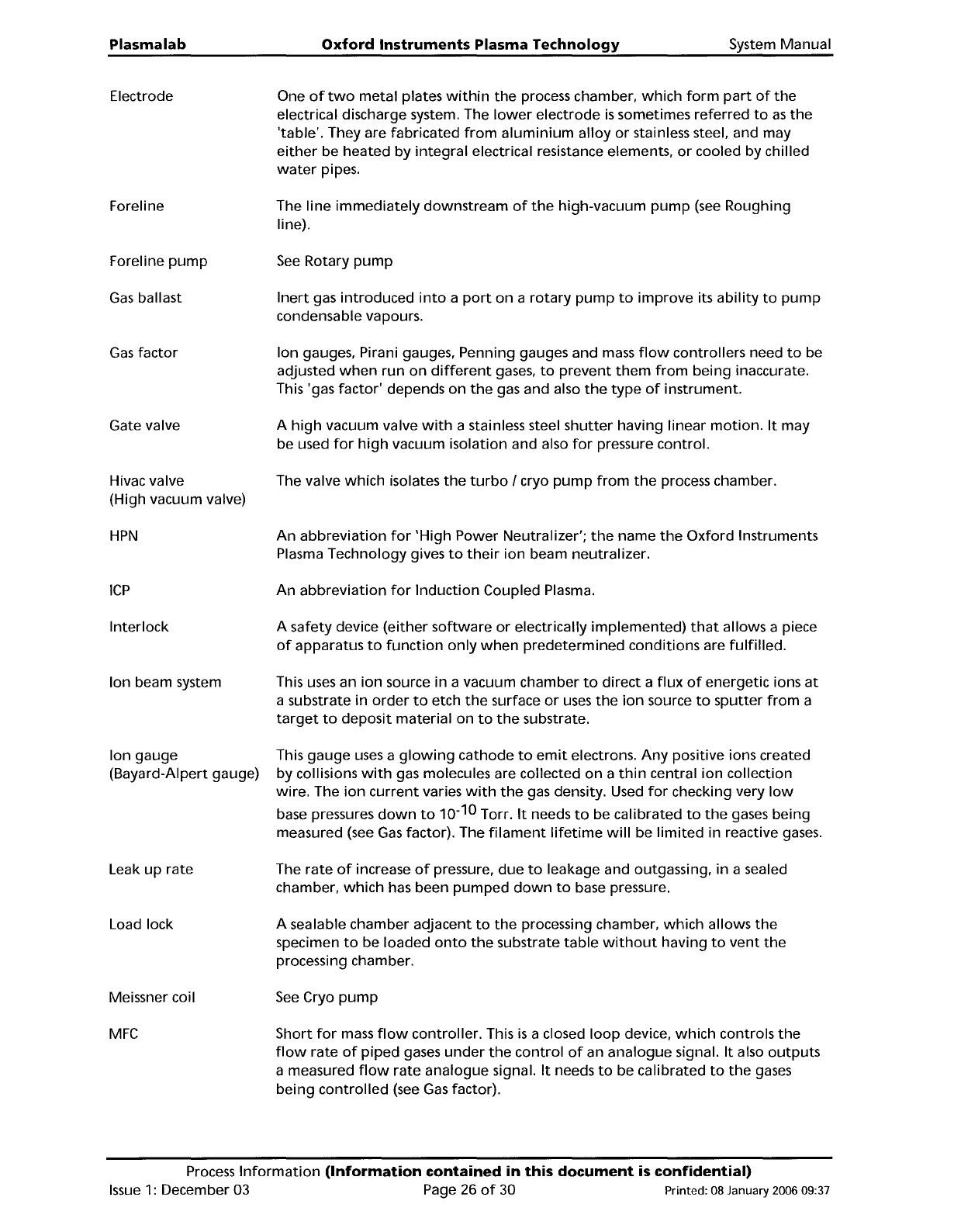
Electrode
Foreline
Foreline
pump
Gas
ballast
Gas
factor
Gate valve
Hivac valve
(High vacuum valve)
HPN
ICP
Interlock
Ion beam system
Ion
gauge
(Bayard-Alpert gauge)
Leak
up
rate
Load lock
Meissner coil
MFC
One
of
two
metal
plates
within
the
process chamber,
which
form
part
of
the
electrical discharge system. The
lower
electrode
is
sometimes referred
to
as
the
'table'.
They are fabricated
from
aluminium
alloy
or
stainless steel, and may
either
be
heated
by
integral
electrical resistance elements,
or
cooled by chilled
water
pipes.
The
line
immediately
downstream
of
the
high-vacuum
pump
(see
Roughing
line).
See
Rotary
pump
Inert
gas
introduced
into
a
port
on
a
rotary
pump
to
improve
its
ability
to
pump
condensable vapours.
Ion gauges, Pirani gauges, Penning gauges and
mass
flow
controllers need
to
be
adjusted
when
run
on
different
gases,
to
prevent
them
from
being inaccurate.
This 'gas
factor'
depends on
the
gas and also
the
type
of
instrument.
A
high
vacuum valve
with
a stainless steel
shutter
having linear
motion.
It
may
be used
for
high
vacuum isolation and also
for
pressure
control.
The valve
which
isolates
the
turbo
I cryo
pump
from
the
process chamber.
An
abbreviation
for
'High
Power Neutralizer';
the
name
the
Oxford
Instruments
Plasma Technology gives
to
their
ion
beam neutralizer.
An
abbreviation
for
Induction
Coupled Plasma.
A safety device
(either
software
or
electrically
implemented)
that
allows a piece
of
apparatus
to
function
only
when
predetermined
conditions are
fulfilled.
This
uses
an
ion
source in a vacuum chamber
to
direct
a
flux
of
energetic ions
at
a substrate in
order
to
etch
the
surface
or
uses
the
ion
source
to
sputter
from
a
target
to
deposit
material
on
to
the
substrate.
This
gauge
uses
a
glowing
cathode
to
emit
electrons.
Any
positive ions created
by collisions
with
gas molecules are collected
on
a
thin
central
ion
collection
wire. The
ion
current
varies
with
the
gas density. Used
for
checking very
low
base pressures
down
to
10-
10
Torr.
It
needs
to
be calibrated
to
the
gases being
measured
(see
Gas
factor). The
filament
lifetime
will
be
limited
in reactive
gases.
The
rate
of
increase
of
pressure,
due
to
leakage and outgassing, in a sealed
chamber,
which
has been
pumped
down
to
base pressure.
A sealable chamber adjacent
to
the
processing chamber,
which
allows
the
specimen
to
be loaded
onto
the
substrate
table
without
having
to
vent
the
processing chamber.
See
Cryo
pump
Short
for
mass
flow
controller. This
is
a closed
loop
device,
which
controls
the
flow
rate
of
piped
gases
under
the
control
of
an
analogue
signal.
It
also
outputs
a measured
flow
rate
analogue signal.
It
needs
to
be calibrated
to
the
gases
being
controlled
(see
Gas
factor).
Process
Information
(Information
contained
in
this
document
is
confidential)
Issue
1:
December 03 Page
26
of
30 Printed: 08 January 2006 09:37
System
Manual
Oxford
Instruments
Plasma Technology
Plasma
lab
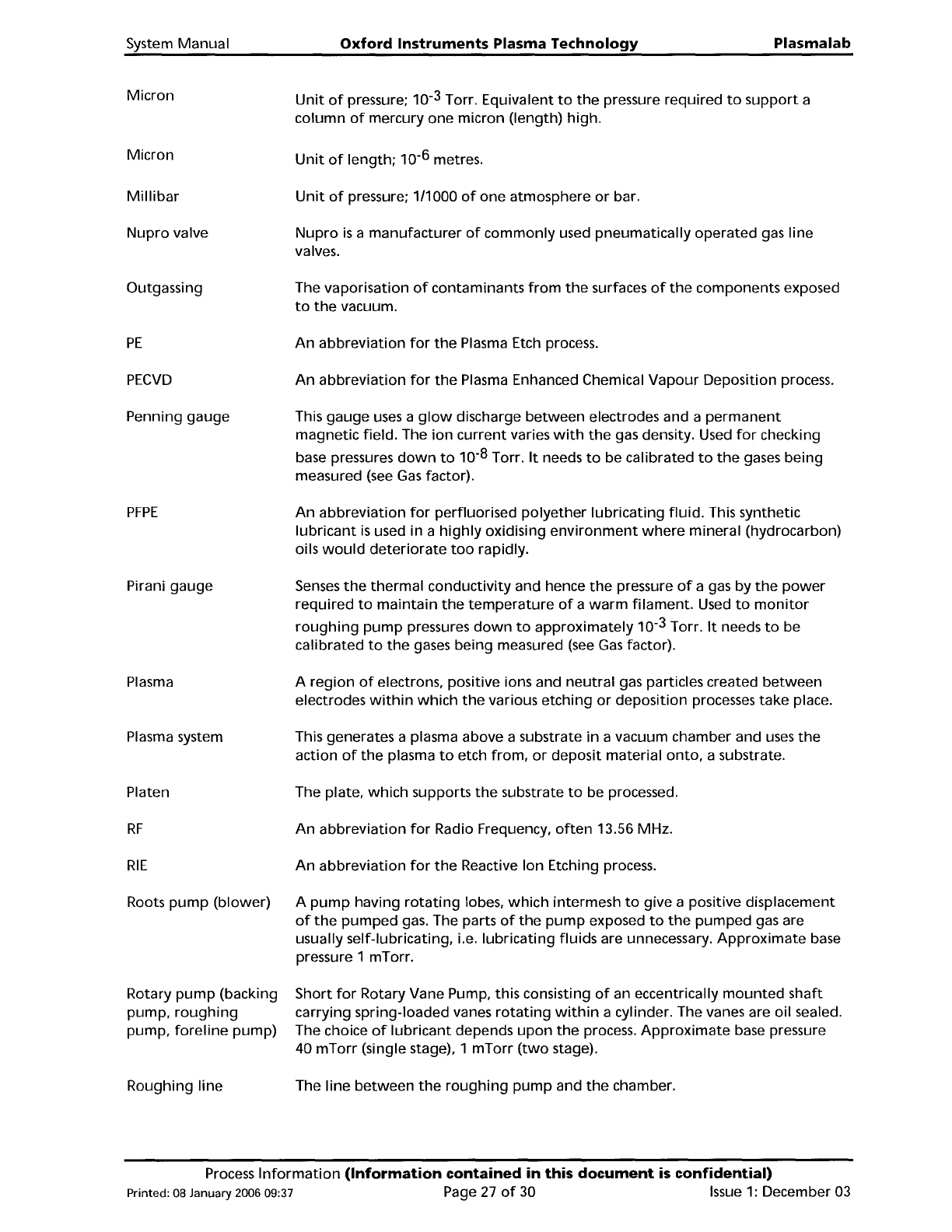
Micron
Micron
Millibar
Nupro
valve
Outgassing
PE
PECVD
Penning
gauge
PFPE
Pirani
gauge
Plasma
Plasma system
Platen
RF
RIE
Roots
pump
(blower)
Rotary
pump
(backing
pump,
roughing
pump,
foreline
pump)
Roughing line
Unit
of
pressure; 10-
3
Torr. Equivalent
to
the
pressure required
to
support
a
column
of
mercury
one
micron (length) high.
Unit
of
length;
10-
6
metres.
Unit
of
pressure; 1/1000
of
one
atmosphere
or
bar.
Nupro
is
a
manufacturer
of
commonly
used
pneumatically
operated
gas line
valves.
The vaporisation
of
contaminants
from
the
surfaces
of
the
components exposed
to
the
vacuum.
An
abbreviation
for
the
Plasma Etch process.
An
abbreviation
for
the
Plasma Enhanced Chemical
Vapour
Deposition process.
This
gauge
uses
a
glow
discharge
between
electrodes and a
permanent
magnetic
field. The
ion
current
varies
with
the
gas density. Used
for
checking
base pressures
down
to
10-
8
Torr. It needs
to
be calibrated
to
the
gases being
measured (see
Gas
factor).
An
abbreviation
for
perfluorised
polyether
lubricating
fluid.
This synthetic
lubricant
is
used in a
highly
oxidising
environment
where
mineral (hydrocarbon)
oils
would
deteriorate
too
rapidly.
Senses
the
thermal
conductivity
and hence
the
pressure
of
a
gas
by
the
power
required
to
maintain
the
temperature
of
a
warm
filament.
Used
to
monitor
roughing
pump
pressures
down
to
approximately
10-
3
Torr.
It
needs
to
be
calibrated
to
the
gases being measured
(see
Gas
factor).
A
region
of
electrons, positive ions and
neutral
gas particles created
between
electrodes
within
which
the
various
etching
or
deposition
processes
take
place.
This generates a plasma above a substrate
in
a vacuum chamber and
uses
the
action
of
the
plasma
to
etch
from,
or
deposit material
onto,
a substrate.
The plate,
which
supports
the
substrate
to
be processed.
An
abbreviation
for
Radio Frequency,
often
13.56 MHz.
An
abbreviation
for
the
Reactive Ion Etching process.
A
pump
having
rotating
lobes,
which
intermesh
to
give a positive displacement
of
the
pumped
gas. The parts
of
the
pump
exposed
to
the
pumped
gas are
usually self-lubricating, i.e.
lubricating
fluids are unnecessary.
Approximate
base
pressure 1 mTorr.
Short
for
Rotary Vane Pump, this consisting
of
an eccentrically
mounted
shaft
carrying spring-loaded vanes
rotating
within
a cylinder. The vanes are oil sealed.
The choice
of
lubricant
depends
upon
the
process.
Approximate
base pressure
40
mTorr
(single stage), 1 mTorr
(two
stage).
The
line
between
the
roughing
pump
and
the
chamber.
Process
Information
(Information
contained
in
this
document
is
confidential)
Printed: 08
January
2006 09:37 Page
27
of
30
Issue
1:
December 03
Plasma
lab
Oxford
Instruments
Plasma
Technology
System
Manual
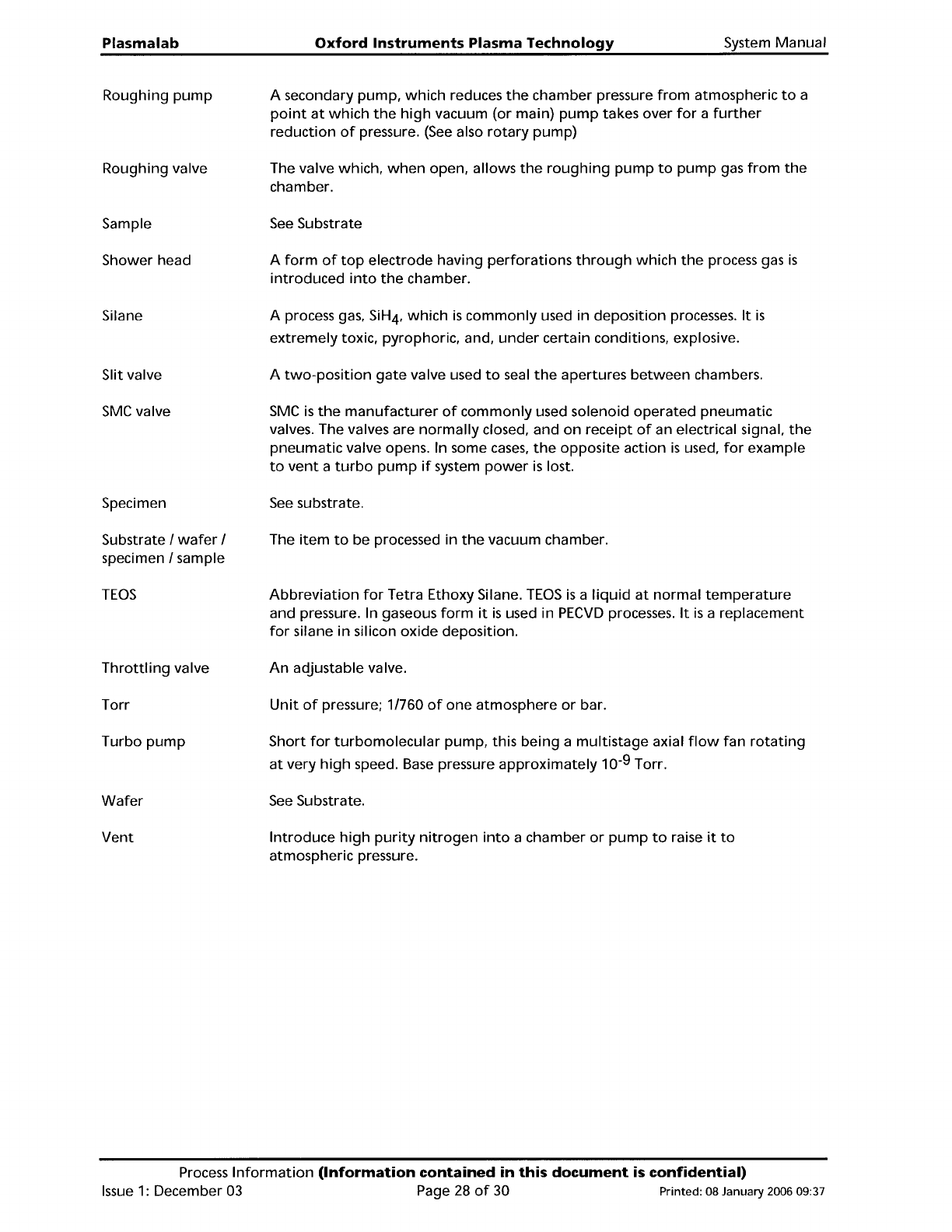
Roughing
pump
Roughing valve
Sample
Shower head
Silane
Slit valve
SMC
valve
Specimen
Substrate
I
wafer
I
specimen I sample
TEOS
Throttling
valve
Torr
Turbo
pump
Wafer
Vent
A secondary
pump,
which
reduces
the
chamber pressure
from
atmospheric
to
a
point
at
which
the
high
vacuum (or main)
pump
takes over
for
a
further
reduction
of
pressure.
(See
also
rotary
pump)
The valve which,
when
open, allows
the
roughing
pump
to
pump
gas
from
the
chamber.
See
Substrate
A
form
of
top
electrode having
perforations
through
which
the
process gas
is
introduced
into
the
chamber.
A process gas, SiH4,
which
is
commonly
used in
deposition
processes.
It
is
extremely
toxic, pyrophoric, and,
under
certain conditions, explosive.
A
two-position
gate
valve used
to
seal
the
apertures
between
chambers.
SMC
is
the
manufacturer
of
commonly
used solenoid
operated
pneumatic
valves. The valves are
normally
closed, and
on
receipt
of
an electrical signal,
the
pneumatic
valve opens. In some
cases,
the
opposite
action
is
used,
for
example
to
vent
a
turbo
pump
if
system
power
is
lost.
See
substrate.
The
item
to
be processed in
the
vacuum chamber.
Abbreviation
for
Tetra Ethoxy Silane.
TEOS
is
a
liquid
at
normal
temperature
and pressure. In gaseous
form
it
is
used in
PECVD
processes.
It
is
a replacement
for
silane
in
silicon
oxide
deposition.
An
adjustable valve.
Unit
of
pressure;
11760
of
one
atmosphere
or
bar.
Short
for
turbomolecular
pump,
this being a
multistage
axial
flow
fan
rotating
at
very
high
speed.
Base
pressure
approximately
10-
9
Torr.
See
SUbstrate.
Introduce
high
purity
nitrogen
into
a chamber
or
pump
to
raise
it
to
atmospheric pressure.
Process
Information
(Information
contained
in
this
document
is
confidential)
Issue
1:
December 03 Page 28
of
30 Printed: 08 January 2006 09:37