Oxford-100-Manual.pdf - 第24页
Plasmalab and lonfab Oxford Instruments Plasma Technology Health and Safety 1.3.8 1.3.9 Process Chemicals WARNING SOME MATERIALS USED IN AND RESULTING FROM DEPOSITION AND ETCHING PROCESS CAN BE DANGEROUSLY TOXIC; CONTACT…
Health and Safety
Oxford
Instruments
Plasma
Technology
Plasma
lab
and
lonfab
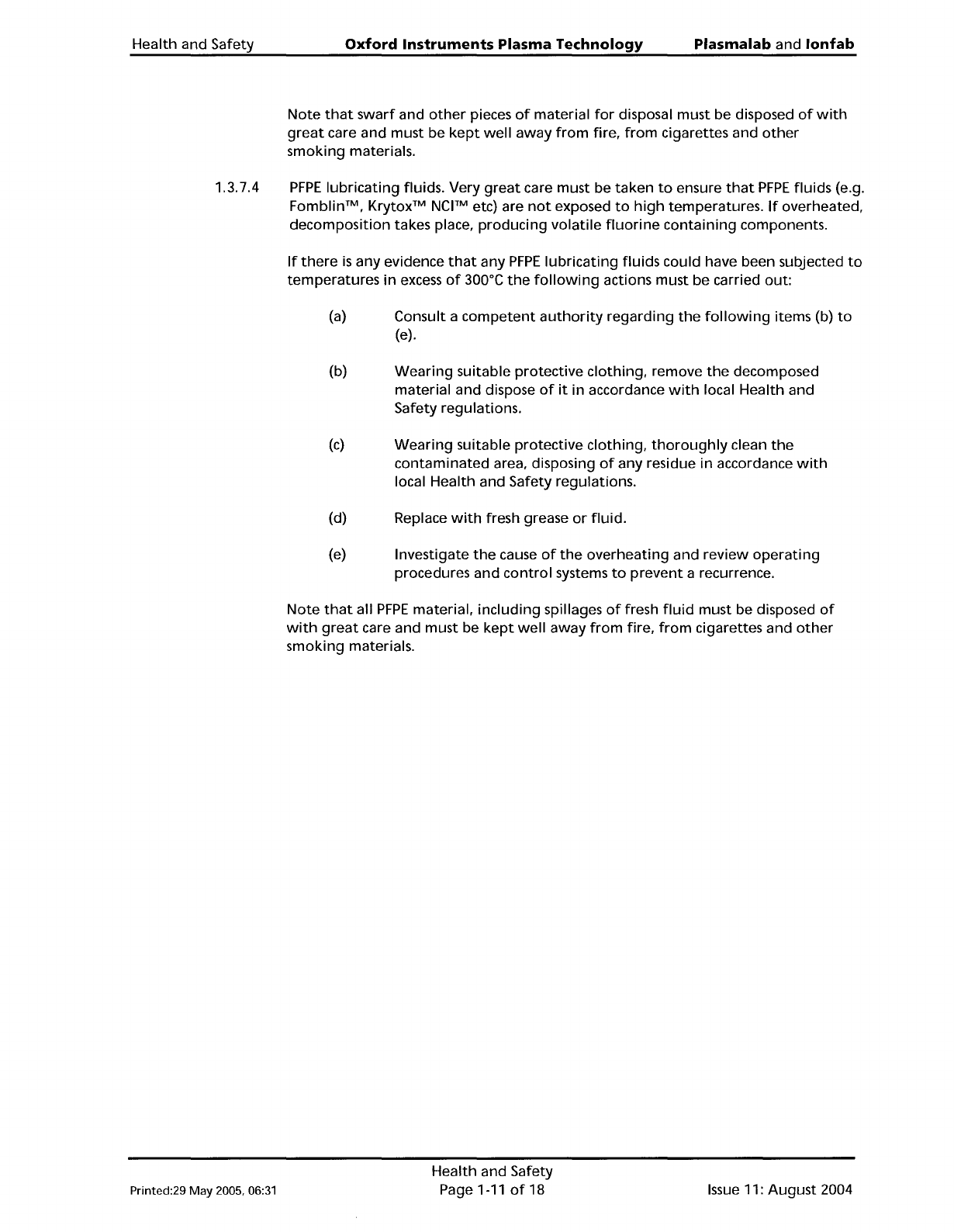
1.3.7.4
Note
that
swarf
and
other
pieces
of
material
for
disposal must be disposed
of
with
great
care and must be
kept
well
away
from
fire,
from
cigarettes and
other
smoking
materials.
PFPE
lubricating
fluids. Very
great
care must be
taken
to
ensure
that
PFPE
fluids (e.g.
Fomblin™,
Krytox™
NCFM
etc) are
not
exposed
to
high
temperatures.
If
overheated,
decomposition
takes place,
producing
volatile
fluorine
containing
components.
If
there
is
any evidence
that
any
PFPE
lubricating
fluids could have been subjected
to
temperatures
in
excess
of
300°C
the
following
actions must be carried out:
(a) Consult a
competent
authority
regarding
the
following
items (b)
to
(e).
(b)
Wearing
suitable
protective
clothing,
remove
the
decomposed
material and dispose
of
it
in accordance
with
local Health and
Safety regulations.
(c)
Wearing
suitable
protective
clothing,
thoroughly
clean
the
contaminated
area, disposing
of
any residue
in
accordance
with
local Health and Safety regulations.
(d) Replace
with
fresh grease
or
fluid.
(e) Investigate
the
cause
of
the
overheating
and
review
operating
procedures and
control
systems
to
prevent
a recurrence.
Note
that
all
PFPE
material,
including
spillages
of
fresh
fluid
must be disposed
of
with
great
care and must be
kept
well
away
from
fire,
from
cigarettes and
other
smoking
materials.
Printed:29 May 2005, 06:31
Health and Safety
Page
1-11
of
18
Issue
11:
August
2004
Plasmalab and
lonfab
Oxford
Instruments
Plasma
Technology
Health and Safety
1.3.8
1.3.9
Process Chemicals
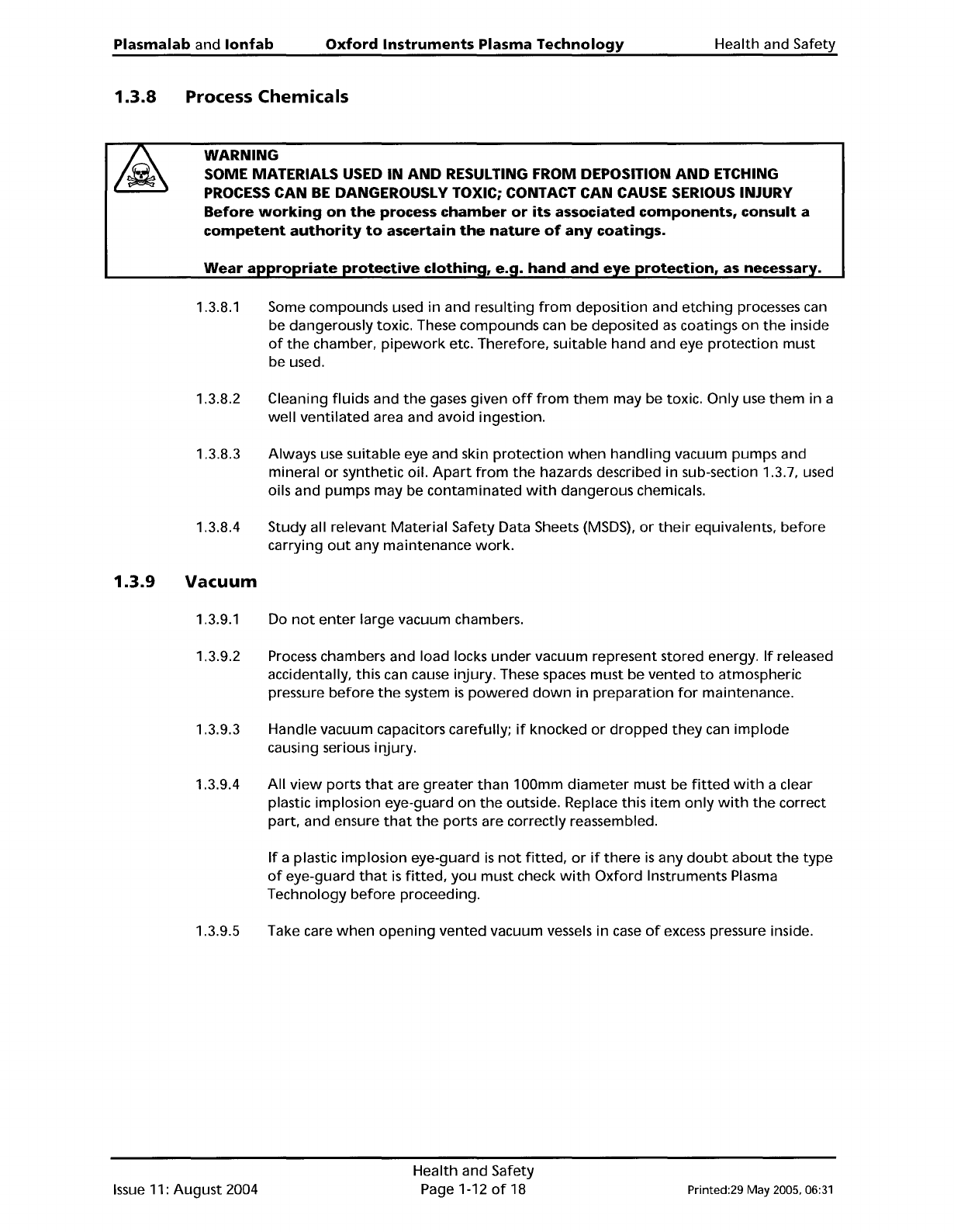
WARNING
SOME MATERIALS USED
IN
AND
RESULTING FROM DEPOSITION
AND
ETCHING
PROCESS
CAN
BE
DANGEROUSLY TOXIC; CONTACT CAN CAUSE SERIOUS INJURY
Before
working
on
the
process
chamber
or
its
associated
components,
consult a
competent
authority
to
ascertain
the
nature
of
any
coatings.
Wear
a
ro
riate
rotective
clothin
, e. .
hand
and
e e
rotection,
as necessar
1.3.8.1 Some compounds used
in
and resulting
from
deposition
and
etching
processes can
be dangerously toxic. These compounds can be deposited
as
coatings
on
the
inside
of
the
chamber,
pipework
etc. Therefore, suitable hand and eye
protection
must
be used.
1.3.8.2 Cleaning fluids and
the
gases given
off
from
them
may be toxic.
Only
use
them
in a
well
ventilated
area and avoid ingestion.
1.3.8.3 Always use suitable eye and skin
protection
when
handling
vacuum pumps and
mineral
or
synthetic oil.
Apart
from
the
hazards described in sub-section 1.3.7, used
oils and pumps may be
contaminated
with
dangerous chemicals.
1.3.8.4 Study all relevant
Material
Safety Data Sheets
(MSDS),
or
their
equivalents,
before
carrying
out
any maintenance
work.
Vacuum
1.3.9.1
1.3.9.2
1.3.9.3
1.3.9.4
1.3.9.5
Do
not
enter
large vacuum chambers.
Process
chambers and load locks
under
vacuum represent stored energy.
If
released
accidentally, this can cause injury. These spaces
must
be vented
to
atmospheric
pressure
before
the
system
is
powered
down
in
preparation
for
maintenance.
Handle vacuum capacitors carefully;
if
knocked
or
dropped
they
can
implode
causing serious injury.
All
view
ports
that
are
greater
than
1
OOmm
diameter
must be
fitted
with
a clear
plastic implosion eye-guard
on
the
outside. Replace this
item
only
with
the
correct
part. and ensure
that
the
ports are correctly reassembled.
If
a plastic implosion eye-guard
is
not
fitted,
or
if
there
is
any
doubt
about
the
type
of
eye-guard
that
is
fitted,
you
must
check
with
Oxford
Instruments Plasma
Technology
before
proceeding.
Take care
when
opening
vented vacuum
vessels
in
case
of
excess
pressure inside.
Issue
11:
August
2004
Health and Safety
Page 1-12
of
18 Printed:29
May
2005, 06:31
Health and Safety
1.3.10
Compressed
air
Oxford
Instruments
Plasma
Technology
Plasma
lab
and
lonfab
1.3.11
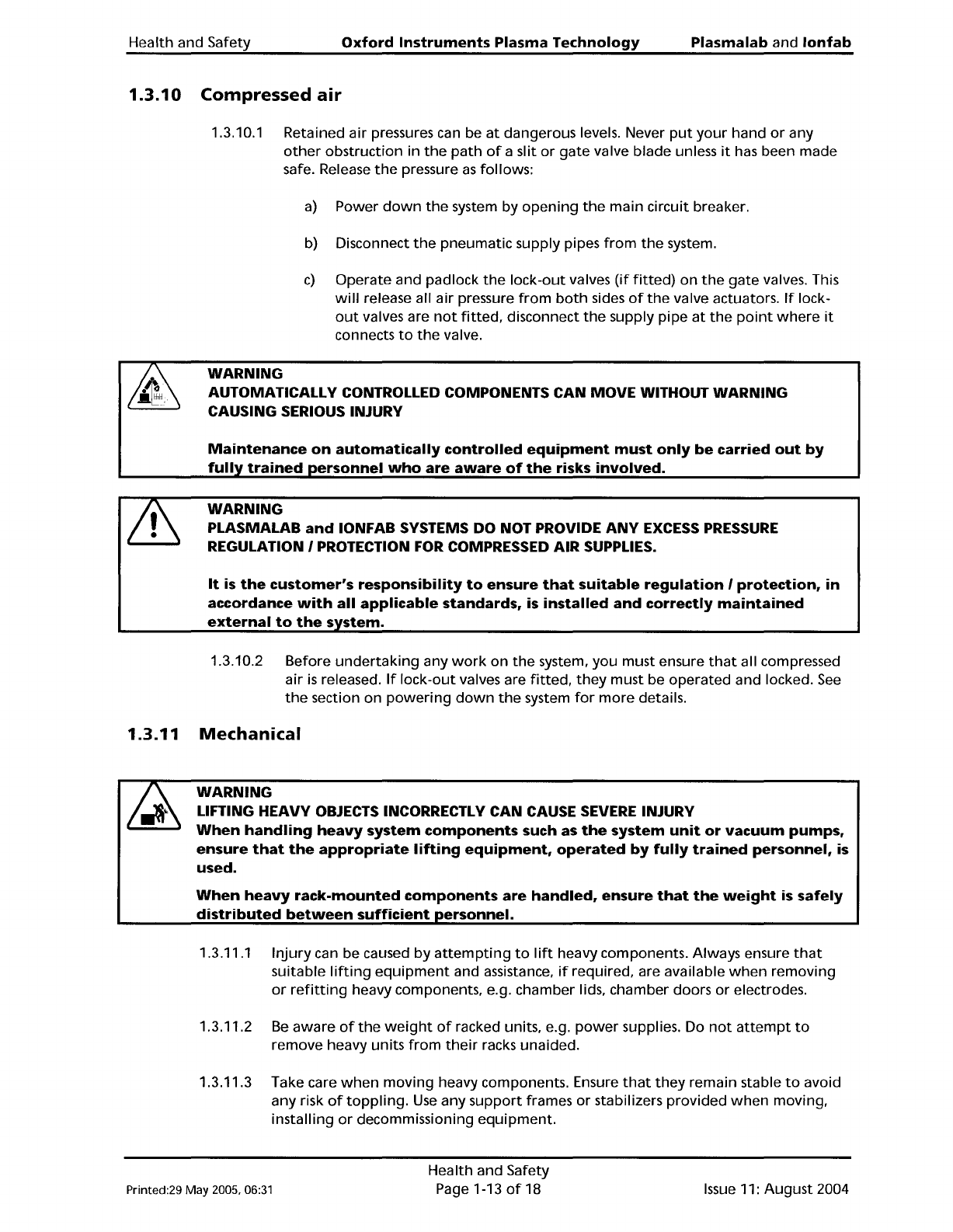
1.3.10.1 Retained
air
pressures can be
at
dangerous levels. Never
put
your
hand
or
any
other
obstruction
in
the
path
of
a slit
or
gate
valve blade unless
it
has been made
safe. Release
the
pressure
as
follows:
a)
Power
down
the
system by
opening
the
main
circuit
breaker.
b) Disconnect
the
pneumatic
supply pipes
from
the
system.
c)
Operate
and padlock
the
lock-out
valves
(if
fitted)
on
the
gate
valves. This
will
release all
air
pressure
from
both
sides
of
the
valve actuators.
If
lock-
out
valves are
not
fitted,
disconnect
the
supply pipe
at
the
point
where
it
connects
to
the
valve.
WARNING
AUTOMATICALLY CONTROLLED COMPONENTS CAN
MOVE
WITHOUT
WARNING
CAUSING SERIOUS INJURY
Maintenance
on
automatically
controlled
equipment
must
only
be
carried
out
by
fully
trained
personnel
who
are
aware
of
the
risks
involved.
WARNING
PLASMALAB
and
10NFAB SYSTEMS DO NOT PROVIDE
ANY
EXCESS
PRESSURE
REGULATION I PROTECTION
FOR
COMPRESSED AIR SUPPLIES.
It
is
the
customer's
responsibility
to
ensure
that
suitable
regulation
I
protection,
in
accordance
with
all
applicable
standards, is
installed
and
correctly
maintained
external
to
the
system.
1.3.10.2 Before
undertaking
any
work
on
the
system,
you
must ensure
that
all compressed
air
is
released.
If
lock-out
valves are
fitted,
they
must be
operated
and locked.
See
the
section on
powering
down
the
system
for
more
details.
Mechanical
WARNING
LIFTING HEAVY
OBJECTS
INCORRECTLY CAN CAUSE SEVERE INJURY
When
handling
heavy
system
components
such as
the
system
unit
or
vacuum
pumps,
ensure
that
the
appropriate
lifting
equipment,
operated
by
fully
trained
personnel,
is
used.
When
heavy
rack-mounted
components
are
handled,
ensure
that
the
weight
is
safely
distributed
between
sufficient
personnel.
1.3.11.1
Injury
can be caused
by
attempting
to
lift
heavy components. Always ensure
that
suitable
lifting
equipment
and assistance,
if
required, are available
when
removing
or
refitting
heavy components, e.g. chamber lids, chamber doors
or
electrodes.
1.3.11.2
Be
aware
of
the
weight
of
racked units, e.g.
power
supplies. Do
not
attempt
to
remove heavy units
from
their
racks unaided.
1.3.11.3 Take care
when
moving
heavy components. Ensure
that
they
remain stable
to
avoid
any risk
of
toppling.
Use
any
support
frames
or
stabilizers
provided
when
moving,
installing
or
decommissioning
equipment.
Printed:29
May
2005, 06:31
Health and Safety
Page 1-13
of
18
Issue
11:
August
2004