80S-20用户手册.pdf - 第478页
11 Station extensions /Hardware SIPLACE 80S-20 /F4 User Manual 11.3 Dual conv eyor Software version SR.407.xx 01/ 2001 US Edition 478 1 1 .3.10 T echnical data for the dual conveyor 1 1.3.1 1 Maintena nce Maintenanc e fo…

SIPLACE 80S-20/F4 User Manual 11 Station extensions /Hardware
Software version SR.407.xx 01/2001 US Edition 11.3 Dual conveyor
477
11.3.8 Synchronous transport type
11.3.8.1 Description
In synchronous mode, two PCBs of the same size are moved into the placement position together.
These PCBs must be processed as a common cluster. 11
This enables the topside and underside of a PCB to be processed on the same line. As a result,
it takes less time to transport the PCBs since two PCBs are always moved at the same time. 11
11.3.8.2 Function
PCBs on transport tracks 1 and 2 are moved synchronously onto the transport sections (i.e. the
conveyors are controlled synchronously, but independently of one another). The components to
be placed for transport tracks 1 and 2 must be organized into a cluster via two subpanels. (See
the user manual for the line computer). 11
If only one transport track (or center conveyor) is full when the placement sequence starts, the
subpanel on this section will be identified as “not for placement”. 11
11.3.9 Controlling the dual conveyor using the Single Functions menu
Control of the dual conveyor and the Single Functions menu are described in chapter 4 of this user
manual. 11
11.3.9.1 Automatic width adjustment on the dual conveyor
PLEASE NOTE 11
The desired conveyor width relates to both conveyors. When the command is received, the con-
veyors are set to the desired width one after another.
Automatic width adjustment is deactivated if “synchronous transport” is selected. 11

11 Station extensions /Hardware SIPLACE 80S-20/F4 User Manual
11.3 Dual conveyor Software version SR.407.xx 01/2001 US Edition
478
11.3.10 Technical data for the dual conveyor
11.3.11 Maintenance
Maintenance for the individual conveyors and the additional lifting table is exactly the same as for
the standard conveyor. Each conveyor belt must be maintained as described in the maintenance
instructions. 11
PCB format
50 mm x 50 mm to 460 mm x 216,5 mm
2" x 2" to 18" x 8.5"
PCB thickness 0.3 mm to 4.5 mm
Max. PCB warpage
On top: 4.5 mm - PCB thickness
On bottom: 0.3 mm + PCB thickness
Clearance on PCB underside 25 mm (standard), 40 mm (option)
PCB transport height
830 ± 15 mm (standard)
900 ± 15 mm (option)
930 ± 15 mm (option)
950 ± 15 mm (SMEMA option)
Type of interface Siemens (standard), SMEMA (option)
Component-free handling edge 3 mm
PCB changeover time 2.5 s
Fixed conveyor edge Right (standard), left (option)
Components on each conveyor Synchronous: same or different, asynchronous: same
PCB width on each conveyor Synchronous: different, asynchronous: same
Ink spot recognition Synchronous: not possible, asynchronous: possible
Automatic width adjustment Synchronous: not possible, asynchronous: possible
SIPLACE 80S-20/F4 User Manual 11 Station extensions /Hardware
Software version SR.407.xx 01/2001 US Edition 11.4 PCB barcode
479
11.4 PCB barcode
11.4.1 Overview
The PCB barcode reader is used to automatically record and decode barcodes on PCBs. The
PCB barcode reader sends the read data via its serial interface to the machine controller for fur-
ther processing. 11
The PCB barcode readers are installed on the input side of the placement machine, above and
below the PCB conveyor, so that barcode labels on the topside and underside of the PCBs can
be read.
One or two PCB barcode readers may be retrofitted in order to read the topside and underside of
the PCB on the transport track. 11
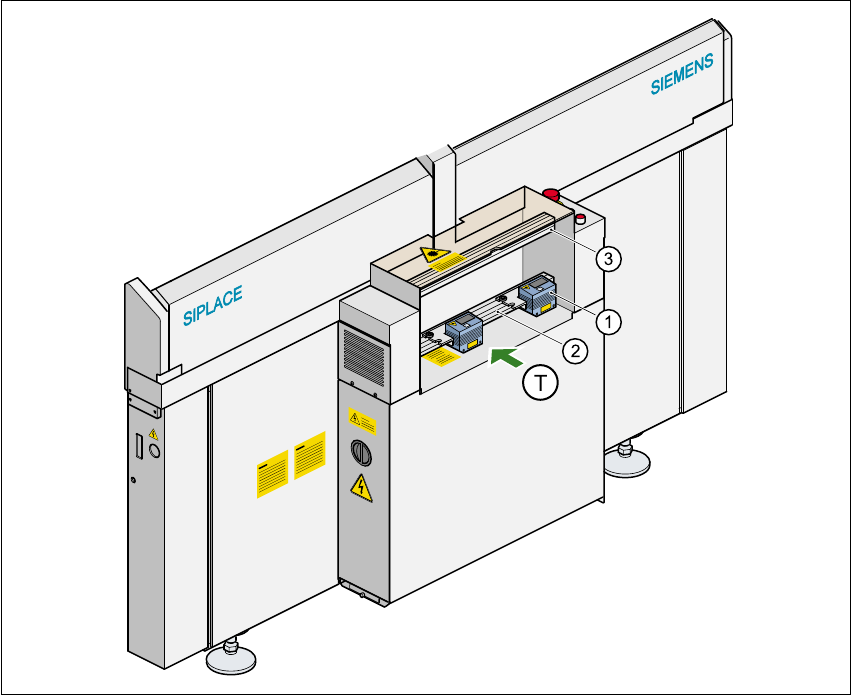
Fig. 11.4 - 1 Position of the modules on the input side of the placement machine
(1) Barcode reading head
(2) Profiled rail for ‘underside’ PCB barcode reader
(3) Profiled rail for ‘topside’ PCB barcode reader