Oxford-100-Manual.pdf - 第147页
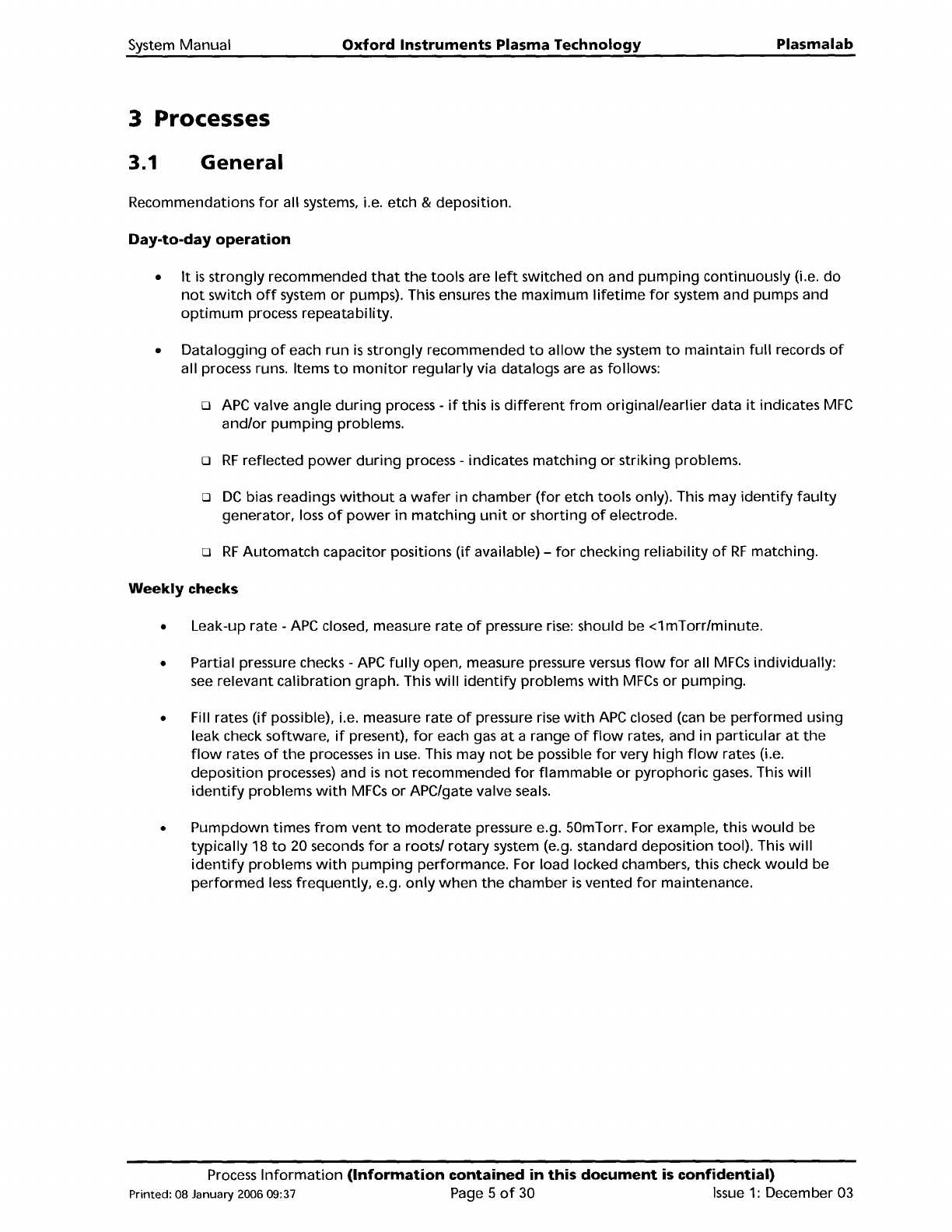
System Manual 3 Processes 3.1 General Oxford Instruments Plasma Technology Plasma lab Recommendations for all systems, Le. etch & deposition. Day-to-day operation • It is strongly recommended that the tools are left …
Plasma
lab
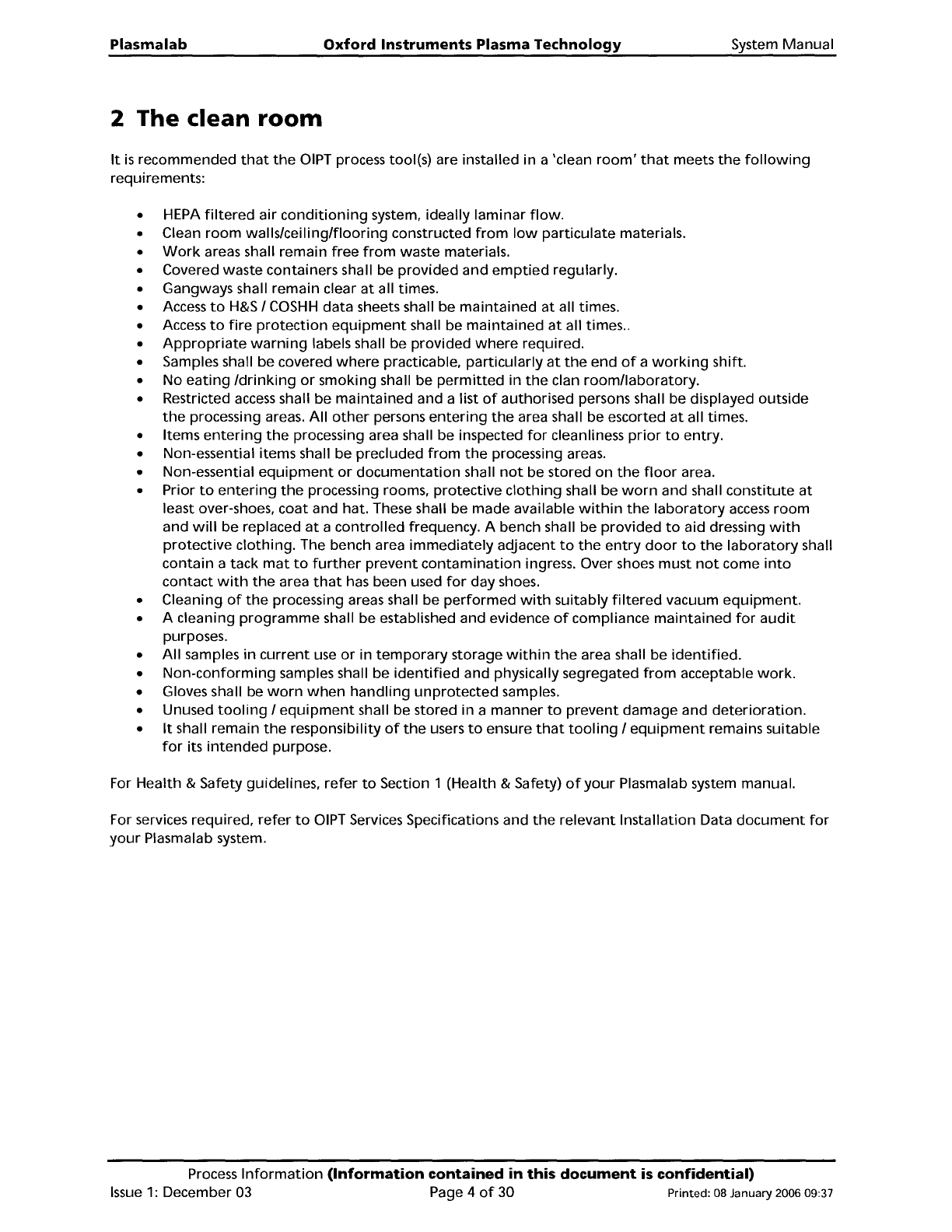
2 The clean
room
Oxford
Instruments
Plasma
Technology
System
Manual
It
is
recommended
that
the
OIPT
process tool(s) are installed in a 'clean
room'
that
meets
the
following
requirements:
•
HEPA
filtered
air
conditioning
system, ideally
laminar
flow.
• Clean
room
walls/ceiling/flooring
constructed
from
low
particulate
materials.
•
Work
areas shall remain free
from
waste materials.
• Covered waste containers shall be
provided
and
emptied
regularly.
• Gangways shall remain clear
at
all times.
•
Access
to
H&S
/
COSHH
data sheets shall be
maintained
at
all times.
•
Access
to
fire
protection
equipment
shall be
maintained
at
all times
..
•
Appropriate
warning
labels shall be provided
where
required.
• Samples shall be covered
where
practicable,
particularly
at
the
end
of
a
working
shift.
• No
eating
/drinking
or
smoking shall be
permitted
in
the
clan
room/laboratory.
• Restricted
access
shall
be
maintained
and a list
of
authorised persons shall be displayed outside
the
processing areas.
All
other
persons
entering
the
area shall be escorted
at
all times.
• Items
entering
the
processing area shall be inspected
for
cleanliness
prior
to
entry.
• Non-essential items shall be precluded
from
the
processing areas.
• Non-essential
equipment
or
documentation
shall
not
be stored
on
the
floor
area.
• Prior
to
entering
the
processing rooms, protective
clothing
shall be
worn
and shall
constitute
at
least over-shoes,
coat
and hat. These shall be made available
within
the
laboratory
access
room
and
will
be replaced
at
a
controlled
frequency. A bench shall
be
provided
to
aid dressing
with
protective
clothing. The bench area
immediately
adjacent
to
the
entry
door
to
the
laboratory
shall
contain
a tack
mat
to
further
prevent
contamination
ingress. Over shoes must
not
come
into
contact
with
the
area
that
has been used
for
day shoes.
• Cleaning
of
the
processing areas shall be
performed
with
suitably
filtered
vacuum
equipment.
• A cleaning
programme
shall be established and evidence
of
compliance
maintained
for
audit
purposes.
•
All
samples
in
current
use
or
in
temporary
storage
within
the
area shall be
identified.
•
Non-conforming
samples shall be
identified
and physically segregated
from
acceptable
work.
• Gloves shall be
worn
when
handling
unprotected
samples.
• Unused
tooling
/
equipment
shall be stored in a
manner
to
prevent
damage and
deterioration.
•
It
shall remain
the
responsibility
of
the
users
to
ensure
that
tooling
/
equipment
remains suitable
for
its
intended
purpose.
For Health & Safety guidelines,
refer
to
Section 1 (Health & Safety)
of
your
Plasmalab system manual.
For services required,
refer
to
OIPT
Services Specifications and
the
relevant
Installation Data
document
for
your
Plasmalab system.
Process
Information
(Information
contained
in
this
document
is
confidential)
Issue
1: December 03 Page 4
of
30 Printed:
OB
January 2006 09:37
System
Manual
3 Processes
3.1
General
Oxford
Instruments
Plasma Technology
Plasma
lab
Recommendations
for
all systems,
Le.
etch & deposition.
Day-to-day
operation
•
It
is
strongly
recommended
that
the
tools
are
left
switched
on
and
pumping
continuously (i.e.
do
not
switch
off
system
or
pumps). This ensures
the
maximum
lifetime
for
system and pumps and
optimum
process
repeatability.
•
Datalogging
of
each
run
is
strongly
recommended
to
allow
the
system
to
maintain
full
records
of
all process runs. Items
to
monitor
regularly
via datalogs are
as
follows:
o
APC
valve
angle
during
process -
if
this
is
different
from
original/earlier
data
it
indicates
MFC
and/or
pumping
problems.
o
RF
reflected
power
during
process - indicates
matching
or
striking
problems.
o
DC
bias readings
without
a
wafer
in chamber
(for
etch
tools
only). This may
identify
faulty
generator,
loss
of
power
in
matching
unit
or
shorting
of
electrode.
o
RF
Automatch
capacitor positions
(if
available) -
for
checking
reliability
of
RF
matching.
Weekly
checks
• Leak-up
rate
-
APC
closed, measure
rate
of
pressure rise: should be <1mTorr/minute.
• Partial pressure checks -
APC
fully
open, measure pressure versus
flow
for
all
MFCs
individually:
see
relevant
calibration
graph. This
will
identify
problems
with
MFCs
or
pumping.
• Fill rates
(if
possible), i.e. measure
rate
of
pressure rise
with
APC
closed (can be
performed
using
leak check software,
if
present),
for
each gas
at
a range
of
flow
rates, and in
particular
at
the
flow
rates
of
the
processes in
use.
This may
not
be possible
for
very
high
flow
rates (i.e.
deposition
processes) and
is
not
recommended
for
flammable
or
pyrophoric
gases.
This
will
identify
problems
with
MFCs
or
APC/gate valve
seals.
•
Pumpdown
times
from
vent
to
moderate
pressure e.g. 50mTorr. For example, this
would
be
typically 18
to
20 seconds
for
a roots!
rotary
system (e.g. standard
deposition
tool). This
will
identify
problems
with
pumping
performance. For load locked chambers, this check
would
be
performed
less
frequently,
e.g.
only
when
the
chamber
is
vented
for
maintenance.
Process
Information
(Information
contained
in
this
document
is
confidential)
Printed: 08
January
200609:37
Page 5
of
30
Issue
1:
December 03
Plasma
lab
Oxford
Instruments
Plasma
Technology
System
Manual
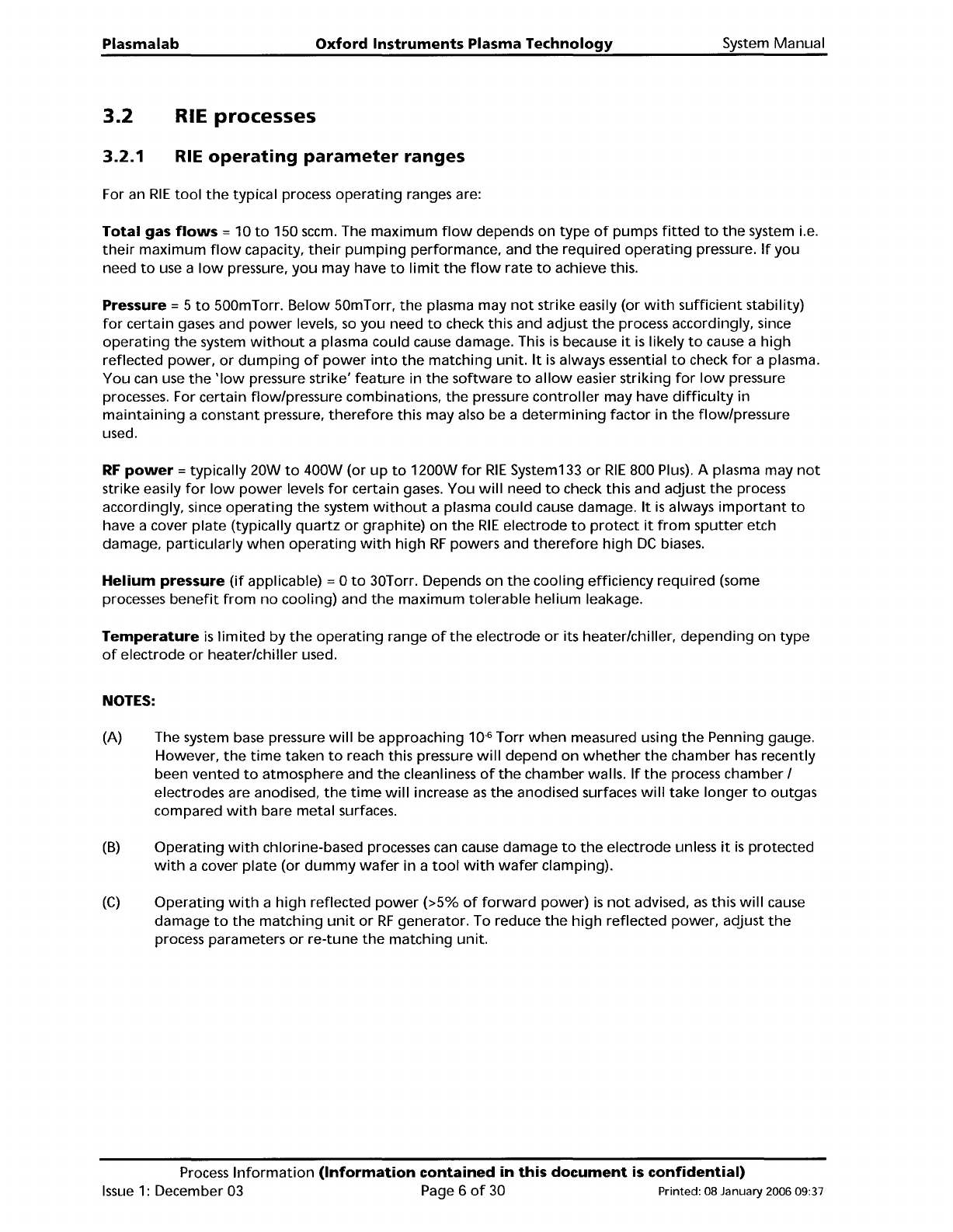
3.2
3.2.1
HIE
processes
RIE
operating
parameter
ranges
For an
RIE
tool
the
typical process
operating
ranges are:
Total
gas
flows
= 10
to
150
sccm.
The
maximum
flow
depends on
type
of
pumps
fitted
to
the
system i.e.
their
maximum
flow
capacity,
their
pumping
performance, and
the
required
operating
pressure.
If
you
need
to
use a
low
pressure,
you
may have
to
limit
the
flow
rate
to
achieve this.
Pressure = 5
to
500mTorr.
Below
50mTorr,
the
plasma
may
not
strike easily (or
with
sufficient
stability)
for
certain gases and
power
levels,
so
you need
to
check this and adjust
the
process accordingly, since
operating
the
system
without
a plasma could cause damage. This
is
because
it
is
likely
to
cause a
high
reflected power,
or
dumping
of
power
into
the
matching
unit.
It
is
always essential
to
check
for
a plasma.
You can use
the
'low
pressure strike'
feature
in
the
software
to
allow
easier
striking
for
low
pressure
processes. For certain flow/pressure combinations,
the
pressure
controller
may have
difficulty
in
maintaining
a constant pressure,
therefore
this may also be a
determining
factor
in
the
flow/pressure
used.
RF
power
=
typically
20W
to
400W (or
up
to
1200W
for
RIE
System133
or
RIE
800 Plus). A plasma may
not
strike easily
for
low
power
levels
for
certain
gases.
You
will
need
to
check this and adjust
the
process
accordingly, since
operating
the
system
without
a plasma could cause damage.
It
is
always
important
to
have a cover
plate
(typically
quartz
or
graphite)
on
the
RIE
electrode
to
protect
it
from
sputter
etch
damage,
particularly
when
operating
with
high
RF
powers and
therefore
high
DC
biases.
Helium
pressure
(if
applicable) = 0
to
30Torr. Depends
on
the
cooling
efficiency
required
(some
processes
benefit
from
no
cooling) and
the
maximum
tolerable
helium
leakage.
Temperature
is
limited
by
the
operating
range
of
the
electrode
or
its heater/chiller,
depending
on
type
of
electrode
or
heater/chiller used.
NOTES:
(A) The system base pressure
will
be approaching
10-
6
Torr
when
measured using
the
Penning gauge.
However,
the
time
taken
to
reach this pressure
will
depend
on
whether
the
chamber has recently
been vented
to
atmosphere and
the
cleanliness
of
the
chamber walls.
If
the
process chamber /
electrodes are anodised,
the
time
will
increase
as
the
anodised surfaces
will
take
longer
to
outgas
compared
with
bare metal surfaces.
(B)
Operating
with
chlorine-based processes can cause damage
to
the
electrode unless
it
is
protected
with
a cover
plate
(or
dummy
wafer
in a
tool
with
wafer
clamping).
(C)
Operating
with
a
high
reflected
power
(>5%
of
forward
power)
is
not
advised,
as
this
will
cause
damage
to
the
matching
unit
or
RF
generator. To reduce
the
high
reflected power, adjust
the
process parameters
or
re-tune
the
matching
unit.
Process
Information
(Information
contained
in
this
document
is
confidential)
Issue
1:
December 03 Page 6
of
30 Printed: 08 January 2006 09:37