Oxford-100-Manual.pdf - 第165页
System Manual Oxford Instruments Plasma Technology Plasma lab 3.4 Process troubleshooting 3.4.1 Partial process failure 3.4.1.1 Example problems • Etch rate has dropped • Selectivity reduced • Profile no longer anisotrop…
Plasma
lab
Oxford
Instruments
Plasma
Technology
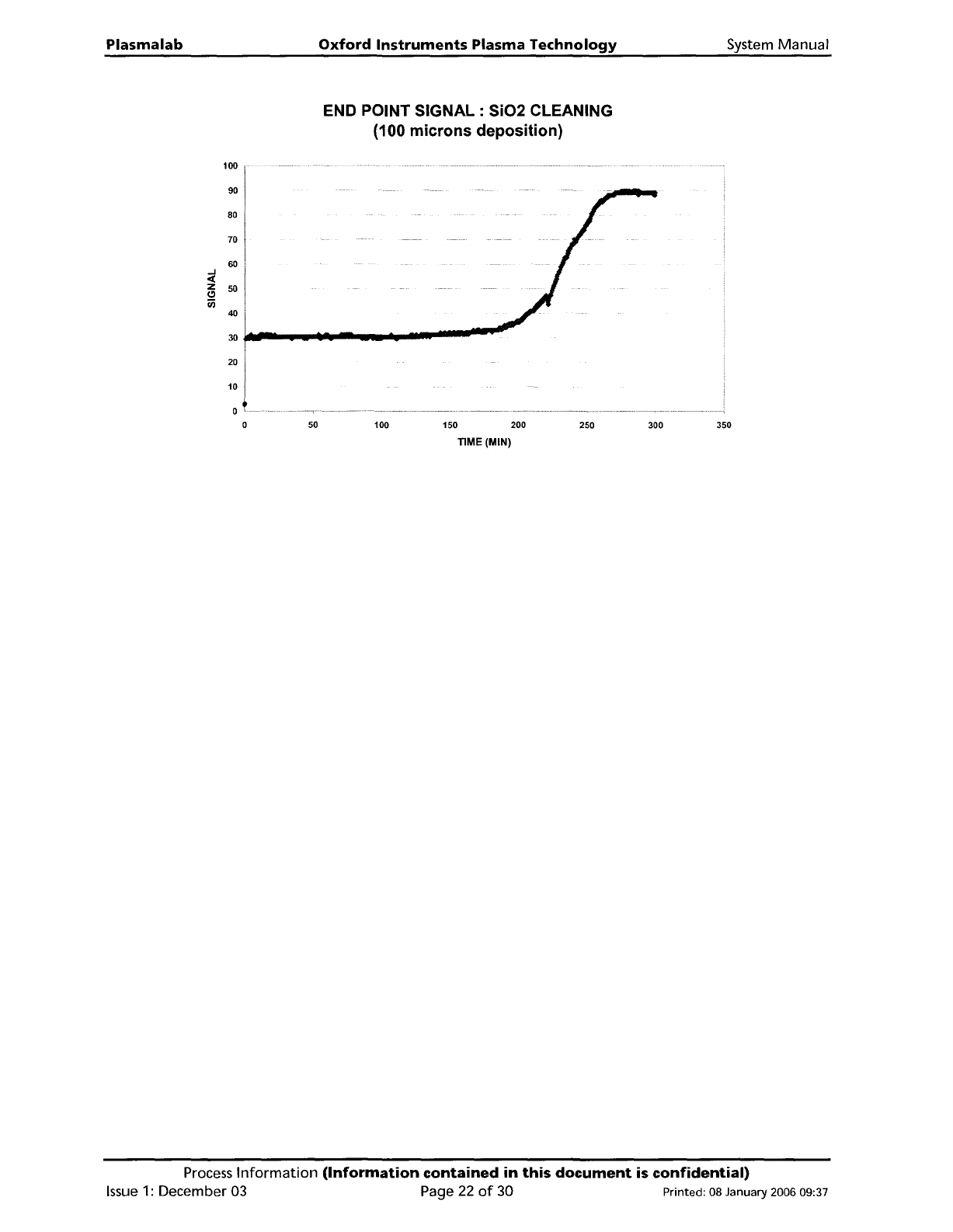
END POINT SIGNAL:
Si02
CLEANING
(100 microns deposition)
System
Manual
100
90
80
70
60
..J
«
z
50
Cl
iii
40
30
20
10
0
0 50 100 150 200
250 300
350
TIME (MIN)
Process
Information
(Information
contained
in
this
document
is
confidential)
Issue
1:
December 03 Page
22
of
30 Printed: 08 January 2006 09:37
System
Manual
Oxford
Instruments Plasma Technology
Plasma
lab
3.4
Process
troubleshooting
3.4.1
Partial
process
failure
3.4.1.1
Example
problems
• Etch rate has
dropped
• Selectivity reduced
•
Profile
no
longer
anisotropic
•
Non-uniform
etching
(or deposition)
3.4.1.2
Typical causes
•
Hardware
has changed -
new
gas cylinder,
new
cover plate,
RF
connection /
grounding
is
faulty.
• Chamber leak - Check leak-up
rate
• Faulty
MFC
- check
partial
pressures
•
APC
cannot
control
pressure - check
MFCs
/ Pumps
•
RF
generator/matching
- adjust
matching
unit
set-up, check
generator
range switch,
watch
HF
matching
time
in
mixed frequency pulsed process
• Incorrect gases used
•
Temperature
-
poor
clamping / cooling, e.g. particles
on
electrode/wafer,
lift
pin
not
fully
down,
wafer
piece
not
glued
to
carrier, incorrect set-up
of
Eurotherm,
high
power,
or
poor
resist
preparation
• Chamber
is
dirty
- needs
more
frequent
cleaning
• Incorrect process
regime
(knife-edge
process)
•
Wrong
hardware
for
given process -
wrong
cover plate,
wafer
not
being cooled / heated
sufficiently,
wrong
electrode
gap
•
Wrong
process
for
given
hardware
-
no
pumpdown
time,
no
preheat
step,
no
pre-clean step
3.4.2 Total process
failure
3.4.2.1
Example
problems
• Process
not
etching
/
depositing
- does plasma
ignite?
• Plasma does
not
ignite/light
up
• Plasma
is
unstable/pulsing
• Plasma
is
flickering
3.4.2.2
Typical causes
Check
that
readbacks are
within
tolerance -
MFCs,
pressure control,
RF
matching,
temperature.
Check
that
base pressure has been reached (this can always be changed
if
you are
in
a
hurry!)
Read
error
/
warning
/
information
messages
Process
Information
(Information
contained
in
this
document
is
confidential)
Printed:
08
January
2006 09:37 Page
23
of
30
Issue
1:
December 03
Plasma
lab
Oxford
Instruments
Plasma
Technology
System Manual
Check
that
plasma
is
striking
-
try
high
pressure strike
(>SOmT
RIE,
>8mT
ICP),
or
increased
RF
power
input,
or
addition
of
more
DC
bias
Try selecting
'ignore
tolerance'
checkbox
Sudden pressure rise - check
for
dissociation, -
try
Ar
instead, strike
at
reduced
ICP
power
Sudden pressure rise
at
plasma strike - check
for
cross
talk
between
RF
power
and CM
gauge
Sudden
temperature
rise
at
plasma strike - check
for
cross
talk
between
RF
power
and
temperature
gauge
Sudden gas
flow
change
at
plasma strike - check
for
RF
cross
talk
Process
Information
(Information
contained
in
this
document
is
confidential)
Issue
1:
December 03 Page 24
of
30 Printed: 08 January 2006 09:37