Oxford-100-Manual.pdf - 第152页
Plasma lab Oxford Instruments Plasma Technology System Manual 3.2.5 Arcing I pitting Arcing around the showerhead could be related to: (a) Contamination of the showerhead / chamber walls (e.g. insulating/polymer coating,…
System
Manual
Oxford Instruments Plasma Technology
Plasma
lab
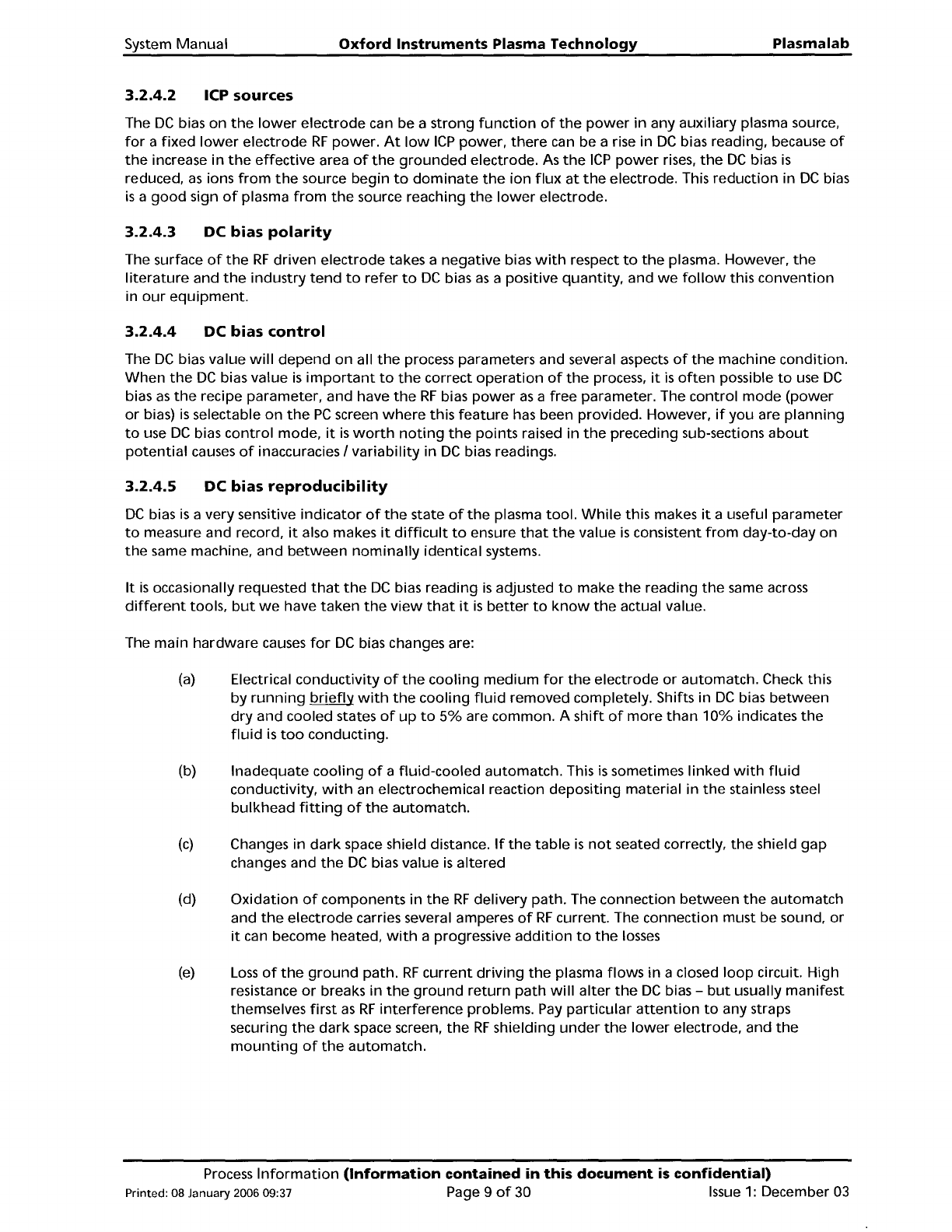
3.2.4.2
ICP sources
The
DC
bias on
the
lower
electrode
can be a strong
function
of
the
power
in
any auxiliary plasma source,
for
a
fixed
lower
electrode
RF
power.
At
low
ICP
power,
there
can be a rise in
DC
bias reading, because
of
the
increase
in
the
effective
area
of
the
grounded
electrode.
As
the
ICP
power
rises,
the
DC
bias
is
reduced,
as
ions
from
the
source begin
to
dominate
the
ion
flux
at
the
electrode. This
reduction
in
DC
bias
is
a
good
sign
of
plasma
from
the
source reaching
the
lower
electrode.
3.2.4.3
DC
bias
polarity
The surface
of
the
RF
driven electrode takes a
negative
bias
with
respect
to
the
plasma. However,
the
literature
and
the
industry
tend
to
refer
to
DC
bias
as
a positive
quantity,
and
we
follow
this
convention
in
our
equipment.
3.2.4.4
DC
bias
control
The
DC
bias value
will
depend
on
all
the
process parameters and several aspects
of
the
machine condition.
When
the
DC
bias value
is
important
to
the
correct
operation
of
the
process,
it
is
often
possible
to
use
DC
bias
as
the
recipe parameter, and have
the
RF
bias
power
as
a free parameter. The
control
mode
(power
or
bias)
is
selectable
on
the
PC
screen
where
this
feature
has been provided. However,
if
you
are
planning
to
use
DC
bias
control
mode,
it
is
worth
noting
the
points raised in
the
preceding sub-sections
about
potential
causes
of
inaccuracies I
variability
in
DC
bias readings.
3.2.4.5
DC
bias
reproducibility
DC
bias
is
a very sensitive
indicator
of
the
state
of
the
plasma
tool.
While
this makes
it
a useful
parameter
to
measure and record,
it
also makes
it
difficult
to
ensure
that
the
value
is
consistent
from
day-to-day on
the
same machine, and
between
nominally
identical systems.
It
is
occasionally requested
that
the
DC
bias reading
is
adjusted
to
make
the
reading
the
same across
different
tools,
but
we
have
taken
the
view
that
it
is
better
to
know
the
actual value.
The main
hardware
causes
for
DC
bias changes are:
(a) Electrical
conductivity
of
the
cooling
medium
for
the
electrode
or
automatch. Check this
by
running
briefly
with
the
cooling
fluid
removed completely. Shifts in
DC
bias
between
dry
and cooled states
of
up
to
5%
are common. A
shift
of
more
than
10%
indicates
the
fluid
is
too
conducting.
(b)
Inadequate
cooling
of
a
fluid-cooled
automatch.
This
is
sometimes
linked
with
fluid
conductivity,
with
an electrochemical reaction
depositing
material in
the
stainless steel
bulkhead
fitting
of
the
automatch.
(c)
Changes in
dark
space shield distance.
If
the
table
is
not
seated correctly,
the
shield
gap
changes and
the
DC
bias value
is
altered
(d)
Oxidation
of
components
in
the
RF
delivery path. The connection
between
the
automatch
and
the
electrode
carries several amperes
of
RF
current. The connection must be sound,
or
it
can become heated,
with
a progressive
addition
to
the
losses
(e)
Loss
of
the
ground
path.
RF
current
driving
the
plasma
flows
in
a closed
loop
circuit. High
resistance
or
breaks
in
the
ground
return
path
will
alter
the
DC
bias -
but
usually manifest
themselves
first
as
RF
interference
problems.
Pay
particular
attention
to
any straps
securing
the
dark
space screen,
the
RF
shielding
under
the
lower
electrode, and
the
mounting
of
the
automatch.
Process
Information
(Information
contained in this
document
is
confidential)
Printed: 08 January 2006 09:37 Page 9
of
30
Issue
1:
December
03
Plasma
lab
Oxford
Instruments
Plasma
Technology
System
Manual
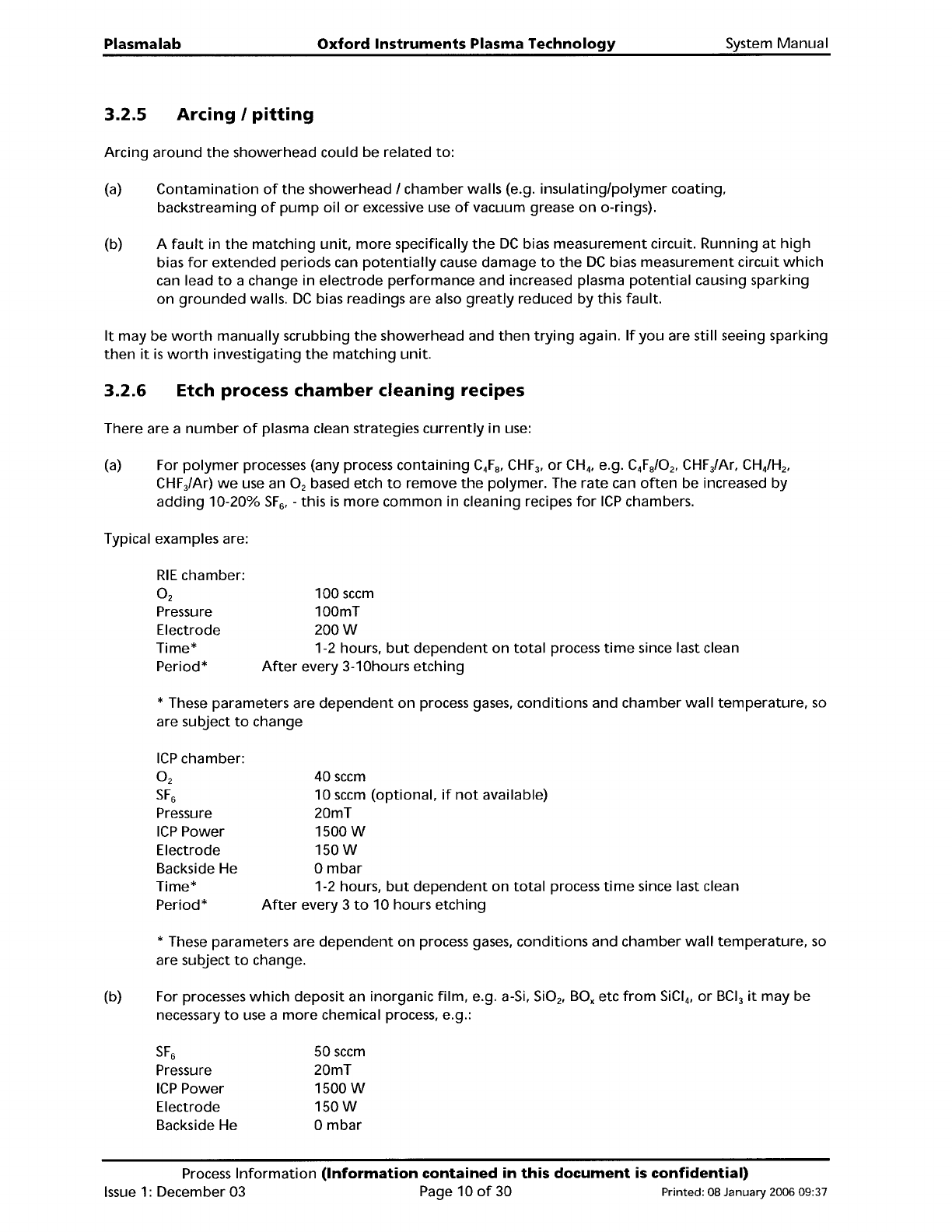
3.2.5
Arcing I
pitting
Arcing
around
the
showerhead could be related
to:
(a)
Contamination
of
the
showerhead / chamber walls (e.g.
insulating/polymer
coating,
backstreaming
of
pump
oil
or
excessive use
of
vacuum grease
on
o-rings).
(b) A
fault
in
the
matching
unit,
more
specifically
the
DC
bias measurement circuit. Running
at
high
bias
for
extended periods can
potentially
cause damage
to
the
DC
bias measurement circuit
which
can lead
to
a change in electrode performance and increased plasma
potential
causing sparking
on
grounded
walls.
DC
bias readings are also
greatly
reduced by this
fault.
It
may be
worth
manually
scrubbing
the
showerhead and
then
trying
again.
If
you
are still seeing sparking
then
it
is
worth
investigating
the
matching
unit.
3.2.6
Etch process
chamber
cleaning recipes
There are a
number
of
plasma clean strategies
currently
in
use:
(a)
For
polymer
processes (any process
containing
C
4
F
a
,
CHF
3
,
or
CH
4
,
e.g. C
4
F
a
/0
2
,
CHFiAr,
CHiH
2
,
CHFiAr)
we
use an O
2
based etch
to
remove
the
polymer. The
rate
can
often
be increased by
adding
10-20%
SF
6
, -
this
is
more
common
in cleaning recipes
for
ICP
chambers.
Typical examples are:
RIE
chamber:
O
2
Pressure
Electrode
Time*
Period*
100
sccm
100mT
200W
1-2 hours,
but
dependent
on
total
process
time
since last clean
After
every 3-10hours
etching
* These parameters are
dependent
on
process
gases,
conditions and chamber
wall
temperature,
so
are subject
to
change
ICP
chamber:
O
2
SF
6
Pressure
ICP
Power
Electrode
Backside He
Time*
Period*
40
sccm
10
sccm
(optional,
if
not
available)
20mT
1500W
150W
o
mbar
1-2 hours,
but
dependent
on
total
process
time
since last clean
After
every 3
to
10 hours
etching
* These parameters are
dependent
on process
gases,
conditions
and chamber
wall
temperature,
so
are subject
to
change.
(b) For processes
which
deposit an inorganic
film,
e.g. a-Si,
Si0
2
,
BOx
etc
from
SiCI
4
,
or
BCI
3
it
may be
necessary
to
use a
more
chemical process, e.g.:
SF
6
Pressure
ICP
Power
Electrode
Backside He
50
sccm
20mT
1500W
150W
o
mbar
Process
Information
(Information
contained
in
this
document
is
confidential)
Issue
1:
December 03 Page 10
of
30 Printed: 08 January 2006 09:37
System
Manual
Oxford
Instruments
Plasma Technology
Plasma
lab
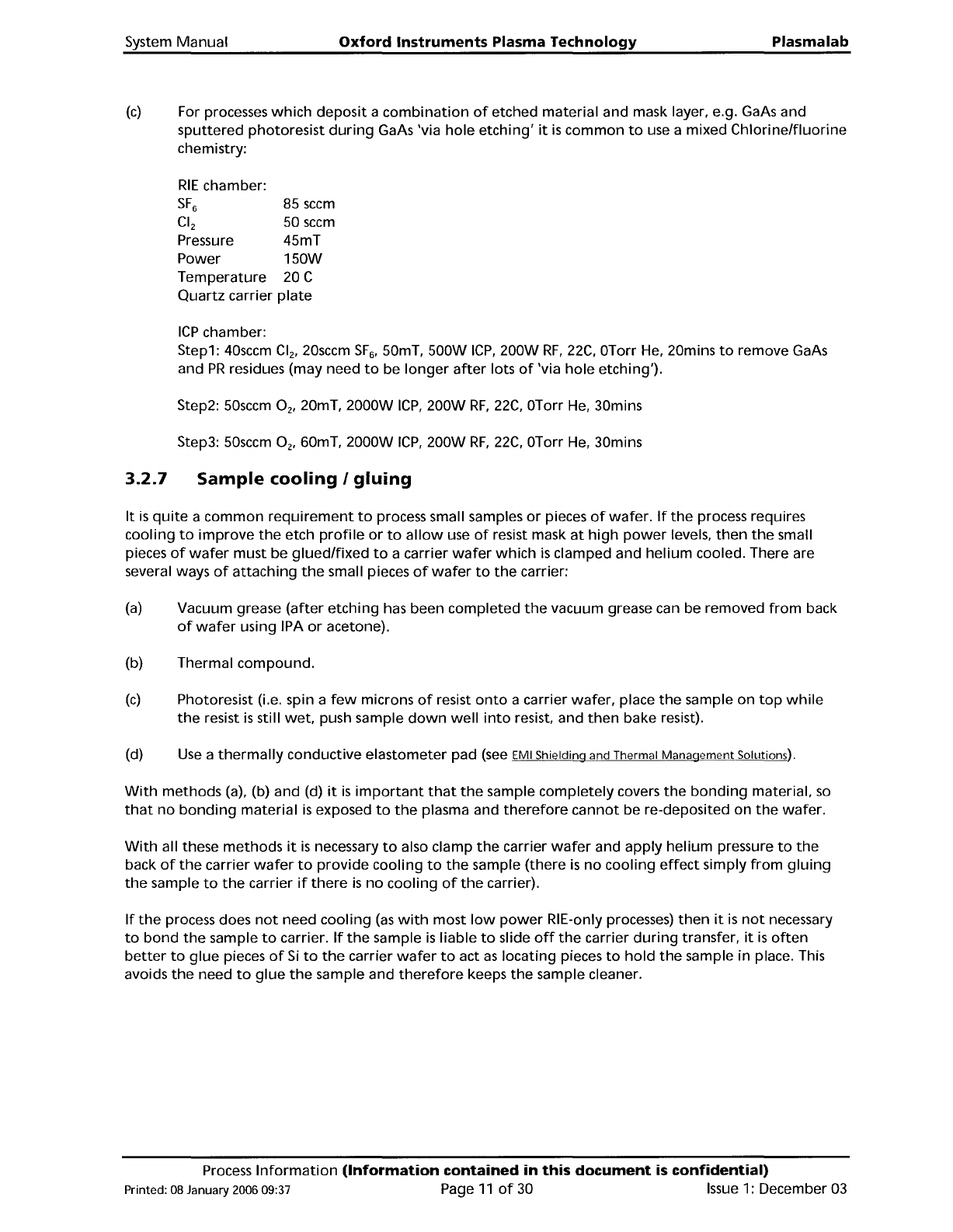
(c)
For processes
which
deposit
a
combination
of
etched material and mask layer, e.g. GaAs and
sputtered
photoresist
during
GaAs 'via
hole
etching'
it
is
common
to
use a mixed
Chlorine/fluorine
chemistry:
RIE
chamber:
SF
6
85
sccm
CI
2
50
sccm
Pressure 45mT
Power
150VV
Temperature
20 C
Quartz
carrier
plate
ICP
chamber:
Step1:
40sccm
C1
2
,
20sccm
SF
6
,
50mT,
500VV
ICP,
200VV
RF,
22C,
OTorr He, 20mins
to
remove GaAs
and
PR
residues (may need
to
be
longer
after
lots
of
'via
hole
etching').
Step2:
50sccm
°
2
,
20mT,
2000VV
ICP,
200VV
RF,
22C,
OTorr He, 30mins
Step3:
50sccm
°
2
,
60mT,
2000VV
ICP,
200VV
RF,
22C,
OTorr He, 30mins
3.2.7
Sample
cooling
I
gluing
It
is
quite
a
common
requirement
to
process small samples
or
pieces
of
wafer.
If
the
process requires
cooling
to
improve
the
etch
profile
or
to
allow
use
of
resist mask
at
high
power
levels,
then
the
small
pieces
of
wafer
must be
glued/fixed
to
a carrier
wafer
which
is
clamped and
helium
cooled. There are
several ways
of
attaching
the
small pieces
of
wafer
to
the
carrier:
(a)
Vacuum grease
(after
etching
has been
completed
the
vacuum grease can be removed
from
back
of
wafer
using IPA
or
acetone).
(b) Thermal
compound.
(c)
Photoresist (i.e. spin a
few
microns
of
resist
onto
a carrier
wafer,
place
the
sample on
top
while
the
resist
is
still
wet,
push sample
down
well
into
resist, and
then
bake resist).
(d)
Use
a
thermally
conductive elastometer pad
(see
EMI Shielding and Thermal
Manaqement
Solutions).
VVith
methods
(a), (b) and (d)
it
is
important
that
the
sample
completely
covers
the
bonding
material,
so
that
no
bonding
material
is
exposed
to
the
plasma and
therefore
cannot
be re-deposited on
the
wafer.
VVith
all these
methods
it
is
necessary
to
also clamp
the
carrier
wafer
and apply
helium
pressure
to
the
back
of
the
carrier
wafer
to
provide
cooling
to
the
sample
(there
is
no
cooling
effect
simply
from
gluing
the
sample
to
the
carrier
if
there
is
no
cooling
of
the
carrier).
If
the
process does
not
need
cooling
(as
with
most
low
power
RIE-only processes)
then
it
is
not
necessary
to
bond
the
sample
to
carrier.
If
the
sample
is
liable
to
slide
off
the
carrier
during
transfer,
it
is
often
better
to
glue
pieces
of
Si
to
the
carrier
wafer
to
act
as
locating pieces
to
hold
the
sample in place. This
avoids
the
need
to
glue
the
sample and
therefore
keeps
the
sample cleaner.
Process
Information
(Information
contained
in
this
document
is
confidential)
Printed: 08 January 2006 09:37 Page
11
of
30
Issue
1: December 03