Oxford-100-Manual.pdf - 第164页
Plasma lab Oxford Instruments Plasma Technology END POINT SIGNAL: Si02 CLEANING (100 microns deposition) System Manual 100 90 80 70 60 ..J « z 50 Cl iii 40 30 20 10 0 0 50 100 150 200 250 300 350 TIME (MIN) Process Infor…
System
Manual
Oxford
Instruments
Plasma
Technology
Plasma
lab
Particle
descriptions
When
they
most
Possible
causes
Remedy/Quick
Fix
-Test
often
occur
Particles
or
marks,
which
Every
run
The
wafer
has been cleaned using
Use
a fresh
wafer
straight
appear
randomly
on
the
solvents,
which
have
not
been
from
a
new
box.
wafer,
but
look
as
if
they
are
properly
washed
off
with
de-ionised
underneath
the
film.
water.
As
part
of
the
regular
maintenance
of
the
system
the
showerhead (and
doughnut
ring) must be bead
blasted. This
is
the
only
Oxford
Instruments Plasma Technology approved
way
of
cleaning a showerhead.
The use
of
solvents and ultra-sonic baths
is
strongly
discouraged. Scrubbing
with
Scotchbrite
is
also
not
recommended.
OIPT
will
not
be
able
to
support
you
if
you
use these
alternative
cleaning
methods
and still
experience problems
the
problems described in
the
above
table
with
showerhead particles.
Recommended
bead
blasting
specification:
Bead blast using alumina
powder
(aluminium
oxide beads)
of
180
grit
size
or
less
- maybe 120. Do
not
use
any solvents. Clean
the
showerhead
after
bead blasting using compressed air only. Hold
the
showerhead
up
to
the
light
to
check
that
none
of
the
holes are blocked by any
grit
from
the
bead blasting. Clean
out
holes
with
paper
clip
or
similar
if
blocked.
3.3.5
Enlarging
of
showerhead
holes
PECVD
showerhead holes can become
enlarged
during
use.
This
is
caused
during
high-power
processing
(on an 80 Plus this
is
typically
during
plasma cleaning).
Any
holes,
which
have
slightly
sharper edges,
will
form
an intense discharge over
the
hole
(due
to
the
high
fields
generated
by
the
sharper edges). This can
be seen
as
a
'bright
spot'
in
the
plasma located over
the
hole
during
the
clean process.
This can cause some erosion
of
the
hole
and
widening
of
the
hole
opening
(on
the
outlet
side only).
Eventually,
the
bright
spot
burning
itself
out,
i.e.
the
erosion removes
the
sharp edges and hence
the
bright
spot
no
longer
occurs
at
that
hole. This may happen
for
several holes
during
the
initial
run-up
of
the
system,
until
the
showerhead 'stabilises' itself.
The
bright
spot
may also result in some
black/brown
polymer
deposition
around
the
holes which, can
cause
premature
flake-off
of
deposited films.
It
is
recommended
that
the
showerhead
is
bead-blasted
clean
to
remove such residues.
The
bright
spots should
not
be observed
during
low
power
«50W)
80 Plus
deposition
processes.
If
they
are,
it
is
recommended
that
the
showerhead
is
plasma cleaned and bead-blasted cleaned
until
the
bright
spots are
eliminated.
If
bright
spots are still present
then
it
may be necessary
to
obtain
a replacement
showerhead.
The
effect
of
the
enlarged
holes on
the
deposition
results should be
minimal,
since
they
only
enlarge
the
outlet
of
the
hole, hence
they
do
not
affect
the
gas
flow.
3.3.6
Optical
emission
endpoint
detector
for
chamber
clean
process
Oxford
Instruments Plasma Technology has
integrated
its optical emission spectroscopy
(OES)
end-point
detector
with
the
Plasma
lab
standard
PC
2000
operating
software. This provides a real-time display
of
detector
signal, and allows
for
automatic
process
end-point
detection
or
user
terminated
end-point.
Part
No.
81-12-70
The
end-point
detector
is
a fixed, single
wavelength
detector
with
a
narrow
bandpass optical
filter
and
high
sensitivity
photodiode.
The
kit
includes a
KF40
process
window
and
detector
mount
assembly.
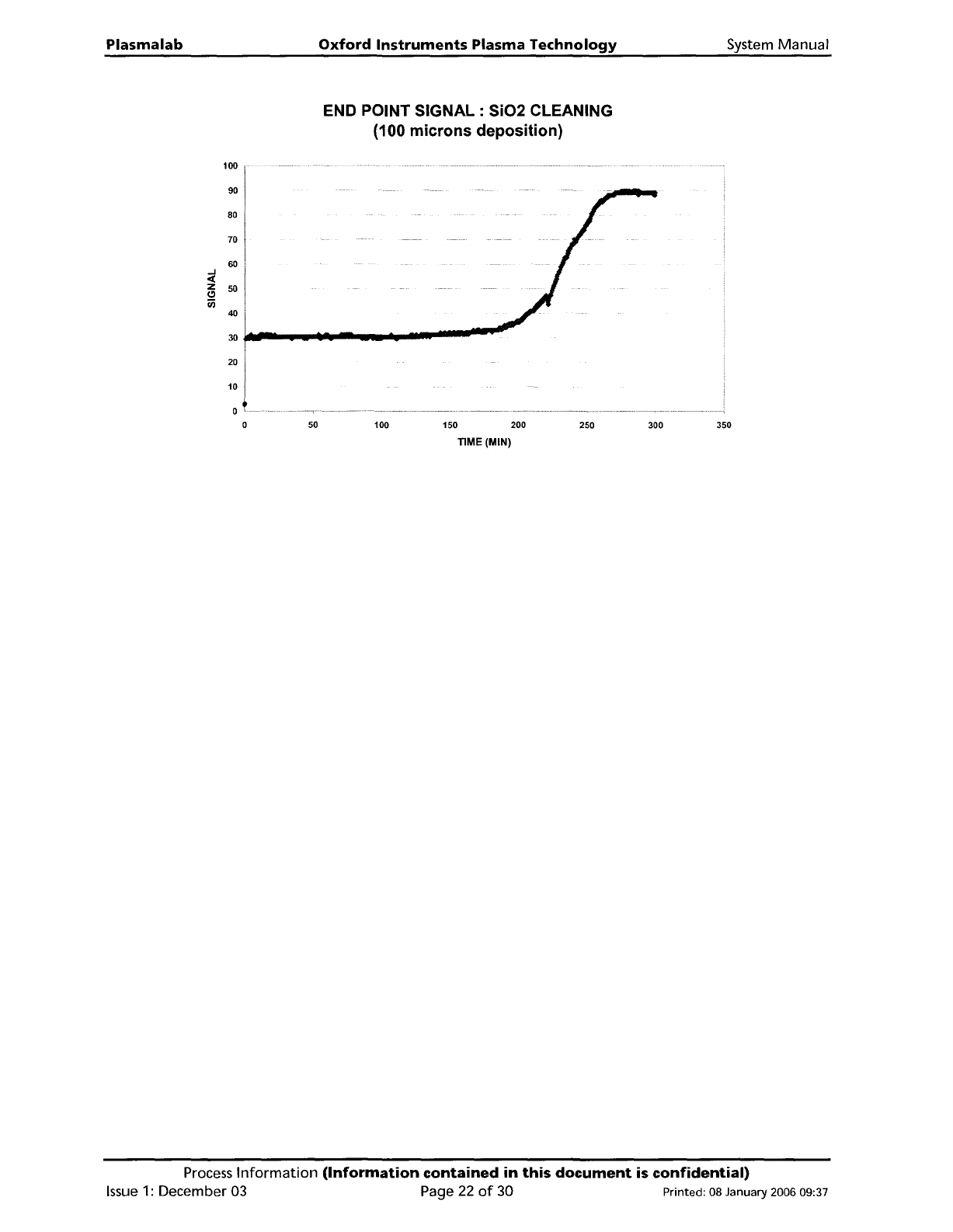
The system
monitors
the
704
nm
wavelength
(atomic
fluorine)
emission. This
fluorine
is
consumed
while
the
deposited
material
in
the
chamber
is
clearing and
rises
at
endpoint,
indicating
the
completion
of
the
chamber plasma cleaning process.
An
example
of
clearing a
thick
film
(100um)
deposition
is
shown in
the
following
graph.
Process
Information
(Information
contained
in
this
document
is
confidential)
Printed: 08 January 2006 09:37 Page
21
of
30
Issue
1:
December 03
Plasma
lab
Oxford
Instruments
Plasma
Technology
END POINT SIGNAL:
Si02
CLEANING
(100 microns deposition)
System
Manual
100
90
80
70
60
..J
«
z
50
Cl
iii
40
30
20
10
0
0 50 100 150 200
250 300
350
TIME (MIN)
Process
Information
(Information
contained
in
this
document
is
confidential)
Issue
1:
December 03 Page
22
of
30 Printed: 08 January 2006 09:37
System
Manual
Oxford
Instruments Plasma Technology
Plasma
lab
3.4
Process
troubleshooting
3.4.1
Partial
process
failure
3.4.1.1
Example
problems
• Etch rate has
dropped
• Selectivity reduced
•
Profile
no
longer
anisotropic
•
Non-uniform
etching
(or deposition)
3.4.1.2
Typical causes
•
Hardware
has changed -
new
gas cylinder,
new
cover plate,
RF
connection /
grounding
is
faulty.
• Chamber leak - Check leak-up
rate
• Faulty
MFC
- check
partial
pressures
•
APC
cannot
control
pressure - check
MFCs
/ Pumps
•
RF
generator/matching
- adjust
matching
unit
set-up, check
generator
range switch,
watch
HF
matching
time
in
mixed frequency pulsed process
• Incorrect gases used
•
Temperature
-
poor
clamping / cooling, e.g. particles
on
electrode/wafer,
lift
pin
not
fully
down,
wafer
piece
not
glued
to
carrier, incorrect set-up
of
Eurotherm,
high
power,
or
poor
resist
preparation
• Chamber
is
dirty
- needs
more
frequent
cleaning
• Incorrect process
regime
(knife-edge
process)
•
Wrong
hardware
for
given process -
wrong
cover plate,
wafer
not
being cooled / heated
sufficiently,
wrong
electrode
gap
•
Wrong
process
for
given
hardware
-
no
pumpdown
time,
no
preheat
step,
no
pre-clean step
3.4.2 Total process
failure
3.4.2.1
Example
problems
• Process
not
etching
/
depositing
- does plasma
ignite?
• Plasma does
not
ignite/light
up
• Plasma
is
unstable/pulsing
• Plasma
is
flickering
3.4.2.2
Typical causes
Check
that
readbacks are
within
tolerance -
MFCs,
pressure control,
RF
matching,
temperature.
Check
that
base pressure has been reached (this can always be changed
if
you are
in
a
hurry!)
Read
error
/
warning
/
information
messages
Process
Information
(Information
contained
in
this
document
is
confidential)
Printed:
08
January
2006 09:37 Page
23
of
30
Issue
1:
December 03