Oxford-100-Manual.pdf - 第148页
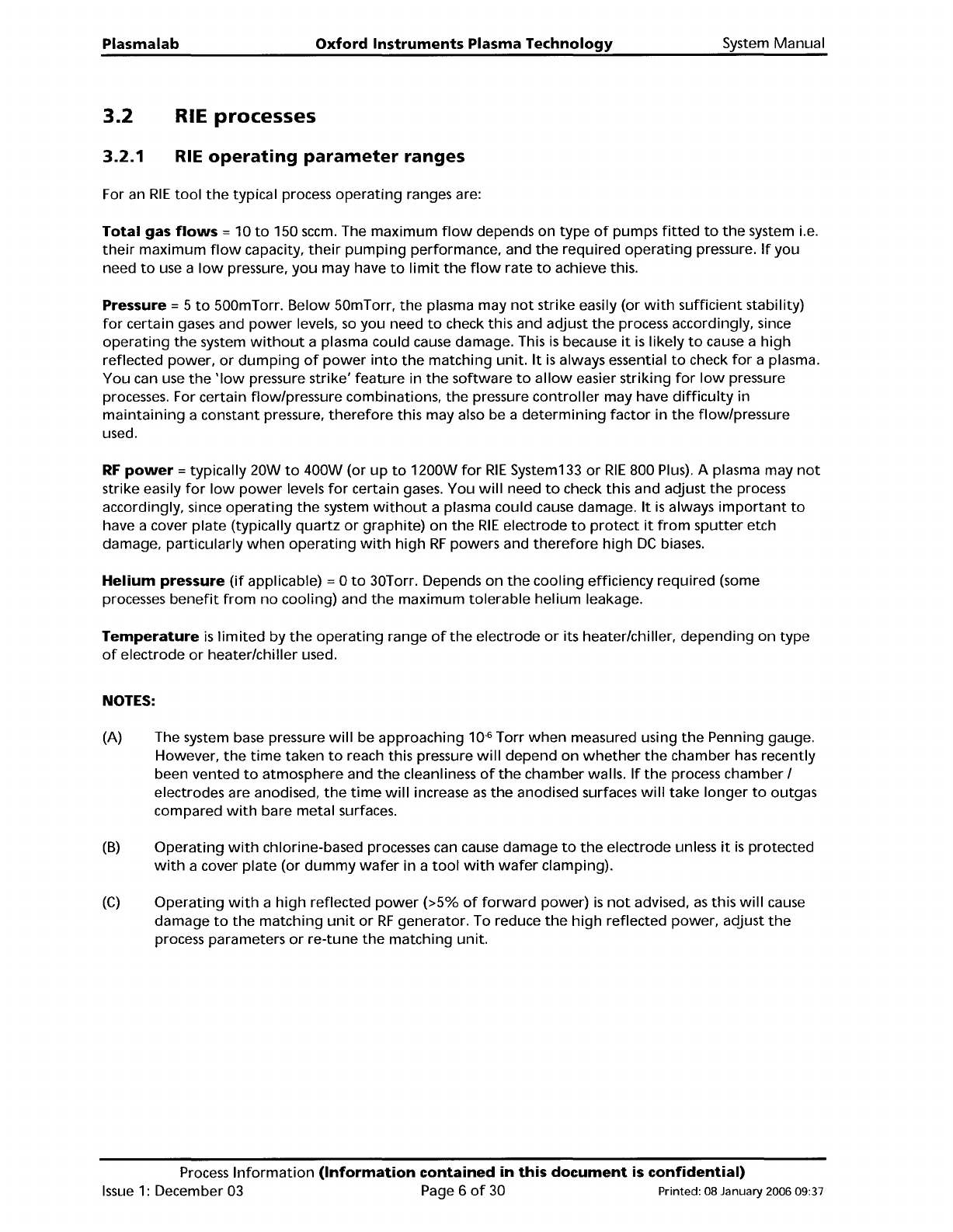
Plasma lab Oxford Instruments Plasma Technology System Manual 3.2 3.2.1 HIE processes RIE operating parameter ranges For an RIE tool the typical process operating ranges are: Total gas flows = 10 to 150 sccm. The maximum…
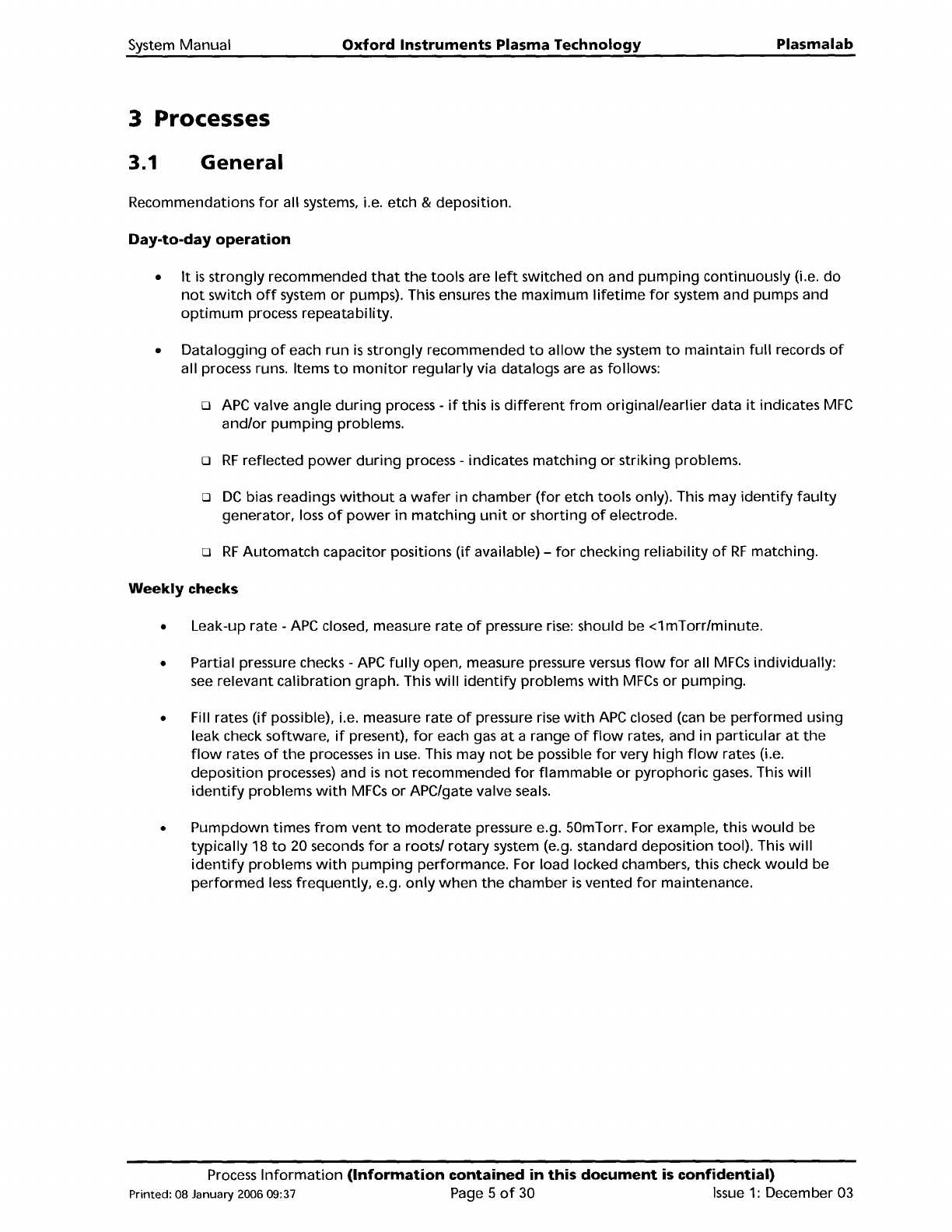
System
Manual
3 Processes
3.1
General
Oxford
Instruments
Plasma Technology
Plasma
lab
Recommendations
for
all systems,
Le.
etch & deposition.
Day-to-day
operation
•
It
is
strongly
recommended
that
the
tools
are
left
switched
on
and
pumping
continuously (i.e.
do
not
switch
off
system
or
pumps). This ensures
the
maximum
lifetime
for
system and pumps and
optimum
process
repeatability.
•
Datalogging
of
each
run
is
strongly
recommended
to
allow
the
system
to
maintain
full
records
of
all process runs. Items
to
monitor
regularly
via datalogs are
as
follows:
o
APC
valve
angle
during
process -
if
this
is
different
from
original/earlier
data
it
indicates
MFC
and/or
pumping
problems.
o
RF
reflected
power
during
process - indicates
matching
or
striking
problems.
o
DC
bias readings
without
a
wafer
in chamber
(for
etch
tools
only). This may
identify
faulty
generator,
loss
of
power
in
matching
unit
or
shorting
of
electrode.
o
RF
Automatch
capacitor positions
(if
available) -
for
checking
reliability
of
RF
matching.
Weekly
checks
• Leak-up
rate
-
APC
closed, measure
rate
of
pressure rise: should be <1mTorr/minute.
• Partial pressure checks -
APC
fully
open, measure pressure versus
flow
for
all
MFCs
individually:
see
relevant
calibration
graph. This
will
identify
problems
with
MFCs
or
pumping.
• Fill rates
(if
possible), i.e. measure
rate
of
pressure rise
with
APC
closed (can be
performed
using
leak check software,
if
present),
for
each gas
at
a range
of
flow
rates, and in
particular
at
the
flow
rates
of
the
processes in
use.
This may
not
be possible
for
very
high
flow
rates (i.e.
deposition
processes) and
is
not
recommended
for
flammable
or
pyrophoric
gases.
This
will
identify
problems
with
MFCs
or
APC/gate valve
seals.
•
Pumpdown
times
from
vent
to
moderate
pressure e.g. 50mTorr. For example, this
would
be
typically 18
to
20 seconds
for
a roots!
rotary
system (e.g. standard
deposition
tool). This
will
identify
problems
with
pumping
performance. For load locked chambers, this check
would
be
performed
less
frequently,
e.g.
only
when
the
chamber
is
vented
for
maintenance.
Process
Information
(Information
contained
in
this
document
is
confidential)
Printed: 08
January
200609:37
Page 5
of
30
Issue
1:
December 03
Plasma
lab
Oxford
Instruments
Plasma
Technology
System
Manual
3.2
3.2.1
HIE
processes
RIE
operating
parameter
ranges
For an
RIE
tool
the
typical process
operating
ranges are:
Total
gas
flows
= 10
to
150
sccm.
The
maximum
flow
depends on
type
of
pumps
fitted
to
the
system i.e.
their
maximum
flow
capacity,
their
pumping
performance, and
the
required
operating
pressure.
If
you
need
to
use a
low
pressure,
you
may have
to
limit
the
flow
rate
to
achieve this.
Pressure = 5
to
500mTorr.
Below
50mTorr,
the
plasma
may
not
strike easily (or
with
sufficient
stability)
for
certain gases and
power
levels,
so
you need
to
check this and adjust
the
process accordingly, since
operating
the
system
without
a plasma could cause damage. This
is
because
it
is
likely
to
cause a
high
reflected power,
or
dumping
of
power
into
the
matching
unit.
It
is
always essential
to
check
for
a plasma.
You can use
the
'low
pressure strike'
feature
in
the
software
to
allow
easier
striking
for
low
pressure
processes. For certain flow/pressure combinations,
the
pressure
controller
may have
difficulty
in
maintaining
a constant pressure,
therefore
this may also be a
determining
factor
in
the
flow/pressure
used.
RF
power
=
typically
20W
to
400W (or
up
to
1200W
for
RIE
System133
or
RIE
800 Plus). A plasma may
not
strike easily
for
low
power
levels
for
certain
gases.
You
will
need
to
check this and adjust
the
process
accordingly, since
operating
the
system
without
a plasma could cause damage.
It
is
always
important
to
have a cover
plate
(typically
quartz
or
graphite)
on
the
RIE
electrode
to
protect
it
from
sputter
etch
damage,
particularly
when
operating
with
high
RF
powers and
therefore
high
DC
biases.
Helium
pressure
(if
applicable) = 0
to
30Torr. Depends
on
the
cooling
efficiency
required
(some
processes
benefit
from
no
cooling) and
the
maximum
tolerable
helium
leakage.
Temperature
is
limited
by
the
operating
range
of
the
electrode
or
its heater/chiller,
depending
on
type
of
electrode
or
heater/chiller used.
NOTES:
(A) The system base pressure
will
be approaching
10-
6
Torr
when
measured using
the
Penning gauge.
However,
the
time
taken
to
reach this pressure
will
depend
on
whether
the
chamber has recently
been vented
to
atmosphere and
the
cleanliness
of
the
chamber walls.
If
the
process chamber /
electrodes are anodised,
the
time
will
increase
as
the
anodised surfaces
will
take
longer
to
outgas
compared
with
bare metal surfaces.
(B)
Operating
with
chlorine-based processes can cause damage
to
the
electrode unless
it
is
protected
with
a cover
plate
(or
dummy
wafer
in a
tool
with
wafer
clamping).
(C)
Operating
with
a
high
reflected
power
(>5%
of
forward
power)
is
not
advised,
as
this
will
cause
damage
to
the
matching
unit
or
RF
generator. To reduce
the
high
reflected power, adjust
the
process parameters
or
re-tune
the
matching
unit.
Process
Information
(Information
contained
in
this
document
is
confidential)
Issue
1:
December 03 Page 6
of
30 Printed: 08 January 2006 09:37
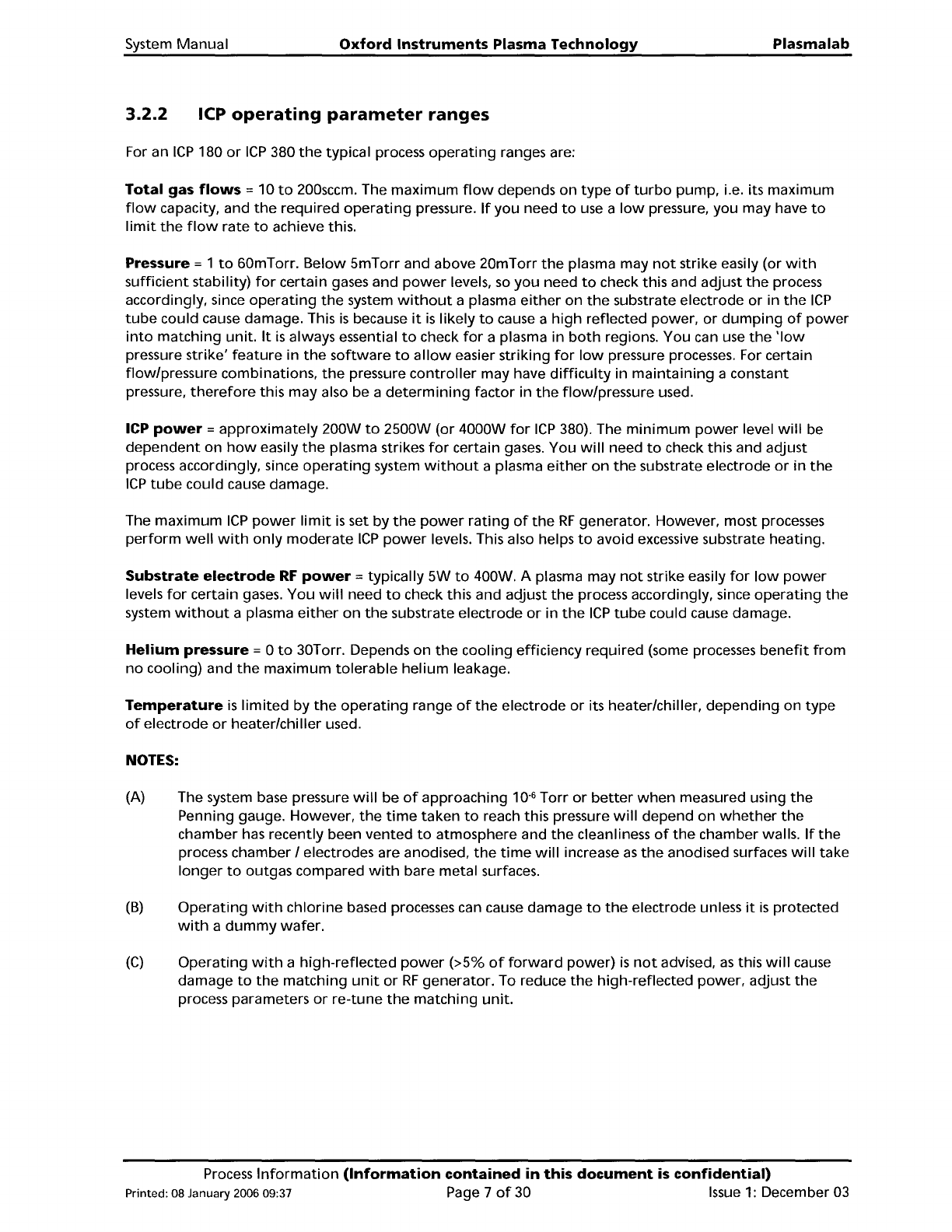
System
Manual
Oxford
Instruments
Plasma Technology
Plasma
lab
3.2.2
ICP
operating
parameter
ranges
For an
ICP
180
or
ICP
380
the
typical process
operating
ranges are:
Total
gas
flows
==
10
to
200sccm. The
maximum
flow
depends
on
type
of
turbo
pump, i.e. its maximum
flow
capacity, and
the
required
operating
pressure.
If
you
need
to
use a
low
pressure, you may have
to
limit
the
flow
rate
to
achieve this.
Pressure
==
1
to
60mTorr.
Below
5mTorr and above 20mTorr
the
plasma may
not
strike easily (or
with
sufficient
stability)
for
certain gases and
power
levels,
so
you
need
to
check this and adjust
the
process
accordingly, since
operating
the
system
without
a plasma
either
on
the
substrate electrode
or
in
the
ICP
tube
could cause damage. This
is
because
it
is
likely
to
cause a
high
reflected power,
or
dumping
of
power
into
matching
unit.
It
is
always essential
to
check
for
a plasma in
both
regions. You can use
the
'low
pressure strike'
feature
in
the
software
to
allow
easier
striking
for
low
pressure processes. For certain
flow/pressure combinations,
the
pressure
controller
may have
difficulty
in
maintaining
a constant
pressure,
therefore
this
may
also be a
determining
factor
in
the
flow/pressure used.
ICP
power
==
approximately
200W
to
2500W (or 4000W
for
ICP
380). The
minimum
power
level
will
be
dependent
on
how
easily
the
plasma strikes
for
certain gases. You
will
need
to
check this and adjust
process accordingly, since
operating
system
without
a plasma
either
on
the
substrate electrode
or
in
the
ICP
tube
could cause damage.
The
maximum
ICP
power
limit
is
set
by
the
power
rating
of
the
RF
generator. However, most processes
perform
well
with
only
moderate
ICP
power
levels. This also helps
to
avoid excessive substrate heating.
Substrate
electrode
RF
power
==
typically
5W
to
400W. A plasma
may
not
strike easily
for
low
power
levels
for
certain
gases.
You
will
need
to
check this and adjust
the
process accordingly, since
operating
the
system
without
a plasma
either
on
the
substrate electrode
or
in
the
ICP
tube
could cause damage.
Helium
pressure
==
0
to
30Torr. Depends
on
the
cooling
efficiency
required
(some processes
benefit
from
no
cooling) and
the
maximum
tolerable
helium
leakage.
Temperature
is
limited
by
the
operating
range
of
the
electrode
or
its heaterlchiller,
depending
on
type
of
electrode
or
heater/chiller used.
NOTES:
(A) The system base pressure
will
be
of
approaching
10-
6
Torr
or
better
when
measured using
the
Penning gauge. However,
the
time
taken
to
reach this pressure
will
depend
on
whether
the
chamber has recently been
vented
to
atmosphere and
the
cleanliness
of
the
chamber walls.
If
the
process chamber / electrodes are anodised,
the
time
will
increase
as
the
anodised surfaces
will
take
longer
to
outgas compared
with
bare metal surfaces.
(B)
Operating
with
chlorine
based processes can cause damage
to
the
electrode unless
it
is
protected
with
a
dummy
wafer.
(C)
Operating
with
a
high-reflected
power
(>5%
of
forward
power)
is
not
advised,
as
this
will
cause
damage
to
the
matching
unit
or
RF
generator.
To reduce
the
high-reflected
power,
adjust
the
process parameters
or
re-tune
the
matching
unit.
Process
Information
(Information
contained
in
this
document
is
confidential)
Printed: 08 January 2006 09:37 Page 7
of
30
Issue
1:
December 03