Oxford-100-Manual.pdf - 第257页
Equipment Manual Oxford Instruments Plasma Technology WARNING Plasma lab Ie P 180 BEFORE PROCEEDING WITH ANY MAINTENANCE WORK, READ SECTION 1 - HEALTH AND SAFETY. 6.3 Routine maintenance &. WARNING PINCH POINT - WHEN…
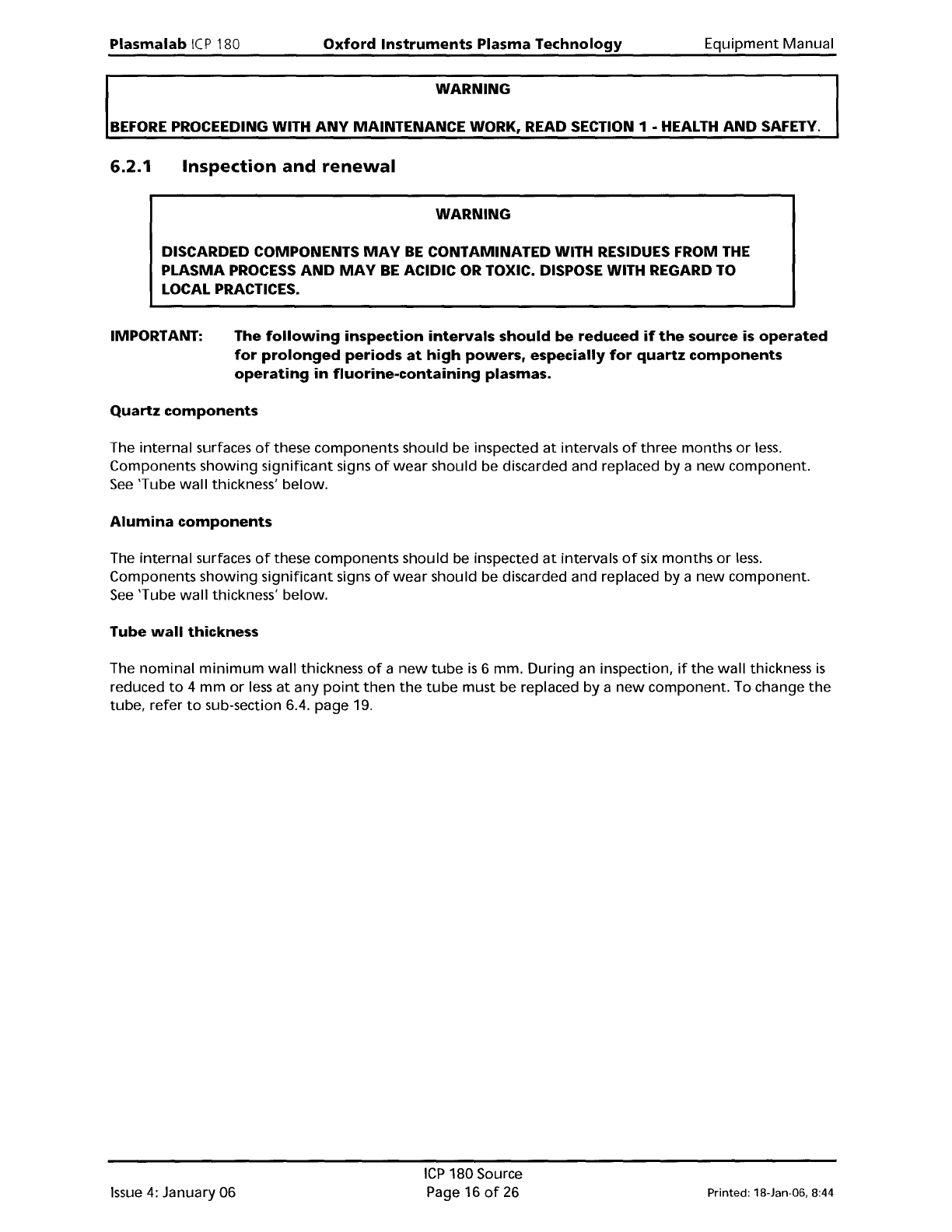
Plasmalab IeP180
Oxford
Instruments
Plasma Technology
WARNING
Equipment
Manual
BEFORE
PROCEEDING WITH
ANY
MAINTENANCE WORK, READ SECTION
1·
HEALTH
AND
SAFETY.
6.2.1
Inspection
and
renewal
WARNING
DISCARDED COMPONENTS
MAY
BE
CONTAMINATED WITH RESIDUES FROM
THE
PLASMA
PROCESS
AND
MAY
BE
ACIDIC
OR
TOXIC. DISPOSE WITH REGARD
TO
LOCAL PRACTICES.
IMPORTANT:
The
following
inspection
intervals
should
be
reduced
if
the
source is
operated
for
prolonged
periods
at
high
powers,
especially
for
quartz
components
operating
in
fluorine-containing
plasmas.
Quartz
components
The
internal
surfaces
of
these components should be inspected
at
intervals
of
three
months
or
less.
Components
showing
significant
signs
of
wear
should be discarded and replaced by a
new
component.
See
'Tube
wall
thickness'
below.
Alumina
components
The
internal
surfaces
of
these components should be inspected
at
intervals
of
six
months
or
less.
Components
showing
significant
signs
of
wear
should be discarded and replaced
by
a
new
component.
See
'Tube
wall
thickness' below.
Tube
wall
thickness
The
nominal
minimum
wall
thickness
of
a
new
tube
is
6 mm.
During
an inspection,
if
the
wall
thickness
is
reduced
to
4
mm
or
less
at
any
point
then
the
tube
must be replaced by a
new
component. To change
the
tube,
refer
to
sub-section 6.4. page 19.
Issue
4:
January 06
ICP
180 Source
Page 16
of
26
Printed: 18-Jan-06, 8:44
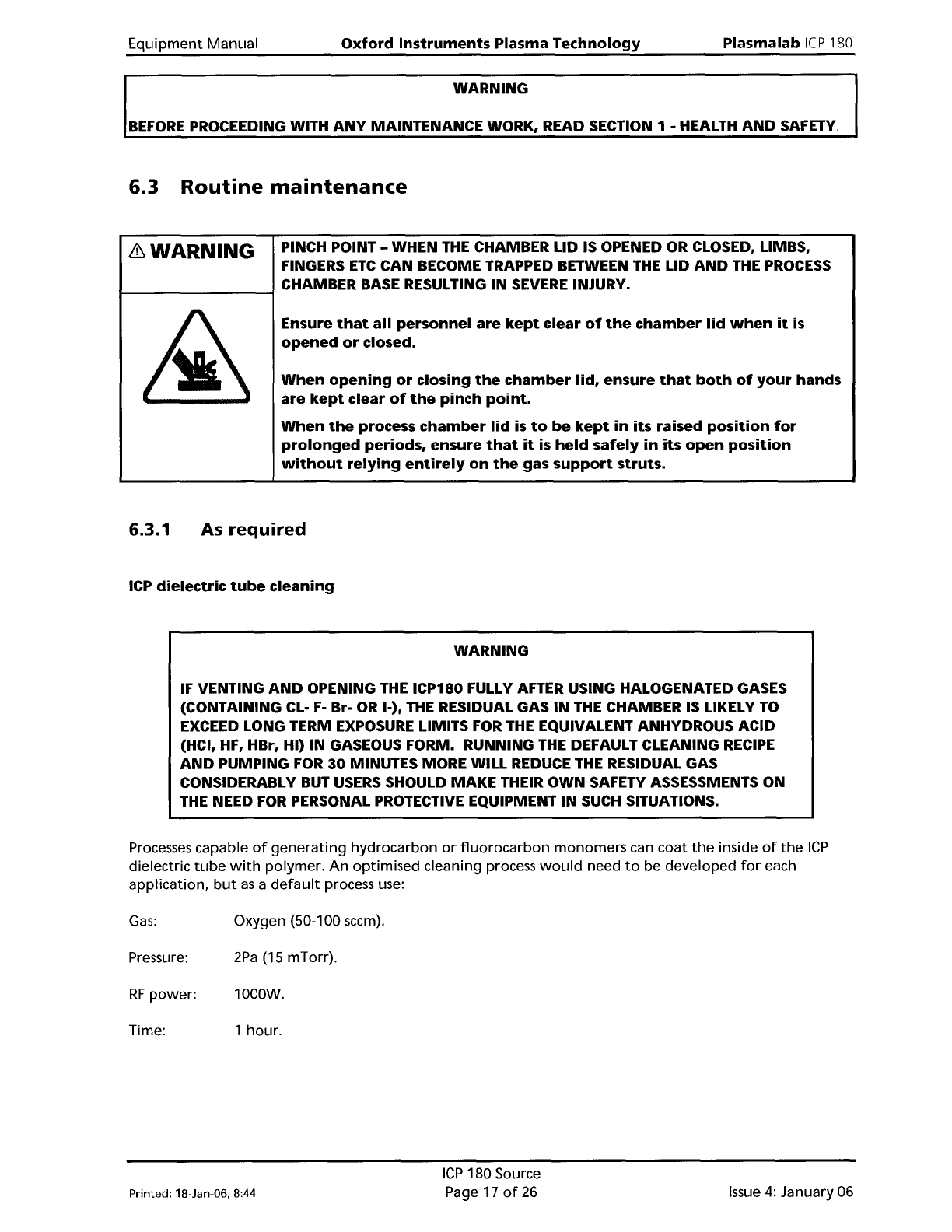
Equipment
Manual
Oxford
Instruments
Plasma
Technology
WARNING
Plasma
lab
Ie
P180
BEFORE
PROCEEDING WITH
ANY
MAINTENANCE WORK, READ SECTION 1 - HEALTH
AND
SAFETY.
6.3
Routine
maintenance
&.
WARNING
PINCH POINT - WHEN
THE
CHAMBER LID IS OPENED
OR
CLOSED, LIMBS,
FINGERS
ETC
CAN BECOME TRAPPED BETWEEN
THE
LID
AND
THE
PROCESS
1-------------1
CHAMBER BASE RESULTING
IN
SEVERE INJURY.
Ensure
that
all
personnel
are
kept
clear
of
the
chamber
lid
when
it
is
opened
or
closed.
When
opening
or
closing
the
chamber
lid,
ensure
that
both
of
your
hands
are
kept
clear
of
the
pinch
point.
When
the
process
chamber
lid
is
to
be
kept
in
its
raised
position
for
prolonged
periods,
ensure
that
it
is
held
safely
in
its
open
position
without
relying
entirely
on
the
gas
support
struts.
6.3.1
As
required
ICP
dielectric
tube
cleaning
WARNING
IF
VENTING
AND
OPENING
THE
ICP180 FULLY AFTER USING HALOGENATED GASES
(CONTAINING
CL-
F-
Br-
OR
1-),
THE
RESIDUAL GAS
IN
THE
CHAMBER
IS
LIKELY
TO
EXCEED LONG TERM EXPOSURE LIMITS FOR
THE
EQUIVALENT ANHYDROUS ACID
(HCI, HF, HBr, HI) IN GASEOUS FORM. RUNNING
THE
DEFAULT CLEANING
RECIPE
AND
PUMPING FOR
30
MINUTES MORE WILL REDUCE THE RESIDUAL GAS
CONSIDERABLY
BUT
USERS
SHOULD
MAKE
THEIR
OWN
SAFETY ASSESSMENTS ON
THE
NEED
FOR
PERSONAL PROTECTIVE EQUIPMENT
IN
SUCH SITUATIONS.
Processes
capable
of
generating
hydrocarbon
or
fluorocarbon
monomers can
coat
the
inside
of
the
ICP
dielectric
tube
with
polymer.
An
optimised
cleaning process
would
need
to
be developed
for
each
application,
but
as
a
default
process use:
Gas:
Pressure:
RF
power:
Time:
Oxygen (50-100
seem).
2Pa
(15
mTorr).
1000W.
1 hour.
Printed: 18-Jan-06, 8:44
ICP
180 Source
Page 17
of
26
Issue
4:
January 06
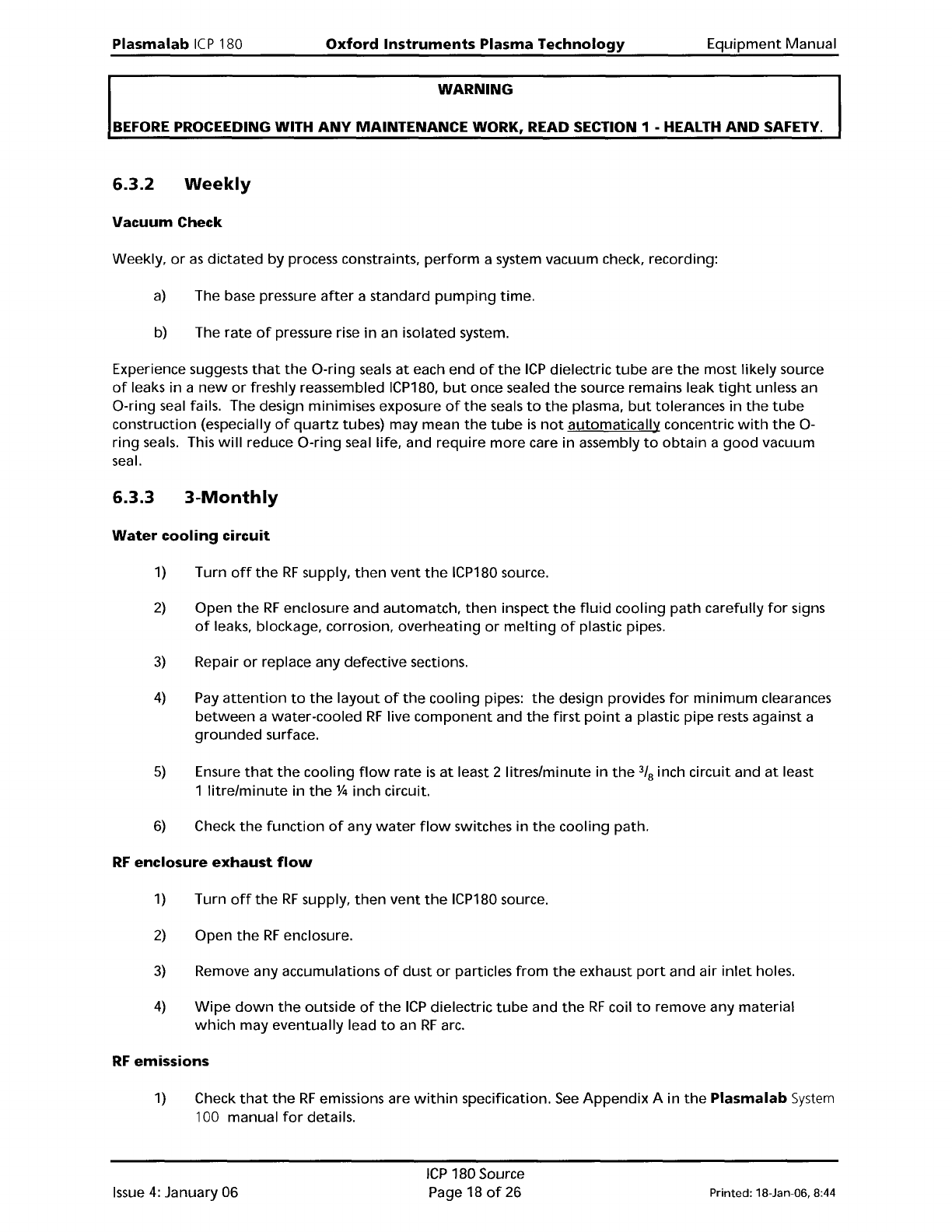
Plasma
lab
Ie
P180
Oxford
Instruments
Plasma
Technology
WARNING
Equipment
Manual
BEFORE
PROCEEDING WITH
ANY
MAINTENANCE
WORK, READ SECTION 1 - HEALTH
AND
SAFETY.
6.3.2
Weekly
Vacuum
Check
Weekly,
or
as
dictated
by
process constraints,
perform
a system vacuum check, recording:
a)
The base pressure
after
a standard
pumping
time.
b)
The
rate
of
pressure rise
in
an isolated system.
Experience suggests
that
the
O-ring
seals
at
each end
of
the
ICP
dielectric
tube
are
the
most likely source
of
leaks in a
new
or
freshly reassembled
ICP180,
but
once sealed
the
source remains leak
tight
unless an
O-ring seal fails. The design minimises exposure
of
the
seals
to
the
plasma,
but
tolerances
in
the
tube
construction (especially
of
quartz
tubes) may mean
the
tube
is
not
automatically
concentric
with
the
0-
ring
seals.
This
will
reduce
O-ring
seal life, and
require
more
care in assembly
to
obtain
a
good
vacuum
seal.
6.3.3
3-Monthly
Water
cooling
circuit
1)
Turn
off
the
RF
supply,
then
vent
the
ICP180 source.
2)
Open
the
RF
enclosure and
automatch,
then
inspect
the
fluid
cooling
path
carefully
for
signs
of
leaks, blockage, corrosion,
overheating
or
melting
of
plastic pipes.
3)
Repair
or
replace any defective sections.
4)
Pay
attention
to
the
layout
of
the
cooling
pipes:
the
design provides
for
minimum
clearances
between
a
water-cooled
RF
live
component
and
the
first
point
a plastic pipe rests against a
grounded
surface.
5)
Ensure
that
the
cooling
flow
rate
is
at
least 2 litres/minute in
the
3/
8
inch circuit and
at
least
1
litre/minute
in
the
% inch circuit.
6)
Check
the
function
of
any
water
flow
switches in
the
cooling
path.
RF
enclosure
exhaust
flow
1)
Turn
off
the
RF
supply,
then
vent
the
ICP180 source.
2)
Open
the
RF
enclosure.
3)
Remove any accumulations
of
dust
or
particles
from
the
exhaust
port
and air
inlet
holes.
4)
Wipe
down
the
outside
of
the
ICP
dielectric
tube
and
the
RF
coil
to
remove any material
which
may
eventually
lead
to
an
RF
arc.
RF
emissions
1)
Check
that
the
RF
emissions are
within
specification.
See
AppendiX A in
the
Plasma
lab
System
100 manual
for
details.
Issue
4:
January 06
fCP
180Source
Page 18
of
26
Printed: 18-Jan-D6, 8:44