Oxford-100-Manual.pdf - 第221页
System Manual Oxford Instruments Plasma Technology OIPT Systems 1. Introduction This document gives the specifications of the services required for the Plasma lab and lonfab systems. For details of cooling flow rates and…
OIPT Systems
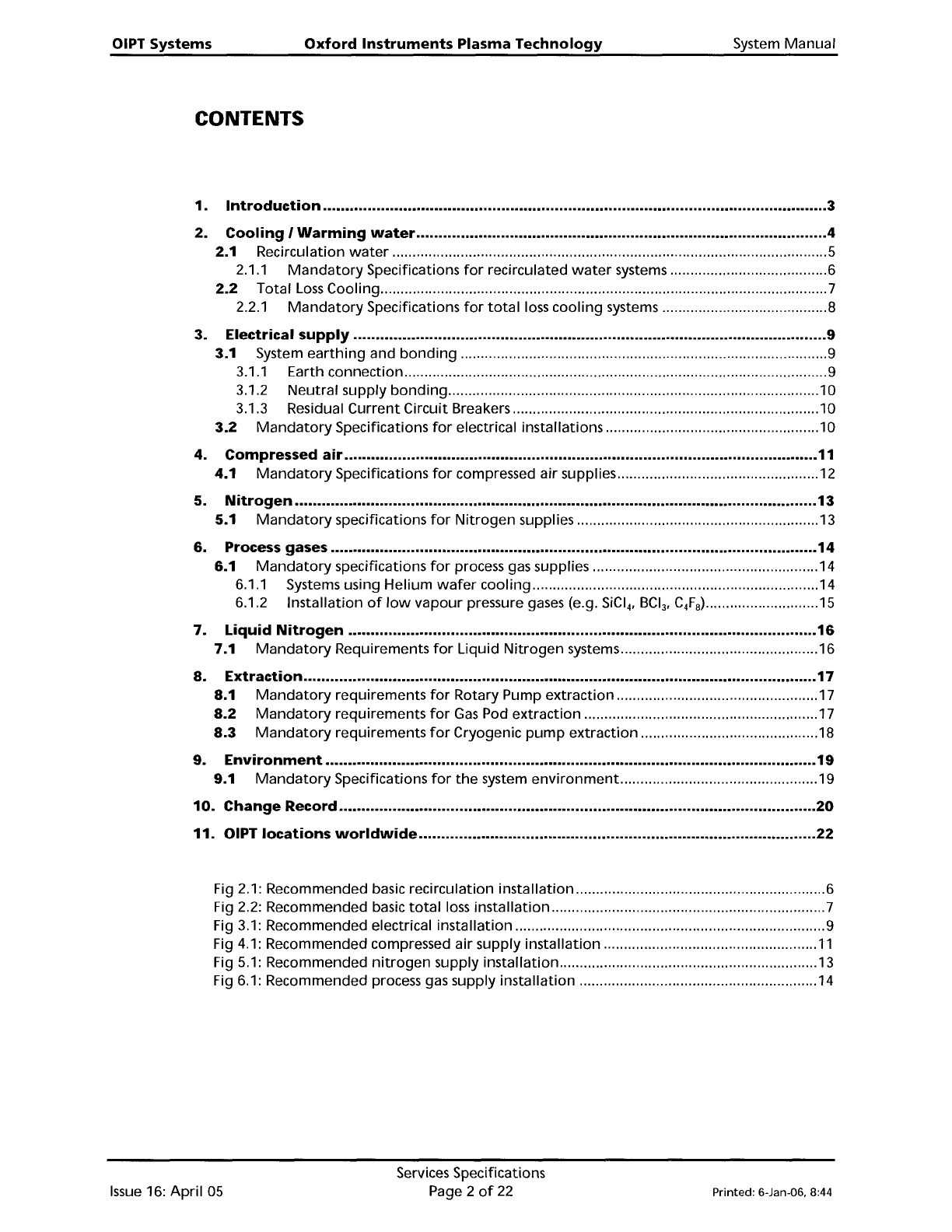
CONTENTS
Oxford
Instruments
Plasma
Technology
System
Manual
1.
Introduction
3
2.
Cooling
I
Warming
water
4
2.1 Recirculation
water
5
2.1.1
Mandatory
Specifications
for
recirculated
water
systems 6
2.2
Total
Loss
Cooling 7
2.2.1
Mandatory
Specifications
for
total
loss
cooling
systems 8
3. Electrical
supply
9
3.1 System
earthing
and
bonding
9
3.1.1
Earth connection 9
3.1.2 Neutral supply
bonding
10
3.1.3 Residual
Current
Circuit Breakers 10
3.2
Mandatory
Specifications
for
electrical installations 10
4. Compressed
air
11
4.1
Mandatory
Specifications
for
compressed
air
supplies
12
5.
Nitrogen
13
5.1
Mandatory
specifications
for
Nitrogen
supplies 13
6. Process gases
14
6.1
Mandatory
specifications
for
process gas supplies 14
6.1.1 Systems using Helium
wafer
cooling 14
6.1.2 Installation
of
low
vapour
pressure gases (e.g.
SiCI
4
•
BCI
3
•
C
4
F
s
)
15
7.
Liquid
Nitrogen
16
7.1
Mandatory
Requirements
for
Liquid
Nitrogen
systems 16
8.
Extraction
17
8.1
Mandatory
requirements
for
Rotary Pump
extraction
17
8.2
Mandatory
requirements
for
Gas
Pod extraction 17
8.3
Mandatory
requirements
for
Cryogenic
pump
extraction
18
9.
Environment
19
9.1
Mandatory
Specifications
for
the
system
environment..
19
10.
Change
Record
20
11.
OIPT
locations
worldwide
22
Fig 2.1: Recommended basic recirculation installation 6
Fig 2.2: Recommended basic
total
loss
installation
7
Fig 3.1: Recommended electrical installation 9
Fig 4.1: Recommended compressed air supply installation
11
Fig 5.1: Recommended
nitrogen
supply installation
13
Fig 6.1: Recommended process gas supply installation 14
Issue
16:
April
05
Services Specifications
Page 2
of
22
Printed: 6-Jan-06. 8:44
System
Manual
Oxford
Instruments Plasma Technology
OIPT Systems
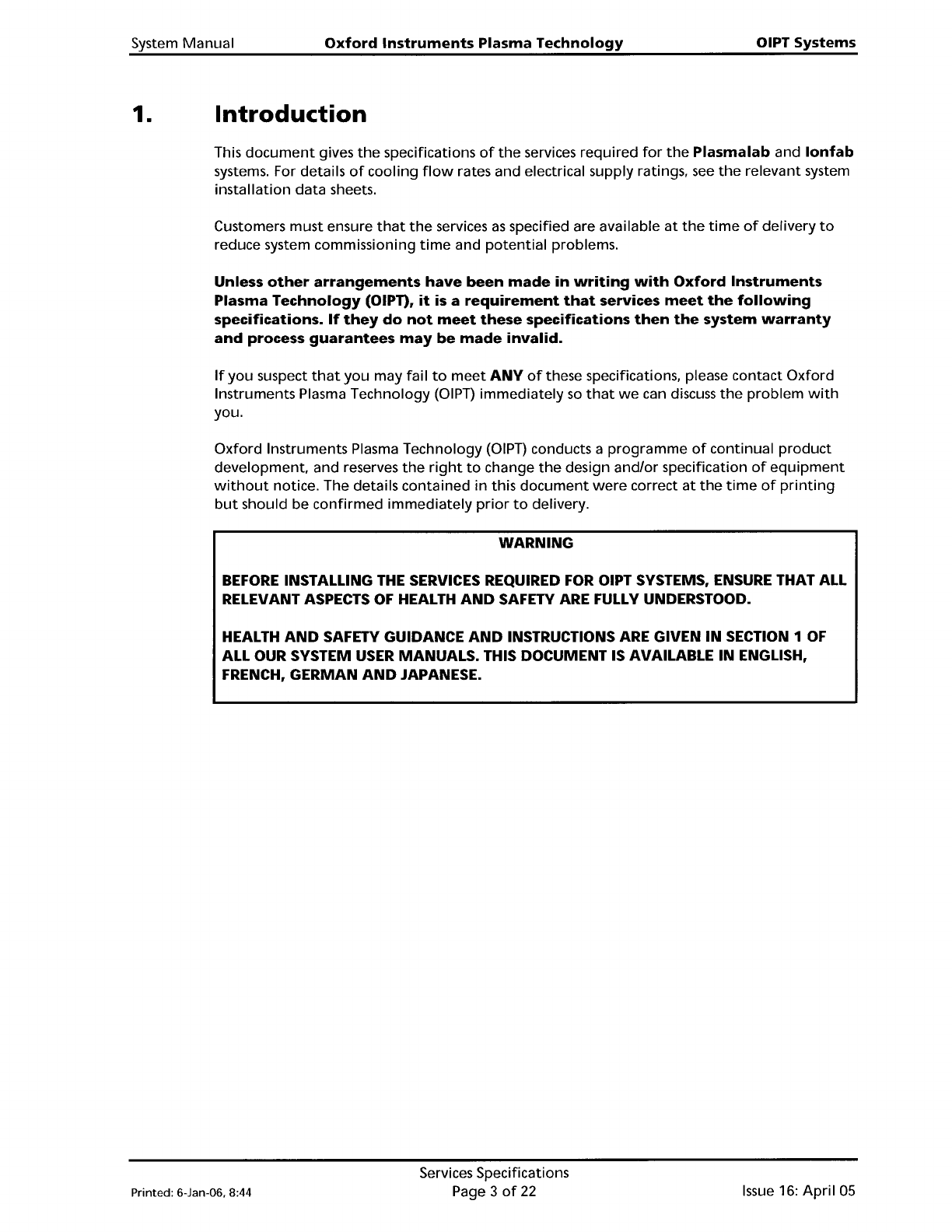
1.
Introduction
This
document
gives
the
specifications
of
the
services
required
for
the
Plasma
lab
and
lonfab
systems. For details
of
cooling
flow
rates and electrical supply ratings,
see
the
relevant system
installation
data
sheets.
Customers
must
ensure
that
the
services
as
specified are available
at
the
time
of
delivery
to
reduce system commissioning
time
and
potential
problems.
Unless
other
arrangements
have
been
made
in
writing
with
Oxford Instruments
Plasma Technology (OIPT),
it
is
a
requirement
that
services
meet
the
following
specifications.
If
they
do
not
meet
these
specifications
then
the
system
warranty
and
process
guarantees
may
be
made
invalid.
If
you
suspect
that
you
may fail
to
meet
ANY
of
these specifications. please contact
Oxford
Instruments Plasma Technology
(OIPT)
immediately
so
that
we
can discuss
the
problem
with
you.
Oxford
Instruments Plasma Technology
(OIPT)
conducts a
programme
of
continual
product
development,
and reserves
the
right
to
change
the
design and/or specification
of
equipment
without
notice. The details
contained
in
this
document
were
correct
at
the
time
of
printing
but
should be
confirmed
immediately
prior
to
delivery.
WARNING
BEFORE
INSTALLING
THE
SERVICES
REQUIRED
FOR
OIPT SYSTEMS,
ENSURE
THAT
ALL
RELEVANT
ASPECTS
OF
HEALTH
AND
SAFETY
ARE
FULLY
UNDERSTOOD.
HEALTH
AND
SAFETY GUIDANCE
AND
INSTRUCTIONS
ARE
GIVEN IN SECTION 1
OF
ALL OUR SYSTEM
USER
MANUALS. THIS DOCUMENT
IS
AVAILABLE IN ENGLISH,
FRENCH, GERMAN
AND
JAPANESE.
Printed: 6-Jan-06, 8:44
Services Specifications
Page 3
of
22
Issue
16:
April
05
OIPT Systems
Oxford
Instruments
Plasma
Technology
System Manual
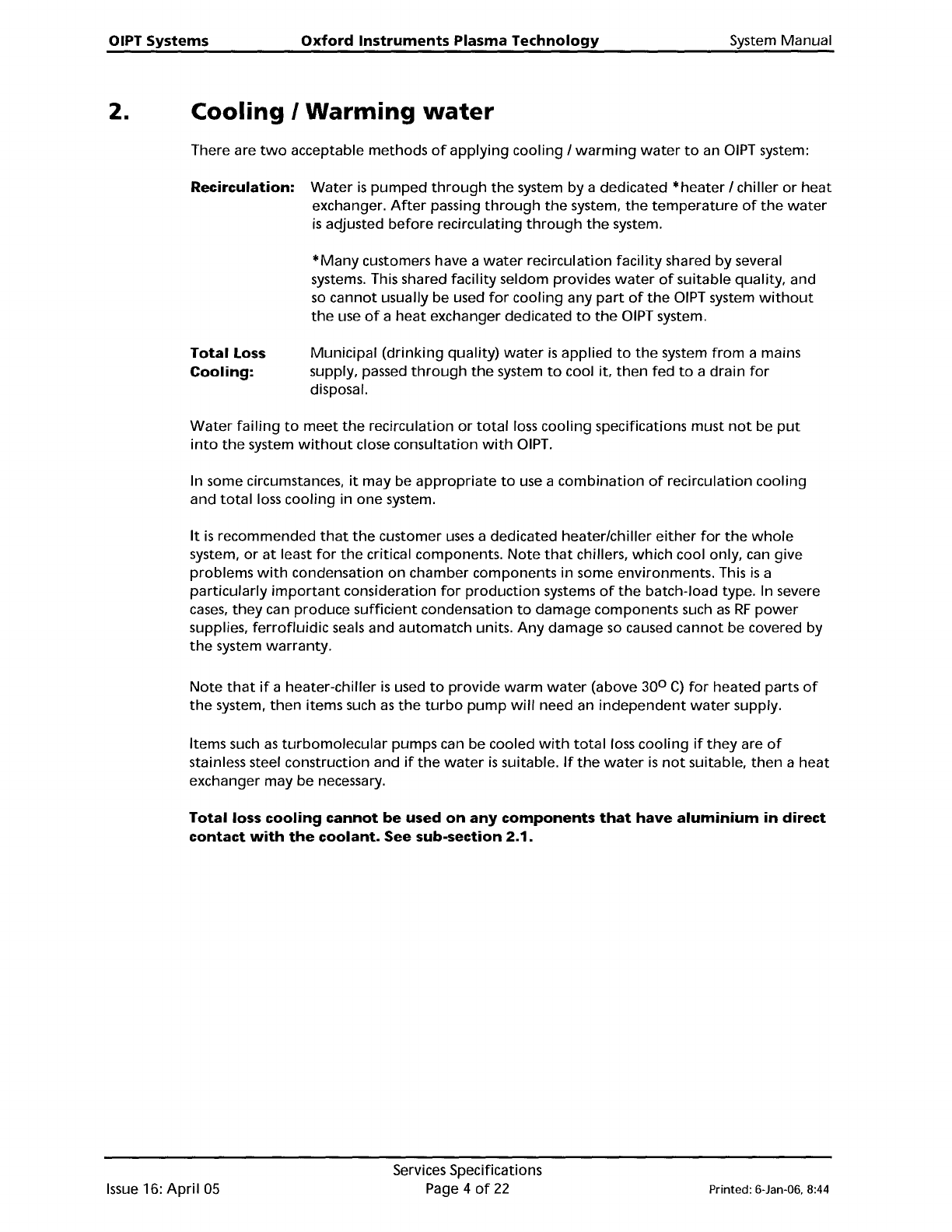
2. Cooling I
Warming
water
There are
two
acceptable methods
of
applying
cooling
/
warming
water
to
an DIPT system:
Recirculation:
Water
is
pumped
through
the
system
by
a dedicated
*heater
/ chiller
or
heat
exchanger.
After
passing
through
the
system,
the
temperature
of
the
water
is
adjusted
before
recirculating
through
the
system.
*Many
customers have a
water
recirculation
facility
shared
by
several
systems. This shared
facility
seldom provides
water
of
suitable quality, and
so
cannot
usually be used
for
cooling
any
part
of
the
DIPT system
without
the
use
of
a
heat
exchanger dedicated
to
the
DIPT system.
Total
Loss
Cooling:
Municipal
(drinking
quality)
water
is
applied
to
the
system
from
a mains
supply, passed
through
the
system
to
cool
it,
then
fed
to
a
drain
for
disposal.
Water
failing
to
meet
the
recirculation
or
total
loss
cooling
specifications must
not
be
put
into
the
system
without
close consultation
with
DIPT.
In some circumstances,
it
may be
appropriate
to
use a
combination
of
recirculation
cooling
and
total
loss
cooling
in
one
system.
It
is
recommended
that
the
customer
uses
a dedicated heater/chiller
either
for
the
whole
system,
or
at
least
for
the
critical components.
Note
that
chillers,
which
cool only, can give
problems
with
condensation
on
chamber components in some environments. This
is
a
particularly
important
consideration
for
production
systems
of
the
batch-load type. In severe
cases,
they
can produce
sufficient
condensation
to
damage components such
as
RF
power
supplies,
ferrofluidic
seals and
automatch
units.
Any
damage
so
caused
cannot
be covered by
the
system
warranty.
Note
that
if
a heater-chiller
is
used
to
provide
warm
water
(above 30
0
C)
for
heated
parts
of
the
system,
then
items such
as
the
turbo
pump
will
need an
independent
water
supply.
Items such
as
turbomolecular
pumps can be cooled
with
total
loss
cooling
if
they
are
of
stainless steel construction and
if
the
water
is
suitable.
If
the
water
is
not
suitable,
then
a
heat
exchanger may be necessary.
Total
loss
cooling
cannot
be
used
on
any
components
that
have
aluminium
in
direct
contact
with
the
coolant.
See
sub-section
2.1.
Issue
16:
April
05
Services Specifications
Page 4
of
22
Printed: 6-Jan-06, 8:44