IPC-T-50F_.pdf.pdf - 第11页
Basic Specification (BS) 26.1778 A document that describes the common elements for a set, family or group of products, materials, or services. Basic Statistical Method 91.1336 The application of a theory of variation thr…
Backdriving 92.0074
An in-circuit testing technique that drives digital circuitry
outputs to a given logic level, by supplying pulses of suf-
ficient electrical current magnitude in parallel with the out-
puts, in order to overdrive the logic state conditions of the
next digital device inputs.
Backfill 36.0075
Filling a hybrid circuit package with a dry inert gas prior
to hermetic sealing.
Background (Artwork) 22.0076
The nonfunctional area of a phototool.
Background Variable 94.0077
A parameter of no experimental interest that is not held at
a constant value.
Backlighting 24.0078
Viewing or photographing by placing an object between a
light source and the eye or recording medium.
Backpanel 85.0080
see ‘‘Backplane.’’
Backplane 85.1331
An interconnection device used to provide point-to-point
electrical interconnections. (It is usually a printed board
that has discrete wiring terminals on one side and connec-
tor receptables on the other side.) (See also ‘‘Mother
Board.’’)
Backward Crosstalk 21.1332
Noise induced into a quiet line, as seen at the end of the
quiet line that is closest to the signal source, because the
quiet line has been placed next to an active line. (See also
‘‘Forward Crosstalk.’’)
Bake Out 56.0082
Subjecting a product to an elevated temperature in order to
remove moisture and unwanted gasses prior to certain steps
in the printed board manufacturing process or prior to final
coating.
Balanced Transmission Line 21.1333
A transmission line that has distributed inductance, capaci-
tance, resistance, and conductance elements that are
equally distributed between its conductors.
Ball Bond 74.0083
The thermocompression termination of the ball-shaped end
of an interconnecting wire to a land. (See also ‘‘Wedge
bond.’’)
Bar Code Marking 70.1731
An identification code consisting of a pattern of vertical
bars whose width and spacing identifies the item marked.
Bare Board 60.0084
An unassembled (unpopulated) printed board.
Barrier Metal 74.0085
A metal used to seal the semiconductor-die lands.
Base Material 40.1334
The insulating material upon which a conductive pattern
may be formed. (The base material may be rigid or flex-
ible, or both. It may be a dielectric or insulated metal
sheet.)
Base Material Thickness 22.1604
The thickness of the base material excluding conductive
foil or material deposited on the surfaces.
Base Metal 45.0088
see ‘‘Basis Metal.’’
Base Solderability 92.0089
The ease with which a metal or metal alloy surface can be
wetted by molten solder under minimum realistic condi-
tions.
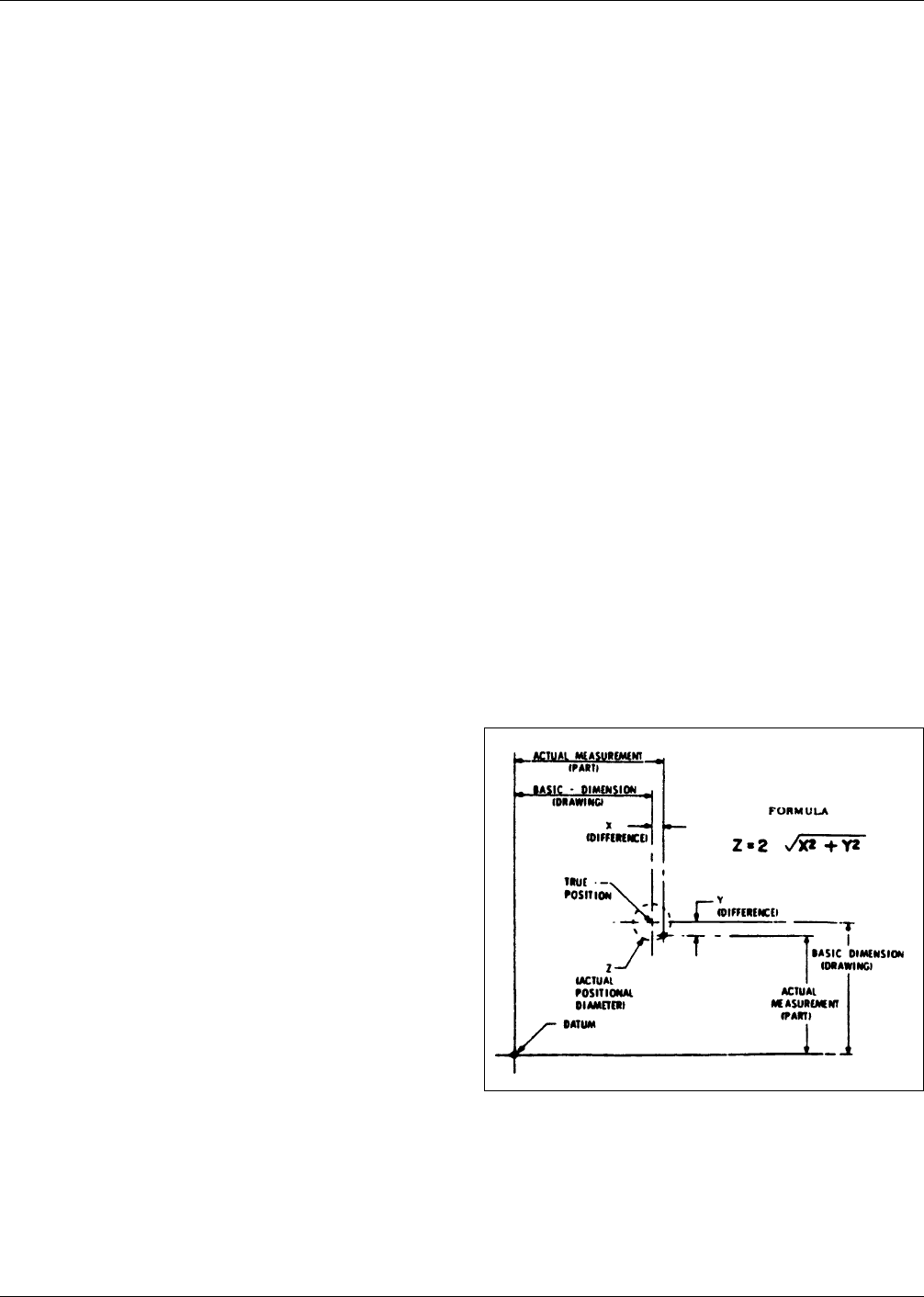
Baseline Dimensioning 26.0086
The maximum variation between two features that is equal
to the sum of the tolerances on the two feature location
dimensions taken from the same origin. (See Figure B-1.)
Basic Dimension 26.1335
A numerical value used to describe the theoretical exact
location of a feature or hole. (It is the basis from which
permissible variations are established by tolerance on other
dimensions in notes or by feature control symbols.)
Figure B−1 Example of feature location using baseline
dimensions
IPC-T-50F June 1996
6
Basic Specification (BS) 26.1778
A document that describes the common elements for a set,
family or group of products, materials, or services.
Basic Statistical Method 91.1336
The application of a theory of variation through the use of
basic problem-solving techniques and statistical process
control. (This includes control and capability analysis for
both variables and attributes data.)
Basic Wettability 70.0090
The ease with which a metal or metal alloy can be wetted
by molten solder.
Basis Material 40.0091
Material upon which coatings are deposited.
Basis Metal 45.0092
A metal upon which coatings are deposited.
Batch Oven 56.0093
A large temperature-controlled oven that is used to heat
clean rolls of fabric.
Batch Processing 11.0094
Executing a computer-aided program without human input.
Batch Size 17.0095
see ‘‘Lot Size’’
Bathtub Curve 93.0096
A plot of failures versus time.
Baume 92.0097
An arbitrary scale of specific gravities used in the gradation
of hydrometers.
Beam Lead 33.0100
A component terminal in the form of a long metallic struc-
tural member that is not supported along its length.
Beaming 44.0099
The operation in which yarn from several section beams is
combined on the final warp beam.
Beam-Lead Device 33.0098
An active or passive chip component with beam leads for
interconnecting it to lands on a base material.
Bed-of-Nails Fixture 92.0101
A test fixture consisting of a frame and a holder containing
a field of spring-loaded pins that make electrical contact
with a planar test object.
Bellows Contact 36.1337
A type connector contact that consists of a flat spring that
has been folded to provide a very uniform spring rate over
the full tolerance range of the mating part.
Benchmark, Computer 11.0102
A standard measure of the performance of computers rela-
tive to each other, including set-up time, program genera-
tion, and data processing capability.
Benchmark, Testing 92.0103
A standard measure of the performance of testers relative
to each other, including set-up time, test program genera-
tion, and fixturing.
Beta Error 91.0104
The size of a Type II error or the probability of accepting
a hypothesis that is false.
Bias (Fabric) 44.0105
Filling yarn that is off-square with the warp ends of a fab-
ric.
Bifurcated Contact 36.1810
A type of connector contact that usually consists of a flat
spring that has been slotted length-wise in order to provide
independent contact points with the mating part.
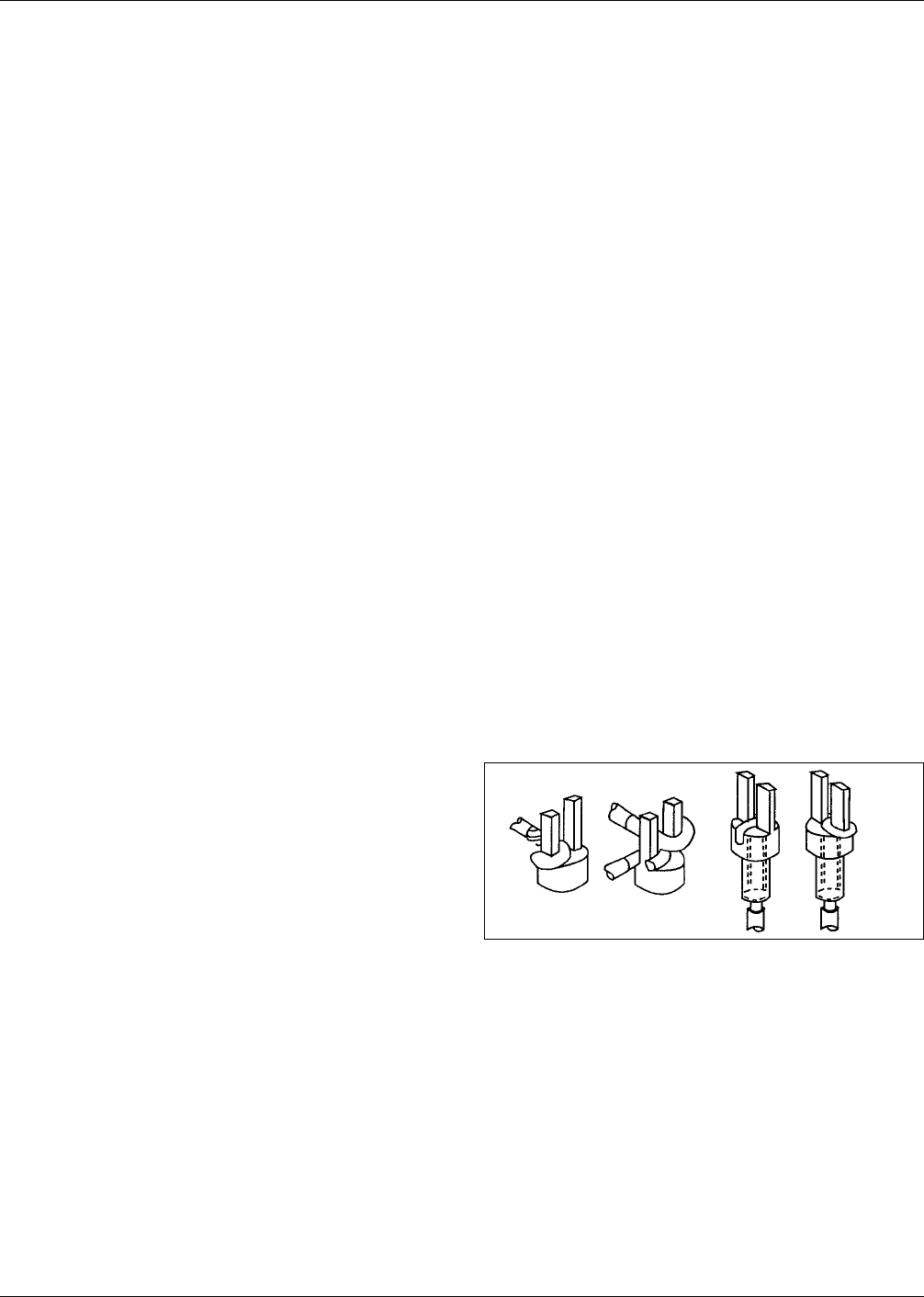
Bifurcated Solder Terminal 37.0106
A solder terminal with a slot or slit opening through which
one or more wires are placed prior to soldering. (See Fig-
ure B-2.)
Binder 47.0107
Material added to thick-film compositions and unfired base
materials to give them additional strength for pre-fire han-
dling. (See also ‘‘Glass Binder.’’)
Binomial Distribution 94.0108
A discrete probability distribution that, with certain
assumptions, describes the variation of an attribute (propor-
tion).
Biochemical Oxygen Demand 92.0109
A standardized measure used for estimating the degree of
contamination of water.
IPC-0-001024
Figure B–2 Bifurcated solder terminal
June 1996 IPC-T-50F
7

Biocide 76.0110
A general name for any substance that kills or inhibits the
growth of micro-organisms.
Birdcage 37.1338
A defect in stranded wire whereby the strands in the
stripped portion between the covering of an insulated wire
and a soldered connection, or an end-tinned lead, have
separated from the normal lay of the strands.
Bismaleimide 41.0111
A resin that has the generic chemical structure of an aro-
matic chemical group that is attached to two (or ‘‘Bis’’)
maleimide groups.
Bismaleimide Triazine 41.0112
A resin that contains a mixture of bismaleimide and triaz-
ine resins.
Blank 41.1339
An unprocessed or partially processed piece of base mate-
rial or metal- clad base material, that has been cut from a
sheet or panel, that has the rough dimensions of a printed
board. (See also ‘‘Panel.’’)
Bleeding 52.0113
A condition in which a plated hole discharges process
material or solution from crevices or voids or a condition
in which a resist migrates beyond the image area.
Blends 41.0114
Mixtures of resins.
Blind Via 22.0115
A via extending only to one surface of a printed board.
(See Figure B-3.)
Blister 96.1340
Delamination in the form of a localized swelling and sepa-
ration between any of the layers of a lamination base mate-
rial, or between base material and conductive foil or pro-
tective coating.
Blocking Variables 94.0116
A relatively-homogeneous set of conditions within which
different conditions of primary variables are compared.
Blow Hole 53.0117
A void caused by outgassing.
Board 60.0118
see ‘‘Printed Board,‘‘ and ‘‘Multilayer Printed Board.’’
Board Thickness 22.0119
The overall thickness of the base material and all conduc-
tive materials deposited thereon.
Body Land Clearance 51.1341
That portion of the land diameter of a drill that is decreased
in order to provide clearance behind the margin. (See Fig-
ure B-4, Feature K.)
Bond 74.0120
An interconnection that performs a permanent electrical
and/or mechanical function.
Bond Deformation 74.0123
The plastic-flow change in the form of a lead caused by a
bonding tool during a termination process.
Bond Enhancement Treatment 74.0125
The improvement of the adhesion of a metal foil surface to
an adjacent layer of material to which it is being attached
Bond Envelope 74.0126
The range of termination parameters within which accept-
able bonds may be formed.
Bond Interface 74.0133
The common area between a lead and a land to which it
has been terminated.
Bond Land 74.0134
see ‘‘Bonding Area.’’
Bond Lift-Off 74.0135
The failure mode whereby a bonded lead separates from
the surface to which it has been joined.
Bond Schedule 74.0136
The values of termination machine parameters.
Bond Separation 74.0137
The distance between the termination points of the first
bond and the second bond.
Bond Site 74.0138
That portion of the bonding area where the actual termina-
tion takes place.
Bond Strength 60.0139
The force perpendicular to a board’s surface required to
separate two adjacent layers of the board, expressed as
force per unit area.
IPC-I-001033
Figure B–3 Blind and buried vias
INTERFACIAL
CONNECTION
BURIED VIA
BLIND VIA
A
B
IPC-T-50F June 1996
8