IPC-T-50F_.pdf.pdf - 第46页
Mark (Fabric) 44.0741 A heavy or light area in a fabric that is due to excessive or insuf f icient filling yarns. Mask 47.0742 see ‘ ‘Resist.’ ’ Mass Lamination 55.1443 The simultaneous lamination of a number of pre-etche…
Lyophobic 76.0730
A characterization of material that exists in a colloidal state
with a tendency to repel liquids.
M
Machine Language 11.0732
The actual language, usually a binary code, that is used by
a computer when it performs operations.
Machined Contact 37.0731
A type of connector contact that consists of solid spring
metal that has been formed by machining. (See also
‘‘Sheet-Metal Contact.’’)
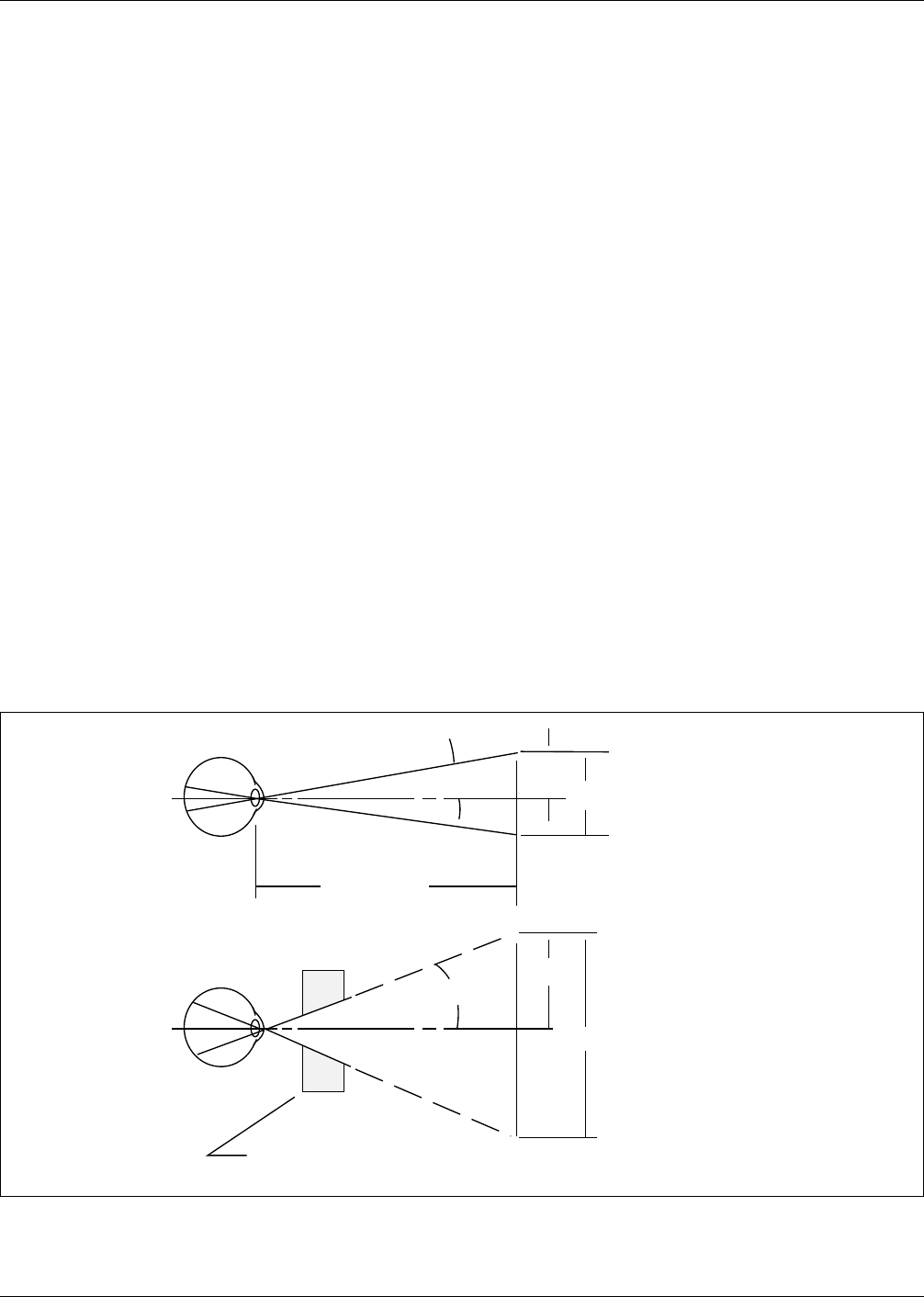
Magnification Power 92.0733
The ratio of the tangent of one-half of the angle (beta) sub-
tended by the image of an object (H), as seen through and
centered in the field of view of the magnification device, to
the tangent of one-half of the angle (alpha) subtended by
the object (H) as seen at 10 inches by the unaided eye. (See
Figure M-1.)
Major Defect 94.0734
A defect that is likely to result in a failure of a unit or
product or that materially reduces its usability for its
intended purpose.
Manhattan Distance 25.0735
The orthogonal distance between two points.
Manual Data Input 25.0736
Computer data that is manually generated with or without
the aid of a data-entry device, such as a keyboard, lightpen,
mouse, etc.
Manual Soldering 75.0737
see ‘‘Hand Soldering.’’
Manufacturing Drawing 26.1634
A working document that shows the dimensional limits or
grid locations that are applicable to any and all parts of a
product to be fabricated, including the arrangement of con-
ductors and nonconductive patterns or elements; the size,
type, and location of holes; and all other necessary infor-
mation.
Manufacturing Hole 20.0738
see ‘‘Tooling Hole.’’
Margin (Flat Cable) 37.0739
The distance between the reference edge of a flat cable and
the nearest edge of the first conductor. (See also ‘‘Edge
Spacing.’’)
Margin Width (Drill) 51.0740
The thickness of the cylindrical portion of a drill land that
is perpendicular to the leading edge.
IPC-I-002273
Figure M–1 Magnification power parameters
▼
▼
Magnifying aid focused so eye is
focused for infinity
Centered Image
of the Object
seen through aid
H
’
1/2 H
’
▼
β
▼
▼
▼
▼
254mm [10"]
Object viewed
with unaided
eye
H
1/2 H
▼
α
▼
▼
▼
▼
▼
▼
▼
▼▼
June 1996 IPC-T-50F
41

Mark (Fabric) 44.0741
A heavy or light area in a fabric that is due to excessive or
insufficient filling yarns.
Mask 47.0742
see ‘‘Resist.’’
Mass Lamination 55.1443
The simultaneous lamination of a number of pre-etched,
multiple-image, C-staged resin panels or sheets that are
sandwiched between layers of B-staged resin and coppper
foil. (See also ‘‘Cap Lamination’’ and ‘‘Foil Lamination.’’)
Mass Soldering 75.1678
Methods of soldering in which many joints are made in the
same operation.
Master Dot Pattern 26.0743
see ‘‘Hole Pattern.’’
Master Drawing 26.0744
A control document that shows the dimensional limits or
grid locations that are applicable to any and all parts of a
product to be fabricated, including the arrangement of con-
ductors and nonconductive patterns or elements; the size,
type, and location of holes; and all other necessary infor-
mation.
Master Line 22.0745
see ‘‘Design Width of Conductor.’’
Master Pattern 24.0746
see ‘‘Production Master
Maximum Material Condition (MMC) 22.0747
A drawing defining certain characteristics of the printed
board, such material within the stated limits of size.
Mealing 76.1814
A condition in the form of discrete spots or patches that
reveals a separation at the interface between a conformal
coating and a base material on the surface of a printed
board, on the surface of an attached component, or both.
Measling 55.0748
A condition that occurs in laminated base material in which
internal glass fibers are separated from the resin at the
weave intersection. (This condition manifests itself in the
form of discrete white spots or ‘‘crosses’’ that are below
the surface of the base material. It is usually related to
thermally-induced stress.) (See also ‘‘Crazing, Base Mate-
rial.’’)
Mechanical Stress 95.1755
To subject a mechanical component to a process of physi-
cal stress.
Mechanical Wrap 75.0749
The physical securing of a wire lead or component lead
around a solder terminal.
Meniscus 92.0750
The contour of a shape that is the result of the surface-
tension forces that take place during wetting.
Metal-Clad Base Material 41.1609
Base material covered with conductive foil on one or both
sides.
Metal-Clad Laminate 41.0752
see ‘‘Metal-Clad base Material.’’
Metal Core Printed Board 61.1587
Printed board using a metal core base material.
Metal Migration 96.1445
The electrolytic transfer of metal ions along an electrically
conductive path from one metal surface to another when an
electrical potential is applied to the two metal surfaces.
Metal Migrativity 96.0754
The comparative rate of the velocity of metal migration
under the same conditions.
Metal Surface Migration 96.1226
The migration of metal on the surface of an electrical insu-
lator.
Metal Through Migration 96.0662
The migration of metal through an electrical insulator.
Metalized Land Areas 22.1756
A pattern of conductive material used on a substrate to
interconnect electronic components. Widened conductor
areas used as attachment point for wire bonding or other
devices.
Metalization (n.) 53.0753
A deposited or plated thin metallic film that is used for its
protective and/or electrical properties.
Microbond 74.0756
A termination made with a small diameter wire, i.e.,
0.025-mm (0.001-inch) or less.
Microcircuit 30.0757
A relatively high density combination of equivalent circuit
elements that are interconnected so as to perform as an
indivisible electronic circuit component.
Microcircuit Module 86.1446
A combination of microcircuits or of microcircuits and dis-
crete components that are interconnected so as to perform
as an indivisible electronic circuit assembly.
IPC-T-50F June 1996
42

Microcomponents 30.0758
Small discrete components.
Microelectronics 30.0759
The area of electronic technology with, or applied to, the
realization of electronic systems from extremely-small
electronic elements, devices or parts.
Microprobe 92.0760
A small sharp-pointed object with a positional handle that
is used to make temporary electrical contact to a land on a
semiconductor for testing purposes.
Microsectioning 92.1447
The preparation of a specimen of a material, or materials,
that is to be used in a metallographic examination. (This
usually consists of cutting out a cross-section, followed by
encapsulation, polishing, etching, staining, etc.)
Microstrip 21.0761
A transmission-line configuration that consists of a conduc-
tor that is positioned over, and parallel to, a ground plane
with a dielectric between them.
Microwave Integrated Circuit 21.0762
An integrated circuit that performs at microwave frequen-
cies.
Migration Rate 96.0763
The distance over which metal migration proceeds in a
given unit of time.
Migration Velocity 96.0764
see ‘‘Migration Rate.
Minimum Annular Ring 22.0766
see ‘‘Minimum Annular Width.’’
Minimum Annular Width 22.0765
The minimum width of metal(s) at the narrowest point
between the edge of a hole and the outer edge of a circum-
scribing land. (This determination is made to the drilled
hole on internal layers of multilayer printed boards and to
the edge of the plating on external layers of multilayer and
double-sided printed board.)
Minimum Electrical Spacing 21.1451
The minimum allowable distance between adjacent con-
ductors, at a given voltage and altitude, that is sufficient to
prevent dielectric breakdown, corona, or both, from occur-
ing between the conductors.
Minor Defect 91.0767
A defect that is not likely to result in a failure of a unit or
product or that does not materially reduce its usability for
its intendeded purpose.
Mirrored Pattern 24.0768
A pattern whose orientation denotes a transposition from
right reading. (See Figure M-2.)
Mis-Pick 44.0769
A break in the pattern of cloth from selvage to selvage that
is caused by a missing filling yarn.
Mislocated Bond 74.0770
see ‘‘Off Bond.’’
Misregistration 50.0771
Imperfect registration.
Mixed Component-Mounting Technology 70.1452
A component mounting technology that uses both through-
hole and surface- mounting technologies on the same pack-
aging and interconneting structure.
Mixed-Effects Model 91.0772
An experimental treatment that contains elements of both
fixed-effects and random-effects models.
Mixed Technology 70.1757
In surface mounting, refers to mixing through hole compo-
nent and surface mounting components on the same side of
a printed circuit board.
Modal Form 25.0773
The technique whereby a data description or other pertinent
command is given only once at the beginning of a related
set of data.
Modification 77.0774
The revision of the functional capability of a product in
order to satisfy new acceptance criteria.
Module 80.0775
A separable unit in a packaging scheme.
Molecular Dye-Imaging Material 24.0776
see ‘‘Diazo Material’’
Monolithic Integrated Circuit 30.0777
An integrated circuit in the form of a monolithic structure.
Montreal Protocol 76.1758
An agreement by industrialized nations, at a meeting held
in Montreal, Canada, to eliminate chlorofluorocarbons
from all processes by 1995.
Mother Board 85.0778
A printed board assembly that is used for interconnecting
arrays of plug-in electronic modules. (See also ‘‘Back-
plane.’’)
June 1996 IPC-T-50F
43