IPC-T-50F_.pdf.pdf - 第5页
Terms and Definitions for Interconnecting and Packaging Electronic Circuits Abrasive Trimming 54.1318 Adjusting the value of a film component by notching it with a finely- adjusted stream of an abrasive material against th…

Acknowledgment
Any Standard involving a complex technology draws material from a vast number of sources. While the principal members of the
Terms and Definitions Committee are shown below, it is not possible to include all of those who assisted in the evolution of this
Standard. To each of them, the members of the IPC extend their gratitude.
Terms & Definitions Committee
Richard R. Douglas
Chairman
Douglas & Associates
Ron Underwood
Technical Liaison of the Board of Directors
Circuit Center
Committee Members
Masamitsu Aoki...........................Toshiba Chemical Corporation
Robert Blanchette........................................................U.S. Navy
John P. Caputo........................................... Raytheon Company
Linda Cartwright....................... Compaq Computer Corporation
Alan Cash................................................. Northrop Corporation
James Cordum ........................................... Teledyne Lewisburg
Francis J. Dance......................................... Burndy Corporation
Alfred C. Dentino ................................................. Acton Division
Richard R. Douglas................................. Douglas & Associates
Howard S. Feldmesser...................... Johns Hopkins University
Joe R. Felty........................................... Texas Instruments, Inc.
Karen Flewharty.................................... Texas Instruments, Inc.
Robert N. Garabedian...................... Printed Circuit Corporation
Gerald Ginsberg............................ Component Data Associates
William G. Hali ..............................................E&SCorporation
Ralph J. Hersey ........ Lawrence Livermore National Laboratory
David D. Hillman ..................................... Rockwell International
Les Hymes................................................... Plexus Corporation
Larry P. Knowles................................... Librascope Corporation
Nicholas J. Lester........... Comargus Information Service (USA)
William E. Loeb.......................... Loeb/Henderson & Associates
Kosaku Maeda ............................................ Mec Company, Ltd.
James F. Maguire ................... Boeing Aerospace & Electronics
George Messner....... AMP-AKZO Corporation/PCK Technology
James H. Moffitt......................................................... U.S. Navy
Michael S. Morris ....................................................... U.S. Navy
John H. Morton................................................. IBM Corporation
Robert Parker......................... University of Southern California
William Reid...................................................... I-Con Industries
Robert S. Reylek.................................................. 3 M Company
Bruce C. Rietdorf....... Magnavox Electronic Systems Company
David E. Robertson.................................................... Pace, Inc.
Jerald G. Rosser............................... Hughes Aircraft Company
Don W. Rumps ................................ AT&T Technology Systems
Mark A. Savrin........................... Kulicke & Soffa Industries, Inc.
Donald P. Schnorr............................ General Electric Company
Laura Scholten.................................................... Optrotech, Inc.
Jack Semenik........................................ Allen-Bradley Company
Rick Smedley ........................................ Texas Instruments, Inc.
Norbert Socolowski........................................ Alpha Metals, Inc.
Lutz Treutler...................... Fachverband Elektronik Design e.V.
Ron Underwood............................................ Circuit Center, Inc.
IPC-T-50F June 1996
ii
Terms and Definitions for Interconnecting
and Packaging Electronic Circuits
Abrasive Trimming 54.1318
Adjusting the value of a film component by notching it
with a finely- adjusted stream of an abrasive material
against the resistor surface.
Absorption Coefficients 40.1727
The degree to which various materials absorb heat or radi-
ant energy when compared to each other.
Accelerated Aging 93.0001
The means whereby the deterioration encountered in natu-
ral aging is artificially reproduced and hastened.
Accelerator 53.0002
see ‘‘Catalyst.’’
Acceptance Quality Level (AQL) 90.0003
The maximum number of defectives likely to exist within
a population (lot) that can be considered to be contractually
tolerable; normally associated with statistically derived
sampling plans.
Acceptance Tests 92.0004
Those tests deemed necessary to determine the acceptabil-
ity of a product and as agreed to by both purchaser and
vendor.
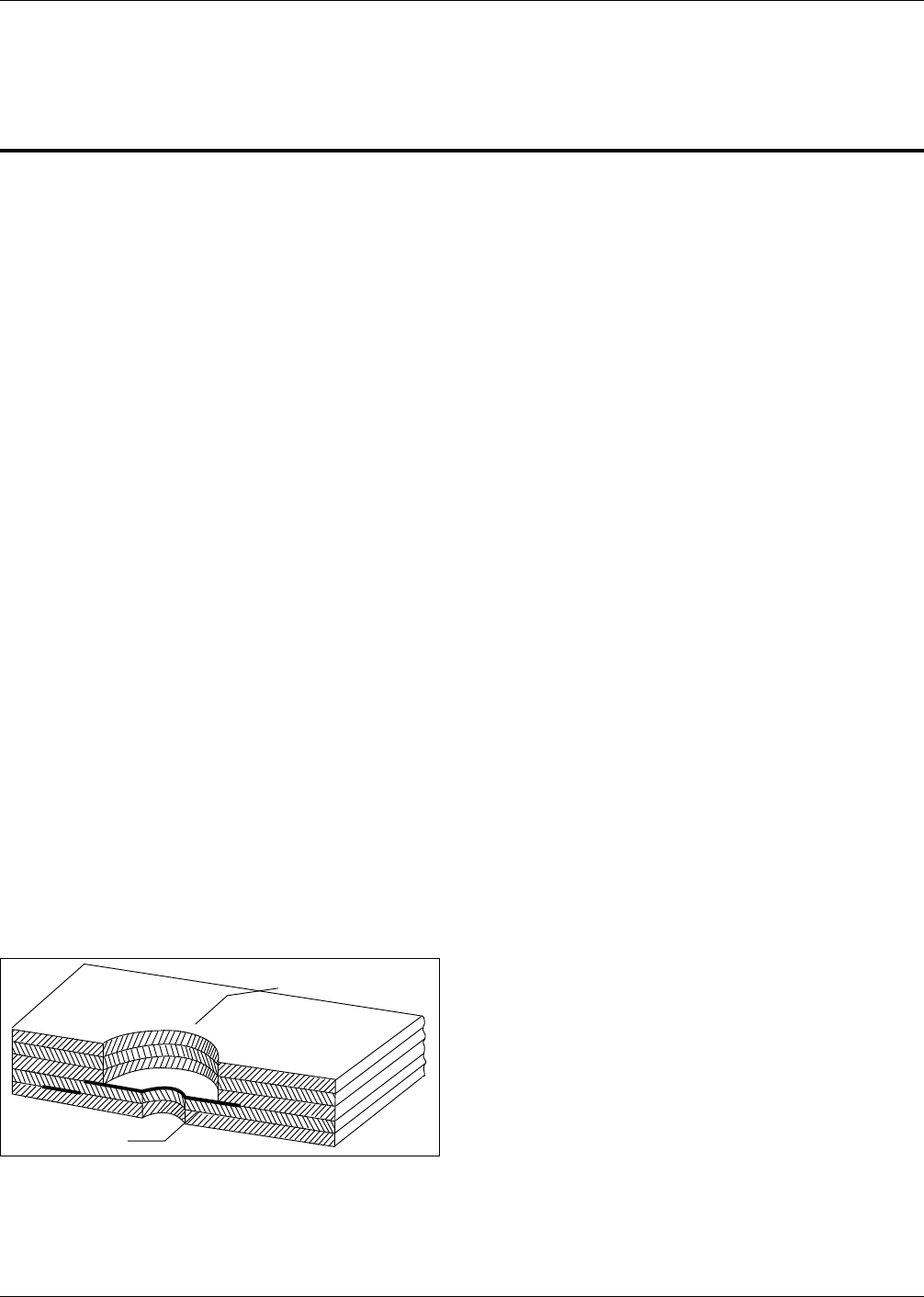
Access Hole 60.1319
A series of holes in successive layers of a multilayer board,
each set having their centers on the same axis. These holes
provide access to the surface of the land on one of the lay-
ers of the board. (See Figure A-1.)
Access Protocol 21.0005
An agreed principle for establishing how nodes in a net-
work communicate electronically.
Accordion Contact 36.0006
A type of connector contact that consists of a flat spring
formed into a ‘‘Z’’ shape in order to permit high deflection
without overstress.
Accuracy 90.0007
The deviation of the measured or observed value from the
accepted reference.
Acid Flux 46.0009
A solution of an acid and an inorganic, organic, or water
soluble organic flux. (See also ‘‘Inorganic Flux,’’ ‘‘Organic
Flux,’’ and ‘‘Water Soluble Organic Flux.’’)
Acid Number 54.0010
The amount of potassium hydroxide in milligrams that is
required to neutralize one gram of an acid medium.
Acid Value 54.1217
see ‘‘Acid Number’’
Acid-Core Solder 46.0008
Wire solder with a self-contained acid flux.
Actinic Radiation 52.0011
Light energy that reacts with a photosensitive material in
order to produce an image.
Activated Rosin Flux 46.0012
A mixture of rosin and small amounts of organic-halide or
organic-acid activators. (See also ‘‘Synthetic Activated
Flux.’’)
Activating 53.0013
A treatment that renders nonconductive material receptive
to electroless deposition.
Activating Layer 53.0014
A layer of material that renders a nonconductive material
receptive to electroless deposition.
Activator 46.0015
A substance that improves the ability of a flux to remove
surface oxides from the surfaces being joined.
IPC-I-002309
Figure A–1 Access hole
Land
Access Hole
▼
▼
June 1996 IPC-T-50F
1

Active Device 30.0016
An electronic component whose basic character changes
while operating on an applied signal. (This includes diodes,
transistors, thyristors and integrated circuits that are used
for the rectification, amplification, switching, etc., of ana-
log or digital circuits in either monolithic or hybrid form.)
Active Metal 36.0017
A metal that is very high in electromotive force.
Active Trimming 54.1321
Adjusting the value of a film circuit element in order to
obtain a specified functional output from the circuit while
it is electrically activated.
Actual Size 90.0018
The measured size.
Additive Process 53.1322
A Process for obtaining conductive patterns by the selec-
tive deposition of conductive material on clad or unclad
base material. (See also ‘‘Semi-Additive Process’’ and
‘‘Fully-Additive Process.’’)
Add-On Component 30.0019
Discrete or integrated packaged or chip components that
are attached to a film circuit in order to complete the cir-
cuit’s function.
Adhesive 46.1728
A substance such as glue or cement used to fasten objects
together. In surface mounting, an epoxy adhesive is used to
adhere SMD’s to the substrate.
Adhesion Failure 96.0020
The rupture of an adhesive bond such that the separation
appears to be at the adhesive-adherend interface.
Adhesion Layer 74.0021
The metal layer that adheres a barrier metal to a metal land
on the surface of an integrated circuit.
Adhesion Promotion 53.0022
The chemical process of preparing a surface to enhance its
ability to be bonded to another surface or to accept an
over-plate.
Adhesive-Coated Catalyzed Laminate 41.1320
A base material with a thin polymer coating, that contains
a plating catalyst, that is subsequently treated in order to
obtain a microporous surface.
Adhesive-Coated Uncatalyzed Laminate 41.1323
A base material with a thin polymer coating, that does not
contain a plating catalyst, that is subsequently treated in
order to obtain a microporous surface.
Adsorbed Contaminant 96.0023
A contaminant attracted to the surface of a material that is
held captive in the form of a gas, vapor or condensate.
Advanced Statistical Method 91.0024
A statistical process analysis and control technique that is
more- sophisticated and less widely-applicable than basic
statistical methods.
Aging 90.0025
The change of a property, e.g., solderability, with time.
(See also ‘‘Accelerated Aging.’’)
Air Contamination 14.0026
see ‘‘Air Pollution’’
Air Pollution 14.0027
Contamination of the atmosphere with substances that are
toxic or otherwise harmful.
Algorithm 11.0849
A set of procedures for the solution of a problem in a series
of steps.
Alignment Mark 22.0030
A stylized pattern that is selectively positioned on a base
material to assist in alignment.
Aliphatic Solvents 76.0031
‘‘Straight chain’’ solvents, derived from petroleum, of low
solvent power.
Alkaline Cleaner 76.0032
A material blended from alkali hydroxides and alkaline
salts.
Alpha Error 91.0033
The size of a Type I error or the probability of rejecting a
hypothesis that is true.
Alphanumerical 25.1729
Pertaining to data that contain the letters of an alphabet, the
decimal digits, and may contain control characters, special
characters and the space character.
Alternating Current (ac) 21.1793
A current that varies with time, commonly applied to a
power source that switches polarity many times per second,
in the shape of a sinusoidal, square, or triangular wave.
Alternative Hypothesis 93.1324
The supposition that a significant difference exists between
the desired results of two comparable populations. (See
also ‘‘Null Hypothesis’’ and ‘‘Statistical Hypothesis.’’)
IPC-T-50F June 1996
2