IPC-T-50F_.pdf.pdf - 第62页
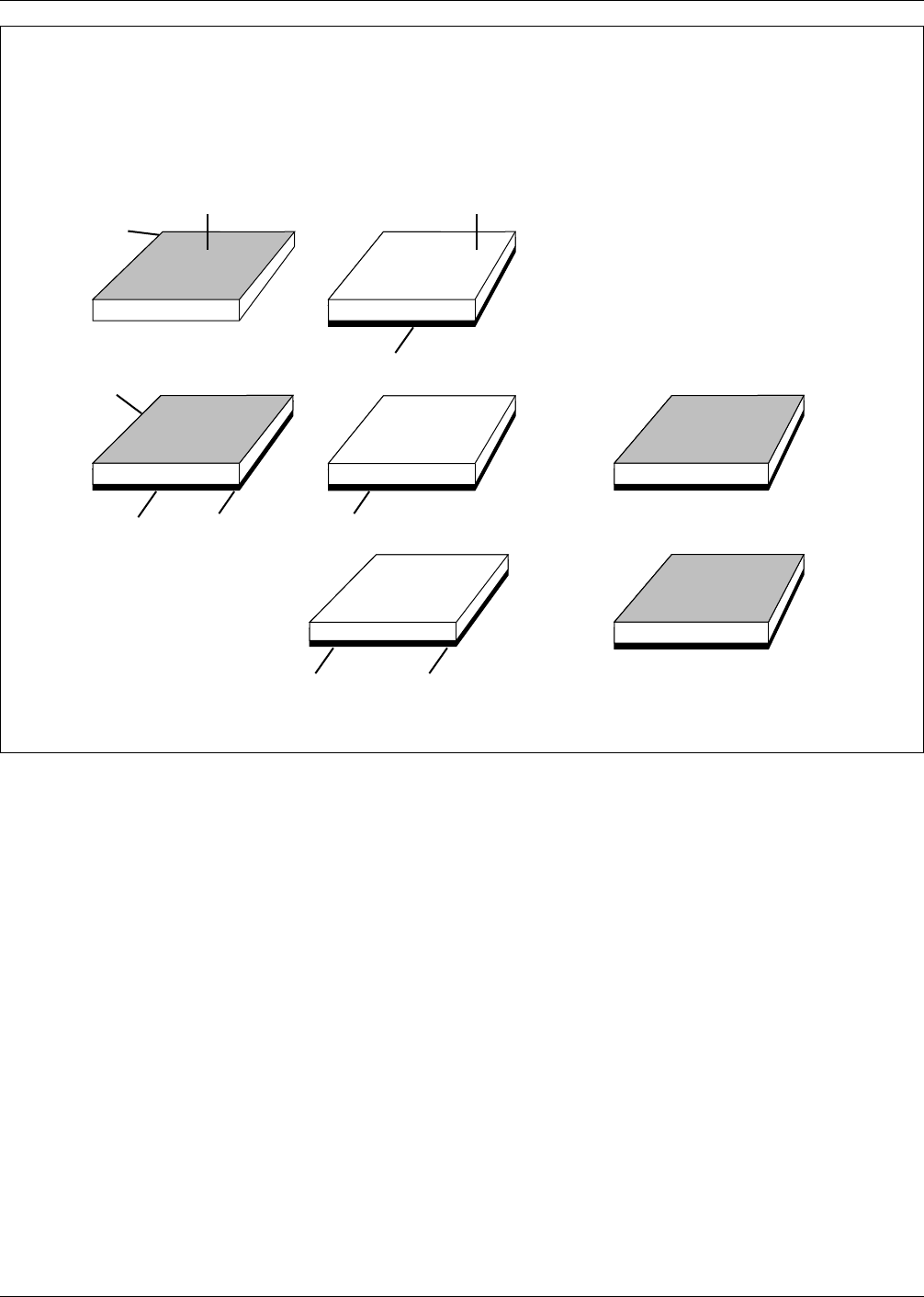
IPC-I-002768 Figure R–2 Printed board viewing orientations Notes: 1. A precise definition of image tone and orientation necessitates that the orientation of the pattern and the legend be separately identified. For exampl…

Resin Smear 51.1506
Base material resin that covers the exposed edge of con-
ductive material in the wall of a drilled hole. (This resin
transfer is usually caused by the drilling operation).
Resin-Rich Area 41.1505
The location in a printed board of a significant thickness of
unreinforced surface-layer resin that is of the same compo-
sition as the resin within the base material.
Resin-Starved Area 41.1507
The location in a printed board that does not have a suffi-
cient amount resin to completely wet out the reinforcing
material. (Evidence of this condition is often in the form of
low-gloss dry spots or exposed fibers.)
Resist 52.1508
A coating material that is used to mask or protect select
areas of a pattern during manufacturing or testing from the
action of an etchant, plating, solder, etc. (See also
‘‘Negative-Acting Resist’’ and ‘‘Positive- Acting Resist.’’)
Resistance 21.1805
The restriction to the flow of electrons, determined by
Ohms law; the quotient of DC voltage, applied to the
extremes of a conductor or insulator, and the current flow-
ing through it.
Resistance Soldering 75.1248
Soldering by a combination of pressure and heat generated
by passing a high current through two mechanically-joined
conductors.
Resistance Welding 75.1249
Welding by a combination of pressure and heat generated
by passing a high current through two mechanically-joined
conductors.
Resistor Drift 92.1250
The change in resistance of a resistor caused by aging,
usually expressed a percent change per 1,000 hours.
Resolving Power 24.1509
The ability of a photographic system to maintain the sepa-
rate identity of parallel lines and spaces in a developed
image when their relative displacement is small.
Response Variable 91.1251
The dependent variable being studied.
Reversal Development 24.1252
The reversing of the tone of an image on a photographic
emulsion from that which can be accomplished with con-
ventional developing.
Reverse Current Cleaning 76.1253
see ‘‘Anodic Cleaning’’
Reverse Image 52.1254
The pattern of resist on a printed board that is used to allow
for the exposure of conductive areas for subsequent plat-
ing.
Reversion 96.1510
A chemical reaction in which a polymerized material par-
tially or completely degenerates to a lower polymeric state
or to the original monomer. (This is usually accompanied
by significant changes in physical and mechanical proper-
ties.)
Rework 77.1511
The act of reprocessing noncomplying articles, through the
use of original or alternate equivalent processing, in a man-
ner that assures compliance of the article with applicable
drawings or specifications.
Ribbon Cable 37.1255
A flat cable with round conductors.
Ribbon Interconnect (n.) 37.1256
A flat narrow ribbon of metal used to make interconnec-
tions to lands, lead frames, etc.
Right Reading 24.1257
A phototool pattern-orientation that is the same as the art-
work master when it is viewed from the primary side of a
product. (See Figures M-2 and R-2.)
Right Reading Down 24.1512
An orientation of a phototool in which the pattern is right
and the emulsion is on the surface that is away from the
viewing surface. (See Figures M-2 and R-2.)
Right Reading Up 24.1513
An orientation of a phototool in which the pattern is right
reading and the emulsion is on the surface that is toward
the viewing surface. (See Figures M-2 and R-2.)
IPC-I-001047
Figure R–1 Resin recession
RESIN
RECESSION
RESIN
RECESSION
June 1996 IPC-T-50F
57
IPC-I-002768
Figure R–2 Printed board viewing orientations
Notes:
1. A precise definition of image tone and orientation necessitates that the orientation of the pattern and the legend be separately
identified. For example: Layer 1—Pos RR DN (Legend Corr. Read) or Layer 2—Pos RR UP (Legend Rev. Read) (There is no such
thing as wrong reading.)
2. By definition, all layer patterns are viewed from the same direction. (This view defines RR for the pattern appearance of all layers; this
is not the same as viewing the final board copper head on.)
3. Legend is usually correct reading when viewing the copper; therefore, on occasion alphanumerics must be reversed reading when
the pattern is right reading by definition.
4. Production master emulsion must be presented against the board copper in the stack up. Therefore, production master emulsion
orientation is opposite to individual copper layer orientation, i.e., if copper is RR UP by definition, corresponding production master
must be RR DN.
5. When specifying artwork tone and orientation, remember the board layup and the purpose of the artwork, i.e., file copy, artwork
master, or production master, etc.
6. In manual designs the artwork is usually prepared at an enlarged scale with tapes and other drafting aids. The artwork master is
produced from the artwork by photographic reduction.
7. In semi-automated designs, there may be no artwork by definition. Typically, an enlarged color-coded printed wiring layout on a
gridded format is prepared for subsequent digitizing and photoplotting. This procedure may yield intermediate phototools which can
be photographically processed into an artwork master or it may directly yield an artwork master, working master, or production
master.
8. In fully automated systems, there is usually no artwork or printed wiring layout prepared. A computerized procedure from a form of
the electrical schematic by total computerization or a combination of computer and interactive design procedures. This procedure
may yield intermediate phototools or the artwork master, working master, or production master directly.
Multilayer
Printed
Boards
Corresponding
Registered
Production
Master
L3 - RR
UP
L4 - RR UP (Legend Rev. Read)
L4 - RR DN
(Legend Rev. Read)
Emulsion
Emulsion
L1 - RR UP
(Legend Corr. Read)
L1 - RR UP
(Legend
Corr.
Read)
Viewing Primary Side
Copper
Substrate Base Material
Substrate Base Material
Substrate
Base Material
Base Material
COPPER
COPPER
EMULSION
EMULSION
▼ ▼
▼
▼
L2 - RR UP
▼
L3 - RR DN
▼
Copper
▼
▼
Viewing Component Side
▼
▼
L2 - RR
DN
IPC-T-50F June 1996
58

Rigid Double-sided Printed Board 61.1577
Double-sided printed board, either printed circuit or printed
wiring, using rigid base materials only.
Rigid Multilayer Printed Board 61.1578
Multilayer printed board, either printed circuit or printed
wiring, using rigid base materials only.
Rigid Printed Board 61.1571
A printed board using rigid base materials only.
Rigid Single-sided Printed Board 61.1576
Single-sided printed board, either printed circuit or printed
wiring, using rigid base materials only.
Rigid-flex Double-sided Printed Board 63.1584
Double-sided printed board, either printed circuit or printed
wiring, using combinations of rigid and flexible base mate-
rials.
Rigid-Flex Printed Board 63.1258
A printed board with both rigid and flexible base materials.
Rise Time 21.1259
The time required for a signal voltage to increase (switch)
from 10 to 90 % of its final voltage level after a level
change has been initiated.
Risk Management Factor (RMF) 94.1777
The maximum tolerable percentage of possible defects
within a lot (group) of units, based on appoximately 95 %
confidence level.
Roadmap 26.1260
A printed nonconductive pattern that delineates the compo-
nents and circuitry on a printed board in order to aid in
servicing and repairing the final assembly.
Robber 53.1261
see ‘‘Plating Thief.’’
Rosin 46.1514
A hard, natural resin, consisting of abietic and primaric
acids and their isomers, some fatty acids and terpene
hydrocarbons, that is extracted from pine trees and subse-
quently refined.
Rosin Flux 46.1262
Rosin in an organic solvent or rosin as a paste with activa-
tors.
Rosin Solder Connection 75.1515
A solder connection that has practically the same appear-
ance as does a cold solder connetion, but that also shows
evidence of entrapped rosin separating the surfaces to be
joined. (See also ‘‘Cold Solder Connection’’).
Rotational Error 25.1263
The angular misalignment of a functional pattern with
respect to the X and Y axes.
Router (CAD) 22.1264
A computer program that automatically determines paths
between points to be interconnected.
Routing Mark 25.1265
An artwork feature that is used to define the periphery of a
printed board.
Roving 44.1266
A collection of parallel strands of filaments assembled with
or without an intentional twist.
Rubber Banding 22.1267
A technique for displaying a straight line with one endpoint
fixed and the other end following the commands of a
manual data input device.
Run (n.) 91.1268
A consecutive number of points that consistently increase
or decrease, or that are consistently above or below the
central line of a SPC control chart.
Run Chart 91.1269
A graphic representation of plotted values of some statistic
gathered from a process characteristic and a central line
that can be analyzed for runs.
Run Time 92.1271
The time elapsed while a unit is in an inspection or testing
machine.
Runout 24.1270
The sum of the cumulative-pitch error across a number of
functional patterns on a step-and-repeat phototool.
Runtime System 11.1272
The collection of software programs required to perform
the actual testing and diagnosis of a unit under test.
S
Sacrificial Protection 45.1274
The preferential corrosion of a metal coating in order to
protect the substrate metal.
Sacrificial-Foil Laminate 31.1273
A base material with a treated-metal foil which is subse-
quently removed, for the purpose of impressing a
microporous topography on the surface of the base mate-
rial.
Sagging 74.1275
see ‘‘Wire Sag.’’
June 1996 IPC-T-50F
59