IPC-T-50F_.pdf.pdf - 第36页
Geometric Tolerance 22.0568 A tolerance that is used to control form, profile, orientation, location and runout. Gerber Data 25.1411 A type of data that consists of aperture selection and opera- tion commands and dimensio…

Forward Crosstalk 21.1406
Noise induced into a quiet line, as seen at the end of the
quiet line that is the farthest from the signal source,
because the quiet line has been placed next to an active
line. (See also ‘‘Backward Crosstalk.’’)
Fractional-Factorial Experiment 91.0550
An experiment whereby only a portion of the complete
factorial is run.
Frame Pitch 74.0551
The distance from the centerline of one tape-automated
bonding frame to the centerline on the next frame site on a
reel of carrier tape.
From-To List 21.0553
Written instructions in the form of a list that indicates the
locations of wiring terminations.
Fully Additive Process 53.1407
An additive process wherein the entire thickness of
electrically- isolated conductors is obtained by the use of
electroless deposition. (See also: ‘‘Semi-Additive Pro-
cess.’’)
Fully-Electroless Process 53.0554
see ‘‘Fully-Additive Process.’’
Functional Tester 92.0556
Equipment that analyzes the unit under test as a complete
functional entity by applying inputs and sensing outputs.
Functionality, Resin or Curing Agent 41.0555
The number of reactive groups per molecule.
Fused Coating 56.0557
A metallic coating, usually a tin or solder alloy, that has
been melted and solidified to form a metallurgical bond to
a basis metal.
Fusing 56.1676
Melting of a metallic coating (usually electrodeposted tin
or tin-lead) on a conductive pattern, followed by solidifica-
tion
Fusing Fluid 56.0467
The heat-transfer medium used to attain a fused coating.
Fusing Flux 56.1408
An activated organic fluid that is used in the fusing of a
tin-lead plating on a basis metal. (The application of these
predominantly water- soluble fluids is usually followed by
the use of a fusing oil.)
Fusing Oil 56.1409
An thermally-stable, nonactivated, fluid that is used in the
fusing of tin lead plating on a basis metal. (The application
of these predominantly water-soluble fluids is usually pre-
ceded by the use of a fusing flux.)
G
Galvanic Corrosion 76.1410
Corrosion associated with the current of a galvanic cell
consisting of two dissimilar conductors in an electrolyte or
two similar conductors in dissimilar electrolytes.
Galvanic Deposition 53.0560
see ‘‘Electrodeposition.’’
Galvanic Displacement 53.0561
see ‘‘Immersion Plating.’’
Gang Bonding 74.0562
The making of several terminations simultaneously. (See
also ‘‘Single- Point Bonding.’’)
Gas Blanket 75.0564
A flowing inert gas atmosphere used to keep metallization
from oxidizing.
Gas-Tight Area 97.0563
The common area between mated-metal surfaces from
which gas vapors and impurities are excluded.
Gauge Precision 22.0559
The absolute precision achieved in measuring feature size
or feature location.
Gaussian Distribution 94.1807
See ‘‘Normal Distribution’’
Gel Time 55.0566
The time in seconds required for prepreg to change its
physical state from that of a solid material to a liquid, and
then back to a solid material.
Gelation Particle 44.0565
Microparticles of precured, usually transluscent, resin in a
laminate system.
Generative Process Planning 91.0567
A computer-based method whereby new process plans are
created that are based on part or product information and
manufacturing capabilities.
Generic Specification (GS) 26.1782
A document that describes as many general requirements as
possible, pertaining to a set, family or group of products,
materials, or service.
June 1996 IPC-T-50F
31
Geometric Tolerance 22.0568
A tolerance that is used to control form, profile, orientation,
location and runout.
Gerber Data 25.1411
A type of data that consists of aperture selection and opera-
tion commands and dimensions in X- and Y-coordinates.
(The data is generally used to direct a photoplotter in gen-
erating photoplotted artwork.)
Glass Binder 44.0569
Glass powder added to a thick-film resistive or conductive
ink in order to bind together the metallic particles after fir-
ing
Glass Transition Temperature 55.1412
The temperature at which an amorphous polymer, or the
amorphous regions in a partially-crystalline polymer,
changes from being in a hard and relatively-brittle condi-
tion to being in a viscious or rubbery condition.
Go/No-Go Test 92.0570
A testing process that yields only a pass or a fail condition.
Golden Assembly 92.0571
see ‘‘Know Good Assembly
Golden Board 92.0572
see ‘‘Known Good Board’’
Gouge 92.0573
A form of wear that consists of a wide groove deformation,
accompanied by material removal, that penetrates a consid-
erable distance below a surface.
Graded Wedge 54.0574
see ‘‘Etching Indicator.’’
Grading Frame 44.0575
Equipment used to continuously inspect fabric by the use
of backlighting.
Green Strength 56.0577
The strength of substance, joint, or assembly before it has
been cured (set).
Greige 44.0578
Fabric in a loom state that has no finish.
Grey-Scale Processing 92.0576
The utilizing of more than one level of signal strength,
intensity or amplitude to perform an inspection operation.
Grid 22.1812
An orthogonal network of two sets of parrallel equidistant
lines that is used for locating points on a printed board.
Gross Leak 95.0580
A leak in a sealed package that is greater than 0.00001
cubic centimeters per second at one atmosphere of differ-
ential air pressure.
Ground 20.0581
A common reference point for electrical circuit returns,
shielding, or heat sinking.
Ground Plane 20.1413
A conductor layer, or portion thereof, that serves as a com-
mon reference for electrical circuit returns, shielding, or
heat sinking. (See also ‘‘Signal Plane’’ and ‘‘Voltage
Plane.’’)
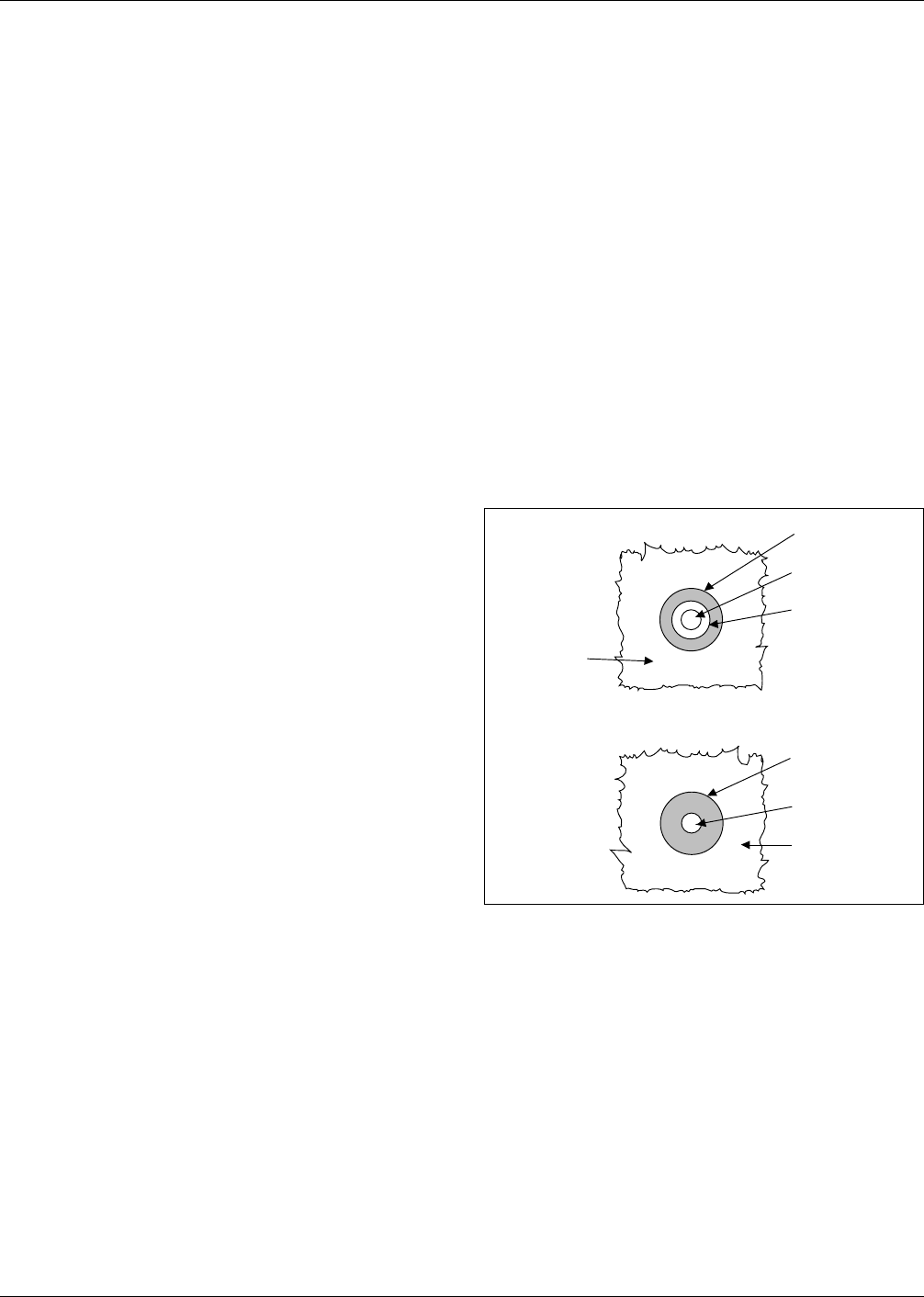
Ground Plane Clearance 22.1414
Removed portions of a ground plane that isolate it from a
hole in the base material to which the plane is attached.
(See Figure G-1.) (See also ‘‘Signal Plane’’ and ‘‘Voltage
Plane.’’)
Guarding 92.0582
The in-circuit testing process of ensuring that a shunt path
does not interfere with the testing of a device.
Guide Pin 37.0583
A connector interfacing device that allows for connector
body movement in order to facilitate contact alignment
prior to contact engagement.
Gull Wing Leads 36.1747
An SMT lead form. Leads extending horizontally from the
component body centerline, bent downward immediately
past the body and then bent outward just below the bottom
of the body, thus forming the shape of a gull’s wing.
IPC-I-001031
Figure G–1 Ground (or voltage) plane clearance
Through Hole
Ground-Plane
Clearance
Nonfunctional
Land
Conductive
Pattern
Ground-Plane
Clearance
Through Hole
Conductive
Pattern
IPC-T-50F June 1996
32

H
Halide Content 76.0584
The ratio of the mass of free halides to the mass of solids
in a flux, expressed in mass percent of free chloride ion.
Haloing 51.1415
Mechanically-induced fracturing or delamination, on or
below the surface of a base material, that is usually exhib-
ited by a light area around holes or other machined fea-
tures.
Hand Soldering 75.0585
Soldering using a soldering iron or other hand-held,
operator- controllable apparatus.
Hard Wiring 75.0587
Electrical wiring that is inseparable from an assembly with-
out the use of special tools and processes.
Hardeners 56.0586
see ‘‘Curing Agent.’’
Haywire 37.0588
A discrete electrical connection that is added to a printed
board in order to modify the basic conductive pattern
formed on the board. (See also ‘‘Jumper Wire.’’)
Header (Connector) 37.0589
A pin field that is positioned in a 3- or 4-sided plastic
housing that mounts directly onto a printed board.
Header (Module) 36.0590
The base of an electronic component package that contains
leads.
Heat Cleaning 44.0591
A process in which organic yarn binder (size) is removed
from a fabric. (See also ‘‘Sizing.’’)
Heat Column 75.0592
The heating element in a eutectic die bonder or wire
bonder that is used to bring the base material up to its
bonding temperature.
Heat of Fusion 56.0593
The quantity of heat required to convert a unit weight of
solid material to its liquid state.
Heatsink 30.0594
A mechanical device that is made of a high thermal-
conductivity and low specific-heat material that dissipates
heat generated by a component or assembly.
Heatsink Plane 22.0595
A continuous sheet of metal on or in a printed board that
functions to dissipate heat away from heat generating com-
ponents.
Heatsink Tool 75.1416
A heatsink that is temporarily attached to a heat-sensitive
component in order to minimize the transfer of heat from
the component lead to the component body during a solder-
ing operation.
Heavy Mark (Fabric) 44.0596
A filling defect that extends across the width of a fabric
containing in excess of two picks per inch from nominal.
Heel, Bonding 74.0598
The part of a lead adjacent to a termination that has been
deformed by the edge of the bonding tool.
Heel Break 97.0599
The rupture of a lead at the heel of a bond.
Heel Crack 97.0600
A crack across the width of a lead at the heel of a bond.
Heel (Drill) 51.0597
The trailing edge of a drill land
Helix Angle 51.0601
The angle of the spiral generated by the flute of a drill with
respect to the axis of the drill.
Hermaphroditic Contact 37.0602
A type of connector contact that mates with a contact that
is identical to itself.
Heterocyclic 76.0603
A cyclic or ring structure, often in the shape of a pentagon,
in which one or more of the atoms in the ring is an element
other than carbon.
Hierarchical Database 11.0604
A database that is arranged in a tree-like structure of logic.
High-Impedance State 21.0605
see ‘‘Tri-State.’’
High-Voltage Wire 37.0606
Insulated wire, with an insulation thickness that is deter-
mined by corona-related factors, that is used for voltag es
over 240 Vac RMS or over 340 Vdc.
Hipot Test 92.0607
A method in which the unit under test is subjected to a high
alternating current (ac) voltage.
Histogram 91.0608
A graph that depicts values that were obtained by dividing
the range of a data set into equal intervals and that plots the
number of data points in each interval.
June 1996 IPC-T-50F
33