IPC-T-50F_.pdf.pdf - 第20页
Computer-Aided Design (CAD) 22.1359 The interactive use of computer systems, programs, and procedures in the design process wherein, the decision- making activity rests with the human operator and a com- puter provides t…

Cold Solder Connection 97.0226
A solder connection that exhibits poor wetting, and that is
characterized by a greyish porous appearance. (This is due
to excessive impurities in the solder, inadequate cleaning
prior to soldering, and/or the insufficient application of heat
during the soldering process.) (See alse ‘‘Rosin Solder
Connection.’’)
Color Temperature 24.1355
A measure of the energy distribution over the visible spec-
tral range of a light source with a continuous spectrum,
expressed in degrees Kelvin (K). (See also ‘‘Effective
Color Temperature.’’)
Comb Pattern 22.0227
A set of interdigitated comblike arrays of uniformly-spaced
conductors.
Comment Record 25.0228
A record that provides, or refers to, additional descriptive
material that further clarifies the control of a data set.
Common Cause 91.0229
A source of variation that affects all the individual values
of the output of a process.
Compensated Artwork 24.0230
Production master or artwork data that has been enlarged
or reduced in order to meet the needs of subsequent pro-
cessing requirements.
Compensation Circuit 21.0231
An electrical circuit that alters the functioning of another
circuit to which it is applied to achieve desired perfor-
mance.
Compiler 11.0232
A software module that analyzes and converts programs
from a high-level language to binary machine codes.
Complex Ion 76.0233
An ion composed of two or more ions or radicals that are
capable of an independent existence.
Compliant Bond 74.0235
A bond that uses an elastically- and/or plastically-
deformable member to impart the required energy to the
lead.
Component 30.0236
An individual part or combination of parts that, when
together, perform a design function(s). (See also ‘‘Discrete
Component.’’)
Component Density 22.0237
The quantity of components on a unit area of printed board.
Component Hole 20.0238
A hole that is used for the attachment and/or electrical con-
nection of component terminations, including pins and
wires, to a printed board.
Component Lead 30.1356
The solid or stranded wire or formed conductor that
extends from a component to serve as a mechanical or
electrical connector, or both. (See also ‘‘Component Pin.’’)
Component Mounting 70.0239
The act of attaching components to a printed board, the
manner in which they are attached, or both.
Component Mounting Orientation 22.1357
The direction in which the components on a printed board
or other assembly are lined up electrically with respect to
the polarity of polarized components, with respect to one
another, and/or with respect to the board outline.
Component Pin 30.0240
A component lead that is not readily formable without
being damaged. (See also ‘‘Component Lead.’’)
Component Side 22.0241
see Primary Side .
Component Thermal Masses 30.1735
The ability of a part to absorb or retain heat energy, usu-
ally relative to its overall size and weight.
Composite (Phototool) 24.0242
A photograph that consists of a combination two separate
(aligned) images.
Composite Record 25.1358
A collection of records that make up an electrical pattern
that is used repeatedly in a design. (The definition and
relationship of such records are covered and referred to as
‘‘subroutine definition’’ and ‘‘subroutine definition call.’’)
Composite Test Pattern (CTP) 24.1792
A grouping of individual test patterns into specific arrange-
ments, to reflect control and precision capability of a manu-
facturer or manufacturing process.
Compression Seal 36.0243
A tight joint made between an component package and its
leads that is formed as heated metal cools and shrinks
around a glass insulator.
Computer Numerical Control (CNC) 11.0244
A system that utilizes a computer and software as the pri-
mary numerical control technique. (See also ‘‘Numerical
Control.’’)
June 1996 IPC-T-50F
15
Computer-Aided Design (CAD) 22.1359
The interactive use of computer systems, programs, and
procedures in the design process wherein, the decision-
making activity rests with the human operator and a com-
puter provides the data manipulation function.
Computer-Aided Engineering (CAE) 21.1360
The interactive use of computer systems, programs, and
procedures in an engineering process wherein, the
decision-making activity rests with the human operator and
a computer provides the data manipulation function.
Computer-Aided Manufacturing (CAM) 25.1361
The interactive use of computer systems, programs, and
procedures in various phases of a manufacturing process
wherein, the decision-making activity rests with the human
operator and a computer provides the data manipulation
functions.
Concentration Polarization 54.0245
That portion of polarization electrode produced by concen-
tration changes at the metal-environment interface.
Condensation Soldering 75.1681
see ‘‘Vapor Phase Soldering.’’
Conditional End-of-Test 25.0246
A command in a test program to stop the execution of the
program when a particular condition, or set of conditions,
is reached.
Conditioning 92.0247
The time-related exposure of a test specimen to a specified
environment(s) prior to or after testing and before evalua-
tion.
Conducting Salt 54.0248
A salt added to a plating solution in order to increase its
conductivity.
Conductive Foil 45.0249
A thin sheet of metal that is intended for forming a conduc-
tive pattern on a base material.
Conductive Pattern 22.1362
The configuration or design of the conductive material on
a base material. (This includes conductors, lands, vias,
heatsinks and passive components when these are integral
part of the printed board manufacturing process.)
Conductivity (Electrical) 40.0250
The ability of a substance or material to conduct electric-
ity.
Conductor 22.0251
A single conductive path in a conductive pattern.
Conductor Base Spacing 60.0252
The spacing between conductor at the plane of the surface
of a base material. (See also Design Spacing of Conduc-
tors.’’)
Conductor Base Width 60.0253
The width of a conductor at the plane of the surface of a
base material. (See also ‘‘Conductor Width’’ and ‘‘Design
Width of Conductors.’’)
Conductor Layer No.1 25.0254
The first layer of a printed board that has a conductive pat-
tern on or adjacent to its primary side.
Conductor Line 22.0256
see ‘‘Conductor.’’
Conductor Layer 22.0848
The total conductive pattern formed on one side of a single
layer of a base material. (This may include all or a portion
of ground and voltage planes.)
Conductor Path 22.0257
see ‘‘Conductor.’’
Conductor Pattern 22.0258
see ‘‘Conductive Pattern.’’
Conductor Side 22.0259
The side of a single-sided printed board that contains the
conductive pattern.
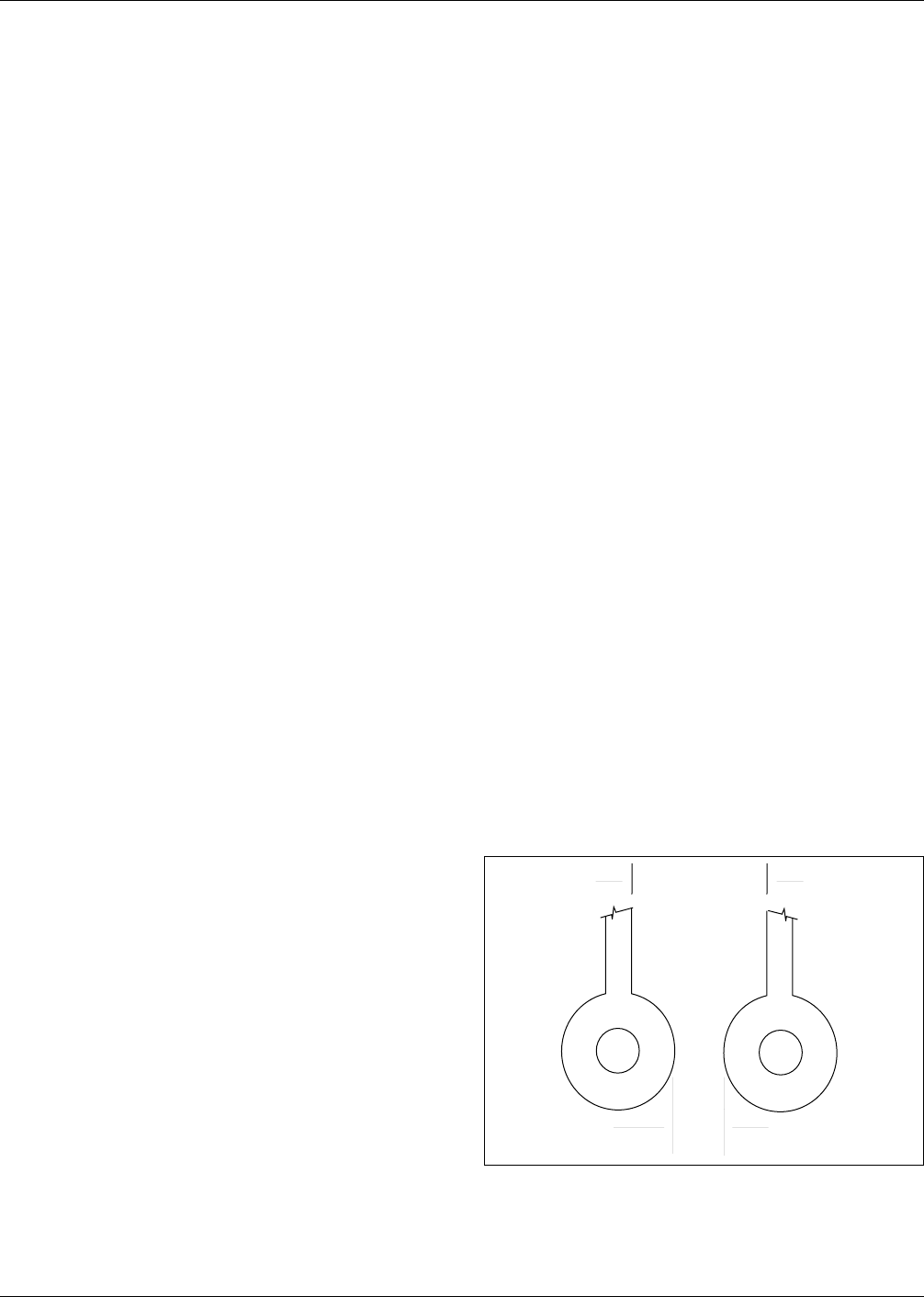
Conductor Spacing 60.1363
The observable distance between adjacent edges (not
center-to-center spacing) of isolated conductive patterns in
a conductor layer. (See Figure C-5.) (See Also ‘‘Center-to-
Center Spacing.’’)
Conductor Thickness 22.1707
Thickness of a conductor including additional metallic
coatings but excluding non-conductive coatings.
IPC-I-001026
Figure C–5 Conductor spacing
Spacing
Spacing
▼
▼
▼
▼
IPC-T-50F June 1996
16

Conductor Track 22.0261
see ‘‘Conductor.’’
Conductor Width 60.1364
The observable width of a conductor at any point chosen at
random on a printed board as viewed from directly above
unless otherwise specified. (See also ‘‘Design Width of
Conductor’’ and ‘‘Conductor Base Width.’’)
Confidence Interval 94.1365
The determination, with a specified degree of confidence,
as to whether or not a particular characteristic is within
ascertained limits of a population.
Confirmation Run 94.0262
A test of the results that are obtained during an experimen-
tal design in order to prove if the results are reproducible
in an actual application.
Conformal Coating 76.0263
An insulating protective covering that conforms to the con-
figuration of the objects coated (e.g. Printed Boards,
Printed Board Assembly) providing a protective barrier
against deleterious effects from environmental conditions.
Confounding 94.0264
A situation whereby certain effects cannot be separated
from other effects.
Connector 37.0265
A device used to provide mechanical connect/disconnect
service for electrical terminations.
Connector Area 22.0269
That portion of printed wiring used for the purpose of pro-
viding external connections.
Connector Contact 22.0270
The conducting member of a connecting device that pro-
vides a separable connection.
Connector Housing 37.0271
A plastic shell that holds electrical contacts in a specific
field pattern that may also have polarization/keying bosses
or slots.
Connector, One-Part 22.0266
see ‘‘Edge-Board Connector
Connector Tang 37.0272
That portion of a printed board that mates with an edge-
board connector.
Connector, Two-Part 22.0267
A connector containing two sets of discretely-formed mat-
ing metal contacts.
Connector, Two-Part, Printed Board 37.0268
A two-part connector wherein at least one set of contacts is
mechanically and electrically attached to a printed board.
Constraining Core 44.0273
A supporting plane that is internal to a packaging and inter-
connecting structure.
Consumer’s Risk 94.0274
see ‘‘Beta Error.’’
Contact Angle (Bonding) 74.0275
The angle between the bonding lead or wire and the bond-
ing land.
Contact Angle (Soldering) 75.1326
The angle of a solder fillet that is enclosed between a plane
that is tangent to the solder/basis-metal surface and a plane
that is tangent to the solder/air interface. (See Figure C-6.)
Contact Area 22.0276
The common area between a conductor and a connector
through which the flow of electricity takes place.
Contact Corrosion 96.0277
see ‘‘Crevice Corrosion.’’
Contact Length 96.0278
The distance of travel made by a contact in touch with
another during the insertion and removal of a connector.
Contact Printing 24.1366
A photographic light-exposure process that transfers an
image from one base material to the photosensitive surface
of another base material while both base materials are in
mechanical contact with each other.
Contact Resistance 70.0279
The electrical resistance of metallic surfaces, under speci-
fied conditions, at their interface in the contact area.
Contact Retention Force 96.0280
The minimum axial load in either direction that a contact
withstands while it is in its normal position in a connector
insert.
Contact Spacing 22.0281
see ‘‘Pitch.’’
Contact Spring 37.0282
The spring member of a socket-type contact that forces the
engaging pin- type contact into a position of positive inti-
mate contact.
Contamination Host Material 76.0283
The material within which contamination is deposited or
entrapped.
June 1996 IPC-T-50F
17