IPC-T-50F_.pdf.pdf - 第56页
Polar Solvent 76.1815 A liquid that is ionized to the extent that it is electrically conductive, that can dissolve noppolar compounds (such as hydrocarbons and resins), but cannot dissolve polar com- pounds (such as inor…

Pinhole (Phototool) 24.0864
A clear defect that is completely within a black pattern or
in the black background of a clear pattern.
Pink Ring 55.0865
A zone around a through-hole/inner-layer interface from
which a copper oxide coating has been chemically
removed.
Pit 92.0866
An imperfection in the form of a small hole that does not
penetrate entirely through a layer of foil. (See also ‘‘Pin-
hole, Material.’’)
Pitch 22.1473
The nominal center-to-center distance of adjacent conduc-
tors. (When the conductors are of equal size and their spac-
ing is uniform, the pitch is usually measured from the ref-
erence edge of the adjacent conductors.)
Pixel 25.0867
The smallest definable picture element area capable of
being displayed.
Placement Force 73.1761
The force required to deposit a surface mount component.
Plain Weave 44.0868
A fabric configuration whereby each warp end goes over
one pick and under the next, and whereby each pick goes
over one warp end and under the next.
Planar-Mount Device 33.0869
see ‘‘Surface-Mount Component (SMC).’’
Plastic 40.0870
Any of a group of synthetic or natural organic materials
that may be shaped when softened and then hardened.
Plastic Deformation 40.0871
Deformation that does, or will, remain permanent after
removal of the load that caused it.
Plastic Device 30.0872
A semiconductor component wherein the package or
encapsulant is plastic.
Plate Finish, Laminating 55.1474
The surface finish, without modification by subsequent pro-
cessing, of the metal on metal-clad base material that
results from direct contact with laminating-press plates.
Plated-Through Hole (PTH) 22.1475
A hole with plating on its walls that makes an electrical
connection between conductive patterns on internal layers,
external layers, or both, of a printed board.
Plated-Through Hole Structure Test 92.1476
The visual examination of the metallic conductors and
plated-through holes of a printed board after the dielectric
material has been dissolved away.
Plating (n.) 53.0873
The chemical or electrochemical deposited metal on a sur-
face.
Plating (v.) 53.0874
Chemical or electrochemical deposition of metal on all or
part of the conductive pattern, base material and/or through
holes.
Plating Bar 53.0876
The conductive path that temporarily interconnects areas of
a conductive pattern that are to be electroplated. (See also
‘‘Bus Bar.’’)
Plating, Burned 53.0875
A rough, dull electrodeposit that was caused by excessive
plating current density.
Plating Thief 53.1477
A racking device, or nonfunctional pattern on a panel, that
is used to help achieve a more uniform current density on
plated parts during an electroplating process.
Plating Up 53.0877
The electrochemical deposition of a conductive material on
a base material that takes place after the base material has
been made conductive.
Plied Yarn 44.0878
Yarn with two or more twisted yarns.
Plotting 24.0879
The mechanical converting of X-Y position information
into a visual pattern, such as artwork.
Plug Connector 37.0880
The unmounted half of a two-piece connector pair that
mates with a receptacle connector.
Point Angle 51.0881
The included angle between the two primary cutting edges
of a drill.
Poisson Distribution 91.1478
A discrete probability distribution for attributes data that is
particularly applicable when there are many opportunities
for the occurence of an event but a low probability on each
trial.
Polar Matter 76.0883
A substance that can dissolve in water and hydrophillic
solvents.
June 1996 IPC-T-50F
51

Polar Solvent 76.1815
A liquid that is ionized to the extent that it is electrically
conductive, that can dissolve noppolar compounds (such as
hydrocarbons and resins), but cannot dissolve polar com-
pounds (such as inorganic salts).
Polarizing Slot 22.0882
A slot in the edge of a printed board that is used to assure
the proper insertion and location of the board in a mating
connector. (See also ‘‘Keying Slot.’’)
Polymer 40.1479
A compound of high molecular weight that is derived from
either the joining together of many small similar or dis-
similar molecules or by the condensation of many small
molecules by the elimination of water, alcohol, or some
other solvent.
Polymer Reversion 76.1480
The irreversible softening or liquifaction of a polymer as
the result of hydrolysis due to the bombardment of the
polymer with vapor molecules that contain an active
hydroxyl group.
Polymerize 40.0884
To form a polymer or polymeric compound.
Polymerized Rosin 76.0885
Rosin that has reacted with itself during the course of a
soldering operation.
Porosity (Solder) 75.0886
A solder coating with an uneven surface and a spongy
appearance that may contain a concentration of small pin-
holes and pits.
Positional Tolerance 22.0887
The amount that a feature is permitted to vary from its
true-position location.
Positive (n.) 24.0888
An artwork, artwork master, or production master in which
the pattern being fabricated is opaque to light and the other
areas are transparent.
Positive-Acting Resist 52.1481
A resist that is decomposed (softened) by light and which,
after exposure and development, is removed from those
areas of surface that were under the transparent areas of a
production master.
Post 37.0889
see ‘‘Terminal.’’
Post Curing 56.0890
Heat aging in order to stabilize material through stress
relieving.
Postprocessing 25.0891
Manipulating data after it has been generated or run
through a batch process.
Postprocessor 25.1482
A software procedure or program that interprets data and
formats it into data that is readable by a numerically-
controlled machine or by other computer programs.
Potting Compound 47.0892
A material, usually organic, that is used for the encapsula-
tion of components and wires.
Power of Source 24.0896
see ‘‘Radiant Intensity’’
Power Plane 22.0897
see ‘‘Voltage Plane.’’
Power Dissipation 21.0893
The energy used by an electronic device in the perfor-
mance of its function.
Power Factor 21.0894
The cosine of the angle of phase difference between current
and the voltage applied.
Power of Experiment 91.0895
The probability of rejecting the results of the null hypoth-
esis when it is false and of accepting the alternative
hypothesis when it is true.
Power Plane Inductance 21.1804
The ractive component inductance, in response to AC
noise, seen on a DC backplane system.
Preconditioning 71.1762
Preparation of a component or assembly for processing or
testing.
Preferred Solder Connection 75.0899
A solder connection that is smooth, bright, and feathered-
out to a thin edge in order to indicate proper solder flow
and wetting action. Also no bare metal is exposed within
the solder connection and there are no sharp protrusions of
solder or the evidence of contamination, e.g., embedded
foreign material.
Pre-finish (n.) 55.0898
A coupling agent that is applied on a fiber in order to
improve compatibility with resins.
Preflow 55.0900
see ‘‘Stabilization Period.’’
IPC-T-50F June 1996
52
Pregelation Particle 92.0901
A white spot in a printed board that will not propagate as
the result of a thermal excursion.
Preheat (n.) 56.0902
A preliminary phase of a process during which the product
is heated at a predetermined rate from ambient temperature
to a desired elevated temperature.
Preheating (v.) 56.1483
The raising of the temperature of a material(s) above the
ambient temperature in order to reduce the thermal shock
and to influence the dwell time during subsequent elevated-
temperature processing.
Preimpregnated Bonding Sheet 41.0903
see ‘‘Prepreg.’’
Prepreg 41.0904
A sheet of material that has been impregnated with a resin
cured to an intermediate stage, i.e., B-staged resin.
Pressfit Contact 37.0905
An electrical contact that can be pressed into a hole in an
insulator or printed board with or without plated-through
holes.
Pretinning 53.0906
see ‘‘Tinning’’
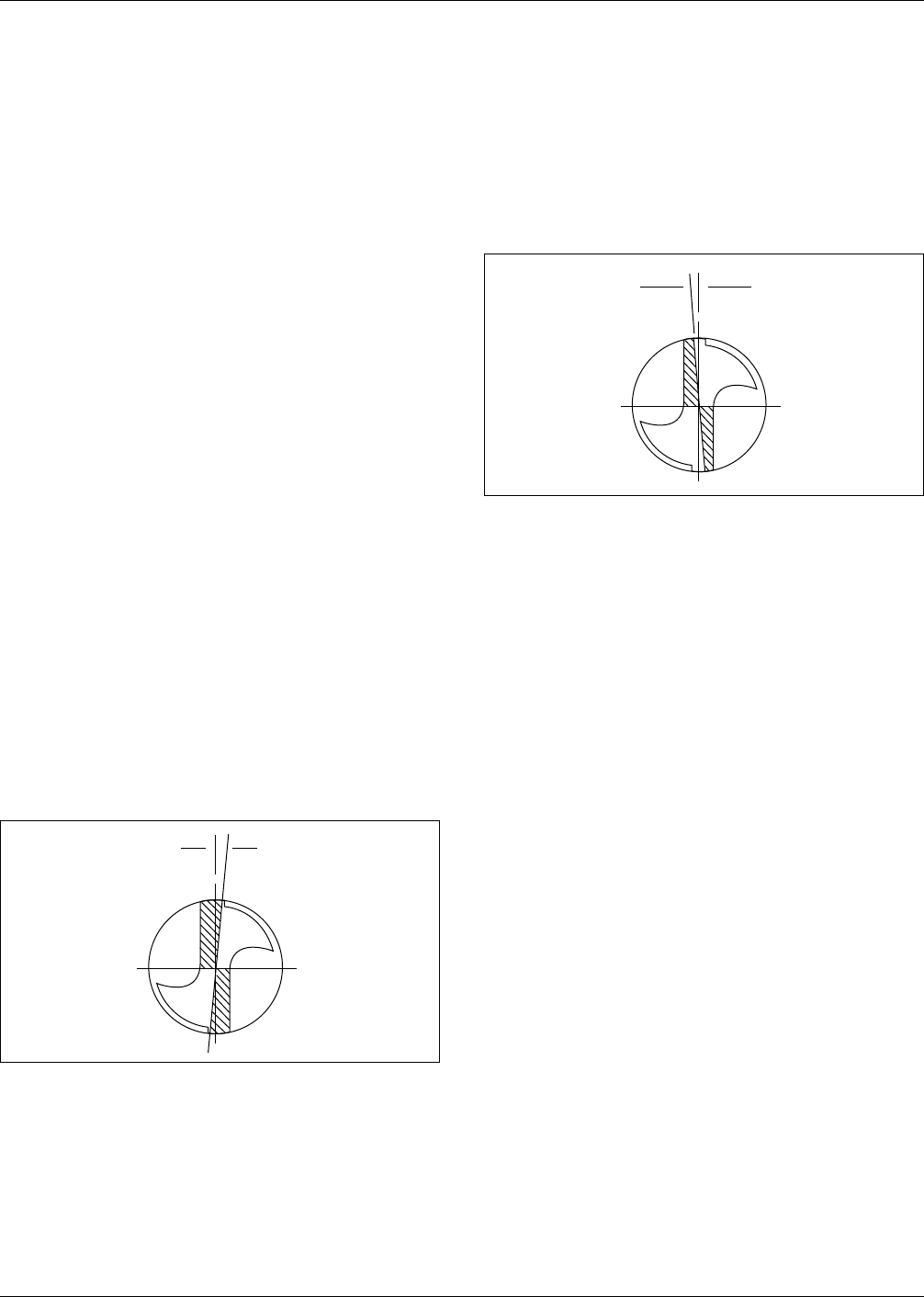
Primary Flare 51.0907
A condition whereby the drill’s primary relief is wider at its
periphery than it is at its center. (See Figure P-2.)
Primary Stage of Manufacture 92.0909
That time during the manufacturing of a product when it is
ready for inspection prior to shipment.
Primary Relief 51.0908
The clearance angle at the outer corner of the cutting edge
of the cutting edge of a drill point.
Primary Side 22.1484
The side of a packaging and interconnecting structure that
is so defined on the master drawing. (It is usually the side
that contains the most complex or the most number of
components.)
Primary Taper 51.0910
A condition whereby the primary relief is wider at the cen-
ter of a drill than it is at the periphery. (See Figure P-3.)
Printed Board (PB) 60.1485
The general term for completely processed printed circuit
and printed wiring configurations. (This includes single-
sided, double-sided and multilayer boards with rigid, flex-
ible, and rigid-flex base materials.)
Printed Board Assembly 80.0911
The generic term for an assembly that uses a printed board
for component mounting and interconnecting purposes.
Printed Board Assembly Drawing 26.1486
The document that shows a printed board, separately
manufactured components, and any information necessary
to describe the joining of them together in order to perform
a specific function.
Printed Circuit 60.0912
A conductive pattern that is composed of printed compo-
nents, printed wiring, discrete wiring, or a combination
thereof, that is formed in a predetermined arrangement on
a common base. (This is also a generic term that is used to
describe a printed board that is produced by any of a num-
ber of techniques.)
Printed Circuit Board 60.1487
Printed board that provides both point-to-point connections
and printed components in a predetermined arrangement on
a common base. (See also ‘‘Printed Wiring Board.’’)
Printed Circuit Board Assembly 80.0913
An assembly that uses a printed circuit board for compo-
nent mounting and interconnecting purposes.
IPC-I-002325
Figure P–2 Primary flare
Primary Flare
▼
▼
IPC-I-002324
Figure P–3 Primary taper
Primary Taper
▼
▼
June 1996 IPC-T-50F
53