IPC-T-50F_.pdf.pdf - 第57页
Pregelation Particle 92.0901 A white spot in a printed board that will not propagate as the result of a thermal excursion. Preheat (n.) 56.0902 A preliminary phase of a process during which the product is heated at a pre…

Polar Solvent 76.1815
A liquid that is ionized to the extent that it is electrically
conductive, that can dissolve noppolar compounds (such as
hydrocarbons and resins), but cannot dissolve polar com-
pounds (such as inorganic salts).
Polarizing Slot 22.0882
A slot in the edge of a printed board that is used to assure
the proper insertion and location of the board in a mating
connector. (See also ‘‘Keying Slot.’’)
Polymer 40.1479
A compound of high molecular weight that is derived from
either the joining together of many small similar or dis-
similar molecules or by the condensation of many small
molecules by the elimination of water, alcohol, or some
other solvent.
Polymer Reversion 76.1480
The irreversible softening or liquifaction of a polymer as
the result of hydrolysis due to the bombardment of the
polymer with vapor molecules that contain an active
hydroxyl group.
Polymerize 40.0884
To form a polymer or polymeric compound.
Polymerized Rosin 76.0885
Rosin that has reacted with itself during the course of a
soldering operation.
Porosity (Solder) 75.0886
A solder coating with an uneven surface and a spongy
appearance that may contain a concentration of small pin-
holes and pits.
Positional Tolerance 22.0887
The amount that a feature is permitted to vary from its
true-position location.
Positive (n.) 24.0888
An artwork, artwork master, or production master in which
the pattern being fabricated is opaque to light and the other
areas are transparent.
Positive-Acting Resist 52.1481
A resist that is decomposed (softened) by light and which,
after exposure and development, is removed from those
areas of surface that were under the transparent areas of a
production master.
Post 37.0889
see ‘‘Terminal.’’
Post Curing 56.0890
Heat aging in order to stabilize material through stress
relieving.
Postprocessing 25.0891
Manipulating data after it has been generated or run
through a batch process.
Postprocessor 25.1482
A software procedure or program that interprets data and
formats it into data that is readable by a numerically-
controlled machine or by other computer programs.
Potting Compound 47.0892
A material, usually organic, that is used for the encapsula-
tion of components and wires.
Power of Source 24.0896
see ‘‘Radiant Intensity’’
Power Plane 22.0897
see ‘‘Voltage Plane.’’
Power Dissipation 21.0893
The energy used by an electronic device in the perfor-
mance of its function.
Power Factor 21.0894
The cosine of the angle of phase difference between current
and the voltage applied.
Power of Experiment 91.0895
The probability of rejecting the results of the null hypoth-
esis when it is false and of accepting the alternative
hypothesis when it is true.
Power Plane Inductance 21.1804
The ractive component inductance, in response to AC
noise, seen on a DC backplane system.
Preconditioning 71.1762
Preparation of a component or assembly for processing or
testing.
Preferred Solder Connection 75.0899
A solder connection that is smooth, bright, and feathered-
out to a thin edge in order to indicate proper solder flow
and wetting action. Also no bare metal is exposed within
the solder connection and there are no sharp protrusions of
solder or the evidence of contamination, e.g., embedded
foreign material.
Pre-finish (n.) 55.0898
A coupling agent that is applied on a fiber in order to
improve compatibility with resins.
Preflow 55.0900
see ‘‘Stabilization Period.’’
IPC-T-50F June 1996
52
Pregelation Particle 92.0901
A white spot in a printed board that will not propagate as
the result of a thermal excursion.
Preheat (n.) 56.0902
A preliminary phase of a process during which the product
is heated at a predetermined rate from ambient temperature
to a desired elevated temperature.
Preheating (v.) 56.1483
The raising of the temperature of a material(s) above the
ambient temperature in order to reduce the thermal shock
and to influence the dwell time during subsequent elevated-
temperature processing.
Preimpregnated Bonding Sheet 41.0903
see ‘‘Prepreg.’’
Prepreg 41.0904
A sheet of material that has been impregnated with a resin
cured to an intermediate stage, i.e., B-staged resin.
Pressfit Contact 37.0905
An electrical contact that can be pressed into a hole in an
insulator or printed board with or without plated-through
holes.
Pretinning 53.0906
see ‘‘Tinning’’
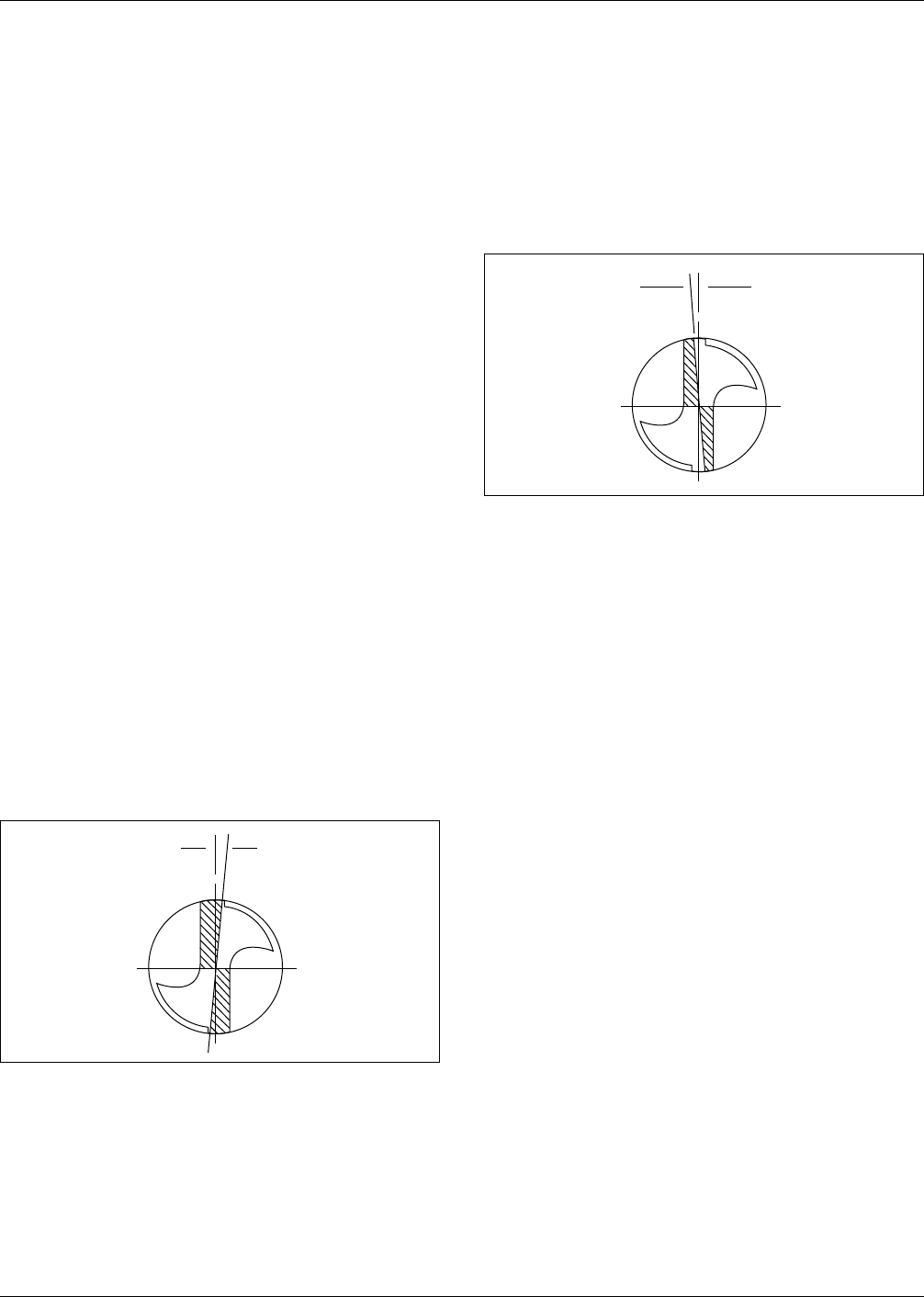
Primary Flare 51.0907
A condition whereby the drill’s primary relief is wider at its
periphery than it is at its center. (See Figure P-2.)
Primary Stage of Manufacture 92.0909
That time during the manufacturing of a product when it is
ready for inspection prior to shipment.
Primary Relief 51.0908
The clearance angle at the outer corner of the cutting edge
of the cutting edge of a drill point.
Primary Side 22.1484
The side of a packaging and interconnecting structure that
is so defined on the master drawing. (It is usually the side
that contains the most complex or the most number of
components.)
Primary Taper 51.0910
A condition whereby the primary relief is wider at the cen-
ter of a drill than it is at the periphery. (See Figure P-3.)
Printed Board (PB) 60.1485
The general term for completely processed printed circuit
and printed wiring configurations. (This includes single-
sided, double-sided and multilayer boards with rigid, flex-
ible, and rigid-flex base materials.)
Printed Board Assembly 80.0911
The generic term for an assembly that uses a printed board
for component mounting and interconnecting purposes.
Printed Board Assembly Drawing 26.1486
The document that shows a printed board, separately
manufactured components, and any information necessary
to describe the joining of them together in order to perform
a specific function.
Printed Circuit 60.0912
A conductive pattern that is composed of printed compo-
nents, printed wiring, discrete wiring, or a combination
thereof, that is formed in a predetermined arrangement on
a common base. (This is also a generic term that is used to
describe a printed board that is produced by any of a num-
ber of techniques.)
Printed Circuit Board 60.1487
Printed board that provides both point-to-point connections
and printed components in a predetermined arrangement on
a common base. (See also ‘‘Printed Wiring Board.’’)
Printed Circuit Board Assembly 80.0913
An assembly that uses a printed circuit board for compo-
nent mounting and interconnecting purposes.
IPC-I-002325
Figure P–2 Primary flare
Primary Flare
▼
▼
IPC-I-002324
Figure P–3 Primary taper
Primary Taper
▼
▼
June 1996 IPC-T-50F
53

Printed Component 52.0914
A part (such as an inductor, resistor, capacitor, or transmis-
sion line) that is formed as part of the conductive pattern
of a printed board.
Printed Components, Conductive Inks 52.1600
Component (e.g. printed inductor, resistor, capacitor or
transmission line) forming part of the pattern of a printed
circuit.
Printed Contact 22.0915
A portion of a conductive pattern that serves as one part of
a contact system.
Printed Edge-Board Contact 22.0916
see ‘‘Edge-Board Contact.’’
Printed Wiring 60.1488
A conductive pattern that provides point-to-point connec-
tions but not printed components in a predetermined
arrangement on a common base. (See also ‘‘Printed Cir-
cuit.’’)
Printed Wiring Board 60.1489
A printed board that provides point-to-point connections
but not printed components in a predetermined arrange-
ment on a common base. (See also ‘‘Printed Circuit
Board.’’)
Printed Wiring Board Assembly 80.0917
An assembly that uses a printed wiring board for compo-
nent mounting and interconnecting purposes.
Printing 52.1592
Act of reproducing a pattern on a surface by any process.
Probe Point 92.0919
The predetermined location on a printed board where elec-
trical contact can be made to exposed circuitry for electri-
cal diagnostic purposes.
Probe, Test 92.0918
A spring-loaded metal device used to make electrical con-
tact between a test equipment and the unit under test.
Process Average 91.0920
The location of the distribution of measured values of a
particular process characteristic.
Process Indicator 91.0921
A detectable anomaly, other than a defect, that is reflective
of material, equipment, personnel, process and/or work-
manship variations.
Process Spread 91.0922
The extent to which the individual values of a process may
vary.
Processability 70.1763
Suitable and capable of being processed.
Producer’s Risk 93.0923
see ‘‘Alpha Error.’’
Production Board 60.1490
A printed board or discrete-wiring board that has been
manufactured in accordance with the applicable detailed
drawings, specifications, and procurement requirements.
Production Master 24.1642
A 1 to-1 scale pattern that is used to produce rigid or flex-
ible printed boards within the accuracy specified on the
master drawimg. (See also ‘‘Multiple-image Production
Master’’ and ‘‘Single Image Production Master’’).
Production Panel (PP) 50.1787
An arrangement of printed boards fabricated from laminate
or base materials as a group in a specific cluster to facili-
tate economic fabrication techniques using controlled and
documented chemical, mechanical and electrical processes.
Production Printed Board (PPB) 50.1786
A printed board fabricated from laminate or base materials
in an environment that consists of controlled and docu-
mented chemical, mechanical and electrical processes used
in combination to produce the features and characteristics
of the final printed board product.
Profile Factor 92.1492
The amount by which the overall average thickness of a
metal exceeds the thickness that is calculated from the
established density of the metal and the area of the sample.
Propagation Delay 21.1493
The time required for an electronic signal to travel along a
transmission line, or the time required for a logic device to
perform its function and to present a signal at its output.
Proportional Dimensions 92.0924
The distortion of an optical system used in a magnification
device.
Pull Strength 92.0925
see ‘‘Bond Strength.’’
Pull-Out Strength 97.1816
The force, normal to the printed board, required to seperate
the metallic wall of a plated-through hole from the base
material.
Pulse, Electronic Signal 21.1494
A logic signal that switches from one digital state to the
other and back again in a short period of time, and that
remains in the original state for most of the time
IPC-T-50F June 1996
54