IPC-T-50F_.pdf.pdf - 第61页
Resin Smear 51.1506 Base material resin that covers the exposed edge of con- ductive material in the wall of a drilled hole. (This resin transfer is usually caused by the drilling operation). Resin-Rich Area 41.1505 The …

Rectangular Leads 36.1764
A lead form or leg shape whose cross section is rectangu-
lar in shape.
Reduction Marks 22.1316
A set of stylized patterns in the border area of an artwork
between which the photographic-reduction dimension is
defined.
Reed 44.1230
A thin comb made of pressed steel wires between which
warp ends are drawn after passing through the needle eyes.
Reference Dimension 26.1231
A dimension without a tolerance that is used only for infor-
mational purposes that does not govern inspection or other
manufacturing operations.
Reference Edge 22.1232
The edge of a cable or conductor from which measure-
ments are made.
Reference Hole 22.1233
see ‘‘Tooling Hole.’’
Reference Master 24.1234
Artwork that is free of defects.
Reflection, Signal 21.1499
The portion of the electrical energy that is sent back toward
its source because the signal encountered a change in
impedance in the transmission line on which it is traveling.
Reflow Soldering 75.1500
The joining of surfaces that have been tinned and/or have
solder between them, placing them together, heating them
until the solder flows, and allowing the surface and the sol-
der to cool in the joined position.
Reflow Spike 75.1235
The portion of the reflow soldering process during which
the temperature of the solder is raised to a value that is
sufficient to cause the solder to melt.
Regardless of Feature Size 22.1236
A geometric tolerance or datum reference that applies at
any increment of size of a feature that is within its size tol-
erance.
Registered Production Master 24.1237
A production master that incorporates physical registration
features.
Registration 50.1240
The degree of conformity of the position of a pattern (or
portion thereof), a hole, or other feature to its intended
position on a product.
Registration Mark 22.1315
A stylized pattern (symbol) that is used as a reference point
for registration.
Regression Analysis 91.1241
The use of statistics to investigate and model the relation-
ships between parameters and results.
Reliability 90.1501
The probability that a component,device, or assembly will
function properly for a definite period of time under the
influence of specific environmental and operatinal condi-
tions.
Removable Contact 37.1242
A type of connector contact that is not permanently
retained within the connector body or insert.
Render True Color 24.1243
The color aberrations of an optical system that have been
sufficiently corrected so as to allow a magnification device
to resolve the required details.
Repair(ing) 77.1502
The act of restoring the functional capability of a defective
article in a manner that recludes compliance of the article
with applicable drawings or specifications.
Repeat Set-Up Time 92.1244
The set-up time for a unit that is identical to one previously
evaluated.
Repeatability (Accept/Reject) Decisions 91.1503
The percentage of features that show the same acceptance
or rejection status on a minimum of three consective tests
using identical operating modes and conditions in a
statistically-significant random sampling of three units.
Residue 76.1245
Any visual or measurable form of process-related contami-
nation.
Resin 40.1246
A natural or synthetic resinous material. (See also ‘‘Rosin’’
and ‘‘Synthetic Resin.’’)
Resin Flux 75.1247
A resin and small amounts of organic activators in an
organic solvent.
Resin Recession 60.1504
The presence of voids between the plating of a plated-
through hole and the wall of the hole as seen in microsec-
tions of plated-through holes that have been exposed to
high temperatures. (See Figure R-1.)
IPC-T-50F June 1996
56

Resin Smear 51.1506
Base material resin that covers the exposed edge of con-
ductive material in the wall of a drilled hole. (This resin
transfer is usually caused by the drilling operation).
Resin-Rich Area 41.1505
The location in a printed board of a significant thickness of
unreinforced surface-layer resin that is of the same compo-
sition as the resin within the base material.
Resin-Starved Area 41.1507
The location in a printed board that does not have a suffi-
cient amount resin to completely wet out the reinforcing
material. (Evidence of this condition is often in the form of
low-gloss dry spots or exposed fibers.)
Resist 52.1508
A coating material that is used to mask or protect select
areas of a pattern during manufacturing or testing from the
action of an etchant, plating, solder, etc. (See also
‘‘Negative-Acting Resist’’ and ‘‘Positive- Acting Resist.’’)
Resistance 21.1805
The restriction to the flow of electrons, determined by
Ohms law; the quotient of DC voltage, applied to the
extremes of a conductor or insulator, and the current flow-
ing through it.
Resistance Soldering 75.1248
Soldering by a combination of pressure and heat generated
by passing a high current through two mechanically-joined
conductors.
Resistance Welding 75.1249
Welding by a combination of pressure and heat generated
by passing a high current through two mechanically-joined
conductors.
Resistor Drift 92.1250
The change in resistance of a resistor caused by aging,
usually expressed a percent change per 1,000 hours.
Resolving Power 24.1509
The ability of a photographic system to maintain the sepa-
rate identity of parallel lines and spaces in a developed
image when their relative displacement is small.
Response Variable 91.1251
The dependent variable being studied.
Reversal Development 24.1252
The reversing of the tone of an image on a photographic
emulsion from that which can be accomplished with con-
ventional developing.
Reverse Current Cleaning 76.1253
see ‘‘Anodic Cleaning’’
Reverse Image 52.1254
The pattern of resist on a printed board that is used to allow
for the exposure of conductive areas for subsequent plat-
ing.
Reversion 96.1510
A chemical reaction in which a polymerized material par-
tially or completely degenerates to a lower polymeric state
or to the original monomer. (This is usually accompanied
by significant changes in physical and mechanical proper-
ties.)
Rework 77.1511
The act of reprocessing noncomplying articles, through the
use of original or alternate equivalent processing, in a man-
ner that assures compliance of the article with applicable
drawings or specifications.
Ribbon Cable 37.1255
A flat cable with round conductors.
Ribbon Interconnect (n.) 37.1256
A flat narrow ribbon of metal used to make interconnec-
tions to lands, lead frames, etc.
Right Reading 24.1257
A phototool pattern-orientation that is the same as the art-
work master when it is viewed from the primary side of a
product. (See Figures M-2 and R-2.)
Right Reading Down 24.1512
An orientation of a phototool in which the pattern is right
and the emulsion is on the surface that is away from the
viewing surface. (See Figures M-2 and R-2.)
Right Reading Up 24.1513
An orientation of a phototool in which the pattern is right
reading and the emulsion is on the surface that is toward
the viewing surface. (See Figures M-2 and R-2.)
IPC-I-001047
Figure R–1 Resin recession
RESIN
RECESSION
RESIN
RECESSION
June 1996 IPC-T-50F
57
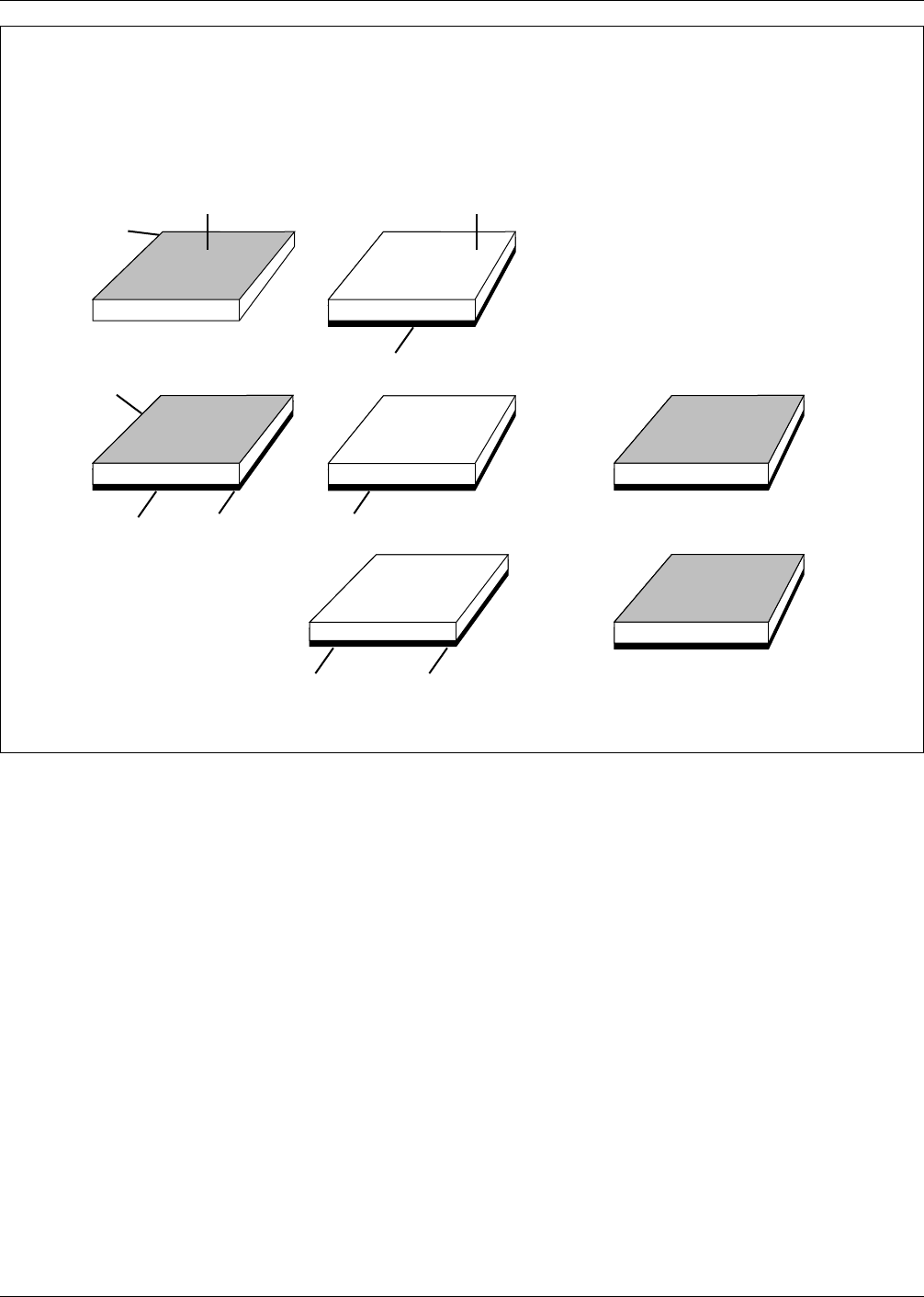
IPC-I-002768
Figure R–2 Printed board viewing orientations
Notes:
1. A precise definition of image tone and orientation necessitates that the orientation of the pattern and the legend be separately
identified. For example: Layer 1—Pos RR DN (Legend Corr. Read) or Layer 2—Pos RR UP (Legend Rev. Read) (There is no such
thing as wrong reading.)
2. By definition, all layer patterns are viewed from the same direction. (This view defines RR for the pattern appearance of all layers; this
is not the same as viewing the final board copper head on.)
3. Legend is usually correct reading when viewing the copper; therefore, on occasion alphanumerics must be reversed reading when
the pattern is right reading by definition.
4. Production master emulsion must be presented against the board copper in the stack up. Therefore, production master emulsion
orientation is opposite to individual copper layer orientation, i.e., if copper is RR UP by definition, corresponding production master
must be RR DN.
5. When specifying artwork tone and orientation, remember the board layup and the purpose of the artwork, i.e., file copy, artwork
master, or production master, etc.
6. In manual designs the artwork is usually prepared at an enlarged scale with tapes and other drafting aids. The artwork master is
produced from the artwork by photographic reduction.
7. In semi-automated designs, there may be no artwork by definition. Typically, an enlarged color-coded printed wiring layout on a
gridded format is prepared for subsequent digitizing and photoplotting. This procedure may yield intermediate phototools which can
be photographically processed into an artwork master or it may directly yield an artwork master, working master, or production
master.
8. In fully automated systems, there is usually no artwork or printed wiring layout prepared. A computerized procedure from a form of
the electrical schematic by total computerization or a combination of computer and interactive design procedures. This procedure
may yield intermediate phototools or the artwork master, working master, or production master directly.
Multilayer
Printed
Boards
Corresponding
Registered
Production
Master
L3 - RR
UP
L4 - RR UP (Legend Rev. Read)
L4 - RR DN
(Legend Rev. Read)
Emulsion
Emulsion
L1 - RR UP
(Legend Corr. Read)
L1 - RR UP
(Legend
Corr.
Read)
Viewing Primary Side
Copper
Substrate Base Material
Substrate Base Material
Substrate
Base Material
Base Material
COPPER
COPPER
EMULSION
EMULSION
▼ ▼
▼
▼
L2 - RR UP
▼
L3 - RR DN
▼
Copper
▼
▼
Viewing Component Side
▼
▼
L2 - RR
DN
IPC-T-50F June 1996
58