IPC-T-50F_.pdf.pdf - 第44页
Light Mark (Fabric) 44.0708 A filling defect that extends across the width of a fabric containing less than one pick per 25mm from nominal. Limits of Size 20.0709 The specified maximum and minimum sizes. Line 20.0710 see ‘…
Lead 36.0688
A length of insulated or uninsulated metallic conductor that
is used for electrical interconnections.
Lead Extension 75.0691
That part of a lead or wire that extends beyond a solder
connection.
Lead Frame 74.0692
The metallic portion of a component package that is used
to interconnect with semiconductor die by wire bonding
and to provide output terminal leads.
Lead Mounting Hole 22.0695
see ‘‘Component Hole.’’
Lead Pin 36.0696
see ‘‘Component Pin.’’
Lead Projection 73.0697
The distance that a component lead protrudes through the
side of a printed board that is opposite from the one upon
which the component is mounted.
Lead Wire 36.0698
see ‘‘Component Lead.’’
Leaded Chip Carrier 31.1224
A chip carrier whose external connections consist of leads
that are around and down the side of the package. (See also
‘‘Leadless Chip Carrier.’’)
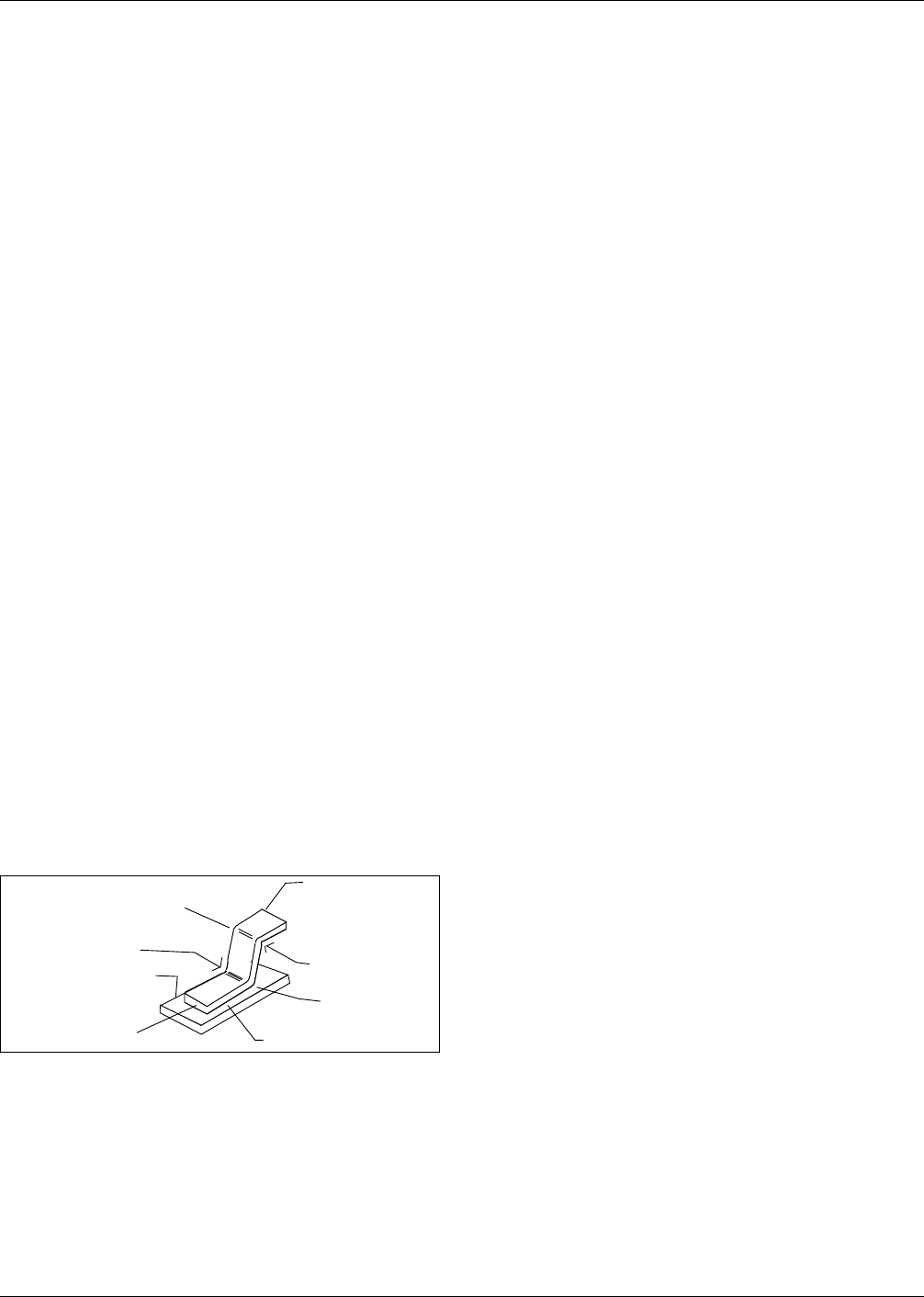
Leaded Surface-Mount Component 33.1435
A surface-mount component for which external connec-
tions consist of leads that are around and down the side of
the package. (See Figure L-3.) (See also ‘‘Leadless
Surface-Mount Component.’’)
Leadless Chip Carrier 33.1436
A chip carrier whose external connections consist of met-
allized terminations that are integral part of the component
body. (See also ‘‘Leaded Chip Carrier.’’)
Leadless Component 30.1754
see Leadless Surface Mount Components .
Leadless Device 33.0694
see Die and Leadless Surface Mount Component .
Leadless Inverted Device 33.1437
A shaped metallized-ceramic form used as an intermediate
carrier for diode or transistor die that has been especially
adapted for leadless surface mounting.
Leadless Surface-Mount Component 33.1438
A surface-mount component whose external connections
consist of metallized terminations that are integral part of
the component body. (See also ‘‘Leaded Surface-Mount
Component.’’)
Leakage Current 21.0699
The undesired flow of electrical current over or through an
insulator.
Learn Time 92.0700
The time it takes to do initial programming (teaching) to
store feature coordinate locations and other data in an
inspection/test machines memory.
Least Material Condition (LMC) 22.0701
The condition in which a feature of size contains the least
amount of material within the stated limits of size.
Legend 22.1439
A format of letters, numbers, symbols and patterns that are
used primarily to identify component locations and orien-
tations for convenience of assembly and maintenance
operations.
Leno End Out 44.0702
Warp-end wrapper that is missing from the end of a fabric.
Levelling 56.0703
see ‘‘Fusing.’’
Levelling Flux 56.0704
see ‘‘Fusing Flux.’’
Levelling Oil 56.0705
see ‘‘Fusing Oil.’’
Library 20.0706
A catalog of related items that contains all of the informa-
tion about the items that is necessary for processing by a
computer program.
Lifted Land 60.0707
A land that has fully or partially separated (lifted) from the
base material, whether or not any resin is lifted with the
land.
IPC-I-001034
Figure L–3 Leaded surface mount component gull-wing
shaped lead
FOOT
HEEL
TOE
LAND
KNEE
UPPER
BEND RADIUS
LOWER
BEND RADIUS
June 1996 IPC-T-50F
39

Light Mark (Fabric) 44.0708
A filling defect that extends across the width of a fabric
containing less than one pick per 25mm from nominal.
Limits of Size 20.0709
The specified maximum and minimum sizes.
Line 20.0710
see ‘‘Conductor.’’
Line Coupling 21.0711
The interaction between two transmission lines that is
caused by their mutual inductance and the capacitance
between them.
Lip Height 51.0712
The perpendicular distance from one primary cutting edge
to another.
Load Capacitance 21.0713
The capacitance seen by the output of a logic circuit or
other signal source.
Load Time 92.0714
The time it takes to load a unit in an inspection/test
machine and to perform any necessary programming or
machine alignment.
Local Fiducial 20.0715
A fiducial mark (or marks) used to locate the position of a
land pattern for an individual component on a printed
board.
Local Intelligence 25.0716
The capability of a work station to independently process
data without the use of a host or central processing unit.
Locating Edge 20.0028
A tooling feature in the form of the edge of a printed board.
Locating Edge Marker 20.0717
A symbol that is used to identify which edge of a printed
board is the index edge.
Locating Hole 20.0718
see ‘‘Tooling Hole.’’
Locating Notch 20.0719
A tooling feature in the form of a notch in a printed board.
Locating Slot 20.0720
A tooling feature in the form of a slot in a printed board.
Location Hole 20.1726
A hole or notch in the panel or printed board to enable
either to be positioned accurately.
Logic 21.0721
The functional digital circuits used to perform computa-
tional functions.
Logic Diagram 21.1440
A drawing that depicts the multistate device implementa-
tion of logic functions with logic symbols and supplemen-
tary notations that show the details of signal flow and con-
trol, but not necessarily the point-to- point wiring.
Logic Family 21.1441
A collection of logic functions using the same form of
electronic circuit, e.g., emitter-coupled logic (ECL),
transistor-transistor logic (TTL), complementary metal-
oxide semiconductor logic (CMOS).
Long-Term Capability 91.0722
The capability of a process that exhibits statistical control
over an extended period of time.
Loom Beam 44.0723
A large flanged cylinder onto which all warp yarns are
wound and from which the yarns enter the loom.
Loop Height 76.0725
The magnitude of deviation of a wire from a straight path
between its end attachment points.
Loop, Wire 76.0724
The curve (arc) in a bonding wire between its end attach-
ment points.
Loss Tangent 21.0726
see ‘‘Dissipation Factor.’’
Lot Size 91.1442
A collection of units produced in one continuous, uninter-
rupted fabrication run from which a sample is drawn and
inspected or tested in order to determine conformance with
acceptability criteria.
Luminance 24.0727
A measure of light flux reflected or emitted from a surface.
Luminous Energy 24.0728
A measure of light flux flow rate, usually in units of lumen-
seconds.
Luminous Flux 24.0729
A measure of flow of visible light energy past any given
point in space.
Lyophilic 76.1225
A characterization of material that readily goes into colloi-
dal suspension in a liquid.
IPC-T-50F June 1996
40
Lyophobic 76.0730
A characterization of material that exists in a colloidal state
with a tendency to repel liquids.
M
Machine Language 11.0732
The actual language, usually a binary code, that is used by
a computer when it performs operations.
Machined Contact 37.0731
A type of connector contact that consists of solid spring
metal that has been formed by machining. (See also
‘‘Sheet-Metal Contact.’’)
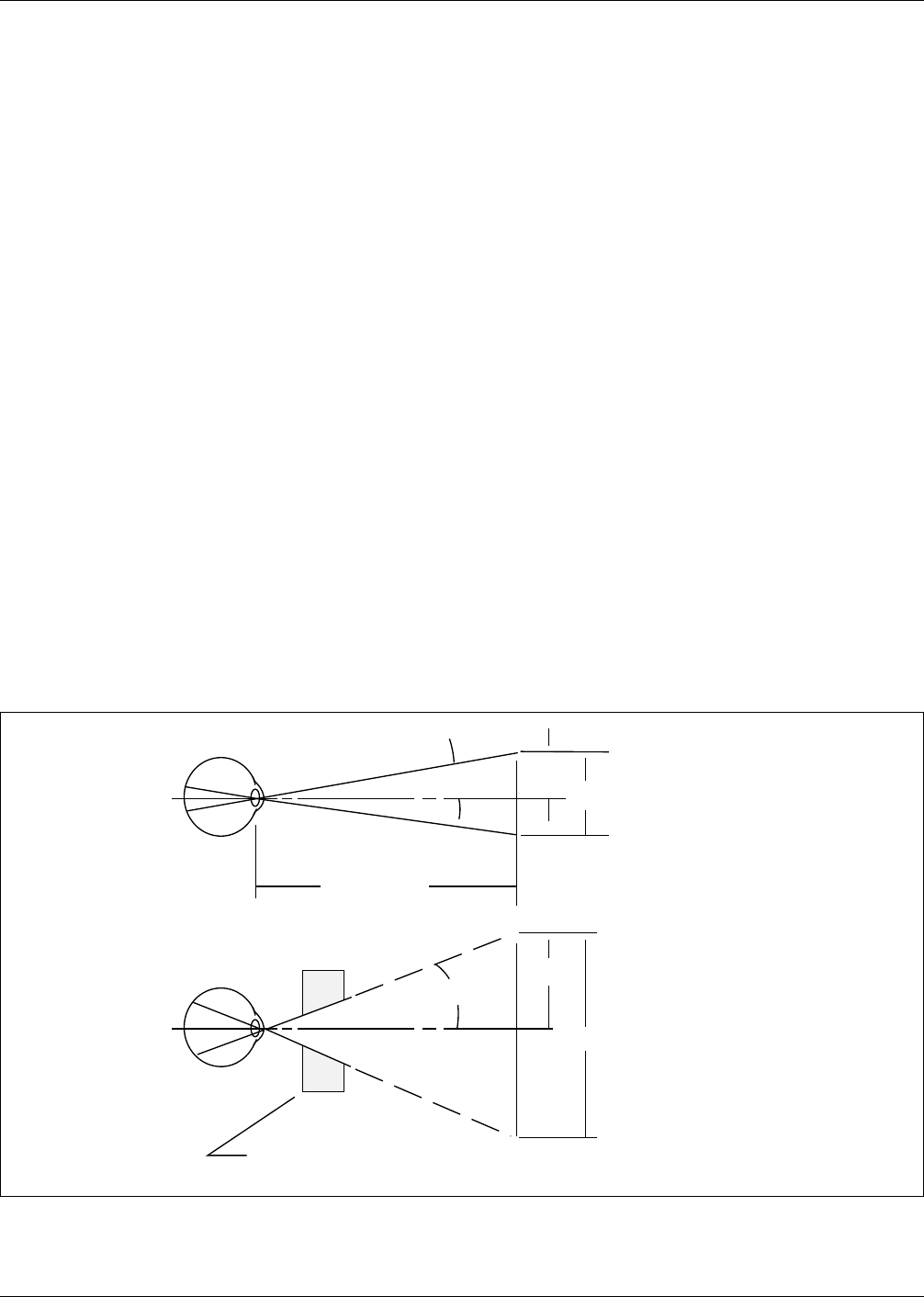
Magnification Power 92.0733
The ratio of the tangent of one-half of the angle (beta) sub-
tended by the image of an object (H), as seen through and
centered in the field of view of the magnification device, to
the tangent of one-half of the angle (alpha) subtended by
the object (H) as seen at 10 inches by the unaided eye. (See
Figure M-1.)
Major Defect 94.0734
A defect that is likely to result in a failure of a unit or
product or that materially reduces its usability for its
intended purpose.
Manhattan Distance 25.0735
The orthogonal distance between two points.
Manual Data Input 25.0736
Computer data that is manually generated with or without
the aid of a data-entry device, such as a keyboard, lightpen,
mouse, etc.
Manual Soldering 75.0737
see ‘‘Hand Soldering.’’
Manufacturing Drawing 26.1634
A working document that shows the dimensional limits or
grid locations that are applicable to any and all parts of a
product to be fabricated, including the arrangement of con-
ductors and nonconductive patterns or elements; the size,
type, and location of holes; and all other necessary infor-
mation.
Manufacturing Hole 20.0738
see ‘‘Tooling Hole.’’
Margin (Flat Cable) 37.0739
The distance between the reference edge of a flat cable and
the nearest edge of the first conductor. (See also ‘‘Edge
Spacing.’’)
Margin Width (Drill) 51.0740
The thickness of the cylindrical portion of a drill land that
is perpendicular to the leading edge.
IPC-I-002273
Figure M–1 Magnification power parameters
▼
▼
Magnifying aid focused so eye is
focused for infinity
Centered Image
of the Object
seen through aid
H
’
1/2 H
’
▼
β
▼
▼
▼
▼
254mm [10"]
Object viewed
with unaided
eye
H
1/2 H
▼
α
▼
▼
▼
▼
▼
▼
▼
▼▼
June 1996 IPC-T-50F
41