IPC-T-50F_.pdf.pdf - 第25页
Datum Feature 22.0345 An actual feature of a part that is used to establish a datum. Datum Reference 22.0346 A defined point, line or plane that is used to locate a pat- tern or layer for manufacturing purposes, inspectio…
Cumulative Tolerance 22.1373
The summation of the tolerances that are permitted
between funtionally- related features. (See also ‘‘Baseline
Dimensioning,’’ ‘‘Basic Dimension,’’ ‘‘Chain Dimension-
ing’’ and ‘‘Direct Dimensioning.’’)
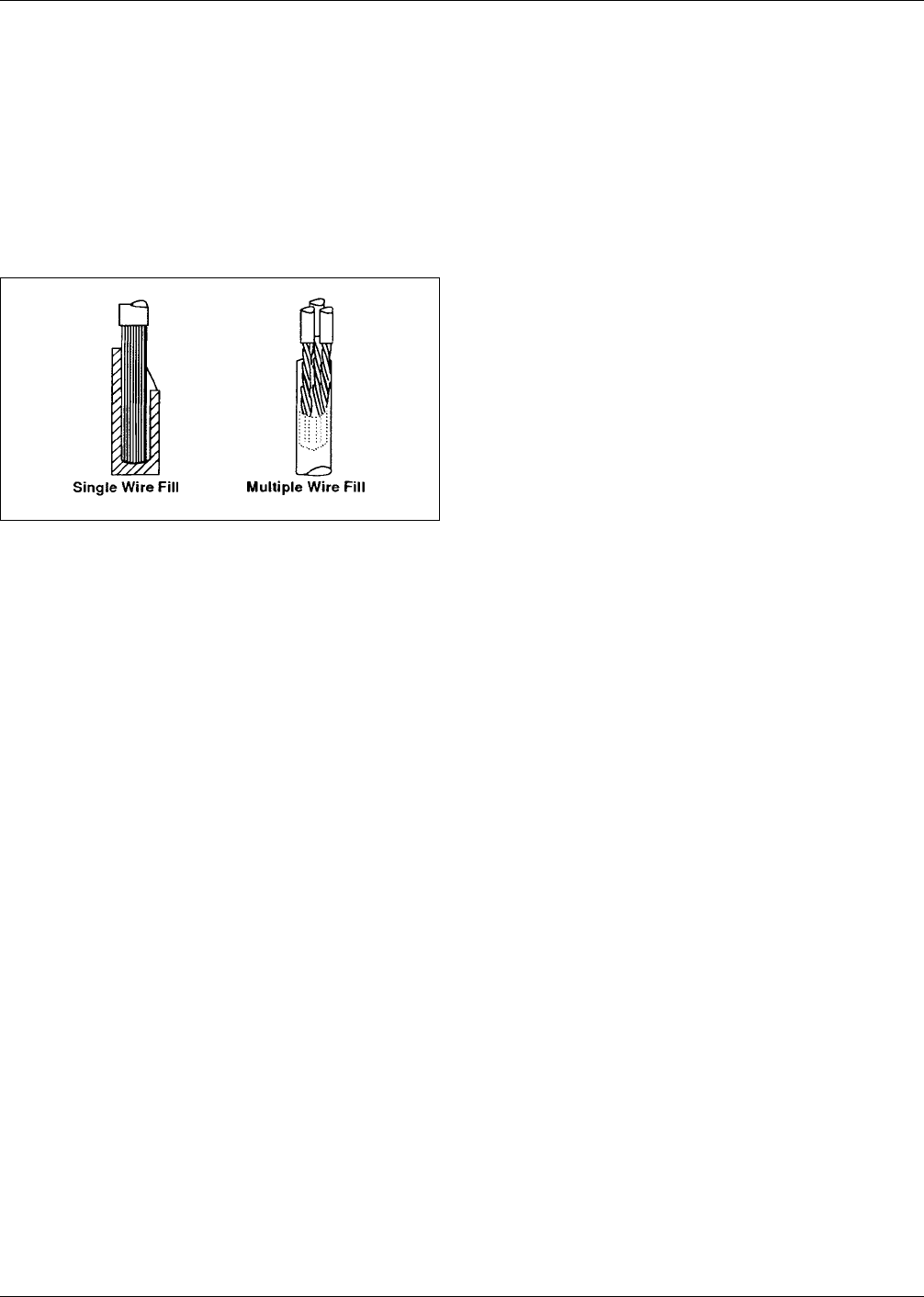
Cup Solder Terminal 37.0329
A cylindrical solder terminal with a hollow opening into
which one or more wires are placed prior to soldering. (See
Figure C-7.)
Cure 56.0330
A chemical reaction that changes the physical properties of
a substance, e.g., an adhesive.
Cure Time 56.0331
The time at which ultimate physical properties of a curing
thermosetting plastic composition are reached.
Curing Agent 56.0332
A chemical substance that can react with a resin in order to
physically harden the resin.
Current 21.1795
The flow or movement of electrons in a conductor as the
result of a voltage difference between the ends of the con-
ductive path.
Current-Carrying Capacity 21.1374
The maximum electrical current that can be carried con-
tinuously by a conductor, under specified conditions, with-
out causing objectable degradation of electrical and
mechanical properties of the product.
Customer Detail Specification (CDS) 26.1779
A document that establishes the specific requirements,
noted in a detailed specification, in order to tailor these to
meet the needs of a custom product, material, or service.
Cusum Chart 91.0333
A diagram that depicts cumulative deviation from a target.
Cut-and-Peel 24.0334
see ‘‘Cut-and-Strip.’’
Cut-and-Strip 24.0335
The making of artwork by cutting a pattern in a resist and
stripping away the unwanted areas or resist.
Cut-Off 74.0336
The operation that follows the final bonding step that sepa-
rates the bond from the source of the wire.
Cylindrical Components 30.1738
A part having the shape of a cylinder.
D
D Curve 24.0347
see ‘‘Characteristic Curve’’
Data Capture 25.0340
The automatic collection of information from a given
machine or other information source.
Data File 11.0341
A database organized in a specific manner for a specific
application.
Data Layer 25.0342
A specific group of related records that are within any indi-
vidual data- information module.
Data Logging 11.0343
The ability of a host computer or test analyzer to store ana-
lyzed data along with statistical data.
Data-Entry Device 25.0337
A device terminal used to enter information into a com-
puter system. (See also ‘‘Control Console).
Data-Information Module (DIM) 25.0338
A group of records that contain related data that describe a
specific function or task.
Database 11.0339
A comprehensive collection of information that is so struc-
tured that some or all of its data may be used to create
queries about related items contained within it.
Date Code 30.1739
Marking of products to indicate their date of manufacture.
Datum 22.0344
The theoretically-exact point, axis or plane that is the ori-
gin from which the location of geometric characteristics of
features of a part are established.
IPC-I-000000
Figure C–7 Cup Solder Terminal
IPC-T-50F June 1996
20

Datum Feature 22.0345
An actual feature of a part that is used to establish a datum.
Datum Reference 22.0346
A defined point, line or plane that is used to locate a pat-
tern or layer for manufacturing purposes, inspection pur-
poses, or both.
Decoupling 21.1375
The absorbing of noise pulses in power supply lines, that
was generated by switching logic, so as to prevent the lines
from disturbing other logic in the same power-supply cir-
cuit.
Defect 90.0348
Any nonconformance to specified requirements by a unit or
product.
Defect Identification 90.0349
The provision for recording the location of a detected
anomaly.
Definition 52.1701
Degree of conformity of the pattern edges with the produc-
tion master.
Definition (Phototool) 24.0350
The clarity of detail in an optically-produced image.
Degradation 90.0351
A decrease in the performance characteristics or service life
of a product.
Degrees of Freedom (df) 94.0352
The number of comparisons that are available in order to
learn about an event.
Delamination 55.1376
A separation between plies within a base material, between
a base material and a conductive foil, or any other planar
separation with a printed board. (See also ‘‘Blister.’’)
Delivered Panel (DP) 50.1788
A production or prototype panel, or portion of either,
intended to contain one or more printed boards in a specific
arrangement or cluster, in order to facilitate economic
assembly and testing in the next level of manufacturing.
Dendritic Growth 90.0353
Metallic filaments that grow between conductors in the
presence of condensed moisture and an electric bias. (See
also ‘‘Whiskers.’’)
Dendritic Migration 90.0354
Migration that proceeds through an insulator in a ‘‘treeing’’
fashion.
Denier 44.0355
The weight, in grams, of 9000 meters of fiber, filament or
yarn..
Densitometer 24.0356
An instrument that is used to measure the amount of light
that has been absorbed by a photographic film.
Density (Phototool) 24.0357
The logarithm of the value of opacity.
Dent 45.0358
A smooth depression in conductive foil that does not sig-
nificantly reduce the foil’s thickness.
Dentrices 90.0359
see ‘‘Dendritic Migration’’
Dependent of Feature Size 22.0360
The concept that permits tolerances of form or position to
vary in proportion to, and dependent on, a feature’s size.
Depth of Field (Optical) 24.0361
The maximum vertical height of an object facing a lens
over which an image is in focus.
Design Automation 20.1377
The use of computer systems, programs, and procedures in
the design process wherein, the computer is responsible for
the decision-making activity and data manipulation func-
tion.
Design Spacing of Conductors 22.0364
The spacing between conductors as delineated or otherwise
noted on the master drawing. (See also ‘‘Conductor Base
Spacing.’’)
Design Width of Conductors 22.0365
The width of conductors as delineated or otherwise noted
on the master drawing. (See also ‘‘Conductor Base Spac-
ing’’ and ‘‘Conductor Spacing.’’)
Design Rule 22.0363
Guidelines that determine automatic conductor routing
behavior with respect to specified design parameters.
Design-Rule Checking 22.0362
The use of a computer-aided design program to perform
continuity verification of all conductor routing in accor-
dance with appropriate design rules.
Desmear 57.0366
The removal of friction-melted resin and drilling debris
from a hole wall.
June 1996 IPC-T-50F
21
Detail Specification 26.1740
A detailed written description of a part or a process.
Detailed Specification (DS) 26.1781
A document that describes the exact requirements for a
specific product, material, or service.
Detection 91.0367
A strategy that attempts to identify and separate acceptable
and unacceptable outputs from a process.
Developing (Phototool) 24.0368
The chemical treatment of radiation-modified photosensi-
tive material in order to produce an image.
Device 30.0369
An individual electrical circuit element that cannot be fur-
ther reduced without destroying its stated function.
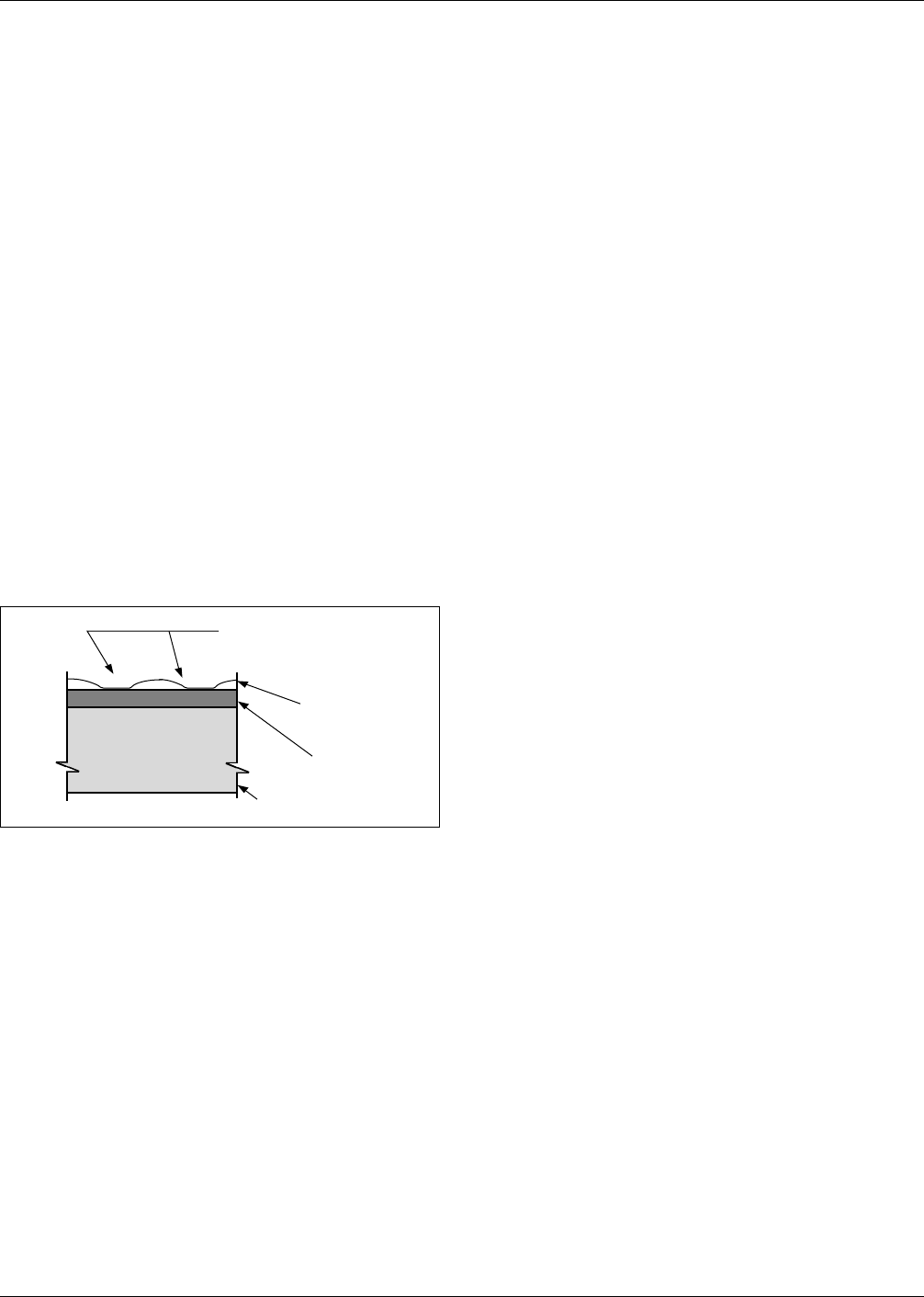
Dewetting 97.0370
A condition that results when molten solder coats a surface
and then recedes to leave irregularly-shaped mounds of
solder that are separated by areas that are covered with a
thin film of solder and with the basis metal not exposed.
(See Figure D-1.)
Diazo Material 24.0371
A nonsilver, room-light hardening, ultraviolet-sensitive
coating material.
Dibasic Acid 76.0372
An acid containing two atoms of acidic hydrogen in a mol-
ecule.
Dice 35.0373
Two or more die.
Dicyandiamide 41.0374
A solid curing agent for epoxy resins.
Die 35.0375
The uncased and normally leadless form of an electronic
component that is either active or passive, discrete or inte-
grated. (See also ‘‘Dice.’’)
Die Bonding 74.0376
The attachment of a die to base material.
Dielectric 40.0377
A material with a high resistance to the flow of direct cur-
rent, and which is capable of being polarized by an electri-
cal field.
Dielectric Constant 21.1379
The ratio of the capacitance of a configuration of electrodes
with a specific material as the dielectric between them to
the capacitance of the same electrode configuration with a
vacuum or air as the dielectric.
Dielectric Breakdown 21.1378
The complete failure of a dielectric material that is charac-
terized by a disruptive electrical discharge through the
material that is due to deterioration of material or due to an
excessive sudden increase in applied voltage.
Dielectric Fluid 21.0378
A fluid that has excellent dielectric strength, excellent vol-
ume resistivity, a low dielectric constant, and a low dissi-
pation factor.
Dielectric Strength 21.1380
The maximum voltage that a dielectric can withstand under
specified conditions without resulting in a voltage break-
down, usually expressed as volts per unit dimension.
Diffusion Bond 74.0379
A bond formed in the absence of any liquid phase at any
time prior to or during the joining process.
Digital Circuit 21.0380
An electrical circuit that provides two (binary) or three dis-
tinct relationships (states) between its input and output.
Digitizing (CAD) 25.0381
The converting of feature locations on a flat plane to its
digital representation in X-Y coordinates.
Dilution Ratio 76.1221
The maximum number of unit volumes of hydrocarbons
that can be added per unit volume of active solvent in order
to cause the first trace of gelation to occur when the con-
centration of nitrocellulose in the solution is 8-grams per
100-milliliters.
Dimensional Stability 21.1381
A measure of the dimensional change of material that is
caused by factors such as temperature changes, humidity
changes, chemical treatment (aging), and stress exposure.
IPC-I-001029
Figure D–1 Dewetting
DEWETTING
SOLDER
BASE METAL
BASE MATERIAL
IPC-T-50F June 1996
22