IPC-T-50F_.pdf.pdf - 第38页
Hole Breakout 60.1699 A condition in which a hole is not completely surrounded by the land. (See Figure H-1.) Hole Density 22.0610 The quantity of holes in a unit area of printed board. Hole Location 22.0611 The dimensio…

H
Halide Content 76.0584
The ratio of the mass of free halides to the mass of solids
in a flux, expressed in mass percent of free chloride ion.
Haloing 51.1415
Mechanically-induced fracturing or delamination, on or
below the surface of a base material, that is usually exhib-
ited by a light area around holes or other machined fea-
tures.
Hand Soldering 75.0585
Soldering using a soldering iron or other hand-held,
operator- controllable apparatus.
Hard Wiring 75.0587
Electrical wiring that is inseparable from an assembly with-
out the use of special tools and processes.
Hardeners 56.0586
see ‘‘Curing Agent.’’
Haywire 37.0588
A discrete electrical connection that is added to a printed
board in order to modify the basic conductive pattern
formed on the board. (See also ‘‘Jumper Wire.’’)
Header (Connector) 37.0589
A pin field that is positioned in a 3- or 4-sided plastic
housing that mounts directly onto a printed board.
Header (Module) 36.0590
The base of an electronic component package that contains
leads.
Heat Cleaning 44.0591
A process in which organic yarn binder (size) is removed
from a fabric. (See also ‘‘Sizing.’’)
Heat Column 75.0592
The heating element in a eutectic die bonder or wire
bonder that is used to bring the base material up to its
bonding temperature.
Heat of Fusion 56.0593
The quantity of heat required to convert a unit weight of
solid material to its liquid state.
Heatsink 30.0594
A mechanical device that is made of a high thermal-
conductivity and low specific-heat material that dissipates
heat generated by a component or assembly.
Heatsink Plane 22.0595
A continuous sheet of metal on or in a printed board that
functions to dissipate heat away from heat generating com-
ponents.
Heatsink Tool 75.1416
A heatsink that is temporarily attached to a heat-sensitive
component in order to minimize the transfer of heat from
the component lead to the component body during a solder-
ing operation.
Heavy Mark (Fabric) 44.0596
A filling defect that extends across the width of a fabric
containing in excess of two picks per inch from nominal.
Heel, Bonding 74.0598
The part of a lead adjacent to a termination that has been
deformed by the edge of the bonding tool.
Heel Break 97.0599
The rupture of a lead at the heel of a bond.
Heel Crack 97.0600
A crack across the width of a lead at the heel of a bond.
Heel (Drill) 51.0597
The trailing edge of a drill land
Helix Angle 51.0601
The angle of the spiral generated by the flute of a drill with
respect to the axis of the drill.
Hermaphroditic Contact 37.0602
A type of connector contact that mates with a contact that
is identical to itself.
Heterocyclic 76.0603
A cyclic or ring structure, often in the shape of a pentagon,
in which one or more of the atoms in the ring is an element
other than carbon.
Hierarchical Database 11.0604
A database that is arranged in a tree-like structure of logic.
High-Impedance State 21.0605
see ‘‘Tri-State.’’
High-Voltage Wire 37.0606
Insulated wire, with an insulation thickness that is deter-
mined by corona-related factors, that is used for voltag es
over 240 Vac RMS or over 340 Vdc.
Hipot Test 92.0607
A method in which the unit under test is subjected to a high
alternating current (ac) voltage.
Histogram 91.0608
A graph that depicts values that were obtained by dividing
the range of a data set into equal intervals and that plots the
number of data points in each interval.
June 1996 IPC-T-50F
33
Hole Breakout 60.1699
A condition in which a hole is not completely surrounded
by the land. (See Figure H-1.)
Hole Density 22.0610
The quantity of holes in a unit area of printed board.
Hole Location 22.0611
The dimensional position of the center of a hole.
Hole Pattern 22.1621
The arrangement of all the holes in a printed board or pro-
duction board.
Hole Pull Strength 53.0613
The load or pull force along the axis of a plated-through
hole that will rupture the hole.
Hole Void 53.0614
A void in the metallic deposit of a plated-through hole that
exposes the base material.
Homocyclic 76.0615
A ring compound containing only one kind of atom in its
ring structure.
Homologous Series 76.0616
A series of organic compounds in which each successive
member has one more CH
2
group in its molecule than the
preceding member.
Homopolymer 76.0617
A polymer derived from a single monomer with the aid of
initiators that act in the manner of catalysts.
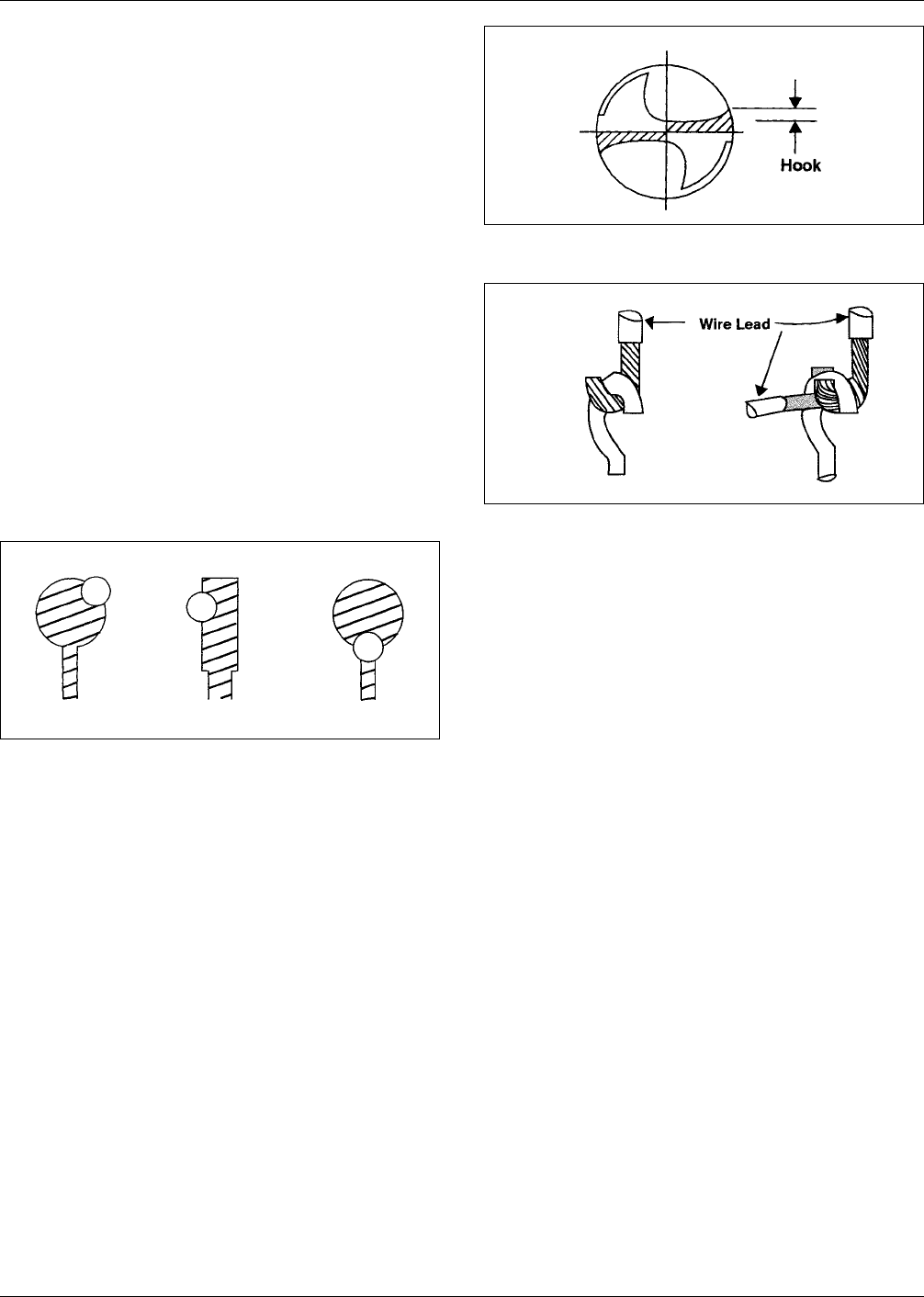
Hook 51.0618
The rake condition in the flute face of a drill. (See Figure
H-2.)
Hook Solder Terminal 37.0619
A solder terminal with a curved feature around which one
or more wires are wrapped prior to soldering. (See Figure
H-3.)
Horn 74.0620
A cone-shaped object that transmits ultrasonic energy from
a transducer to a bonding tool.
Hot Plate Reflow Soldering 75.1748
Reflow soldering using direct contact or close proximity to
a hot plate as the primary source of heat.
Hybrid Circuit 83.1417
An insulating base material with various combinations of
interconnected film conductors, film components, semicon-
ductor dice, passive components and bonding wire that
form an electronic circuit.
Hybrid Integrated Circuit 83.1418
An insulating base material with various combinations of
interconnected film conductors, film components, semicon-
ductor dice, passive components and bonding wire that per-
form the same function as a monolithic semiconductor inte-
grated circuit.
Hybrid Microcircuit 83.1419
An insulating base material with various combinations of
interconnected film conductors, film components, semicon-
ductor dice, passive components and bonding wire that
form an electronic microcircuit.
Hydrocarbon Tolerance 76.0621
see ‘‘Dilution Ratio.’’
Hydrolytic Stability 76.0622
The degree of resistance of a polymer to permanent prop-
erty changes from hydrolytical effects.
IPC-I-001031
Figure H–1 Hole breakout
IPC-I-000000
Figure H–2 Hook
IPC-0-000000
Figure H–3 Hook solder terminal
IPC-T-50F June 1996
34

Hydrophilic Matter 76.0623
see ‘‘Polar Matter.’’
Hydrophilic Solvent 76.0624
see ‘‘Polar Solvent.’’
Hydrophobic Matter 76.0625
see ‘‘Nonpolar Matter.’’
Hydrophobic Solvent 76.0626
see ‘‘Nonpolar Solvent.’’
Hydrotrope 76.0627
A chemical that can increase the aqueous solubility of
slightly-soluble organic chemicals.
Hydrotrophe 76.0628
see ‘‘Hydrotrope.’’
Hypersorption 76.0629
The process by which activated carbon selectively absorbs
less-volatile components from a gaseous mixture while the
more-volatile components are unaffected.
Hypotheses Test 91.0630
An objective method to determine and quantify, within
known levels of risk, whether or not a hypothesis is either
accepted or rejected.
I
Icicle 75.0631
see ‘‘Solder Projection.’’
Identical Processing 91.0632
Fabrication that is conducted under conditions that have
demonstrated the capability to produce measurable
attributes within a narrow band of variability.
Illuminance 24.0633
Luminous flux striking a surface.
Illumination 24.0634
see ‘‘Illuminance.’’
Immersion Attitude 75.1749
The positioning of an object when immersed in a solder
bath.
Immersion Conditions 95.1750
Test conditions resulting when a surface mounting device
package leads are immersed into a solder bath to check
resistance to soldering temperatures.
Immersion Plating 53.0635
The chemical deposition of a thin metallic coating over
certain basis metals that is achieved by a partial displace-
ment of the basis metal.
Impedance 21.1801
The resistance to the flow of current, represented by an
electrical network of combined resistance, capacitance and
inductance reaction, in a conductor as seen by an AC
source of varying time voltage. The unit of measure is
ohms.
In-Circuit Testing 92.0636
The application of test signals directly to a device’s input
terminals and sensing the results directly from the device’s
output terminals.
Inclusions 90.0637
Foreign particles, metallic or nonmetallic, that may be
entrapped in an insulating material, conductive layer, plat-
ing, base material, or solder connection.
Indentation 45.0638
see ‘‘Dent.’’
Independent of Size 22.0639
The concept that requires the tolerance of form or position
to vary independent of, and without regard to, feature size.
Index Edge 22.0640
see ‘‘Locating Edge.’’
Index Edge Marker 22.0641
see ‘‘Locating Edge Marker.’’
Indexing Hole 22.0642
see ‘‘Tooling Hole.’’
Indexing Notch 22.0643
see ‘‘Locating Notch.’’
Indexing Slot 22.0644
see ‘‘Locating Slot.’’
Individual Test Pattern (ITP) 24.1791
A single test pattern designed and intended to serve a spe-
cific evaluation technique for determining a particular
aspect(s) of a manufacturer or manufacturing process capa-
bility.
Individual Test Specimen (ITS) 92.1790
A single test specimen that contains an individual test pat-
tern (ITP) and is used to determine a particular aspect(s) of
a manufacturer or manufacturing process capability.
June 1996 IPC-T-50F
35