IPC-T-50F_.pdf.pdf - 第23页
Cover Lay (Flexible Circuit) 42.0304 The layer of insulating material that is applied covering totally or partially over a conductive pattern on the outer surfaces of a printed board. Cover Layer 42.0305 see ‘ ‘Cover Lay…
Continuity 92.0284
An uninterrupted path for the flow of electrical current in a
circuit.
Contract Services 17.0285
Printed-board manufacturing processing operations that are
performed for by another vendor outside the manufactur-
er’s facility.
Control Chart 91.1368
A graphic representation of a characteristic of a process
that shows plotted values of some statistic gathered from
characteristic, a central line, and one or two statistically-
derived control limits.
Control Console 11.0286
A device terminal used to manipulate and maintain the
operating system of a computer.
Control Drawing 22.0287
see ‘‘Master Drawing.’’
Control Limits 91.0290
The maximum allowable variation of a process characteris-
tic due alone to common causes.
Controlled Collapse, Component Connection 75.0289
see ‘‘Controlled Collapse Soldering’’
Controlled Collapse Soldering 75.0288
The making of termination by controlling the height of sol-
der balls in a flip-chip assembly operation.
Convected Energy 75.1736
Heat transferred through circulation of fluid or gas.
Conveyor, Edge 70.0291
A transporting mechanism that supports a product by the
edges.
Conveyor, Mesh 70.0292
A transporting mechanism that fully supports the product.
Conveyor, Secondary 70.0293
A transporting mechanism used beneath the edge conveyor
to catch a fallen product.
Coordinatograph 92.0294
An X- and Y-coordinate plotting and measuring machine.
Coplanar Leads 33.0295
The flat beam leads of a component package that have been
formed so that they can simultaneously contact one plane
of a base material.
Copolymerize 49.0847
The creation of a polymer by the joining of two or more
different monomers in repeating chain.
Copper-Mirror Test 92.0296
A test of the corrosivity of a flux on a copper film that is
vacuum- deposited on a glass plate.
Corner Marks 22.0297
The marks at the corners of artwork whose inside edges
establish, or help to establish, the borders and contour of a
printed board.
Coronizing 44.0298
Continuous heat cleaning and weave setting.
Corrosion (Chemical/Electrolytic) 76.0299
The attack of chemicals, flux, and flux residues on base
metals.
Corrosive Flux 75.0300
Flux that contains levels of halides, amines, or organic
acids that cause corrosion of copper.
Cosine Law (Illumination) 24.1369
A law of illumination that states that the flux radiated or
received in a given direction varies with the projected area
of the receiver or emitter in a plane that is perpendicular to
the direction of the flux.
Cost of Quality 94.0301
The money spent in the creation, control, and evaluation of
quality and the consequences of the failure to meet speci-
fied requirements.
Coupon 92.0302
see ‘‘Test Coupon.’’
Coupon (Breakaway) 92.1220
Coupons made as an integral part of the end product board
and connected as one piece, except one edge of the coupon
has perforations or a thin section connected to the board
which can be easily broken off without damaging either the
coupon or the board.
Cover Coat 42.0303
see ‘‘Cover Lay.’’
IPC-I-001152
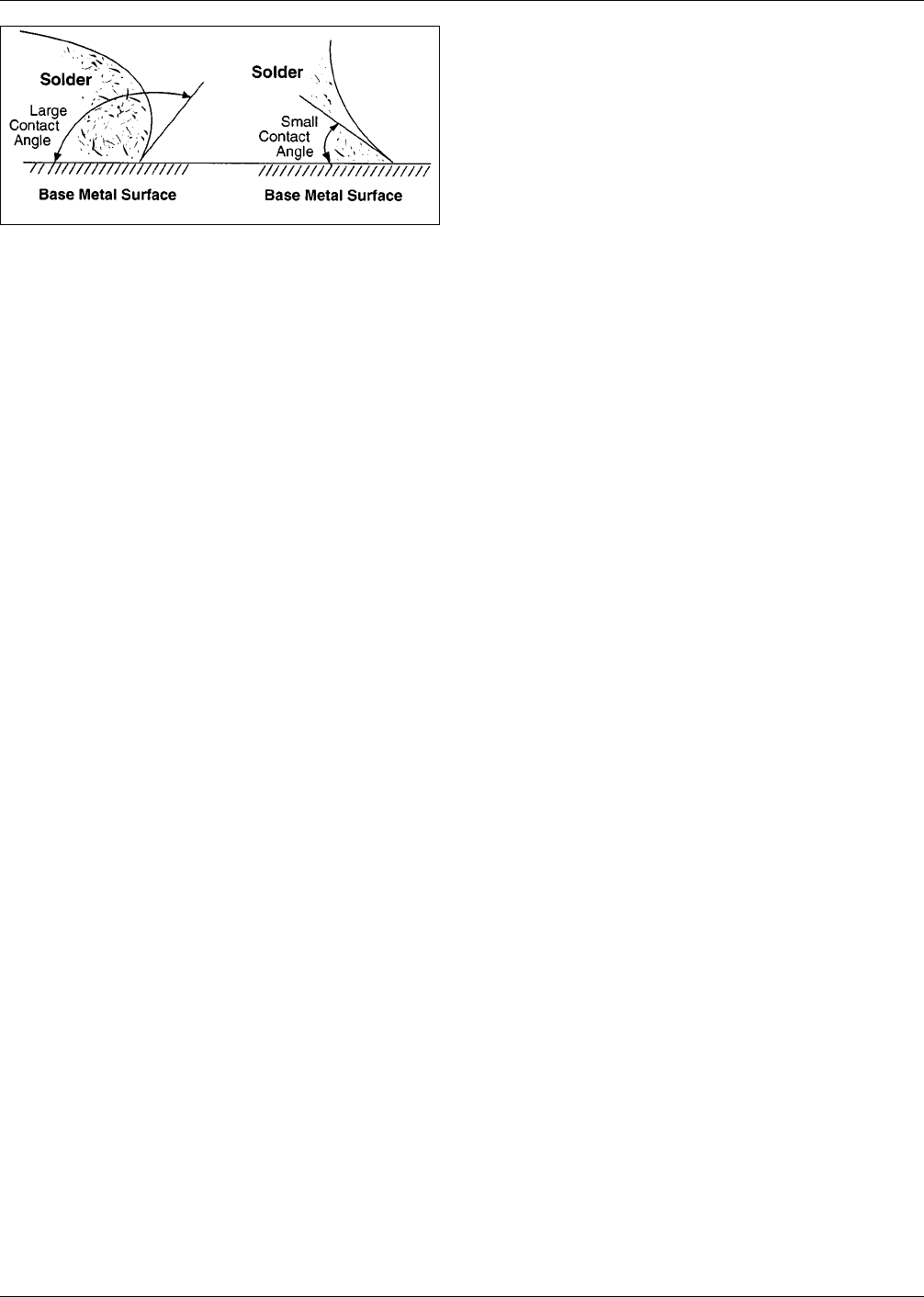
Figure C–6 Soldering contact angle
IPC-T-50F June 1996
18

Cover Lay (Flexible Circuit) 42.0304
The layer of insulating material that is applied covering
totally or partially over a conductive pattern on the outer
surfaces of a printed board.
Cover Layer 42.0305
see ‘‘Cover Lay.’’
Cpk Index (Cpk) 91.0307
A measure of the relationship between the scaled distance
between the process mean value and the closest specifica-
tion limit.
Crack, Foil 90.0308
A break or separation that extends partially or completely
through a layer of metallic foil.
Crack, Plating 90.0309
A break or separation that extends partially or completely
through a metallic coating(s), its overplate, or both.
Cracking 90.0310
A condition that makes breaks or separations in coatings
that extend through to an underlying surface.
Cratering 74.0311
A defect in which a portion of a die under is torn loose by
an excessive amount of ultrasonic wire-bonding energy.
Crazing (Base Material) 51.0312
An internal condition that occurs in reinforced laminate
base material whereby glass fibers are separated from the
resin at the weave intersections. (This condition manifests
itself in the form of connected white spots or crosses that
are below the surface of the base material.) It is usually
related to mechanically-induced stress. (See ‘‘Measling.’’)
Crazing (Conformal Coating) 76.0313
A network of fine cracks on the surface of, or within, a
conformal coating.
Crease 92.0314
A ridge in a material that is caused by a fold or wrinkle
being placed under pressure.
Creel 44.0315
A device used as a yarn package rack to hold warp ends for
a section beam.
Creep 40.0316
Time-dependent strain occurring under stress.
Crevice Corrosion 97.0317
Localized corrosion that is the result of the formation of a
crevice between a metal and a nonmetal, or between two
metal surfaces.
Crimp Contact 37.0318
A type of connector contact whose nonmating end is a hol-
low cylinder that can be crimped onto a wire inserted
within it.
Critical Current Density 53.0319
The current density above which a new and sometimes
undesirable reaction occurs.
Critical Defect 94.0320
Any anomaly specified as being unacceptable.
Critical Humidity 76.1371
The relative humidity above which the atmospheric corro-
sion rate of a given metal increases sharply or above which
the insulation decreases sharply.
Critical Operation 91.0321
One procedure of a total process that has a significant
impact on the characteristics of the completed product.
Critical Solution Temperature 76.0322
The temperature above or below which two liquids are
miscible in all proportions.
Crop Marks 22.0323
see ‘‘Corner Marks.’’
Cross-Sectioning 92.0324
see ‘‘Microsectioning’’
Crosshatching 22.0325
The breaking up of large conductive areas by the use of a
pattern of voids in the conductive material.
Crossing Count 22.1372
The unit for measuring optimum component placement
characteristics that is based on the number of times there
are crossovers of the signal conductor that are used to pro-
vide electrical interconnection between devices.
Crosslink 40.0326
The formation of chemical bonds between molecules in a
thermosetting resin.
Crosstalk 21.0327
The undesirable interference caused by the coupling of
energy between signal paths. (See also ‘‘Backward
Crosstalk’’ and ‘‘Forward Crosstalk.’’)
Crystalline Polymer 40.0328
A polymer with a regular, structured molecular configura-
tion.
Cubic Components 30.1737
A part with a three-dimensional shape having the form of a
cube.
June 1996 IPC-T-50F
19
Cumulative Tolerance 22.1373
The summation of the tolerances that are permitted
between funtionally- related features. (See also ‘‘Baseline
Dimensioning,’’ ‘‘Basic Dimension,’’ ‘‘Chain Dimension-
ing’’ and ‘‘Direct Dimensioning.’’)
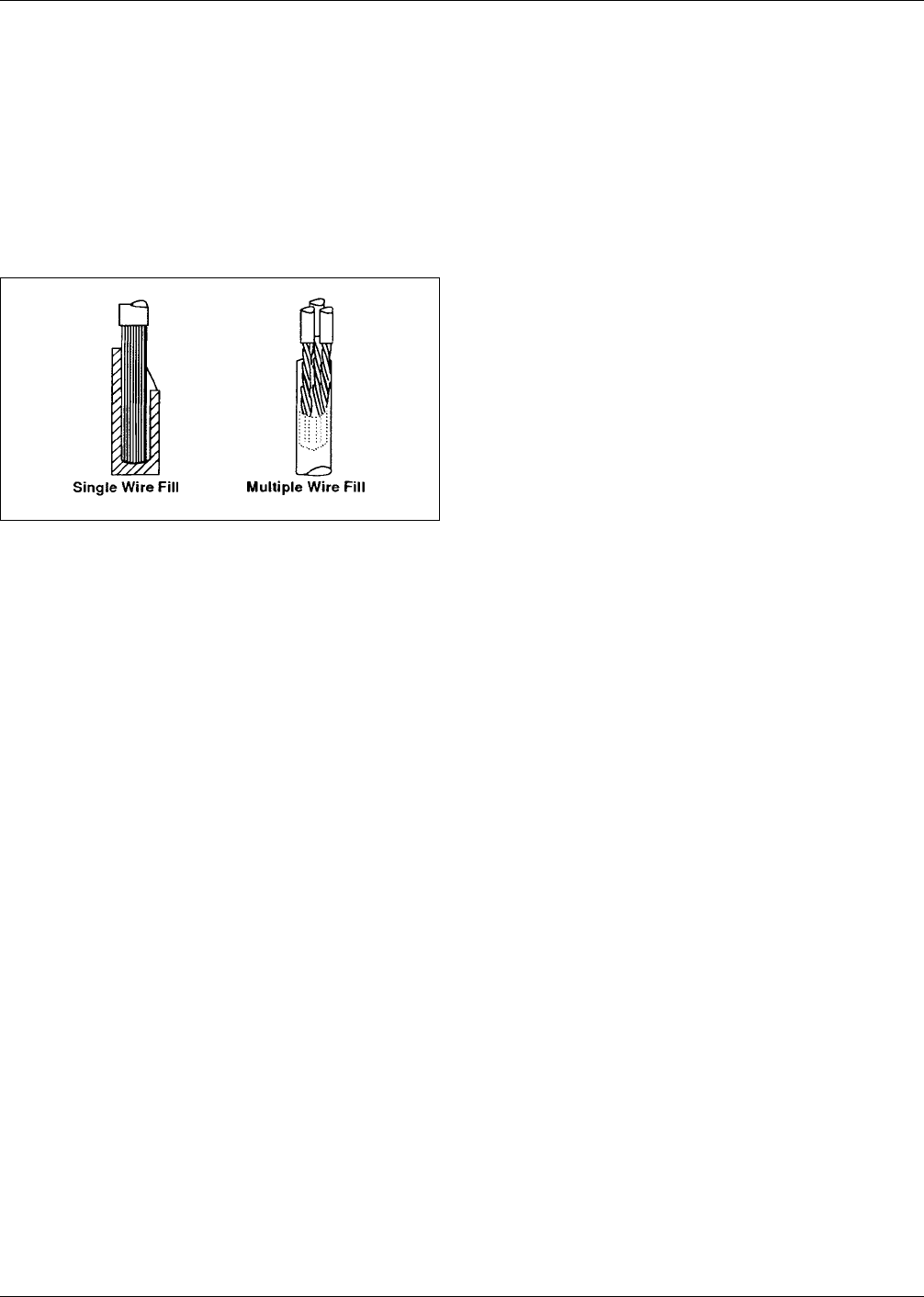
Cup Solder Terminal 37.0329
A cylindrical solder terminal with a hollow opening into
which one or more wires are placed prior to soldering. (See
Figure C-7.)
Cure 56.0330
A chemical reaction that changes the physical properties of
a substance, e.g., an adhesive.
Cure Time 56.0331
The time at which ultimate physical properties of a curing
thermosetting plastic composition are reached.
Curing Agent 56.0332
A chemical substance that can react with a resin in order to
physically harden the resin.
Current 21.1795
The flow or movement of electrons in a conductor as the
result of a voltage difference between the ends of the con-
ductive path.
Current-Carrying Capacity 21.1374
The maximum electrical current that can be carried con-
tinuously by a conductor, under specified conditions, with-
out causing objectable degradation of electrical and
mechanical properties of the product.
Customer Detail Specification (CDS) 26.1779
A document that establishes the specific requirements,
noted in a detailed specification, in order to tailor these to
meet the needs of a custom product, material, or service.
Cusum Chart 91.0333
A diagram that depicts cumulative deviation from a target.
Cut-and-Peel 24.0334
see ‘‘Cut-and-Strip.’’
Cut-and-Strip 24.0335
The making of artwork by cutting a pattern in a resist and
stripping away the unwanted areas or resist.
Cut-Off 74.0336
The operation that follows the final bonding step that sepa-
rates the bond from the source of the wire.
Cylindrical Components 30.1738
A part having the shape of a cylinder.
D
D Curve 24.0347
see ‘‘Characteristic Curve’’
Data Capture 25.0340
The automatic collection of information from a given
machine or other information source.
Data File 11.0341
A database organized in a specific manner for a specific
application.
Data Layer 25.0342
A specific group of related records that are within any indi-
vidual data- information module.
Data Logging 11.0343
The ability of a host computer or test analyzer to store ana-
lyzed data along with statistical data.
Data-Entry Device 25.0337
A device terminal used to enter information into a com-
puter system. (See also ‘‘Control Console).
Data-Information Module (DIM) 25.0338
A group of records that contain related data that describe a
specific function or task.
Database 11.0339
A comprehensive collection of information that is so struc-
tured that some or all of its data may be used to create
queries about related items contained within it.
Date Code 30.1739
Marking of products to indicate their date of manufacture.
Datum 22.0344
The theoretically-exact point, axis or plane that is the ori-
gin from which the location of geometric characteristics of
features of a part are established.
IPC-I-000000
Figure C–7 Cup Solder Terminal
IPC-T-50F June 1996
20