IPC-T-50F_.pdf.pdf - 第43页
Lead 36.0688 A length of insulated or uninsulated metallic conductor that is used for electrical interconnections. Lead Extension 75.0691 That part of a lead or wire that extends beyond a solder connection. Lead Frame 74…
Laminate Thickness 41.0673
The thickness of single- or double-sided metal-clad base
material prior to any subsequent processing. (See also
‘‘Board Thickness.’’)
Laminate (n.) 55.0672
A product made by bonding together two or more layers of
material.
Laminate Void 91.0674
The absence of resin or adhesive in an area that normally
contains them.
Land 22.1622
A portion of a conductive pattern usually, but not exclu-
sively, used for the connection and/or attachment of com-
ponents.
Land (Drill) 51.0676
The peripheral portion of the drill body that is between
adjacent drill flutes.
Land Pattern 22.0678
A combination of lands that is used for the mounting, inter-
connection and testing of a particular component.
Land Width Angle (Drill) 51.1223
The angle between the leading edge and the heel of a drill
land as measured at the drill axis.
Land Width (Drill) 51.0679
The perpendicular distance from the leading edge to the
heel of a drill land.
Landless Hole 22.0677
A plated-through hole without land(s).
Lap Shear Strength 74.0680
The shearing pressure at which an adhesive-bonded (and
cured) lap joint fails. (See also ‘‘Shear Strength’’ and ‘‘Tor-
sional Strength.’’)
Large-Scale Integration (LSI) 30.0681
An integrated circuit with over 100 gates.
Larger-the-Better Characteristic 91.1434
A parameter of quality that improves performance as its
value increases. (See also ‘‘Nominal-Is-Best Characteris-
tic’’ and ‘‘Smaller-the-Better Characteristic.’’)
Laser Soldering 75.1753
A soldering process using laser energy, generally in the
infrared wave length, to heat and form solder bonds.
Laser Trimming 77.0682
The modification of a film component’s value by the
removal of film by applying heat from a focused laser
source.
Latch (Connector) 37.0683
A device at both ends of a connector header that is used to
hold in place and eject a mating receptacle connector.
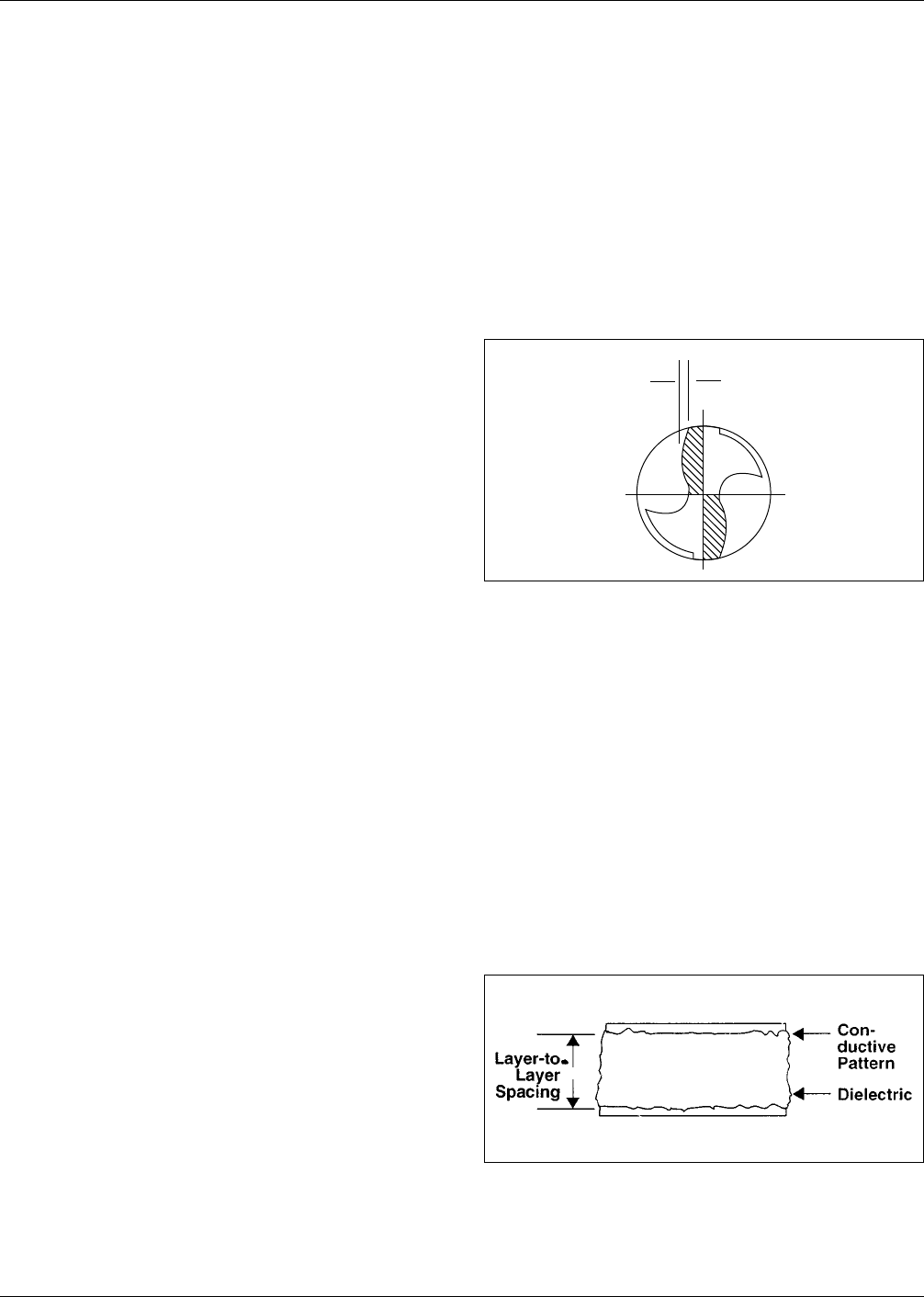
Layback 51.0684
The negative rake angle or rolled condition in the face of a
drill flute. (See Figure L-1.) (See also ‘‘Hook’’ and ‘‘Over-
lap, Drill.’’)
Layer 22.1624
Stratum of a Printed Board. Layers are differentiated
according to their function (conductor layer, insulating
layer) and their location.
Layer-to-Layer Registration 55.0685
The degree of conformity of a conductive pattern, or por-
tion thereof, to that of any other conductor layer of a
printed board.
Layer-to-Layer Spacing 22.0686
The thickness of dielectric material between adjacent lay-
ers of conductive patterns in a printed board. (See Figure
L-2.)
Leaching, (v.) Metalization 75.0687
The loss or removal of a basis metal or coating during a
soldering operation.
IPC-I-002328
Figure L–1 Layback
Lay Back
▼
▼
IPC-I-000000
Figure L–2 Layer-to-layer spacing
IPC-T-50F June 1996
38
Lead 36.0688
A length of insulated or uninsulated metallic conductor that
is used for electrical interconnections.
Lead Extension 75.0691
That part of a lead or wire that extends beyond a solder
connection.
Lead Frame 74.0692
The metallic portion of a component package that is used
to interconnect with semiconductor die by wire bonding
and to provide output terminal leads.
Lead Mounting Hole 22.0695
see ‘‘Component Hole.’’
Lead Pin 36.0696
see ‘‘Component Pin.’’
Lead Projection 73.0697
The distance that a component lead protrudes through the
side of a printed board that is opposite from the one upon
which the component is mounted.
Lead Wire 36.0698
see ‘‘Component Lead.’’
Leaded Chip Carrier 31.1224
A chip carrier whose external connections consist of leads
that are around and down the side of the package. (See also
‘‘Leadless Chip Carrier.’’)
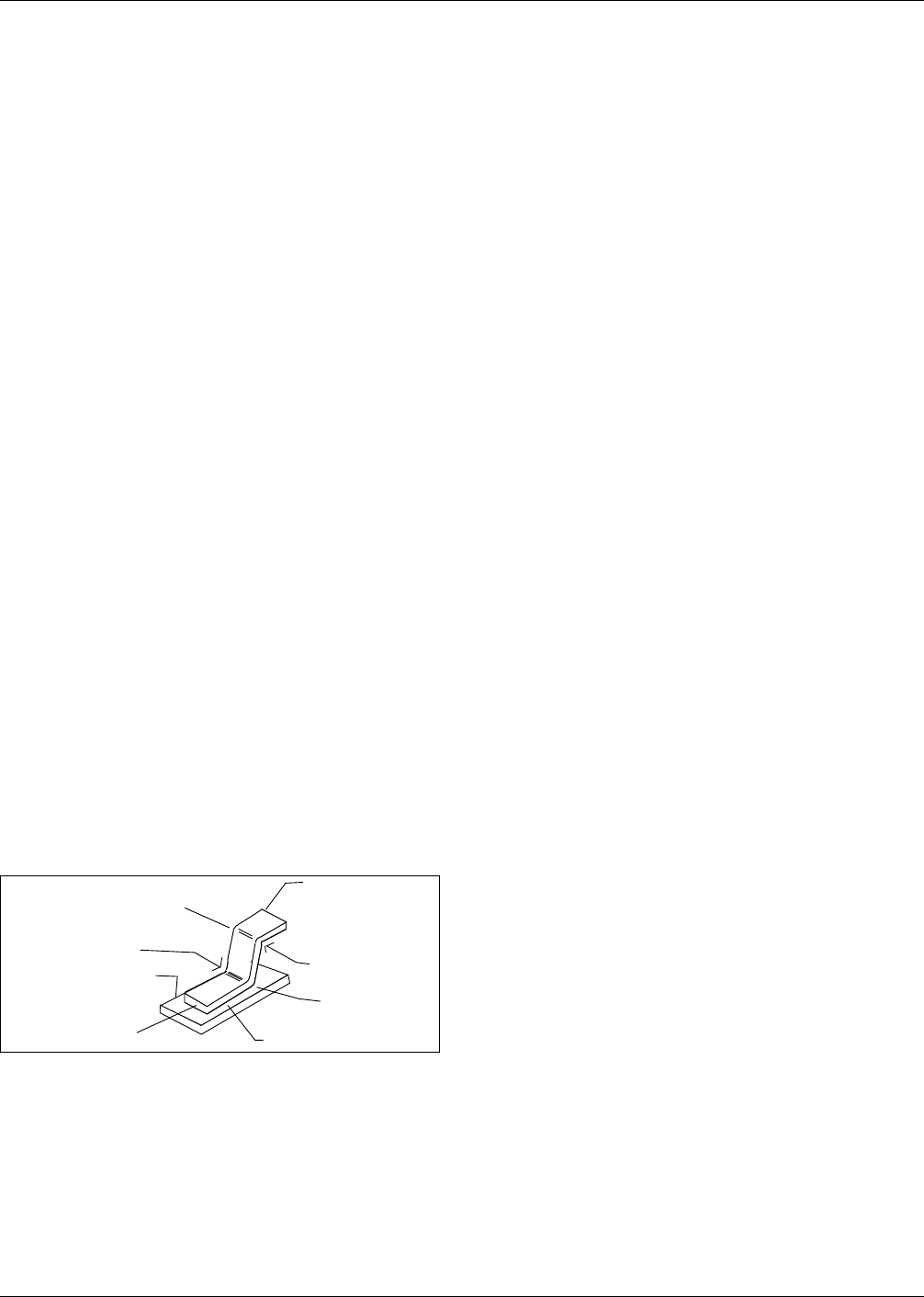
Leaded Surface-Mount Component 33.1435
A surface-mount component for which external connec-
tions consist of leads that are around and down the side of
the package. (See Figure L-3.) (See also ‘‘Leadless
Surface-Mount Component.’’)
Leadless Chip Carrier 33.1436
A chip carrier whose external connections consist of met-
allized terminations that are integral part of the component
body. (See also ‘‘Leaded Chip Carrier.’’)
Leadless Component 30.1754
see Leadless Surface Mount Components .
Leadless Device 33.0694
see Die and Leadless Surface Mount Component .
Leadless Inverted Device 33.1437
A shaped metallized-ceramic form used as an intermediate
carrier for diode or transistor die that has been especially
adapted for leadless surface mounting.
Leadless Surface-Mount Component 33.1438
A surface-mount component whose external connections
consist of metallized terminations that are integral part of
the component body. (See also ‘‘Leaded Surface-Mount
Component.’’)
Leakage Current 21.0699
The undesired flow of electrical current over or through an
insulator.
Learn Time 92.0700
The time it takes to do initial programming (teaching) to
store feature coordinate locations and other data in an
inspection/test machines memory.
Least Material Condition (LMC) 22.0701
The condition in which a feature of size contains the least
amount of material within the stated limits of size.
Legend 22.1439
A format of letters, numbers, symbols and patterns that are
used primarily to identify component locations and orien-
tations for convenience of assembly and maintenance
operations.
Leno End Out 44.0702
Warp-end wrapper that is missing from the end of a fabric.
Levelling 56.0703
see ‘‘Fusing.’’
Levelling Flux 56.0704
see ‘‘Fusing Flux.’’
Levelling Oil 56.0705
see ‘‘Fusing Oil.’’
Library 20.0706
A catalog of related items that contains all of the informa-
tion about the items that is necessary for processing by a
computer program.
Lifted Land 60.0707
A land that has fully or partially separated (lifted) from the
base material, whether or not any resin is lifted with the
land.
IPC-I-001034
Figure L–3 Leaded surface mount component gull-wing
shaped lead
FOOT
HEEL
TOE
LAND
KNEE
UPPER
BEND RADIUS
LOWER
BEND RADIUS
June 1996 IPC-T-50F
39

Light Mark (Fabric) 44.0708
A filling defect that extends across the width of a fabric
containing less than one pick per 25mm from nominal.
Limits of Size 20.0709
The specified maximum and minimum sizes.
Line 20.0710
see ‘‘Conductor.’’
Line Coupling 21.0711
The interaction between two transmission lines that is
caused by their mutual inductance and the capacitance
between them.
Lip Height 51.0712
The perpendicular distance from one primary cutting edge
to another.
Load Capacitance 21.0713
The capacitance seen by the output of a logic circuit or
other signal source.
Load Time 92.0714
The time it takes to load a unit in an inspection/test
machine and to perform any necessary programming or
machine alignment.
Local Fiducial 20.0715
A fiducial mark (or marks) used to locate the position of a
land pattern for an individual component on a printed
board.
Local Intelligence 25.0716
The capability of a work station to independently process
data without the use of a host or central processing unit.
Locating Edge 20.0028
A tooling feature in the form of the edge of a printed board.
Locating Edge Marker 20.0717
A symbol that is used to identify which edge of a printed
board is the index edge.
Locating Hole 20.0718
see ‘‘Tooling Hole.’’
Locating Notch 20.0719
A tooling feature in the form of a notch in a printed board.
Locating Slot 20.0720
A tooling feature in the form of a slot in a printed board.
Location Hole 20.1726
A hole or notch in the panel or printed board to enable
either to be positioned accurately.
Logic 21.0721
The functional digital circuits used to perform computa-
tional functions.
Logic Diagram 21.1440
A drawing that depicts the multistate device implementa-
tion of logic functions with logic symbols and supplemen-
tary notations that show the details of signal flow and con-
trol, but not necessarily the point-to- point wiring.
Logic Family 21.1441
A collection of logic functions using the same form of
electronic circuit, e.g., emitter-coupled logic (ECL),
transistor-transistor logic (TTL), complementary metal-
oxide semiconductor logic (CMOS).
Long-Term Capability 91.0722
The capability of a process that exhibits statistical control
over an extended period of time.
Loom Beam 44.0723
A large flanged cylinder onto which all warp yarns are
wound and from which the yarns enter the loom.
Loop Height 76.0725
The magnitude of deviation of a wire from a straight path
between its end attachment points.
Loop, Wire 76.0724
The curve (arc) in a bonding wire between its end attach-
ment points.
Loss Tangent 21.0726
see ‘‘Dissipation Factor.’’
Lot Size 91.1442
A collection of units produced in one continuous, uninter-
rupted fabrication run from which a sample is drawn and
inspected or tested in order to determine conformance with
acceptability criteria.
Luminance 24.0727
A measure of light flux reflected or emitted from a surface.
Luminous Energy 24.0728
A measure of light flux flow rate, usually in units of lumen-
seconds.
Luminous Flux 24.0729
A measure of flow of visible light energy past any given
point in space.
Lyophilic 76.1225
A characterization of material that readily goes into colloi-
dal suspension in a liquid.
IPC-T-50F June 1996
40