IPC-T-50F_.pdf.pdf - 第22页
Continuity 92.0284 An uninterrupted path for the flow of electrical current in a circuit. Contract Services 17.0285 Printed-board manufacturing processing operations that are performed for by another vendor outside the ma…

Conductor Track 22.0261
see ‘‘Conductor.’’
Conductor Width 60.1364
The observable width of a conductor at any point chosen at
random on a printed board as viewed from directly above
unless otherwise specified. (See also ‘‘Design Width of
Conductor’’ and ‘‘Conductor Base Width.’’)
Confidence Interval 94.1365
The determination, with a specified degree of confidence,
as to whether or not a particular characteristic is within
ascertained limits of a population.
Confirmation Run 94.0262
A test of the results that are obtained during an experimen-
tal design in order to prove if the results are reproducible
in an actual application.
Conformal Coating 76.0263
An insulating protective covering that conforms to the con-
figuration of the objects coated (e.g. Printed Boards,
Printed Board Assembly) providing a protective barrier
against deleterious effects from environmental conditions.
Confounding 94.0264
A situation whereby certain effects cannot be separated
from other effects.
Connector 37.0265
A device used to provide mechanical connect/disconnect
service for electrical terminations.
Connector Area 22.0269
That portion of printed wiring used for the purpose of pro-
viding external connections.
Connector Contact 22.0270
The conducting member of a connecting device that pro-
vides a separable connection.
Connector Housing 37.0271
A plastic shell that holds electrical contacts in a specific
field pattern that may also have polarization/keying bosses
or slots.
Connector, One-Part 22.0266
see ‘‘Edge-Board Connector
Connector Tang 37.0272
That portion of a printed board that mates with an edge-
board connector.
Connector, Two-Part 22.0267
A connector containing two sets of discretely-formed mat-
ing metal contacts.
Connector, Two-Part, Printed Board 37.0268
A two-part connector wherein at least one set of contacts is
mechanically and electrically attached to a printed board.
Constraining Core 44.0273
A supporting plane that is internal to a packaging and inter-
connecting structure.
Consumer’s Risk 94.0274
see ‘‘Beta Error.’’
Contact Angle (Bonding) 74.0275
The angle between the bonding lead or wire and the bond-
ing land.
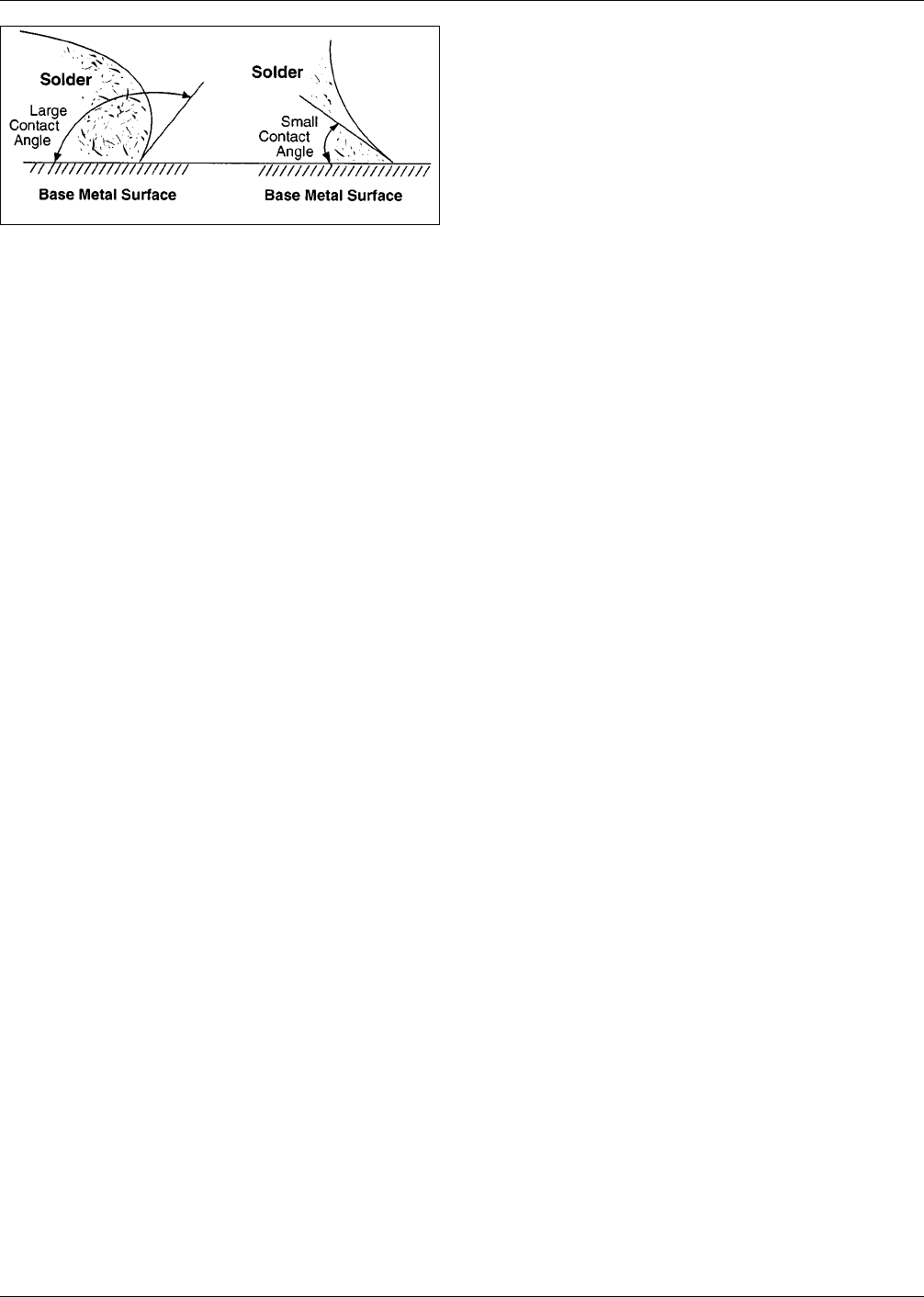
Contact Angle (Soldering) 75.1326
The angle of a solder fillet that is enclosed between a plane
that is tangent to the solder/basis-metal surface and a plane
that is tangent to the solder/air interface. (See Figure C-6.)
Contact Area 22.0276
The common area between a conductor and a connector
through which the flow of electricity takes place.
Contact Corrosion 96.0277
see ‘‘Crevice Corrosion.’’
Contact Length 96.0278
The distance of travel made by a contact in touch with
another during the insertion and removal of a connector.
Contact Printing 24.1366
A photographic light-exposure process that transfers an
image from one base material to the photosensitive surface
of another base material while both base materials are in
mechanical contact with each other.
Contact Resistance 70.0279
The electrical resistance of metallic surfaces, under speci-
fied conditions, at their interface in the contact area.
Contact Retention Force 96.0280
The minimum axial load in either direction that a contact
withstands while it is in its normal position in a connector
insert.
Contact Spacing 22.0281
see ‘‘Pitch.’’
Contact Spring 37.0282
The spring member of a socket-type contact that forces the
engaging pin- type contact into a position of positive inti-
mate contact.
Contamination Host Material 76.0283
The material within which contamination is deposited or
entrapped.
June 1996 IPC-T-50F
17
Continuity 92.0284
An uninterrupted path for the flow of electrical current in a
circuit.
Contract Services 17.0285
Printed-board manufacturing processing operations that are
performed for by another vendor outside the manufactur-
er’s facility.
Control Chart 91.1368
A graphic representation of a characteristic of a process
that shows plotted values of some statistic gathered from
characteristic, a central line, and one or two statistically-
derived control limits.
Control Console 11.0286
A device terminal used to manipulate and maintain the
operating system of a computer.
Control Drawing 22.0287
see ‘‘Master Drawing.’’
Control Limits 91.0290
The maximum allowable variation of a process characteris-
tic due alone to common causes.
Controlled Collapse, Component Connection 75.0289
see ‘‘Controlled Collapse Soldering’’
Controlled Collapse Soldering 75.0288
The making of termination by controlling the height of sol-
der balls in a flip-chip assembly operation.
Convected Energy 75.1736
Heat transferred through circulation of fluid or gas.
Conveyor, Edge 70.0291
A transporting mechanism that supports a product by the
edges.
Conveyor, Mesh 70.0292
A transporting mechanism that fully supports the product.
Conveyor, Secondary 70.0293
A transporting mechanism used beneath the edge conveyor
to catch a fallen product.
Coordinatograph 92.0294
An X- and Y-coordinate plotting and measuring machine.
Coplanar Leads 33.0295
The flat beam leads of a component package that have been
formed so that they can simultaneously contact one plane
of a base material.
Copolymerize 49.0847
The creation of a polymer by the joining of two or more
different monomers in repeating chain.
Copper-Mirror Test 92.0296
A test of the corrosivity of a flux on a copper film that is
vacuum- deposited on a glass plate.
Corner Marks 22.0297
The marks at the corners of artwork whose inside edges
establish, or help to establish, the borders and contour of a
printed board.
Coronizing 44.0298
Continuous heat cleaning and weave setting.
Corrosion (Chemical/Electrolytic) 76.0299
The attack of chemicals, flux, and flux residues on base
metals.
Corrosive Flux 75.0300
Flux that contains levels of halides, amines, or organic
acids that cause corrosion of copper.
Cosine Law (Illumination) 24.1369
A law of illumination that states that the flux radiated or
received in a given direction varies with the projected area
of the receiver or emitter in a plane that is perpendicular to
the direction of the flux.
Cost of Quality 94.0301
The money spent in the creation, control, and evaluation of
quality and the consequences of the failure to meet speci-
fied requirements.
Coupon 92.0302
see ‘‘Test Coupon.’’
Coupon (Breakaway) 92.1220
Coupons made as an integral part of the end product board
and connected as one piece, except one edge of the coupon
has perforations or a thin section connected to the board
which can be easily broken off without damaging either the
coupon or the board.
Cover Coat 42.0303
see ‘‘Cover Lay.’’
IPC-I-001152
Figure C–6 Soldering contact angle
IPC-T-50F June 1996
18

Cover Lay (Flexible Circuit) 42.0304
The layer of insulating material that is applied covering
totally or partially over a conductive pattern on the outer
surfaces of a printed board.
Cover Layer 42.0305
see ‘‘Cover Lay.’’
Cpk Index (Cpk) 91.0307
A measure of the relationship between the scaled distance
between the process mean value and the closest specifica-
tion limit.
Crack, Foil 90.0308
A break or separation that extends partially or completely
through a layer of metallic foil.
Crack, Plating 90.0309
A break or separation that extends partially or completely
through a metallic coating(s), its overplate, or both.
Cracking 90.0310
A condition that makes breaks or separations in coatings
that extend through to an underlying surface.
Cratering 74.0311
A defect in which a portion of a die under is torn loose by
an excessive amount of ultrasonic wire-bonding energy.
Crazing (Base Material) 51.0312
An internal condition that occurs in reinforced laminate
base material whereby glass fibers are separated from the
resin at the weave intersections. (This condition manifests
itself in the form of connected white spots or crosses that
are below the surface of the base material.) It is usually
related to mechanically-induced stress. (See ‘‘Measling.’’)
Crazing (Conformal Coating) 76.0313
A network of fine cracks on the surface of, or within, a
conformal coating.
Crease 92.0314
A ridge in a material that is caused by a fold or wrinkle
being placed under pressure.
Creel 44.0315
A device used as a yarn package rack to hold warp ends for
a section beam.
Creep 40.0316
Time-dependent strain occurring under stress.
Crevice Corrosion 97.0317
Localized corrosion that is the result of the formation of a
crevice between a metal and a nonmetal, or between two
metal surfaces.
Crimp Contact 37.0318
A type of connector contact whose nonmating end is a hol-
low cylinder that can be crimped onto a wire inserted
within it.
Critical Current Density 53.0319
The current density above which a new and sometimes
undesirable reaction occurs.
Critical Defect 94.0320
Any anomaly specified as being unacceptable.
Critical Humidity 76.1371
The relative humidity above which the atmospheric corro-
sion rate of a given metal increases sharply or above which
the insulation decreases sharply.
Critical Operation 91.0321
One procedure of a total process that has a significant
impact on the characteristics of the completed product.
Critical Solution Temperature 76.0322
The temperature above or below which two liquids are
miscible in all proportions.
Crop Marks 22.0323
see ‘‘Corner Marks.’’
Cross-Sectioning 92.0324
see ‘‘Microsectioning’’
Crosshatching 22.0325
The breaking up of large conductive areas by the use of a
pattern of voids in the conductive material.
Crossing Count 22.1372
The unit for measuring optimum component placement
characteristics that is based on the number of times there
are crossovers of the signal conductor that are used to pro-
vide electrical interconnection between devices.
Crosslink 40.0326
The formation of chemical bonds between molecules in a
thermosetting resin.
Crosstalk 21.0327
The undesirable interference caused by the coupling of
energy between signal paths. (See also ‘‘Backward
Crosstalk’’ and ‘‘Forward Crosstalk.’’)
Crystalline Polymer 40.0328
A polymer with a regular, structured molecular configura-
tion.
Cubic Components 30.1737
A part with a three-dimensional shape having the form of a
cube.
June 1996 IPC-T-50F
19