IPC-T-50F_.pdf.pdf - 第14页
Figure B–4 Drill Features IPC-T-50F June 1996 10

Bond Surface 74.0141
see ‘‘Bonding Area.’’
Bond-to-Bond Distance 74.0121
The distance from the bonding site on a die to the corre-
sponding bonding site on a lead frame, interconnecting
base material, etc.
Bond-to-Die Distance 74.0122
The distance from the heal of a beam lead to the die.
Bondability 74.1342
Those surface characteristics and conditions of cleanliness
of a bonding area that must exist in order to provide for the
capability to achieve a successful termination.
Bonding Area 74.0128
The area defined by the extent of a land or portion of a ter-
minal to which a lead is to be bonded.
Bonding, Die 74.0127
see ‘‘Die Bonding.’’
Bonding Island 74.0129
see ‘‘Bonding Area.’’
Bonding Layer 55.0130
An adhesive layer used in bonding together other discrete
layers of a multilayer printed board during lamination.
Bonding Tool 74.0131
The instrument used to position leads or discrete wires over
a land and to impart sufficient energy to complete the ter-
mination.
Bonding Wire 74.0132
Fine gold or aluminum wire used for making electrical
connections between lands, lead frames, and terminals.
Border Area 22.0142
The region on a base material that is external to that of the
end-product being fabricated within it.
Border Data 22.0143
Patterns that appear in the border area, such as tooling fea-
tures, test patterns, and registration marks.
Boss 22.0144
see ‘‘Land.’’
Boss (Connector) 37.0145
A raised section on a connector that fits into a specific slot
in the positive polarization or keying feature of a mating
connector.
Bow (Fabric) 44.0146
Filling yarn that lies in an arc across the width of a fabric.
Bow (Sheet, Panel, or Printed Board) 60.1218
The deviation from flatness of a board characterized by a
roughly cylindrical or spherical curvature such that, if the
product is rectangular, its four corners are in the same
plane. (See Figure B-5.) (See also ‘‘Twist.’’)
Brainstorming 94.0147
The generation of an all-inclusive list of potential causal
factors that are possible contributors to process problems.
Breakout 60.0148
see ‘‘Hole Breakout.’’
Bridging, Electrical 70.0149
The unintentional formation of a conductive path between
conductors. (See also ‘‘Solder Bridging.’’)
Brightness 24.0150
see ‘‘Luminance.’’
Broken Pick 35.0151
A filling yarn that is missing from a portion of the width of
a fabric.
Brominated Epoxy 41.0152
An epoxy resin containing chemically-bound bromine
which is added to act as a flame retardant.
Bubble Effect 76.0153
The entrapment of air, solvent or moisture bubbles in a
protective coating.
Buffer Material 76.0154
A resilient material that is used to protect a crack-sensitive
component from the stresses generated by a conformal
coating.
Bugging Height 74.0155
The distance between a land and the lower surface of a
beam lead caused by the deformation of the lead during
bonding.
Bulge 60.0156
A swelling of a printed board that is usually caused by
internal delamination or separation of fibers.
Bulk Conductance 92.0157
Conductance between two points of a homogeneous mate-
rial.
Bulls-Eye 20.0158
A stylized pattern that is located in the border area in order
to aid in alignment.
June 1996 IPC-T-50F
9
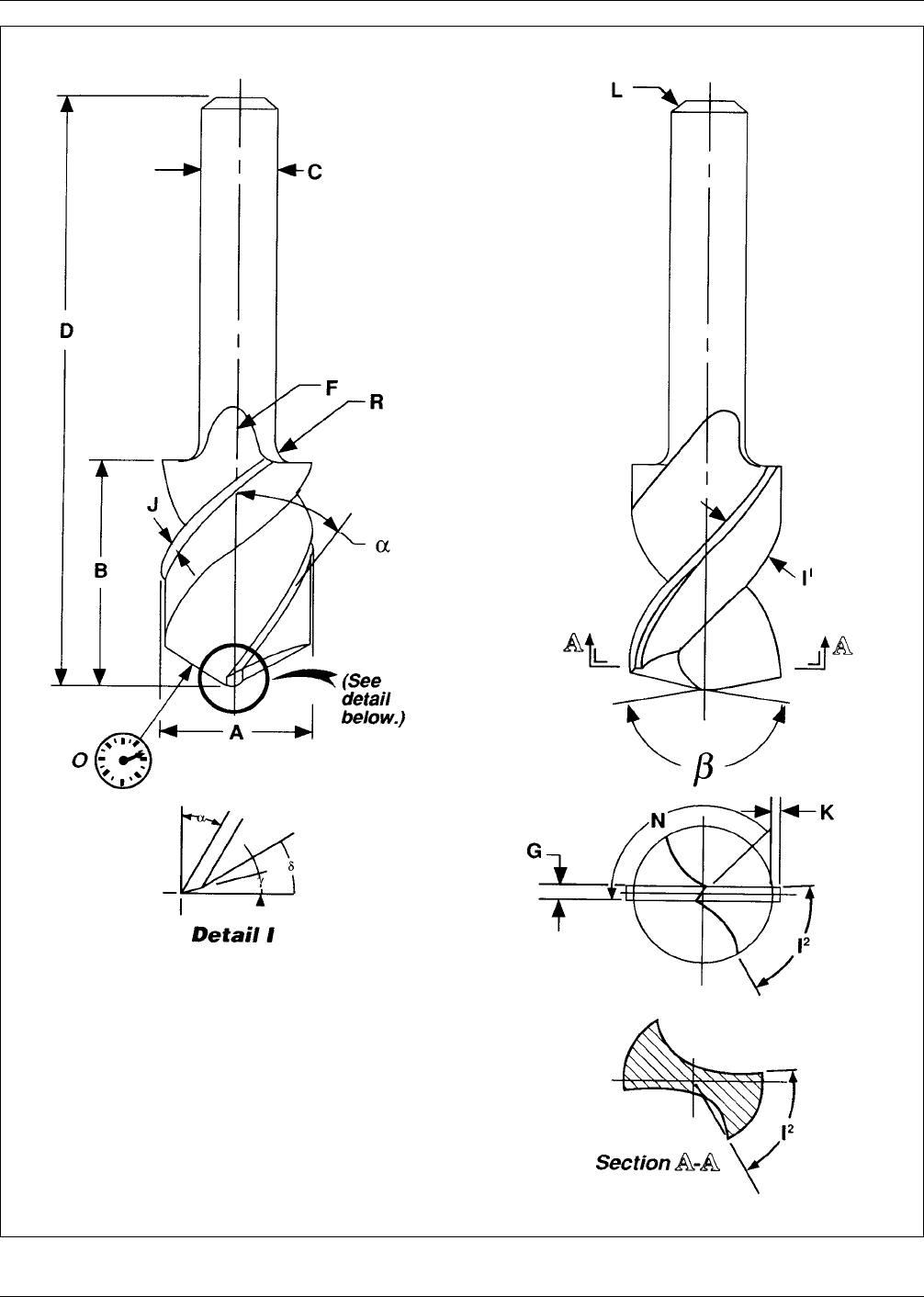
Figure B–4 Drill Features
IPC-T-50F June 1996
10

Bump (Die) 74.0159
A raised metal feature on a die land or tape carrier tape that
facilitates inner-lead bonding.
Bumped Die 74.0160
A semiconductor die with raised metal features that facili-
tate inner-lead bonding.
Bumped Tape 74.0161
Carrier tape with raised metal features that facilitate inner-
lead bonding.
Bumped Wafer 74.0162
A semiconductor wafer with raised metal feature on its die
lands that facilitate inner-lead bonding.
Buried Via 22.0163
A via that does not extend to the surface of a printed board.
(See Figure B-3.)
Burn-In 95.0164
The process of electrically stressing a device at an elevated
temperature, for a sufficient amount of time to cause the
failure of marginal devices (Infant Mortality).
Burn-In, Dynamic 95.0165
Burn-in at high temperatures that simulates the effects of
actual or simulated operating conditions.
Burn-In, Static 95.0166
Burn-in at high temperatures with unvarying voltage, either
forward or reverse bias.
Burn-Off 74.0167
see ‘‘Flame-Off.’’
Bus 21.0168
One or more conductors used for transmitting data signals
or power.
Bus Bar 37.0169
A conduit, such as a component or conductor on a printed
board, that is used for distributing electrical energy. (See
also ‘‘Plating Bar.’’)
Butt Leads 36.1732
A SMT lead form. Leads extending horizontally from about
the center of a component body, formed down at a 90
degree angle and ending immediately below the component
body without additional bends.
Butter Coat 41.0170
An increased amount of resin on the outer surface of a base
material.
C
C-Staged Resin 41.0171
A resin in its final state of cure. (See also ‘‘B-Staged
Resin.’’)
Camber 92.0172
The planar deflection of a flat cable or flexible laminate
from a straight line.
Cap Lamination 55.0176
A process for making multilayer printed boards with sur-
face layers of metal-clad laminate bonded in a single
operation. (See also ‘‘Foil Lamination.’’)
Capability Detail Specification (CapDS) 26.1780
A document that establishes the specific requirements,
noted in a detailed specification, in order to establish the
level of capability that a manufacturer posesses when he
has demonstrated that he has met those requirements.
Capability Index (Cp) 91.0306
see ‘‘Capability Performance Index.’’
Capability Performance Index (Cp) 79.1806
The ratio of the measured performance of a process com-
pared to specified limits.
Capability Performance, Lower (Cpkl) 91.1367
A measure of the relationship between the performance of
a process and the lower specification limit. (See also
‘‘Capability Performance, Upper.’’)
Capability Performance, Upper (Cpku) 91.1344
A measure of the relationship between the performance of
a process and the upper specification limit. (See also
‘‘Capability Performance, Lower.’’)
Capability Test Board (CTB) 94.1784
A printed board specifically designed to act as a capability
qualifying component (CQC), or to be used by manufac-
turer to evaluate process variation, process control, or con-
tinuous improvement procedures.
IPC-I-001036
Figure B–5 Bow
BOW
June 1996 IPC-T-50F
11