IPC-T-50F_.pdf.pdf - 第63页
Rigid Double-sided Printed Board 61.1577 Double-sided printed board, either printed circuit or printed wiring, using rigid base materials only . Rigid Multilayer Printed Board 61.1578 Multilayer printed board, either pri…
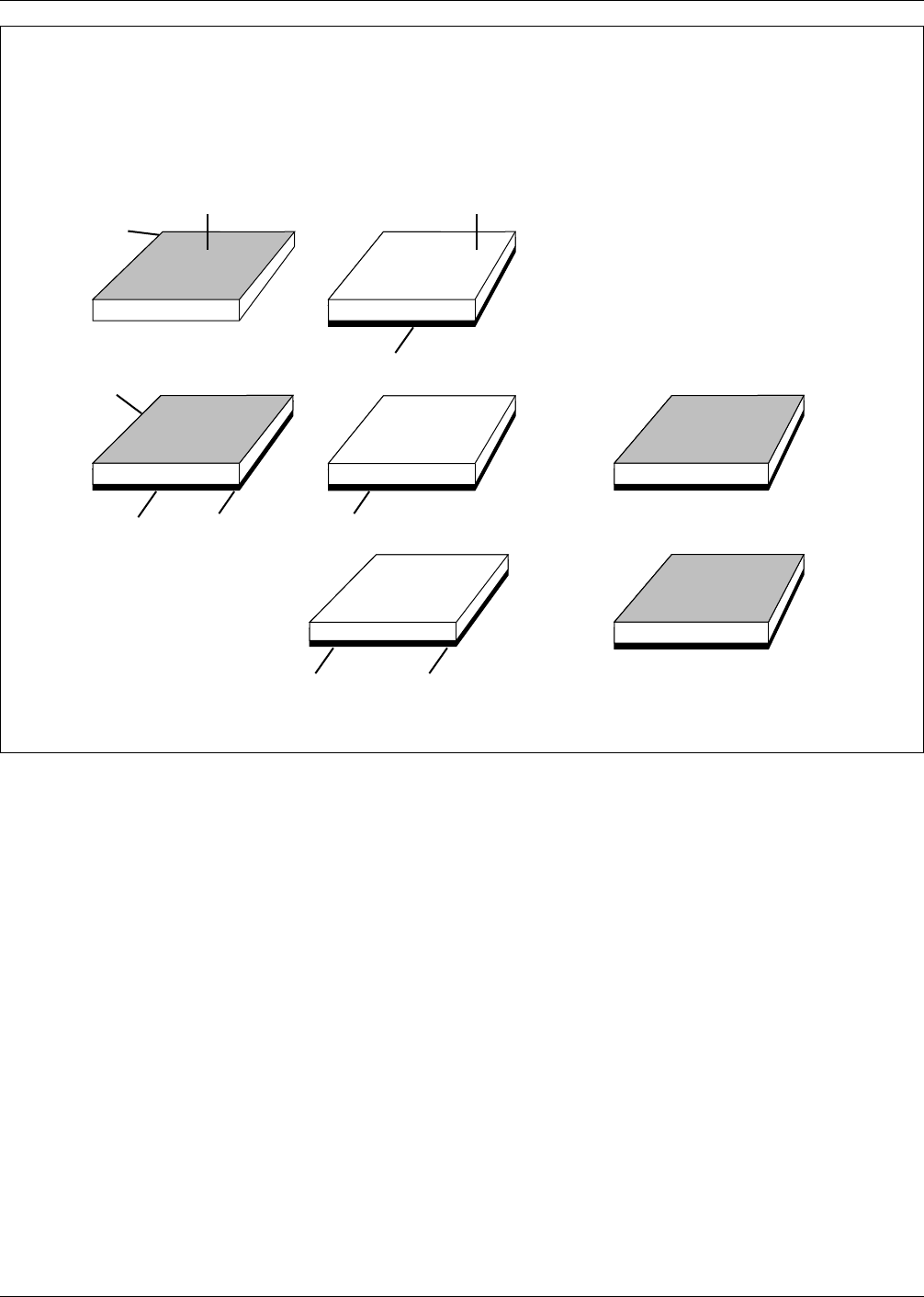
IPC-I-002768
Figure R–2 Printed board viewing orientations
Notes:
1. A precise definition of image tone and orientation necessitates that the orientation of the pattern and the legend be separately
identified. For example: Layer 1—Pos RR DN (Legend Corr. Read) or Layer 2—Pos RR UP (Legend Rev. Read) (There is no such
thing as wrong reading.)
2. By definition, all layer patterns are viewed from the same direction. (This view defines RR for the pattern appearance of all layers; this
is not the same as viewing the final board copper head on.)
3. Legend is usually correct reading when viewing the copper; therefore, on occasion alphanumerics must be reversed reading when
the pattern is right reading by definition.
4. Production master emulsion must be presented against the board copper in the stack up. Therefore, production master emulsion
orientation is opposite to individual copper layer orientation, i.e., if copper is RR UP by definition, corresponding production master
must be RR DN.
5. When specifying artwork tone and orientation, remember the board layup and the purpose of the artwork, i.e., file copy, artwork
master, or production master, etc.
6. In manual designs the artwork is usually prepared at an enlarged scale with tapes and other drafting aids. The artwork master is
produced from the artwork by photographic reduction.
7. In semi-automated designs, there may be no artwork by definition. Typically, an enlarged color-coded printed wiring layout on a
gridded format is prepared for subsequent digitizing and photoplotting. This procedure may yield intermediate phototools which can
be photographically processed into an artwork master or it may directly yield an artwork master, working master, or production
master.
8. In fully automated systems, there is usually no artwork or printed wiring layout prepared. A computerized procedure from a form of
the electrical schematic by total computerization or a combination of computer and interactive design procedures. This procedure
may yield intermediate phototools or the artwork master, working master, or production master directly.
Multilayer
Printed
Boards
Corresponding
Registered
Production
Master
L3 - RR
UP
L4 - RR UP (Legend Rev. Read)
L4 - RR DN
(Legend Rev. Read)
Emulsion
Emulsion
L1 - RR UP
(Legend Corr. Read)
L1 - RR UP
(Legend
Corr.
Read)
Viewing Primary Side
Copper
Substrate Base Material
Substrate Base Material
Substrate
Base Material
Base Material
COPPER
COPPER
EMULSION
EMULSION
▼ ▼
▼
▼
L2 - RR UP
▼
L3 - RR DN
▼
Copper
▼
▼
Viewing Component Side
▼
▼
L2 - RR
DN
IPC-T-50F June 1996
58

Rigid Double-sided Printed Board 61.1577
Double-sided printed board, either printed circuit or printed
wiring, using rigid base materials only.
Rigid Multilayer Printed Board 61.1578
Multilayer printed board, either printed circuit or printed
wiring, using rigid base materials only.
Rigid Printed Board 61.1571
A printed board using rigid base materials only.
Rigid Single-sided Printed Board 61.1576
Single-sided printed board, either printed circuit or printed
wiring, using rigid base materials only.
Rigid-flex Double-sided Printed Board 63.1584
Double-sided printed board, either printed circuit or printed
wiring, using combinations of rigid and flexible base mate-
rials.
Rigid-Flex Printed Board 63.1258
A printed board with both rigid and flexible base materials.
Rise Time 21.1259
The time required for a signal voltage to increase (switch)
from 10 to 90 % of its final voltage level after a level
change has been initiated.
Risk Management Factor (RMF) 94.1777
The maximum tolerable percentage of possible defects
within a lot (group) of units, based on appoximately 95 %
confidence level.
Roadmap 26.1260
A printed nonconductive pattern that delineates the compo-
nents and circuitry on a printed board in order to aid in
servicing and repairing the final assembly.
Robber 53.1261
see ‘‘Plating Thief.’’
Rosin 46.1514
A hard, natural resin, consisting of abietic and primaric
acids and their isomers, some fatty acids and terpene
hydrocarbons, that is extracted from pine trees and subse-
quently refined.
Rosin Flux 46.1262
Rosin in an organic solvent or rosin as a paste with activa-
tors.
Rosin Solder Connection 75.1515
A solder connection that has practically the same appear-
ance as does a cold solder connetion, but that also shows
evidence of entrapped rosin separating the surfaces to be
joined. (See also ‘‘Cold Solder Connection’’).
Rotational Error 25.1263
The angular misalignment of a functional pattern with
respect to the X and Y axes.
Router (CAD) 22.1264
A computer program that automatically determines paths
between points to be interconnected.
Routing Mark 25.1265
An artwork feature that is used to define the periphery of a
printed board.
Roving 44.1266
A collection of parallel strands of filaments assembled with
or without an intentional twist.
Rubber Banding 22.1267
A technique for displaying a straight line with one endpoint
fixed and the other end following the commands of a
manual data input device.
Run (n.) 91.1268
A consecutive number of points that consistently increase
or decrease, or that are consistently above or below the
central line of a SPC control chart.
Run Chart 91.1269
A graphic representation of plotted values of some statistic
gathered from a process characteristic and a central line
that can be analyzed for runs.
Run Time 92.1271
The time elapsed while a unit is in an inspection or testing
machine.
Runout 24.1270
The sum of the cumulative-pitch error across a number of
functional patterns on a step-and-repeat phototool.
Runtime System 11.1272
The collection of software programs required to perform
the actual testing and diagnosis of a unit under test.
S
Sacrificial Protection 45.1274
The preferential corrosion of a metal coating in order to
protect the substrate metal.
Sacrificial-Foil Laminate 31.1273
A base material with a treated-metal foil which is subse-
quently removed, for the purpose of impressing a
microporous topography on the surface of the base mate-
rial.
Sagging 74.1275
see ‘‘Wire Sag.’’
June 1996 IPC-T-50F
59

Saponifier 76.1276
An aqueous organic- or inorganic-base solution with addi-
tives that promote the removal of rosin and/or water-
soluble flux.
Satin Weave 44.1516
A fabric configuration where the surface is almost entirely
made up of warp filling adjacent yarns, thereby producing
a smooth surface. (The intersection points do not fall in a
straight diagonal, or twill, but in a patterned formation.)
Scalar Processing 11.1277
The use of a computer architecture in which single opera-
tions are performed on data elements.
Scan Rate 92.0755
The rate at which a machine scans the surface of the unit
being evaluated, expressed in surface area per unit of time
or time per unit area of surface.
Scan-Dead Time 92.1278
The time during a scanning process when data is not being
collected from the unit being evaluated.
Scanner, Test 92.0693
A program controlled relay matrix used for connecting any
unit-under-test circuit mode to the analog instrument bus.
Scatter Diagram 94.0991
A graph that depicts the relationships between an indepen-
dent variable and a dependent response variable.
Schematic Diagram 26.1107
A drawing that shows, by means of graphic symbols, the
electrical connections, components and functions of a spe-
cific circuit arrangement.
Scoop-Proof Connectors 37.1239
Connectors that incorporate features that prevent contact
damage during mating and unmating.
Scratch 92.1203
A narrow furrow or groove in a surface. (It is usually shal-
low and caused by the marking or rasping of the surface
with a pointed or sharp object.)
Screen Printing 52.1204
The transferring of an image to a surface by forcing a suit-
able media with a squeegee through an imaged-screen
mesh.
Scribe Coat 24.1205
A stable base material, such as glass or film, with an
opaque coating.
Scribing 24.1279
The cutting of the opaque coating, but not the base mate-
rial, on a scribe-coat material.
Scrubbing 74.1280
The rubbing of the lead wire and bonding land in order to
break up oxide layers and to improve bondability.
Search Height 74.1281
The height of a bonding tool above the bonding area prior
to it being lowered to make the termination.
Second Bond 74.1283
The second termination in a sequence of bonds made to
form a conductive path. (See also ‘‘First Bond.’’)
Secondary Relief 51.1282
The clearance angle that is behind the primary relief of a
drill point.
Secondary Side 22.1517
That side of a packaging and interconnecting structure that
is opposite the primary side. (It is the same as the ‘‘solder
side’’ on through-hole mounting technology.)
Section Beam 44.1284
A flanged cylinder onto which yarn is drawn and accumu-
lated from the yarn bobbins or packages.
Sectional Specification (SS) 26.1783
A document that describes the specific requirements per-
taining to a portion of a set, family, or group of products,
materials or, services.
Seed Layer 53.1286
see ‘‘Activating Layer.’’
Seeding 53.1285
see ‘‘Activating.’’
Self Test 92.1287
The ability of an analyzer to appraise itself prior to per-
forming a test procedure.
Selvage 44.1288
The edge of the fabric where the body of the fabric ends as
defined by the last warp yarn.
Semi-Additive Process 53.1518
An additive process wherein the entire thickness of
electrically- isolated conductors is obtained by the com-
bined use of electroless metal deposition and electroplat-
ing, etching, or both. (See also ‘‘Fully- Additive Process.’’)
Semiconductor 30.1289
A solid material, such as silicon, that has a resistivity that
is midway between that of a conductor and of a resistor.
IPC-T-50F June 1996
60