IPC-T-50F_.pdf.pdf - 第19页
Cold Solder Connection 97.0226 A solder connection that exhibits poor wetting, and that is characterized by a greyish porous appearance. (This is due to excessive impurities in the solder , inadequate cleaning prior to s…
Circuit 21.0213
A number of electrical elements and devices that have been
interconnected to perform a desired electrical function.
Circuit Card 60.0214
see ‘‘Printed Board.’’
Circuitry Layer 22.0215
A layer of a printed board containing conductors, including
ground and voltage planes.
Circumferential Separation 96.1349
A crack or void in the plating extending around the entire
circumference of as plated through hole, a solder fillet
around lead wire or eyelet, or the interface between a sol-
der fillet and a land.
Circumferential Thermodes 74.1734
A contact tool used for inner-lead and outer-lead gang
bonding.
Clad (adj.) 55.1350
A condition of the base material to which a relatively-thin
layer or sheet of metal foil has been bonded to one or both
of its sides, e.g. ‘‘a metal-clad base material.’’
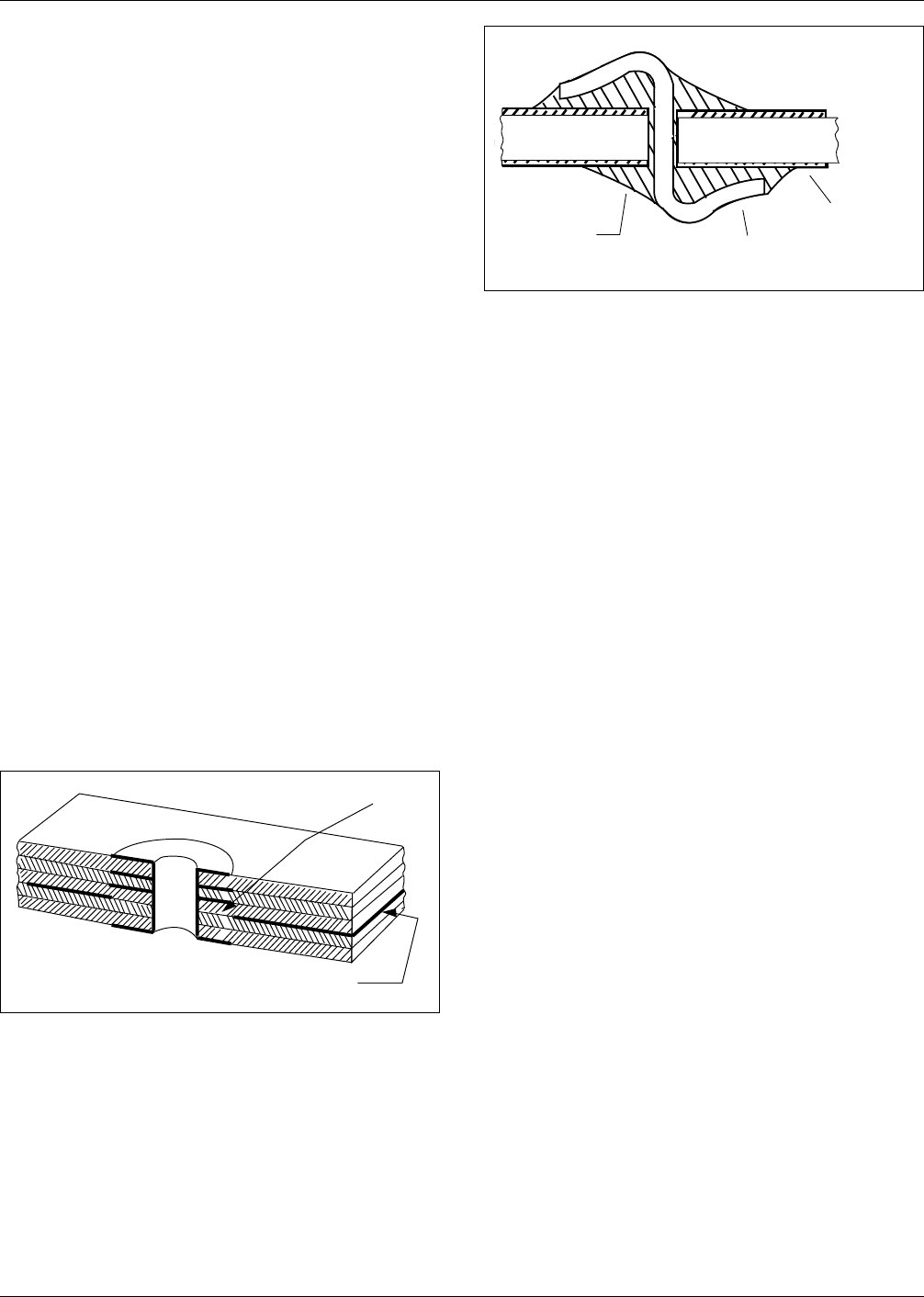
Clearance Hole 22.1811
A hole in a conductive pattern that is larger than, and
coaxial with a hole in the base material of a printed board.
(See Figure C-3.)
Clinched Lead 72.1351
A component lead that is inserted through a hole in a
printed board and is then formed in order to retain the
component in place and in order to make metal-to-metal
contact with a land prior to soldering. (See also ‘‘Partially-
Clinched Lead.’’)
Clinched-Wire Interfacial Connection 72.0217
see ‘‘Clinched-Wire Through Connection.’’
Clinched-Wire Through Connection 72.1352
A connection made by a bare wire that has been passed
through a hole in a printed board and subsequently formed
(clinched) and soldered to the conductive pattern on each
side of the board. (See Figure C-4.)
Closed-Entry Contact 37.0218
A type of female connector contact that prevents the entry
of an oversized mating part. (See also ‘‘Open-Entry Con-
tact.’’)
Co-Firing 56.0219
The simultaneous processing of thick-film circuit elements
during one firing cycle.
Coaxial Cable 37.0220
A cable in the form of a central wire surrounded by a con-
ductor tubing or sheathing that serves as a shield and
return.
Coefficient of Thermal Expansion (CTE) 40.0221
The linear dimensional change of a material per unit
change in temperature. (See also ‘‘Thermal Expansion Mis-
match.’’)
Cohesion Failure 96.0222
The rupture of an adhesive bond such that the separation
appears to be within the adhesive.
Coined Lead 22.0223
The end of a round lead that has been formed to have par-
allel surfaces that approximate the shape of a ribbon lead.
Cold Hand Cleaning 76.0224
Cleaning with a soft brush and rinsing in a small open tank
of chlorinated solvent or isopropanol. (Propan-2-01.)
Cold Machine Cleaning 76.0225
Cleaning with a chlorinated solvent and an inline brush or
wave cleaner.
IPC-I-001035
Figure C–3 Clearance hole
Conductive Pattern
Clearance Hole
IPC-I-001027
Figure C–4 Clinched-wire through connection
Solder
Lead
Conductive
Pattern
▼
▼
▼
IPC-T-50F June 1996
14

Cold Solder Connection 97.0226
A solder connection that exhibits poor wetting, and that is
characterized by a greyish porous appearance. (This is due
to excessive impurities in the solder, inadequate cleaning
prior to soldering, and/or the insufficient application of heat
during the soldering process.) (See alse ‘‘Rosin Solder
Connection.’’)
Color Temperature 24.1355
A measure of the energy distribution over the visible spec-
tral range of a light source with a continuous spectrum,
expressed in degrees Kelvin (K). (See also ‘‘Effective
Color Temperature.’’)
Comb Pattern 22.0227
A set of interdigitated comblike arrays of uniformly-spaced
conductors.
Comment Record 25.0228
A record that provides, or refers to, additional descriptive
material that further clarifies the control of a data set.
Common Cause 91.0229
A source of variation that affects all the individual values
of the output of a process.
Compensated Artwork 24.0230
Production master or artwork data that has been enlarged
or reduced in order to meet the needs of subsequent pro-
cessing requirements.
Compensation Circuit 21.0231
An electrical circuit that alters the functioning of another
circuit to which it is applied to achieve desired perfor-
mance.
Compiler 11.0232
A software module that analyzes and converts programs
from a high-level language to binary machine codes.
Complex Ion 76.0233
An ion composed of two or more ions or radicals that are
capable of an independent existence.
Compliant Bond 74.0235
A bond that uses an elastically- and/or plastically-
deformable member to impart the required energy to the
lead.
Component 30.0236
An individual part or combination of parts that, when
together, perform a design function(s). (See also ‘‘Discrete
Component.’’)
Component Density 22.0237
The quantity of components on a unit area of printed board.
Component Hole 20.0238
A hole that is used for the attachment and/or electrical con-
nection of component terminations, including pins and
wires, to a printed board.
Component Lead 30.1356
The solid or stranded wire or formed conductor that
extends from a component to serve as a mechanical or
electrical connector, or both. (See also ‘‘Component Pin.’’)
Component Mounting 70.0239
The act of attaching components to a printed board, the
manner in which they are attached, or both.
Component Mounting Orientation 22.1357
The direction in which the components on a printed board
or other assembly are lined up electrically with respect to
the polarity of polarized components, with respect to one
another, and/or with respect to the board outline.
Component Pin 30.0240
A component lead that is not readily formable without
being damaged. (See also ‘‘Component Lead.’’)
Component Side 22.0241
see Primary Side .
Component Thermal Masses 30.1735
The ability of a part to absorb or retain heat energy, usu-
ally relative to its overall size and weight.
Composite (Phototool) 24.0242
A photograph that consists of a combination two separate
(aligned) images.
Composite Record 25.1358
A collection of records that make up an electrical pattern
that is used repeatedly in a design. (The definition and
relationship of such records are covered and referred to as
‘‘subroutine definition’’ and ‘‘subroutine definition call.’’)
Composite Test Pattern (CTP) 24.1792
A grouping of individual test patterns into specific arrange-
ments, to reflect control and precision capability of a manu-
facturer or manufacturing process.
Compression Seal 36.0243
A tight joint made between an component package and its
leads that is formed as heated metal cools and shrinks
around a glass insulator.
Computer Numerical Control (CNC) 11.0244
A system that utilizes a computer and software as the pri-
mary numerical control technique. (See also ‘‘Numerical
Control.’’)
June 1996 IPC-T-50F
15
Computer-Aided Design (CAD) 22.1359
The interactive use of computer systems, programs, and
procedures in the design process wherein, the decision-
making activity rests with the human operator and a com-
puter provides the data manipulation function.
Computer-Aided Engineering (CAE) 21.1360
The interactive use of computer systems, programs, and
procedures in an engineering process wherein, the
decision-making activity rests with the human operator and
a computer provides the data manipulation function.
Computer-Aided Manufacturing (CAM) 25.1361
The interactive use of computer systems, programs, and
procedures in various phases of a manufacturing process
wherein, the decision-making activity rests with the human
operator and a computer provides the data manipulation
functions.
Concentration Polarization 54.0245
That portion of polarization electrode produced by concen-
tration changes at the metal-environment interface.
Condensation Soldering 75.1681
see ‘‘Vapor Phase Soldering.’’
Conditional End-of-Test 25.0246
A command in a test program to stop the execution of the
program when a particular condition, or set of conditions,
is reached.
Conditioning 92.0247
The time-related exposure of a test specimen to a specified
environment(s) prior to or after testing and before evalua-
tion.
Conducting Salt 54.0248
A salt added to a plating solution in order to increase its
conductivity.
Conductive Foil 45.0249
A thin sheet of metal that is intended for forming a conduc-
tive pattern on a base material.
Conductive Pattern 22.1362
The configuration or design of the conductive material on
a base material. (This includes conductors, lands, vias,
heatsinks and passive components when these are integral
part of the printed board manufacturing process.)
Conductivity (Electrical) 40.0250
The ability of a substance or material to conduct electric-
ity.
Conductor 22.0251
A single conductive path in a conductive pattern.
Conductor Base Spacing 60.0252
The spacing between conductor at the plane of the surface
of a base material. (See also Design Spacing of Conduc-
tors.’’)
Conductor Base Width 60.0253
The width of a conductor at the plane of the surface of a
base material. (See also ‘‘Conductor Width’’ and ‘‘Design
Width of Conductors.’’)
Conductor Layer No.1 25.0254
The first layer of a printed board that has a conductive pat-
tern on or adjacent to its primary side.
Conductor Line 22.0256
see ‘‘Conductor.’’
Conductor Layer 22.0848
The total conductive pattern formed on one side of a single
layer of a base material. (This may include all or a portion
of ground and voltage planes.)
Conductor Path 22.0257
see ‘‘Conductor.’’
Conductor Pattern 22.0258
see ‘‘Conductive Pattern.’’
Conductor Side 22.0259
The side of a single-sided printed board that contains the
conductive pattern.
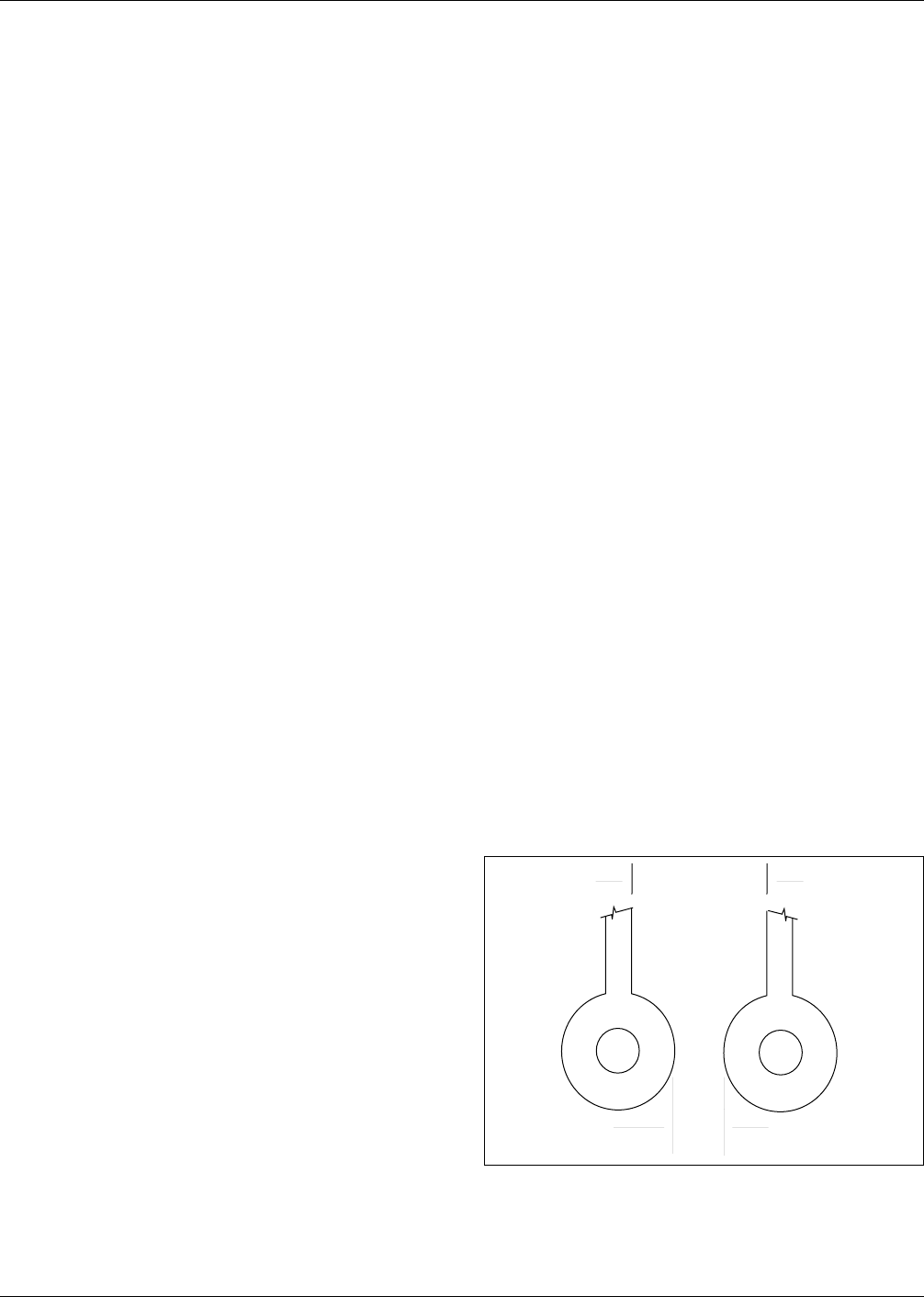
Conductor Spacing 60.1363
The observable distance between adjacent edges (not
center-to-center spacing) of isolated conductive patterns in
a conductor layer. (See Figure C-5.) (See Also ‘‘Center-to-
Center Spacing.’’)
Conductor Thickness 22.1707
Thickness of a conductor including additional metallic
coatings but excluding non-conductive coatings.
IPC-I-001026
Figure C–5 Conductor spacing
Spacing
Spacing
▼
▼
▼
▼
IPC-T-50F June 1996
16