IPC-T-50F_.pdf.pdf - 第13页
Bond Surface 74.0141 see ‘ ‘Bonding Area.’ ’ Bond-to-Bond Distance 74.0121 The distance from the bonding site on a die to the corre- sponding bonding site on a lead frame, interconnecting base material, etc. Bond-to-Die …

Biocide 76.0110
A general name for any substance that kills or inhibits the
growth of micro-organisms.
Birdcage 37.1338
A defect in stranded wire whereby the strands in the
stripped portion between the covering of an insulated wire
and a soldered connection, or an end-tinned lead, have
separated from the normal lay of the strands.
Bismaleimide 41.0111
A resin that has the generic chemical structure of an aro-
matic chemical group that is attached to two (or ‘‘Bis’’)
maleimide groups.
Bismaleimide Triazine 41.0112
A resin that contains a mixture of bismaleimide and triaz-
ine resins.
Blank 41.1339
An unprocessed or partially processed piece of base mate-
rial or metal- clad base material, that has been cut from a
sheet or panel, that has the rough dimensions of a printed
board. (See also ‘‘Panel.’’)
Bleeding 52.0113
A condition in which a plated hole discharges process
material or solution from crevices or voids or a condition
in which a resist migrates beyond the image area.
Blends 41.0114
Mixtures of resins.
Blind Via 22.0115
A via extending only to one surface of a printed board.
(See Figure B-3.)
Blister 96.1340
Delamination in the form of a localized swelling and sepa-
ration between any of the layers of a lamination base mate-
rial, or between base material and conductive foil or pro-
tective coating.
Blocking Variables 94.0116
A relatively-homogeneous set of conditions within which
different conditions of primary variables are compared.
Blow Hole 53.0117
A void caused by outgassing.
Board 60.0118
see ‘‘Printed Board,‘‘ and ‘‘Multilayer Printed Board.’’
Board Thickness 22.0119
The overall thickness of the base material and all conduc-
tive materials deposited thereon.
Body Land Clearance 51.1341
That portion of the land diameter of a drill that is decreased
in order to provide clearance behind the margin. (See Fig-
ure B-4, Feature K.)
Bond 74.0120
An interconnection that performs a permanent electrical
and/or mechanical function.
Bond Deformation 74.0123
The plastic-flow change in the form of a lead caused by a
bonding tool during a termination process.
Bond Enhancement Treatment 74.0125
The improvement of the adhesion of a metal foil surface to
an adjacent layer of material to which it is being attached
Bond Envelope 74.0126
The range of termination parameters within which accept-
able bonds may be formed.
Bond Interface 74.0133
The common area between a lead and a land to which it
has been terminated.
Bond Land 74.0134
see ‘‘Bonding Area.’’
Bond Lift-Off 74.0135
The failure mode whereby a bonded lead separates from
the surface to which it has been joined.
Bond Schedule 74.0136
The values of termination machine parameters.
Bond Separation 74.0137
The distance between the termination points of the first
bond and the second bond.
Bond Site 74.0138
That portion of the bonding area where the actual termina-
tion takes place.
Bond Strength 60.0139
The force perpendicular to a board’s surface required to
separate two adjacent layers of the board, expressed as
force per unit area.
IPC-I-001033
Figure B–3 Blind and buried vias
INTERFACIAL
CONNECTION
BURIED VIA
BLIND VIA
A
B
IPC-T-50F June 1996
8

Bond Surface 74.0141
see ‘‘Bonding Area.’’
Bond-to-Bond Distance 74.0121
The distance from the bonding site on a die to the corre-
sponding bonding site on a lead frame, interconnecting
base material, etc.
Bond-to-Die Distance 74.0122
The distance from the heal of a beam lead to the die.
Bondability 74.1342
Those surface characteristics and conditions of cleanliness
of a bonding area that must exist in order to provide for the
capability to achieve a successful termination.
Bonding Area 74.0128
The area defined by the extent of a land or portion of a ter-
minal to which a lead is to be bonded.
Bonding, Die 74.0127
see ‘‘Die Bonding.’’
Bonding Island 74.0129
see ‘‘Bonding Area.’’
Bonding Layer 55.0130
An adhesive layer used in bonding together other discrete
layers of a multilayer printed board during lamination.
Bonding Tool 74.0131
The instrument used to position leads or discrete wires over
a land and to impart sufficient energy to complete the ter-
mination.
Bonding Wire 74.0132
Fine gold or aluminum wire used for making electrical
connections between lands, lead frames, and terminals.
Border Area 22.0142
The region on a base material that is external to that of the
end-product being fabricated within it.
Border Data 22.0143
Patterns that appear in the border area, such as tooling fea-
tures, test patterns, and registration marks.
Boss 22.0144
see ‘‘Land.’’
Boss (Connector) 37.0145
A raised section on a connector that fits into a specific slot
in the positive polarization or keying feature of a mating
connector.
Bow (Fabric) 44.0146
Filling yarn that lies in an arc across the width of a fabric.
Bow (Sheet, Panel, or Printed Board) 60.1218
The deviation from flatness of a board characterized by a
roughly cylindrical or spherical curvature such that, if the
product is rectangular, its four corners are in the same
plane. (See Figure B-5.) (See also ‘‘Twist.’’)
Brainstorming 94.0147
The generation of an all-inclusive list of potential causal
factors that are possible contributors to process problems.
Breakout 60.0148
see ‘‘Hole Breakout.’’
Bridging, Electrical 70.0149
The unintentional formation of a conductive path between
conductors. (See also ‘‘Solder Bridging.’’)
Brightness 24.0150
see ‘‘Luminance.’’
Broken Pick 35.0151
A filling yarn that is missing from a portion of the width of
a fabric.
Brominated Epoxy 41.0152
An epoxy resin containing chemically-bound bromine
which is added to act as a flame retardant.
Bubble Effect 76.0153
The entrapment of air, solvent or moisture bubbles in a
protective coating.
Buffer Material 76.0154
A resilient material that is used to protect a crack-sensitive
component from the stresses generated by a conformal
coating.
Bugging Height 74.0155
The distance between a land and the lower surface of a
beam lead caused by the deformation of the lead during
bonding.
Bulge 60.0156
A swelling of a printed board that is usually caused by
internal delamination or separation of fibers.
Bulk Conductance 92.0157
Conductance between two points of a homogeneous mate-
rial.
Bulls-Eye 20.0158
A stylized pattern that is located in the border area in order
to aid in alignment.
June 1996 IPC-T-50F
9
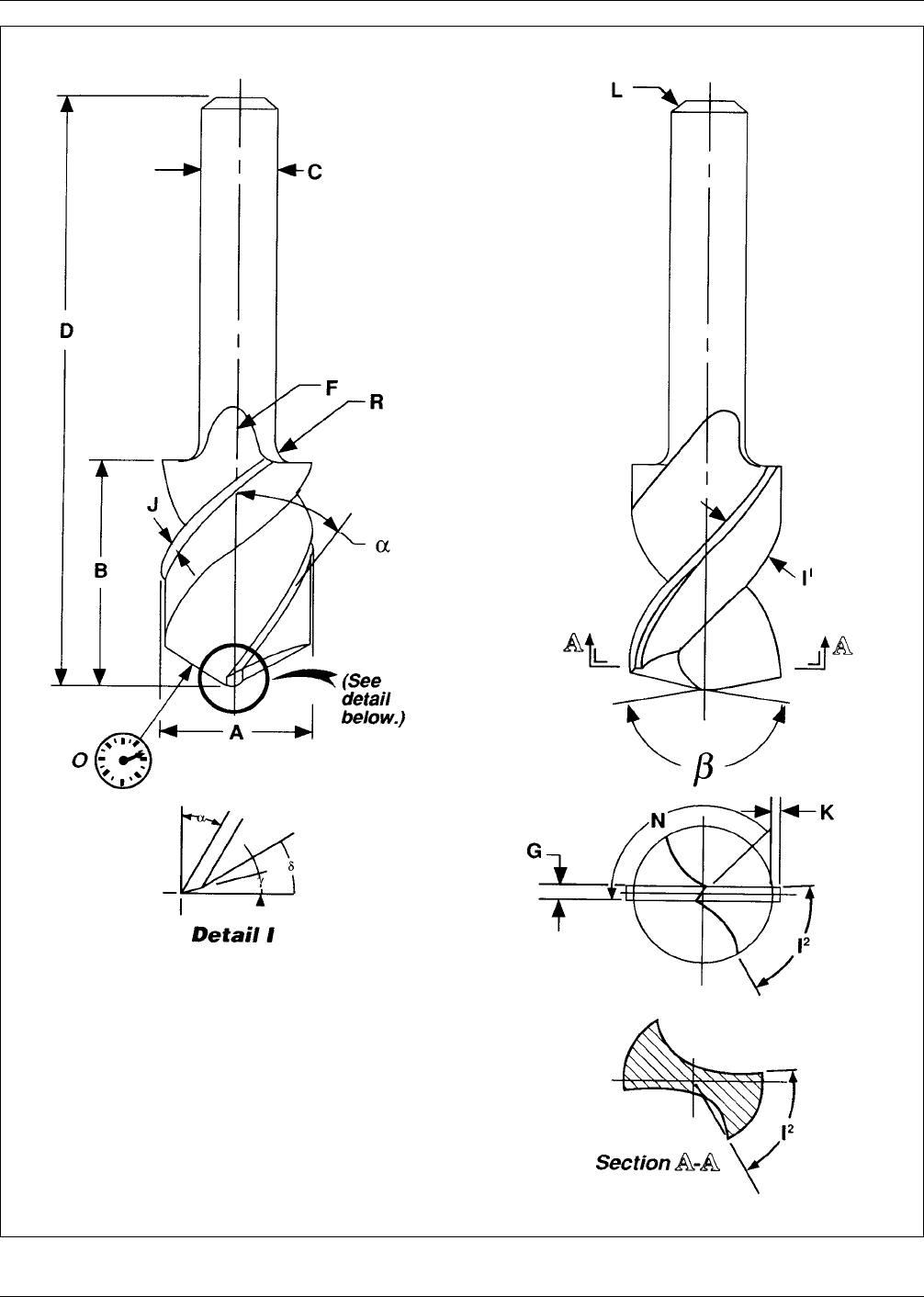
Figure B–4 Drill Features
IPC-T-50F June 1996
10