IPC-T-50F_.pdf.pdf - 第50页
Nonactivated Flux 75.1183 A natural or synthetic-resin flux without activators. Nonconductive Pattern 22.1184 A configuration that is formed by the functional noncon- ductive material of a printed circuit, e.g., dielectric…
N
Nail Heading 51.0794
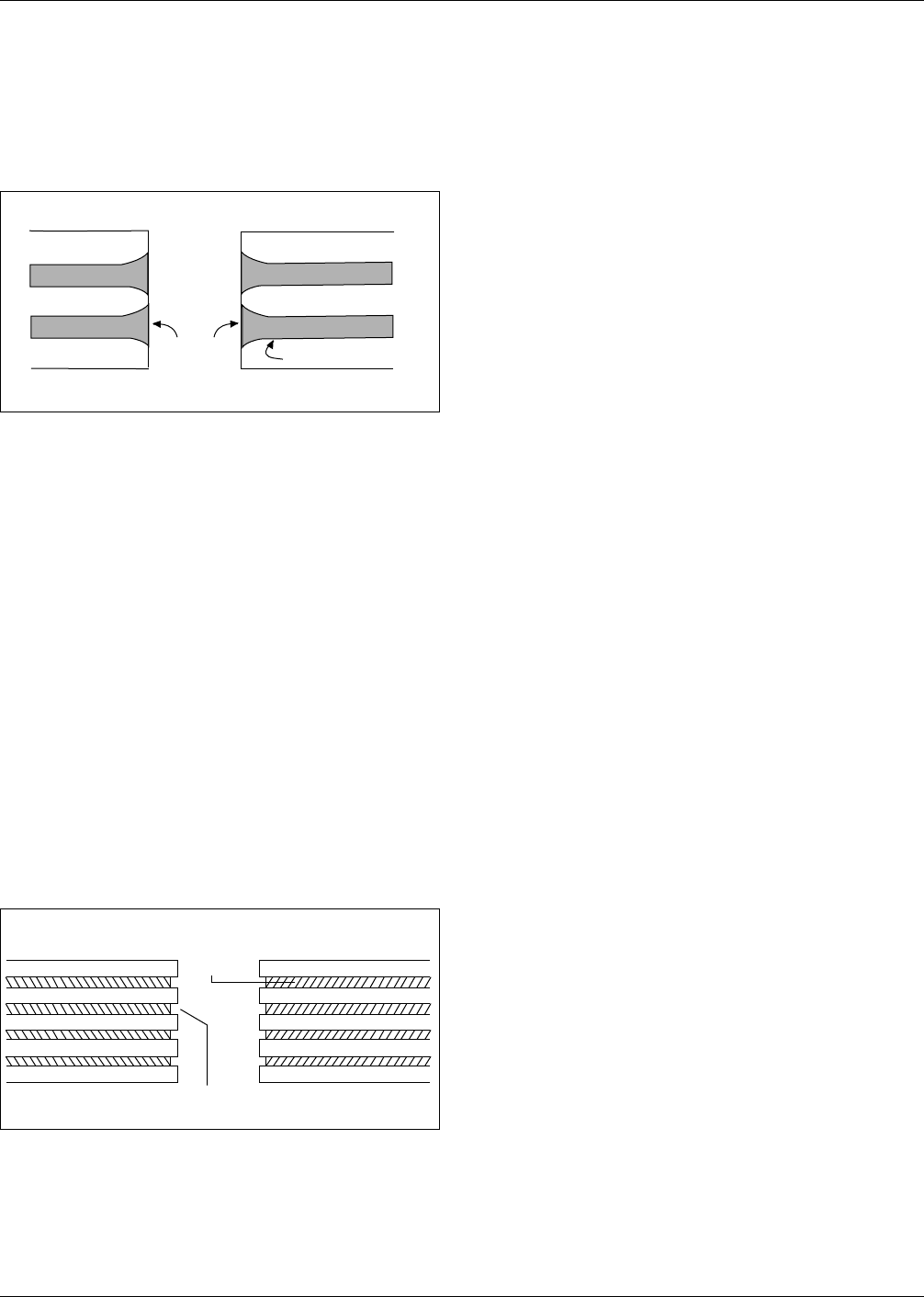
The flared condition of copper on an inner conductive layer
of a multilayer printed board that is caused by hole-drilling.
(See Figure N-1.)
Nail 92.0792
see ‘‘Probe, Test.’’
Nailhead Bond 74.0793
see ‘‘Ball Bond.’’
Near-End Crosstalk 21.0795
see ‘‘Backward Crosstalk.’’
Neckbread 74.0796
A break in a bond immediately above a ball bond.
Negative Etchback 54.0798
Etchback in which the inner conductor layer material is
recessed relative to the surrounding base material. (See
Figure N-2.)
Negative (n.) 24.0797
An artwork, artwork master, or production master in which
the pattern being fabricated is transparent to light and the
other areas are opaque.
Negative Pattern 24.1639
An artwork, artwork master, or production master in which
the pattern being fabricated is transparent to light and the
other areas as opaque.
Negative-Acting Resist 52.1448
A resist that is polymerized by light and which, after expo-
sure and development, remains on a surface in those areas
that were under the transparent areas of a production mas-
ter.
Neighborhood Processing 92.0799
The determination of information about a location or pixel
by the use of information obtained about its neighbors.
Nesting 25.1176
Embedding data in levels of other data so that certain rou-
tines may be executed or accessed continuously in loops.
Net 21.1177
An entire string of electrical connections from the first
source point to the last target point, including lands and
vias.
Net List 21.1178
A list of alphanumeric representations, each of which is
used to describe a group of two or more points that are
electrically common.
Nick (n.) 60.1179
A cut or notch in a wire or in the edge of a conductor.
Node 21.1180
The endpoint of an electrical network branch or the junc-
tion of two or more branches.
Nodule 60.1181
A mass or small lump with an irregular shape that is con-
vex to a surface.
Noise (Process Control) 91.1182
Factors in a manufacturing process that are uncontrollable
or too costly to control.
Nominal Cured Thickness 55.1449
The thickness of a multilayer printed board, or the distance
between two two adjacent layers of a multilayer printed
board, after the prepreg has been cured at the temperature
and pressure specified for that particular class of resin flow.
Nominal-Is-Best Characteristic 91.1450
A parameter of quality that optimizes performance at its
nominal value. (See also ‘‘Larger-the-Better Characteris-
tic’’ and ‘‘Smaller-the-Better Characteristic.’’)
IPC-I-001045
Figure N–1 Nail heading
NAIL HEADING
BASE MATERIAL
COPPER CONDUCTOR
LAYER
IPC-I-001032
Figure N–2 Negative etchback
Negative
Etchback
▼
▼
Base Material
Copper
Conductive
Layer
June 1996 IPC-T-50F
45
Nonactivated Flux 75.1183
A natural or synthetic-resin flux without activators.
Nonconductive Pattern 22.1184
A configuration that is formed by the functional noncon-
ductive material of a printed circuit, e.g., dielectric, resist,
etc.
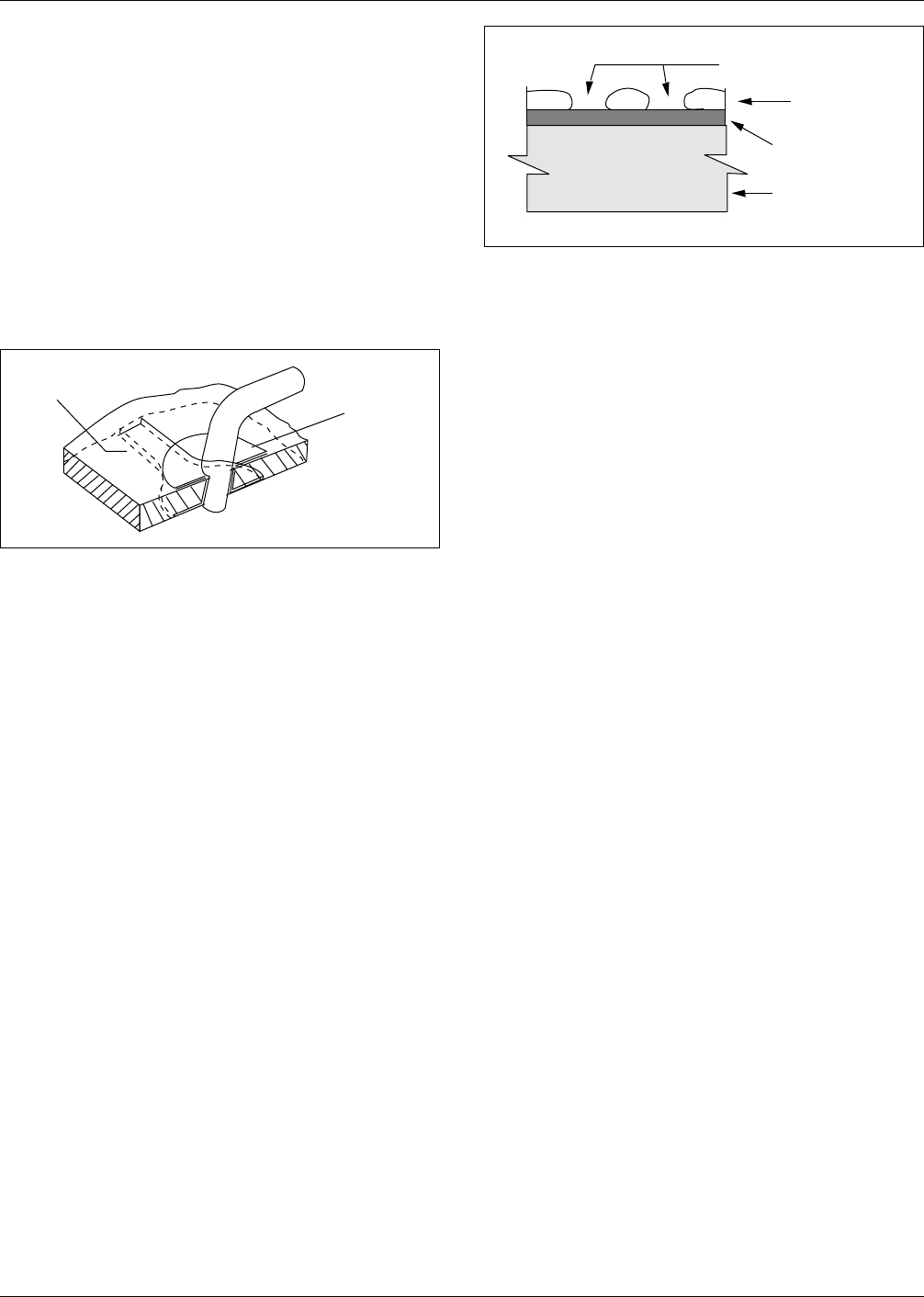
Nonfunctional Interfacial Connection 22.1453
A plated through hole in a double-sided printed board that
electrically connects a printed conductor on one side of the
board to a nonfunctional land on the other side of the
board. (See Figure N-3.)
Nonfunctional Land 22.1185
A land that is not connected electrically to the conductive
pattern on its layer.
Nonfunctional Terminal Area 22.1186
see ‘‘Nonfunctional Land.’’
Nonionic Contaminant 76.1187
A residue that does not readily ionize in water.
Nonpolar Matter 76.1188
A substance that cannot be dissolved in water that is
soluble in hydrophobic solvents.
Nonpolar Solvent 76.1454
A liquid that is not ionized to the extent that it is electri-
cally conductive, that can dissolve nonpolar compounds
(such as hydrocarbons and resins), and cannot dissolve
polar compounds (such as inorganic salts.)
Nonwetting (Solder) 75.1189
The partial adherence of molten solder to a surface that it
has contacted and basis metal remains exposed. (See Fig-
ure N-4.)
Normal Distribution 94.1191
A mathematically-defined continuous distribution of values
that has a bell shape that is perfectly symmetrical about a
mean value.
Normal-Mode Rejection (NMR) 21.1190
The amount of noise superimposed on the input signal of a
direct-current (DC) digital voltmeter that the instrument is
capable of rejecting.
Null Hypothesis 91.1455
The supposition that no significant difference exists
between the desired results of two comparable populations.
(See also ‘‘Alternative Hypothesis’’ and ‘‘Statistical
Hypothesis.’’)
Numerical Control (machine) (NC) 25.1193
The automatic control of electromechanical devices by
means of a digital input to an electronic controller.
Numerical Control (math.) (NC) 20.1192
The use of mathematics to define, design or test geometric
quantities that are used in a computer-aided technology.
O
Object Code 25.0801
The output from a computer compiler or assembler that is,
or is suitable for, processing into executable machine
codes.
Object-Oriented Database 11.0800
A database that combines graphics and text to describe
objects.
Occluded Contaminant 76.0802
A contaminant that is totally contained in an insulating
material.
Occlusion 76.0803
Uniform molecular adhesion between a precipitate and a
soluble substance, or between a gas and a metal.
Off Bond 74.0804
A termination that has some portion of the bonding area
extending off the bonding land.
Offset Land 22.0805
A land that is intentionally not in physical contact with its
associated component hole.
IPC-I-001046
Figure N–3 Nonfunctional interfacial connection
Conductor
Non-
functional
Land
▼
▼
IPC-I-001042
Figure N–4 Nonwetting
NONWETTING
SOLDER
BASIS METAL
BASE MATERIAL
IPC-T-50F June 1996
46
Offset Terminal Area 22.0806
see ‘‘Offset Land.’’
Omnibus Ring 36.0807
see ‘‘Support Ring.’’
One-Piece Connector 37.0809
see ‘‘Edge-Board Connector.’’
One-Sided Board 60.0810
see ‘‘Single-Sided Printed Board.’’
Opacity 24.0811
The reciprocal of the transmittance ratio for a photographic
image.
Opaquer 24.1456
A material that, when added to a resin system, renders
laminate sufficiently opaque, so that the yarn or weave of
the reinforcing material cannot be seen with the unaided
eye using either reflected or transmitting light.
Open Circuit Potential 21.0814
The potential of a cell from which no current flows in the
external circuit.
Open, Electrical (n.) 92.0812
A fault that causes two electrically-connected points to
become separated.
Open-Entry Contact 37.0813
A type of female connector contact that does not prevent
the entry of an oversized mating part. (See also ‘‘Closed-
Entry Contact.’’)
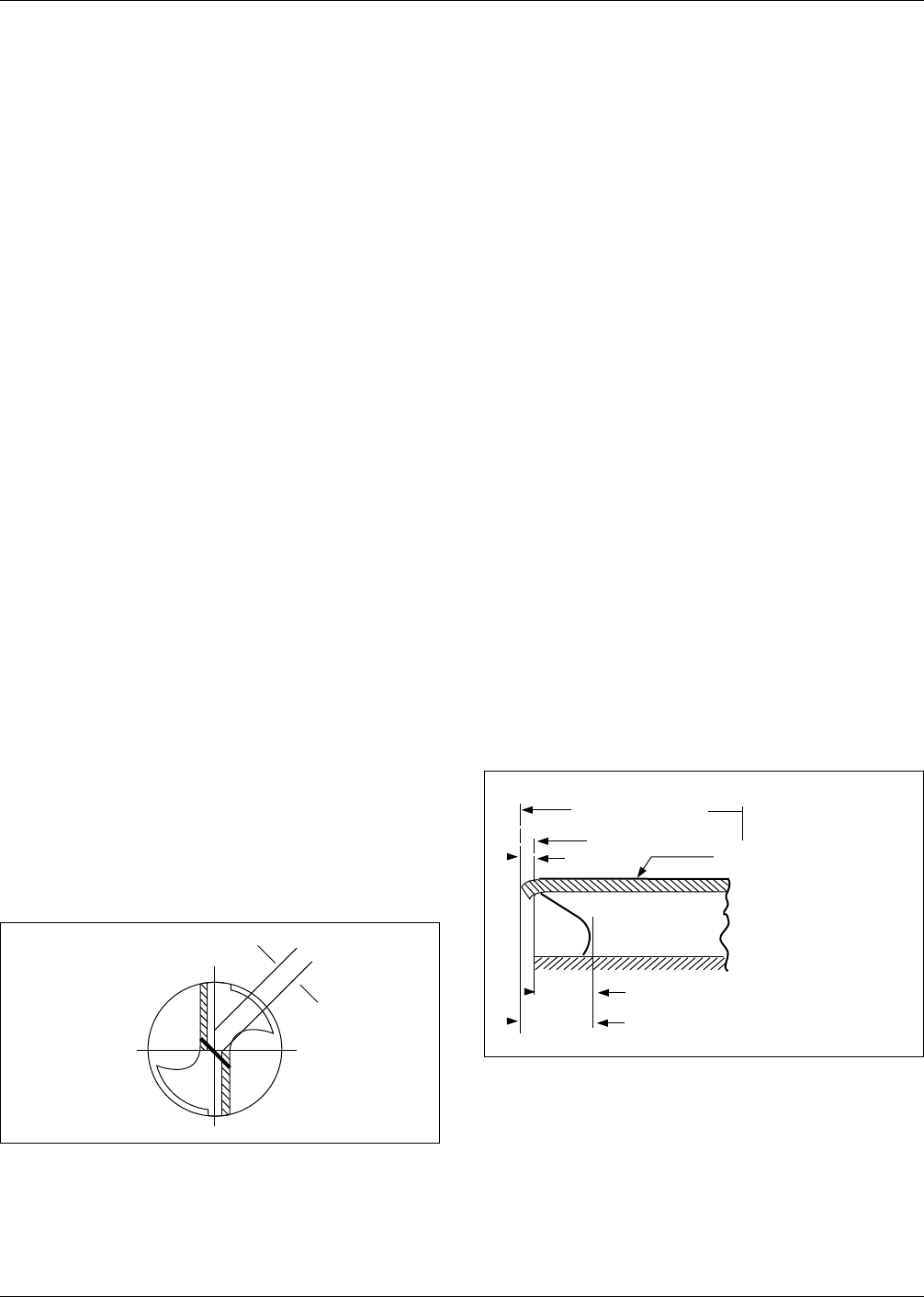
Open Point 51.1457
The amount of misalignment between the trailing edge of
the junction line between the primary and secondary drill-
point clearance angles when they are ahead of the drill
centerline.(See Figure O-1.)
Open Time 75.1194
The maximum duration of the interval from the application
of an adhesive to the formation of a satisfactory bond. (See
also ‘‘Working Time.’’)
Optical Image 24.1195
An image that is projected onto a viewing screen.
Organic Contamination 76.1196
A type of contamination derived from an organic sub-
stance.
Orthochromatic Emulsion 24.1197
A photographic emulsion that is spectrally sensitive to the
violet, blue, and green portions of the visible light spec-
trum.
Orthogonal-Array Experiment 91.1458
A balanced evaluation whereby the avarage effect of a fac-
tor is determined while the levels of all other factors in the
design are systematically changed.
Outer-Lead Bond (OLB) 74.1198
The connection between a conductor on a bonding tape and
the base material. (See also ‘‘Inner-Lead Bond.’’)
Outgassing 53.1199
The gaseous emission from a laminate printed board or
component when the board or the printed board assembly
is exposed to heat or reduced air pressure, or both.
Outgrowth 45.1459
The increase in size of one side of a conductor that is
caused by plating that is in excess of that delineated on the
production master. (See Figures O-2 and O-3.)
Output Vector 91.1228
The set of logic values, either expected or measured, for all
output points at a particular test step of a unit under test.
Overall Length 51.1200
The distance from the end of a drill shank to the cutting
end of the tool, including the point.
IPC-I-002327
Figure O–1 Open point
Open Point
▼
▼
IPC-I-001044
Figure O–2 Outgrowth, overhang, and undercut
COPPER
OVERHANG
UNDERCUT
OUTGROWTH
TIN/LEAD
PLATING
CONDUCTOR WIDTH (ACTUAL)
CONDUCTOR WIDTH AS ON
PRODUCTION MASTER
Undercut and overhang as
observed by fabrication and
user (usually by cross-sectioning)
outgrowth as observed by all
(determined by measurement
from verticallyabove and
by comparison to the production
master)
June 1996 IPC-T-50F
47