IPC-T-50F_.pdf.pdf - 第27页
Dimensioned Hole 22.0382 A hole in a printed board whose location is determined by physical dimensions or coordinate values that do not nec- essarily coincide with the stated grid. Dimorphism 40.0383 The existence of a s…
Detail Specification 26.1740
A detailed written description of a part or a process.
Detailed Specification (DS) 26.1781
A document that describes the exact requirements for a
specific product, material, or service.
Detection 91.0367
A strategy that attempts to identify and separate acceptable
and unacceptable outputs from a process.
Developing (Phototool) 24.0368
The chemical treatment of radiation-modified photosensi-
tive material in order to produce an image.
Device 30.0369
An individual electrical circuit element that cannot be fur-
ther reduced without destroying its stated function.
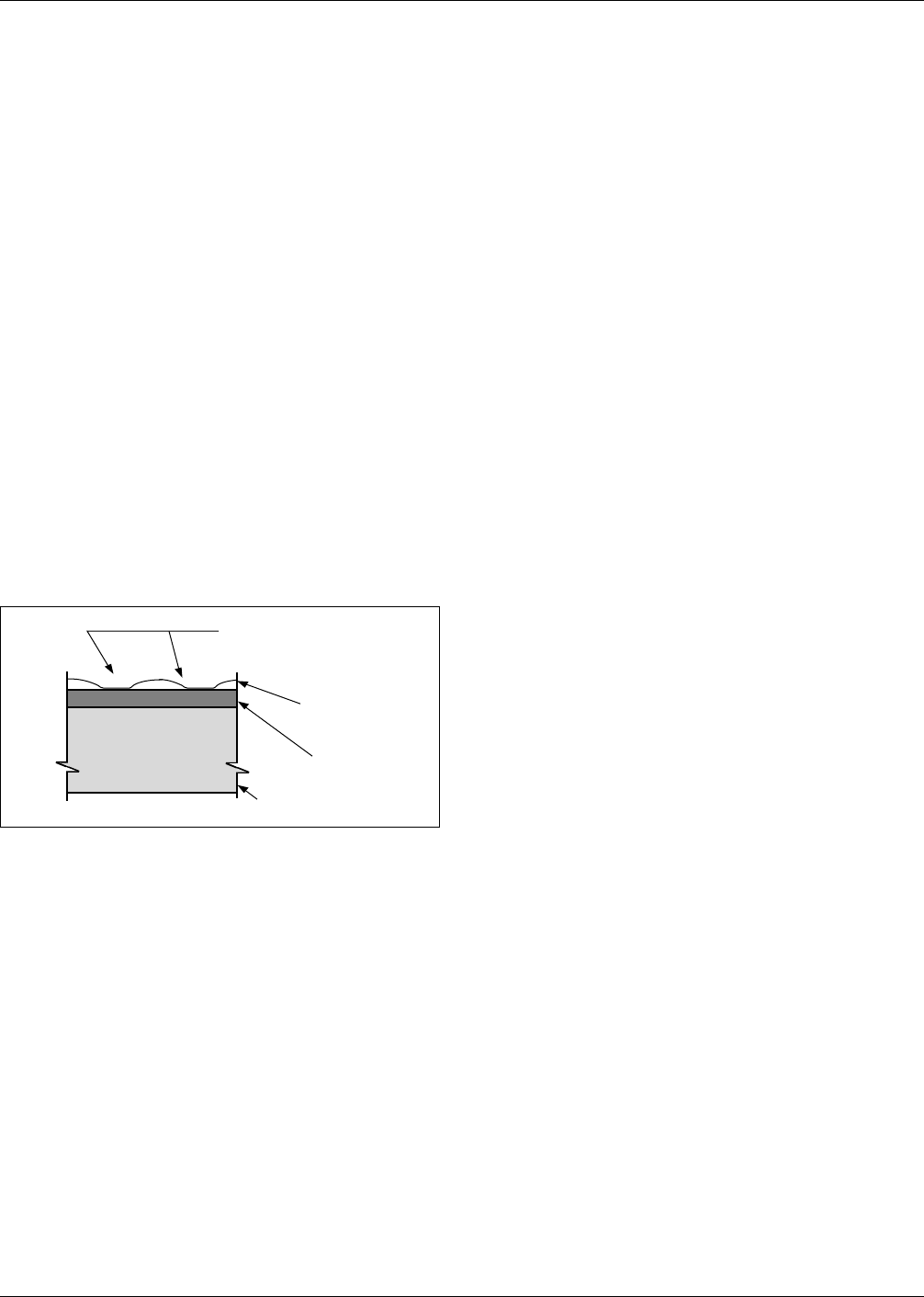
Dewetting 97.0370
A condition that results when molten solder coats a surface
and then recedes to leave irregularly-shaped mounds of
solder that are separated by areas that are covered with a
thin film of solder and with the basis metal not exposed.
(See Figure D-1.)
Diazo Material 24.0371
A nonsilver, room-light hardening, ultraviolet-sensitive
coating material.
Dibasic Acid 76.0372
An acid containing two atoms of acidic hydrogen in a mol-
ecule.
Dice 35.0373
Two or more die.
Dicyandiamide 41.0374
A solid curing agent for epoxy resins.
Die 35.0375
The uncased and normally leadless form of an electronic
component that is either active or passive, discrete or inte-
grated. (See also ‘‘Dice.’’)
Die Bonding 74.0376
The attachment of a die to base material.
Dielectric 40.0377
A material with a high resistance to the flow of direct cur-
rent, and which is capable of being polarized by an electri-
cal field.
Dielectric Constant 21.1379
The ratio of the capacitance of a configuration of electrodes
with a specific material as the dielectric between them to
the capacitance of the same electrode configuration with a
vacuum or air as the dielectric.
Dielectric Breakdown 21.1378
The complete failure of a dielectric material that is charac-
terized by a disruptive electrical discharge through the
material that is due to deterioration of material or due to an
excessive sudden increase in applied voltage.
Dielectric Fluid 21.0378
A fluid that has excellent dielectric strength, excellent vol-
ume resistivity, a low dielectric constant, and a low dissi-
pation factor.
Dielectric Strength 21.1380
The maximum voltage that a dielectric can withstand under
specified conditions without resulting in a voltage break-
down, usually expressed as volts per unit dimension.
Diffusion Bond 74.0379
A bond formed in the absence of any liquid phase at any
time prior to or during the joining process.
Digital Circuit 21.0380
An electrical circuit that provides two (binary) or three dis-
tinct relationships (states) between its input and output.
Digitizing (CAD) 25.0381
The converting of feature locations on a flat plane to its
digital representation in X-Y coordinates.
Dilution Ratio 76.1221
The maximum number of unit volumes of hydrocarbons
that can be added per unit volume of active solvent in order
to cause the first trace of gelation to occur when the con-
centration of nitrocellulose in the solution is 8-grams per
100-milliliters.
Dimensional Stability 21.1381
A measure of the dimensional change of material that is
caused by factors such as temperature changes, humidity
changes, chemical treatment (aging), and stress exposure.
IPC-I-001029
Figure D–1 Dewetting
DEWETTING
SOLDER
BASE METAL
BASE MATERIAL
IPC-T-50F June 1996
22

Dimensioned Hole 22.0382
A hole in a printed board whose location is determined by
physical dimensions or coordinate values that do not nec-
essarily coincide with the stated grid.
Dimorphism 40.0383
The existence of a substance in two different crystalline
forms.
Dip Soldering 75.1382
The making of soldered terminations simultaneously by
bringing the solder side of a printed board with through-
hole mounted components into contact with the surface of
a static pool of molten solder. (See also ‘‘Drag Soldering.’’)
Diphase Cleaning 76.0384
Cleaning by means of solutions that contain a solvent layer
and an aqueous layer.
Dipole 21.0385
An assemblage of atoms or subatomic particles, separated
by a finite distance, that have equal electric charges of
opposite sign.
Dipole Moment 21.1383
Molecules in which the atoms, their electrons, and their
nuclei, that are so arranged that one part of the molecule
has a positive electrical charge while the other part is nega-
tively charged.
Direct Dimensioning 22.0388
The maximum variation between two features that is con-
trolled by the tolerance on the dimension between the fea-
tures.
Direct Cleaning 76.0386
see ‘‘Cathodic Cleaning’’
Direct Current (DC) 21.1796
A current produced by a voltage source that does not vary
with time and is normally provided by power supplies,
transformers or batteries to power electronic circuits.
Direct Current Cleaning 76.0387
see ‘‘Cathodic Cleaning’’
Discrepant Material 92.0389
Material that does not conform to specification.
Discrete Component 30.0392
A separate part of a printed board assembly that performs
a circuit function, e.g., a resistor, a capacitor, a transistor,
etc.
Discrete Wiring Board 64.0390
A base material upon which discrete wiring techniques are
used to obtain electrical interconnections.
Discrete Wiring Board Assembly 64.0391
An assembly that uses a discrete wiring board for compo-
nent mounting and interconnecting purposes.
Dispersant (Organosol) 41.0393
A liquid component that has a solvating or peptizing action
on a resin so as to aid in dispersing and spreading it.
Disperse Phase (Suspension) 41.0394
The particles of solid material dispersed in a liquid
medium.
Dispersing Agent 41.0395
A surface-active agent added to a suspending medium to
promote uniform separation of extremely-fine solid par-
ticles.
Dissipation Factor 21.0396
A value that represents the tendency of insulating or dielec-
tric materials to absorb some of the energy in an
alternating-current signal.
Dissolution of Metallization 36.1741
The process of dissolving metal, usually by introduction of
chemicals. (See also ‘‘Leaching, Metallization’’).
Distributed Numerical Control (DNC) 25.0398
A network that links computer programs or computer-aided
systems to numerically-controlled machine tools.
Disturbed Solder Connection 97.1384
A solder connection that is characterized by the appearance
that there was motion between the metals being joined
when the solder was solidifying.
Don’t Care Area 22.0399
see ‘‘Exclusion Area’’
Doping 35.0400
The addition of an impurity to alter the conductivity of a
semiconductor die.
Double-Sided Assembly 80.0401
A packaging and interconnecting structure with compo-
nents mounted on both the primary and secondary sides.
(See also ‘‘Single-Sided Assembly’’)
Double-Sided Printed Board 60.0402
A printed board with a conductive pattern on both of its
sides.
Download, Computer 11.1385
The transfer of computer programs or data from a com-
puter to a lower- level computer. Expert System - Software
that applies human-like reasoning to solve a problem by
the use of rules and heuristics.
June 1996 IPC-T-50F
23

Download, Tester 92.0403
The ability of a test analyzer to provide failure analysis and
data logging information to a host computer.
Drafting Image 26.0404
An image that is part of a master drawing or layout.
Drag Soldering 75.1386
The making of soldered terminations by moving the solder
side of a supported printed board with through-hole
mounted components through the surface of a static pool of
molten solder. (see also ‘‘Dip Soldering.’’)
Drain Wire 37.0405
An uninsulated wire that is used for the electrical termina-
tion of a shield or ground plane.
Drawbridged Component 73.0406
see ‘‘Tombstoned Component.’’
Drill Body Length 51.0407
The distance from the drill point to the intersection of the
drill diameter and shoulder angle.
Drill Diameter 51.0408
The actual size of the drill body.
Drill Point Concentricity 51.0409
The total variation of the location of the chisel point of a
rotated drill shank.
Dross 75.0410
Oxide and other contaminants that form on the surface of
molten solder.
Dual Fixture 92.0411
A test fixture with two separate bed-of-nails units.
Dual-Inline Package (DIP) 31.1387
A basically-rectangular component package that has a row
of leads extending from each of the longer side of its body
that are formed at right angles to a plane that is parallel to
the base of its body.
Dual-Strip Line 21.1797
A stripline signal conductor embedded between two ground
planes or between two ground conductors on the same
plane and is not necessarily centered between the ground
references.
E
E Glass 44.0423
A low alkali lime alumina borosilicate glass with good
electrical properties.
Edge Definition 92.0415
The reproduction fidelity of a pattern’s edge relative to the
production master.
Edge Detection 92.0416
The ability to recognize (differentiate) the location of an
edge.
Edge Rate 21.0417
The rate of change in voltage with time of a logic signal
transition.
Edge Short 74.0418
An electrical short caused by carrier tape leads making
contact with the edge of a semiconductor die.
Edge Spacing 22.0419
The distance of a pattern or component body from the
edges of a printed board. (See also ‘‘Margin.’’)
Edge-Board Connector 37.0412
A connector that is used specifically for making nonperma-
nent interconnections with the edge-board contacts on a
printed board.
Edge-Board Contact(s) 22.0413
Printed contact(s) on or near any edge of a printed board,
that are used specifically for mating with edge-board con-
nectors.
Edge-to-Edge Spacing 22.0414
see ‘‘Conductor Spacing Line’’
Edge-Transition Attenuation 21.1388
The loss of a logic signal’s switching-edge sharpness that
has been caused by the absorption of the highest-frequency
components by the transmission line.
Effective Color Temperature 24.0420
A color temperature based on an approximation of an
equivalent continuous spectrum resultant source, expressed
in degrees Kelvin (K).
Effective Focal Length 24.0421
A measure of the distance from the principal point of a
magnification device’s optical system to the corresponding
focal point.
Effective Permittivity 21.0422
see ‘‘Dielectric Constant.’’
Effective Relative Dielectric Constant 21.1798
The value of the dielectric constant obtained when experi-
mentally determined in an application as opposed to mea-
sured values of sample material.
IPC-T-50F June 1996
24