IPC-T-50F_.pdf.pdf - 第52页
Overcoat 76.0815 A thin film of insulating material that is applied over a semiconductor die for the purposes of mechanical and con- tamination protecticon. Overhang 60.0816 The sum of outgrowth and undercut. (See Figure …
Offset Terminal Area 22.0806
see ‘‘Offset Land.’’
Omnibus Ring 36.0807
see ‘‘Support Ring.’’
One-Piece Connector 37.0809
see ‘‘Edge-Board Connector.’’
One-Sided Board 60.0810
see ‘‘Single-Sided Printed Board.’’
Opacity 24.0811
The reciprocal of the transmittance ratio for a photographic
image.
Opaquer 24.1456
A material that, when added to a resin system, renders
laminate sufficiently opaque, so that the yarn or weave of
the reinforcing material cannot be seen with the unaided
eye using either reflected or transmitting light.
Open Circuit Potential 21.0814
The potential of a cell from which no current flows in the
external circuit.
Open, Electrical (n.) 92.0812
A fault that causes two electrically-connected points to
become separated.
Open-Entry Contact 37.0813
A type of female connector contact that does not prevent
the entry of an oversized mating part. (See also ‘‘Closed-
Entry Contact.’’)
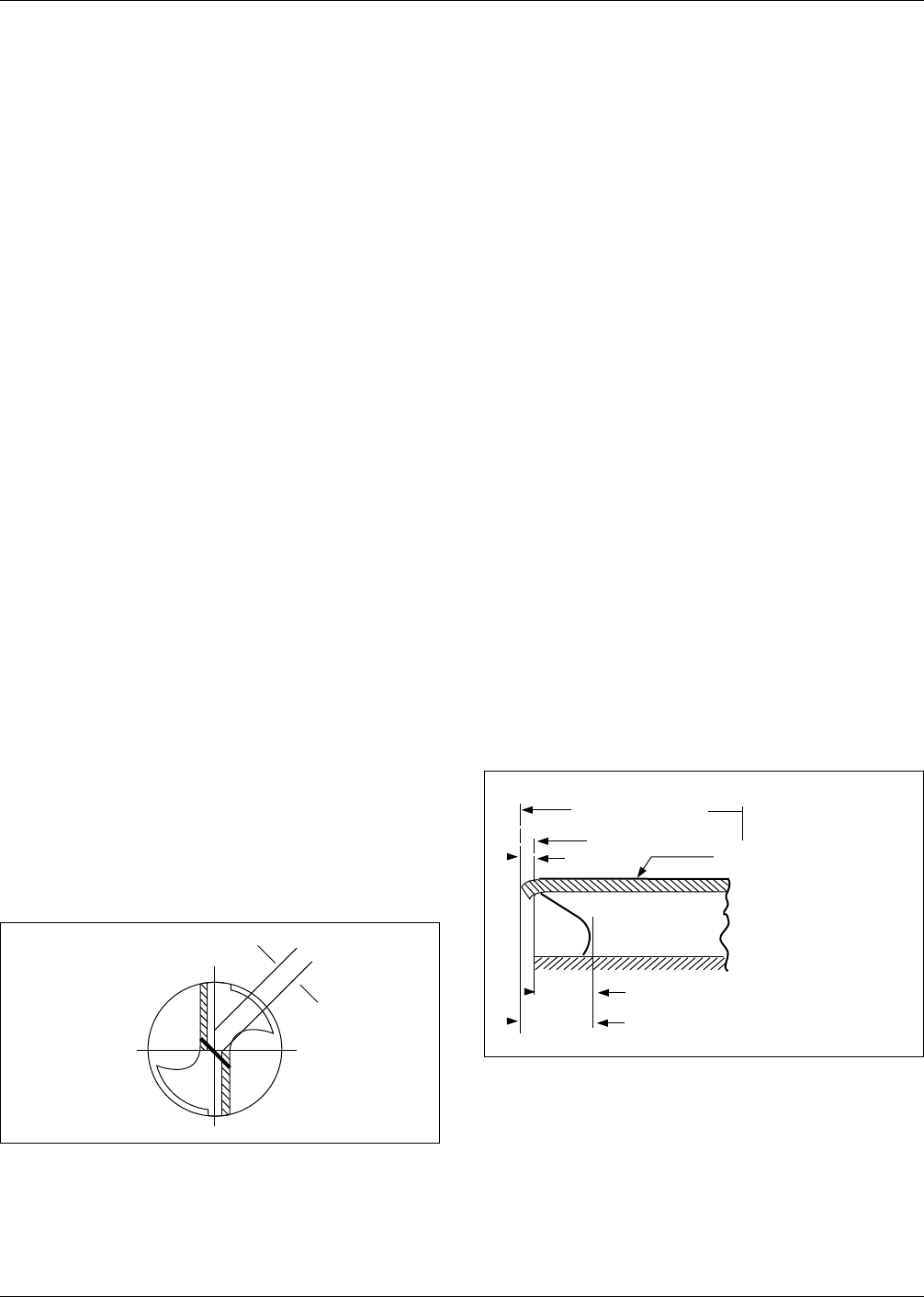
Open Point 51.1457
The amount of misalignment between the trailing edge of
the junction line between the primary and secondary drill-
point clearance angles when they are ahead of the drill
centerline.(See Figure O-1.)
Open Time 75.1194
The maximum duration of the interval from the application
of an adhesive to the formation of a satisfactory bond. (See
also ‘‘Working Time.’’)
Optical Image 24.1195
An image that is projected onto a viewing screen.
Organic Contamination 76.1196
A type of contamination derived from an organic sub-
stance.
Orthochromatic Emulsion 24.1197
A photographic emulsion that is spectrally sensitive to the
violet, blue, and green portions of the visible light spec-
trum.
Orthogonal-Array Experiment 91.1458
A balanced evaluation whereby the avarage effect of a fac-
tor is determined while the levels of all other factors in the
design are systematically changed.
Outer-Lead Bond (OLB) 74.1198
The connection between a conductor on a bonding tape and
the base material. (See also ‘‘Inner-Lead Bond.’’)
Outgassing 53.1199
The gaseous emission from a laminate printed board or
component when the board or the printed board assembly
is exposed to heat or reduced air pressure, or both.
Outgrowth 45.1459
The increase in size of one side of a conductor that is
caused by plating that is in excess of that delineated on the
production master. (See Figures O-2 and O-3.)
Output Vector 91.1228
The set of logic values, either expected or measured, for all
output points at a particular test step of a unit under test.
Overall Length 51.1200
The distance from the end of a drill shank to the cutting
end of the tool, including the point.
IPC-I-002327
Figure O–1 Open point
Open Point
▼
▼
IPC-I-001044
Figure O–2 Outgrowth, overhang, and undercut
COPPER
OVERHANG
UNDERCUT
OUTGROWTH
TIN/LEAD
PLATING
CONDUCTOR WIDTH (ACTUAL)
CONDUCTOR WIDTH AS ON
PRODUCTION MASTER
Undercut and overhang as
observed by fabrication and
user (usually by cross-sectioning)
outgrowth as observed by all
(determined by measurement
from verticallyabove and
by comparison to the production
master)
June 1996 IPC-T-50F
47
Overcoat 76.0815
A thin film of insulating material that is applied over a
semiconductor die for the purposes of mechanical and con-
tamination protecticon.
Overhang 60.0816
The sum of outgrowth and undercut. (See Figure O-3.) (If
undercut does not occur, the overhang is the same as the
outgrowth.)
Overheated Solder Connection 75.0817
A solder connection that is characterized by solder surfaces
that are dull, chalky, grainy, and porous or pitted.
Overlap (Film) 67.0818
The contact area between a film component and a film
conductor.
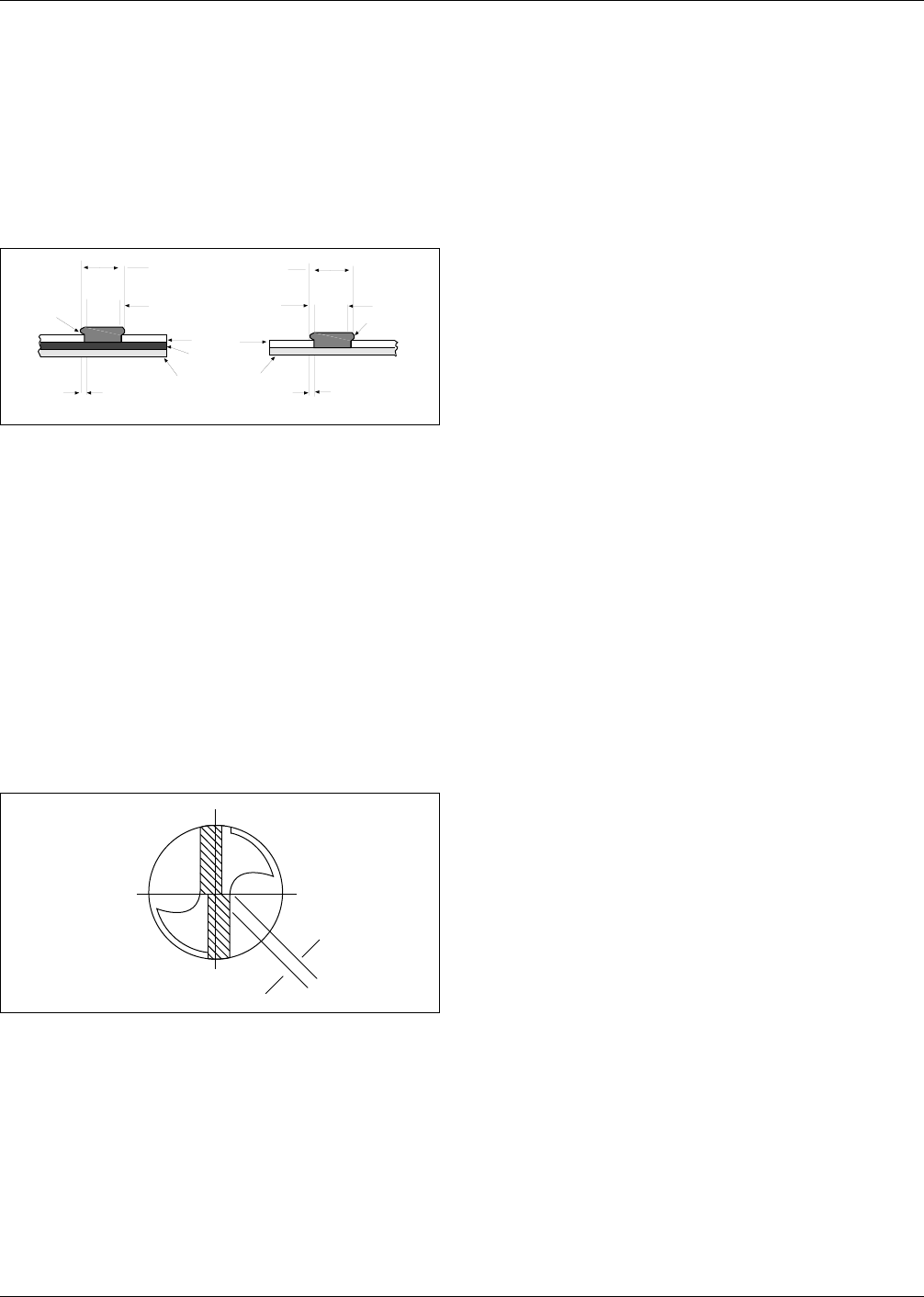
Overlap (Drill) 51.1229
The amount of misalignment between the trailing edge of
the junction line between the primary and secondary drill-
point clearance angles when they are behind the drill cen-
terline. (See Figures B-4 and O-4.) (See also ‘‘Layback.’’)
Overplate 53.1673
Conformal metallic deposition on a previously formed con-
ductive pattern or part thereof.
Oxide Transfer 41.0819
see ‘‘Treatment Transfer.’’
Oxygen Concentration Cell 76.0820
A galvanic cell resulting primarily from differences in oxy-
gen concentration.
P
Package 30.1460
The container for a circuit component, or components, that
is used to protect its contents and to provide terminals for
making connections to the rest of the circuit.
Package Cap 30.0821
A cuplike package cover.
Package Cover 30.0053
The cover that encloses the contents in the cavity of a
package in the final sealing operation.
Package Lid 30.0822
A flat package cover.
Packaging and Interconnecting Assembly 60.0823
The general term for an assembly that has components
mounted on either or both sides of a packaging and inter-
connecting structure.
Packaging and Interconnection Structure 60.1461
The general term for a completely processed combination
of base materials, supporting planes or constraining cores,
and interconnection wiring that are used for the purpose of
mounting and interconnecting components.
Packaging Density 20.1462
The relative quantity of functions (components, intercon-
nection devices, mechanical devices, etc.) per unit volume.
(This is usually expressed by qualitative terms such as
high, medium, and low.)
Pad 20.0824
see ‘‘Land.’’
Panchromatic Emulsion 24.0825
A photographic emulsion that is spectrally sensitive to all
portions of the visible light spectrum.
Panel 41.1463
A rectangular sheet of base material or metal-clad material
of predetermined size that is used for the processing of one
or more printed boards and, when required, one or more
test coupons. (See also ‘‘Blank.’’)
Panel Drawing 26.0826
A document that shows the production master with related
manufacturing patterns and artifacts that relate to the fabri-
cation of printed boards.
Panel Plating 53.0827
The plating of an entire surface of a panel including holes.
IPC-I-001043
Figure O–3 Outgrowth, overhang, and undercut
CONDUCTOR WIDTH
PLATING
CONDUCTOR WIDTH AS ON
PRODUCTION MASTER
BASE MATERIAL
RESIST
METAL FOIL
OUTGROWTH
OUTGROWTH
PLATING
IPC-I-002326
Figure O–4 Overlap
▼
▼
Overlap
IPC-T-50F June 1996
48

Para-aramid 44.1464
The generic term that describes fibers that are made from
wholly- aromatic polyamide, amide polymers in which at
least 85 % of the amide linkages are directly attached to
two benzene rings at the para position in the polymer
chain.
Parallel Pair 22.0828
Two conductors that are side-by-side at a controlled spac-
ing.
Parallel-Gap Soldering 75.1465
The passing of an electrical current through a high-
resistance space between two parallel electrodes in order to
provide the energy required to make a soldered termina-
tion.
Parallel-Gap Welding 75.1466
The passing of an electrical current through a high-
resistance space between two parallel electrodes in order to
provide the energy required to make a welded termination.
Parameter Record 25.0829
A record that defines the characteristics of a subsequent set
of records such as job identification, electrical description,
tolerances, etc.
Pareto Analysis 94.0830
A problem-solving technique whereby all potential prob-
lem areas or sources of variation are ranked according to
their contribution to the end result.
Partial Lift 74.0831
A bonded lead that has been partial removed from the
bonding area.
Partially-Clinched Lead 72.1467
A component lead that is inserted through a hole in a
printed board and is then formed in order to retain the
component in place and but not necessarily in order to
make metal-to-metal contact with a land prior to soldering.
(See also ‘‘Clinched Lead.’’)
Passivation 57.0832
The formation of an insulating layer to protect a surface
from contaminants, moisture and particulate matter.
Passive Base Material 44.0834
Base material, that does not exhibit transistance, that serves
as the physical support and thermal sink for film circuits.
Passive Component (Element) 30.1468
A discrete electronic device whose basic character does not
change while it processes an applied signal. (This includes
components such as resistors, capacitors, and inductors.)
Passive-Active Cell 76.0833
A cell whose electromotive force is due to the potential
difference between a metal in an active state and the same
metal in a passive state.
Paste Flux 75.0836
A flux formulated in the form of a paste to facilitate its
application. (See also ‘‘Solder Paste’’ and ‘‘Solder-Paste
Flux.’’)
Paste, Soldering 75.0835
A soldering method that uses a solder paste applied to the
land, device termination, or both.
Path 20.0837
see ‘‘Conductor.’’
Pattern 20.0838
The configuration of conductive and nonconductive mate-
rials on a base material, and the circuit configuration on
related tools, drawings and masters.
Pattern Area 20.0839
The section of a designated configuration that includes the
pattern and background.
Pattern Plating 53.0840
The selective plating of a conductive pattern.
Peel Strength 92.0841
The force per unit width that is required to peel a conduc-
tor foil from a laminate perpendicular to the surface of the
substrate.
Percent Contribution 91.0842
The amount that a single factor contributes to a total varia-
tion, expressed as a percent.
Percent of the Field of View 92.0843
The specific part of interest of the minimum required field
of view of a magnification device.
Perforated (Pierced) Solder Terminal 37.1469
A flat-metal solder terminal with an opening through which
one or more wires are placed prior to soldering. (See Fig-
ure P-1.)
Perimeter Sealing Area 30.0844
The surface on the perimeter of the cavity of a package that
is used for attachment to the package cover.
Permanent Resist 52.0845
A resist that is not removed after processing, e.g., plating
resist that is used in a fully-additive process.
June 1996 IPC-T-50F
49