YG300_Ope_E.pdf - 第102页
3-16 3 Starting and ending pr oduction • O u t p u t : D e l a y T i m e ( s e c / b o a r d , s e c ) S h o w s t h e t i m e t h a t t h e m a c h i n e h a s w a i t e d f o r b o a r d u n l o a d i n g o n t h e m o…
3-15
3
Starting and ending production
4.3 Detail
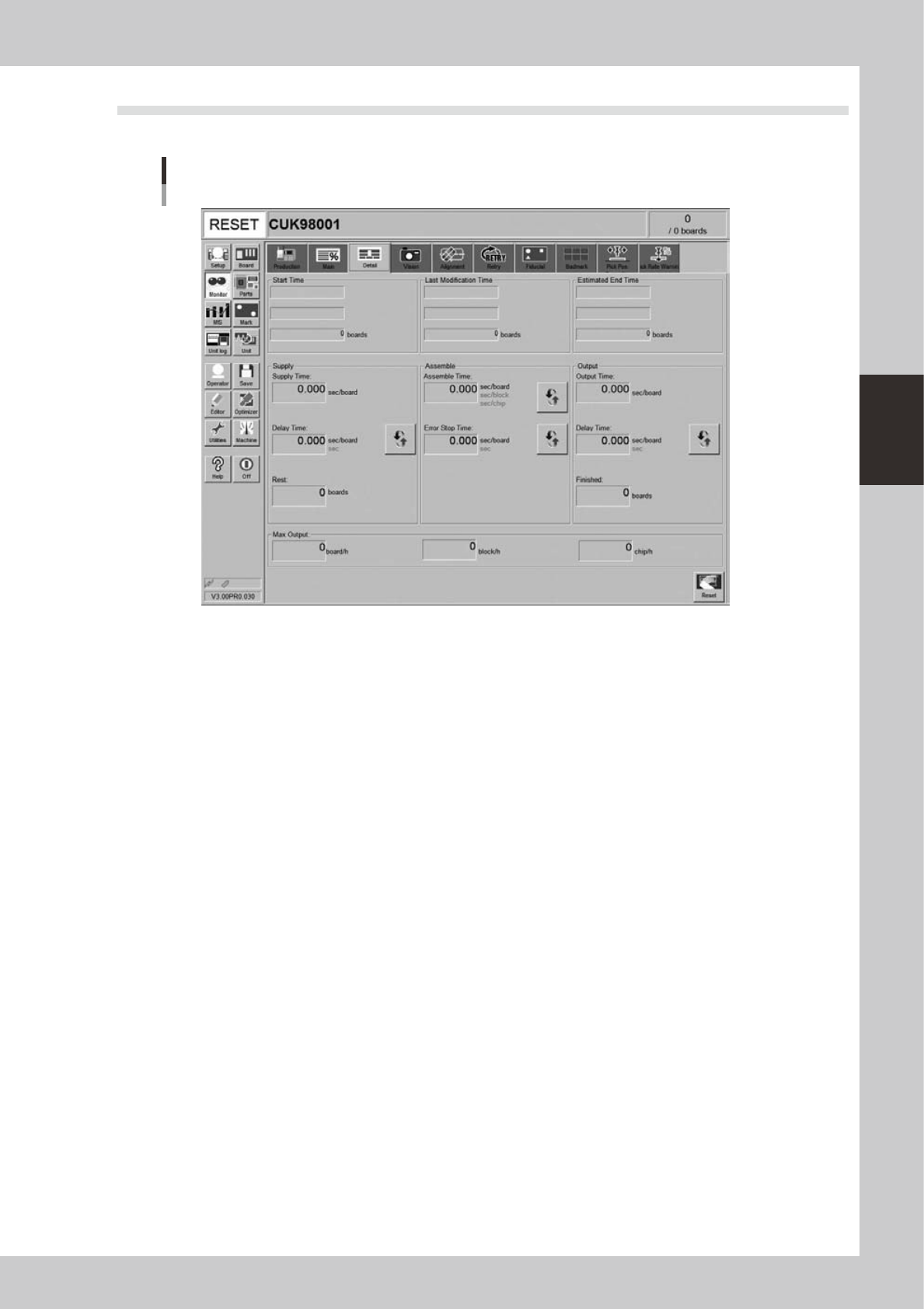
The [Monitor]-[Detail] tab screen shows the detailed production status of the current production board data.
Monitor: Detail
24311-M3-00
• Start Time
Shows the time that production was started (time that board selection was completed). The quantity is normally zero
boards.
• Last Modification Time
Shows the display data update time. The quantity is the number of boards produced up to the present time.
• Estimated End Time
Shows the estimated production end time. The quantity is the scheduled production quantity entered on the Setup
screen. Note that this will be blank if the scheduled production quantity has not been entered.
• Supply Time (sec/board)
Shows the average loading time per board on the entrance-stage conveyor.
• Supply: Delay Time (sec/board, sec)
Shows the time that the machine has waited for board loading to the most upstream stage. Note that when the machine is
mounting components, the delay time will not be counted even if the board is standing by. The average delay time per
board or the cumulative delay time can be displayed by pressing the [Unit Change] button.
• Rest (boards)
This is the value obtained by subtracting the production completed board quantity from the scheduled production
quantity.
• Assemble Time (sec/board, sec/block, sec/chip)
Shows the time for mounting components on a board. This time includes the mark recognition (fiducial, bad mark, etc.),
component pickup, component recognition, mounting, dispensing, retry operation, nozzle change and component dump
time, etc. The average time per board, average time per block or the average time per chip can be displayed by pressing
the [Unit Change] button.
• Error Stop Time (sec/board, sec)
Shows the time that the machine has been stopped with an error, and is the total time from when the error occurs to
when the [CLEAR] button is pressed. Note that the time for recovery is not included. The average error stop time per
board or the cumulative error stop time can be displayed by pressing the [Unit Change] button.
• Output Time (sec/board)
Shows the average unloading time per board on exit-stage conveyor.

3-16
3
Starting and ending production
• Output: Delay Time (sec/board, sec)
Shows the time that the machine has waited for board unloading on the most downstream stage. Note that when the
machine is mounting components or the upstream machine is standing by for supply, the delay time will not be counted
even if the board is standing by for unloading. The average unloading delay time per board or the cumulative unloading
delay time can be displayed by pressing the [Unit Change] button.
• Finished (boards)
Shows the quantity of finished boards.
• Max. Output
• board/h
This is the number of boards that can be produced in an hour. This is calculated in reverse from the average mounting
time and average transfer time. Note that the board supply delay time and error stop time are not included.
• block/h
This is the number of blocks that can be produced in an hour. This is calculated in reverse from the average mounting
time and number of blocks per board in the board information.
• chip/h
This is the number of chips that can be produced in an hour. This is calculated in reverse from the "Cycle Time (sec/
chip)" displayed on the [Main] tab screen.
• [Reset] button
Resets the production control information, including the various data, current production quantity, current unloader
quantity, scheduled production quantity and scheduled unloader quantity displayed on the screen. The "Board Counter"
value on the Setup screen is also reset when this production data is reset.
3-17
3
Starting and ending production
4.4 Vision
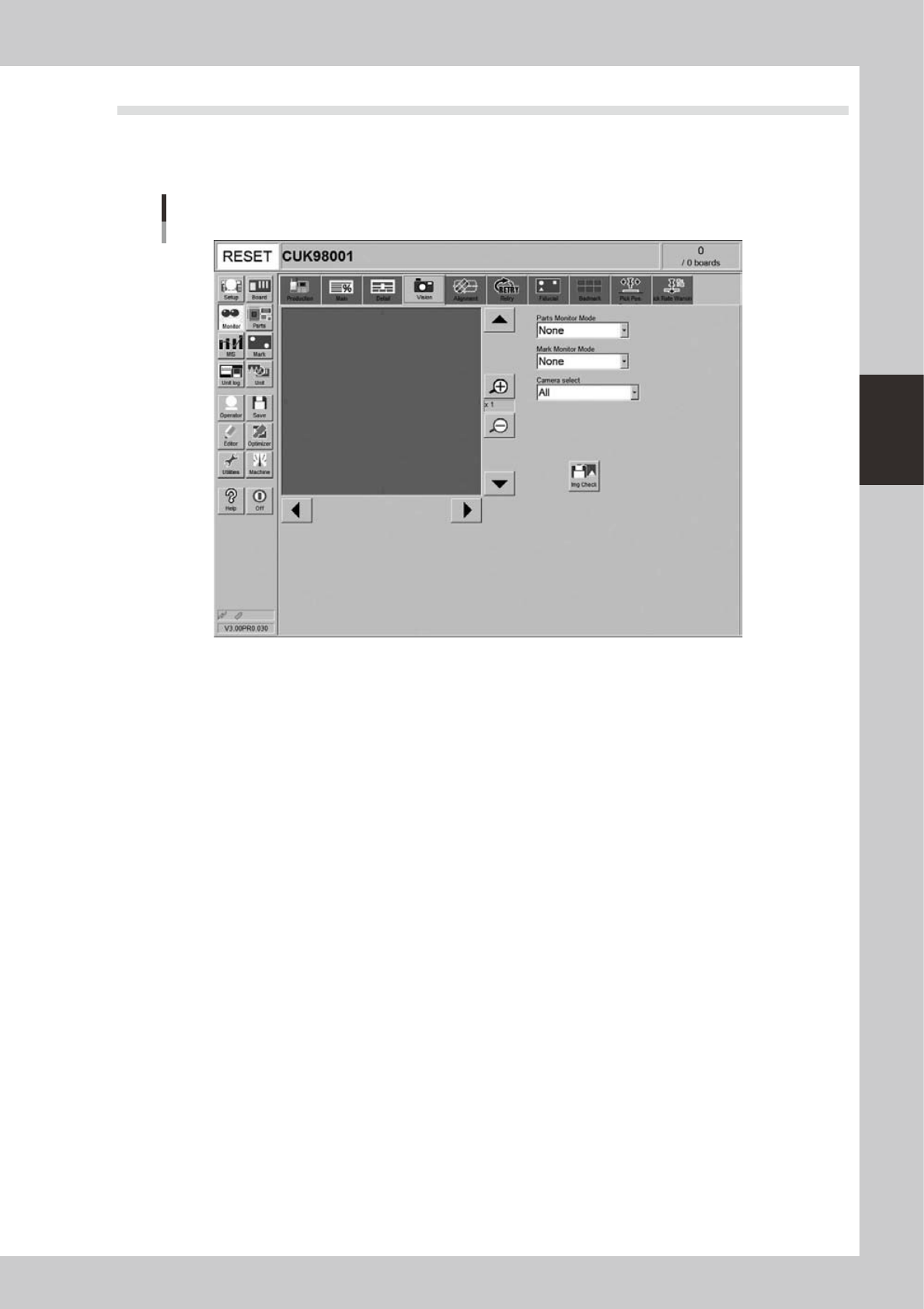
When the fiducial mark, badmark or component is recognized during automatic operation, the recognized
image is displayed. When used with a multi-vision camera, the components will be recognized continuously at
a high speed, so only the component recognized last will be displayed.
Monitor: Vision
24312-M3-00
• Enlarge/reduce buttons
The recognition result image can be enlarged from 1 to 16 times by pressing the enlarge (+) button. The image can be
reduced to 1/16 by pressing the reduce (-) button. Note that when the image is enlarged, the smooth part edges may
appear jagged, and when reduced, gray sections may appear around the edges. But this is not a fault.
• Up/down/left/right buttons
The arrow buttons at the right top and bottom of the screen are used to move the image vertically. The buttons at the
bottom left and right of the screen are used to move the image horizontally. Use these arrow buttons to view a section of
the image that is not displayed on the screen.
• Parts Monitor Mode
This specifies the mode for displaying the components on the monitor during vision recognition. Depending on the
selected item, the recognition results and detection range window will appear on the image. This monitor mode can also
be changed during operation.
"None"
Displays the image taken by the camera. The recognition result values are not displayed.
"Vision Result"
Displays information such as the recognition results X, Y and R direction position (pixels) and number of detection
leads. Note that the displayed items will differ according to the component recognition type.
"Detection Range"
Draws a window for the component detection range. If the component does not fit within the detection range, it will
not be recognized correctly. In this case, check the pickup state or correct the component data.
"Datum Pos."
Displays a cross cursor indicating the position used as a reference for detecting the lead or component edge.
"Find Line"
Displays the line used for component detection, on a chip component or on the component leads. If the detection line
position is incorrect, adjust the Vision parameters.
"Edge Pos."
Displays a cross cursor at the lead or component edge position.
"Last Pos."
Displays a cross cursor at the center of the component.