CP-842E-842ME System Reference-SYS-CP842-10E.pdf - 第16页
Safety >> Safety Rules for All Machine Types 2-6 SYS-CP842-1.0E CAUTION Do not operate the mach ine after re moving or disabling se nsors. z Removing or disabling sensors will disarm the interlock, leading to colli…
Safety >> Safety Rules for All Machine Types
SYS-CP842-1.0E 2-5
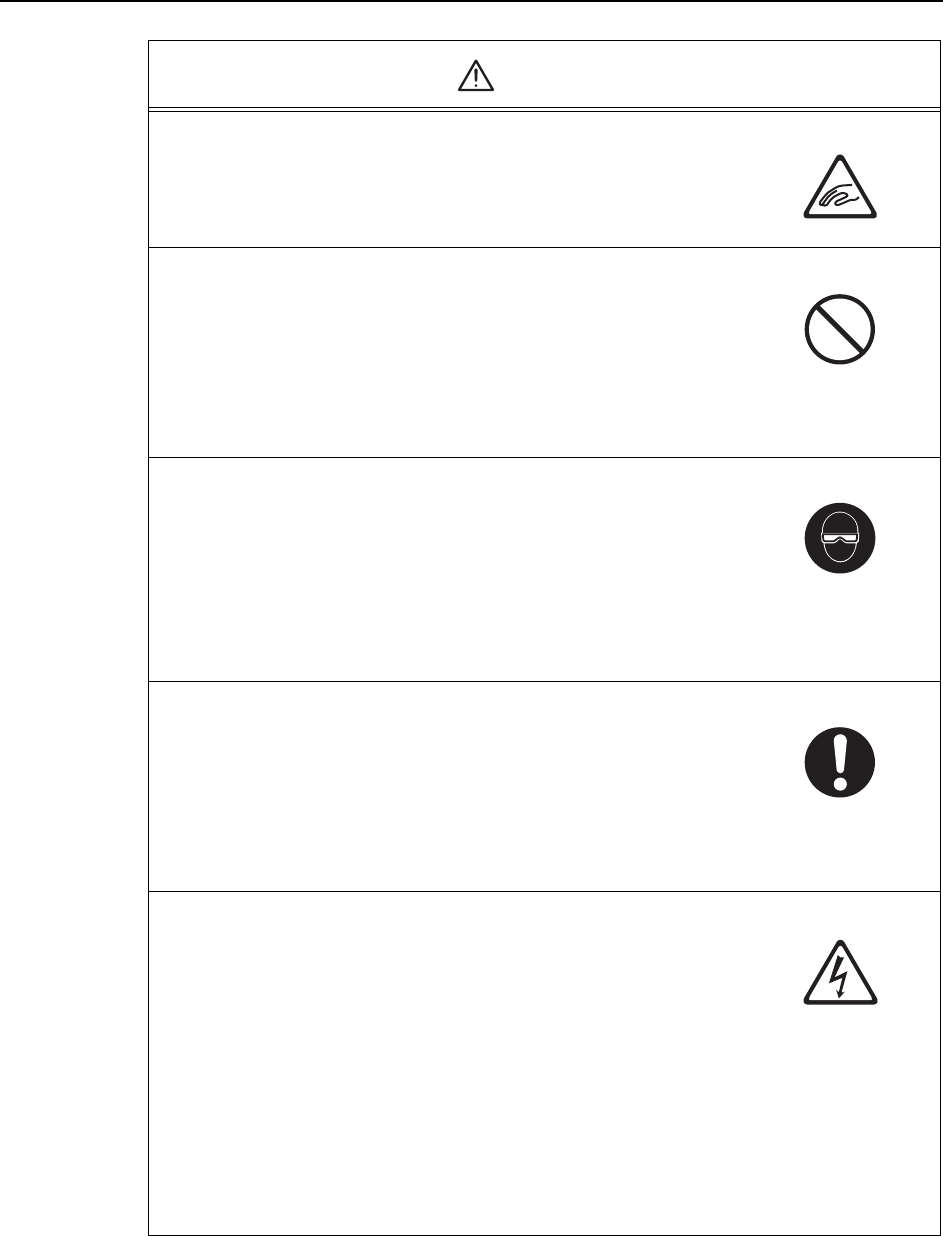
Long hair should be tied back.
z Long hair may get caught in running machines.
z Hair should be kept short or tied back so that it does not
get caught in the machine.
Turn off the air supply when carrying out maintenance on cylin-
ders, valves, and filters.
z Removing cylinders, valves, or filters without turning the
air supply off, may cause parts or particles to be propelled
into the eyes.
z Be sure to turn off the air supply when carrying out main-
tenance on cylinders, valves, and filters.
Be sure to wear protective glasses when removing parts from
the machine.
z Be sure to wear protective glasses when removing or
replacing parts.
[Example]
CP-6, 7, 8 nozzles use springs which may be propelled dur-
ing disassembly. Be sure to handle the nozzles carefully to
prevent eye injuries.
Check the machine monitor and the target axes while manually
operating the machine.
z When operating the machine, carefully follow the instruc-
tions that are displayed at the machine display.
z Operating the machine without looking at the machine
display may lead to operating errors or result in damage to
the machine or products.
Do not touch the servo amp power terminal for at least five min-
utes after turning off the power.
z The servo amp retains a high voltage even after the power
has been turned off. Always wait at least five minutes,
and ensure that the CHARGE lamp is off, before under-
taking any work that may result in contact with the servo
amp terminal.
WARNING
Safety >> Safety Rules for All Machine Types
2-6
SYS-CP842-1.0E
CAUTION
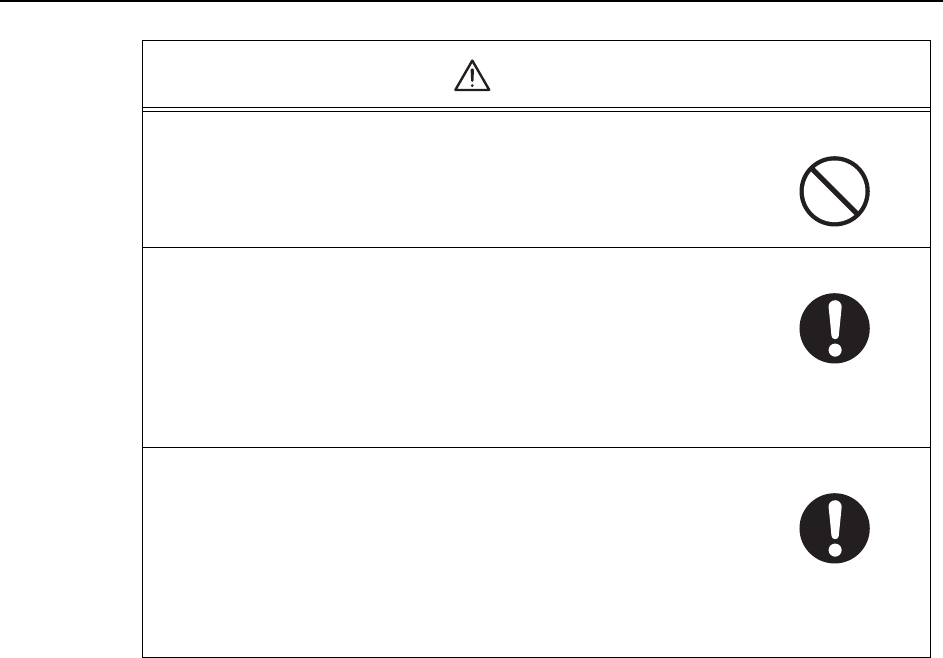
Do not operate the machine after removing or disabling sensors.
z Removing or disabling sensors will disarm the interlock,
leading to collisions and damage to the machine.
Check the machine display to determine whether HELPS com-
patible machines are in the middle of performing changeover.
z During operation in automatic mode on machines equipped
with automatic changeover equipment, it may be difficult
to actually see automatic changeover taking place from the
front of the machine. When a message appears at the
machine display, follow the instructions that are given.
Ensure to use the handle when opening or closing the safety
doors, fences or covers.
z Opening or closing the safety doors, fences or covers with-
out using the handle may result in injury to the hand.
z Opening or closing the safety doors, fences or covers with
force, without using the handle may result in damage to
the machine.
Safety >> Safety Rules for Individual Machine Types
SYS-CP842-1.0E 2-7
2.3 Safety Rules for Individual Machine Types
2.3.1 CP-842E/842ME
WARNING
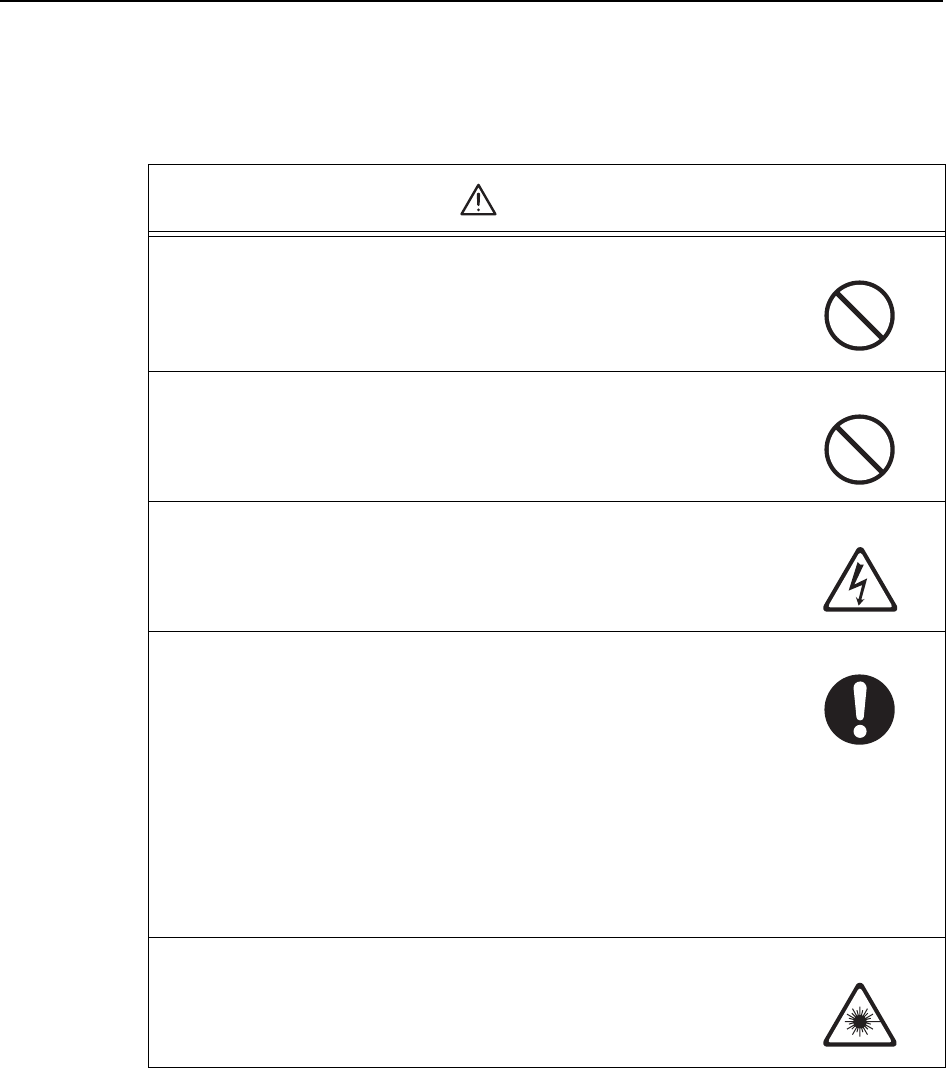
Do not insert hands or other body parts into the conveyor inlets.
z Body parts may get caught in the machine resulting in injury.
Do not operate the machine when the front/rear cover has been
removed.
z Body parts may get caught in the machine resulting in injury.
Do not perform cam box maintenance with power to the machine on.
z Injury may result from electric shock if maintenance on the
cam box is carried out with the power to the machine on.
Caution required if cam is not at its origin (0°).
z Operators must ensure the cam is at its origin (0°) prior to car-
rying out any operations on the machine.
If the cam is not at its origin, recoil from springs used to drive
the placing heads may cause unexpected movement which is
potentially dangerous for the operator.
If an emergency stop occurs, the machine stops immediately.
In this case there is a strong possibility that the cam will not
be at its origin.
z If the cam is not at its origin when the machine stops, use the
cam handle to return it to its origin.
Do not stare into the laser beam.
(On machine fittied with laser type fiber sensors (class 2))
z Exercise extreme caution when working in areas where there
is a risk of eye damage from the laser beams.