Vermes MDS 358X user Manual.pdf - 第121页
Communication Interfaces 110 VTK - TR -BA- 072e - 1 - User Manua l MDS 358X S eries 69 SCENARIO:SAVE:<Scenario no.>:<Segment 1 Setup, Segment 1 Number of Puls es, Segment 1 Scenario - Delay , Sg. 2 Setu p, Sg. 2…
Communication Interfaces
VTK-TR-BA-072e-1 - User Manual MDS 358X Series
109
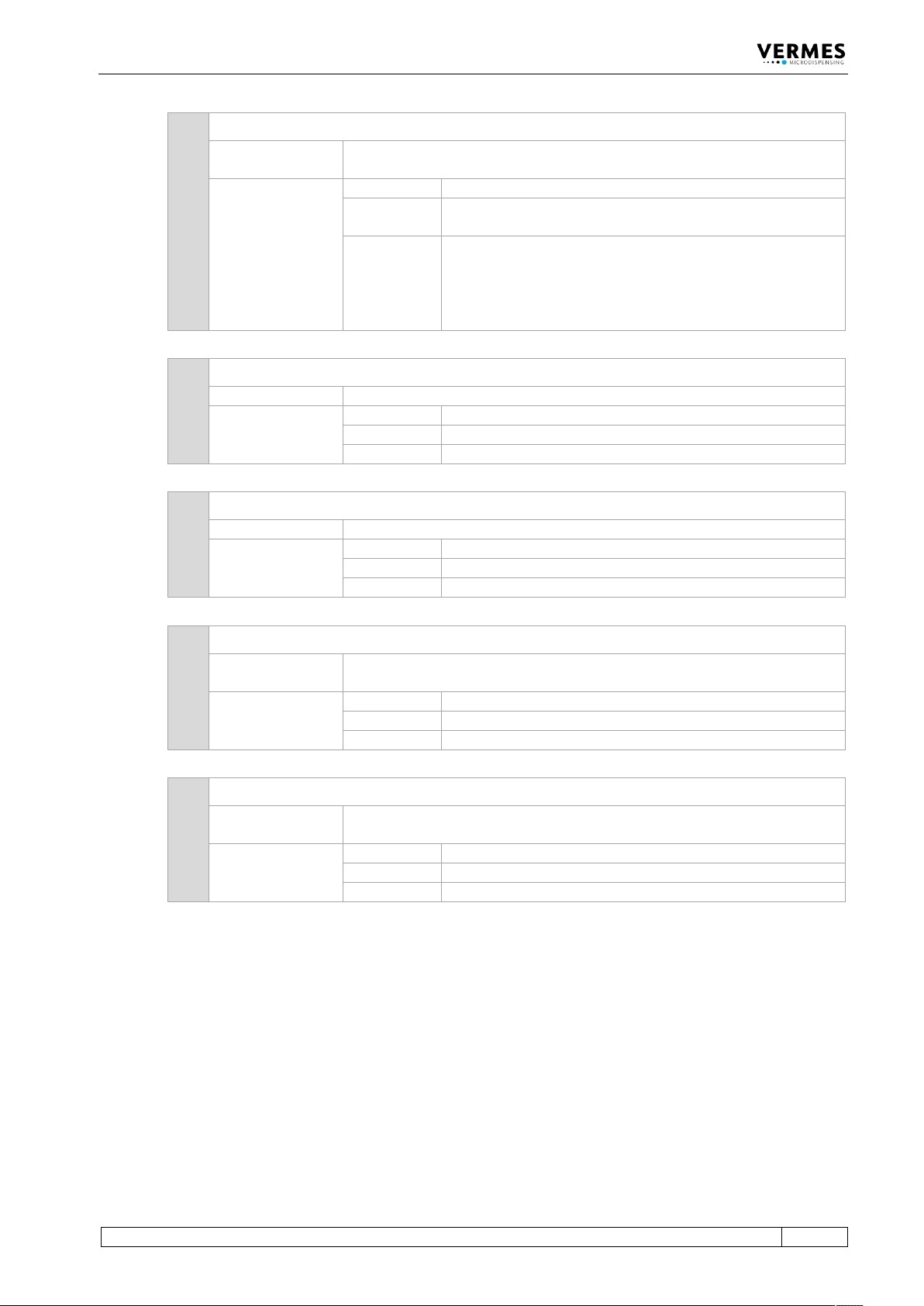
64 SCENARIO:STATUS
Description:
This command tells if scenarios are “ON” or “OFF”. It also gives this
information for the four PLCStops.
Example:
Input:
SCENARIO:STATUS
Result:
Gives the ON/OFF status for scenarios and the four
PLCStops.
Return:
Scenario: OFF
PLCSTOP Scenario 1: OFF
PLCSTOP Scenario 2: OFF
PLCSTOP Scenario 3: OFF
PLCSTOP Scenario 4: OFF
65 SCENARIO:OFF
Description:
This command deactivates the use of scenarios.
Example:
Input:
SCENARIO:OFF
Result:
Use of scenarios is deactivated.
Return:
OK
66 SCENARIO:ON
Description:
This command activates the use of scenarios.
Example:
Input:
SCENARIO:ON
Result:
Use of scenarios is activated.
Return:
OK
67 SCENARIO:PLCSTOP:<Scenario no.>:OFF
Description:
This command deactivates the PLC-Stop. The number of the scenario can
be either 1, 2, 3 or 4.
Example:
Input:
SCENARIO:PLCSTOP:1:OFF
Result:
PLC-stop for scenario 1 is deactivated.
Return:
OK
68 SCENARIO:PLCSTOP:<Scenario no.>:ON
Description:
This command activates the PLC-Stop. The number of the scenario can be
either 1, 2, 3 or 4.
Example:
Input:
SCENARIO:PLCSTOP:1:ON
Result:
PLC-stop for scenario 1 is activated.
Return:
OK
Communication Interfaces
110
VTK-TR-BA-072e-1 - User Manual MDS 358X Series
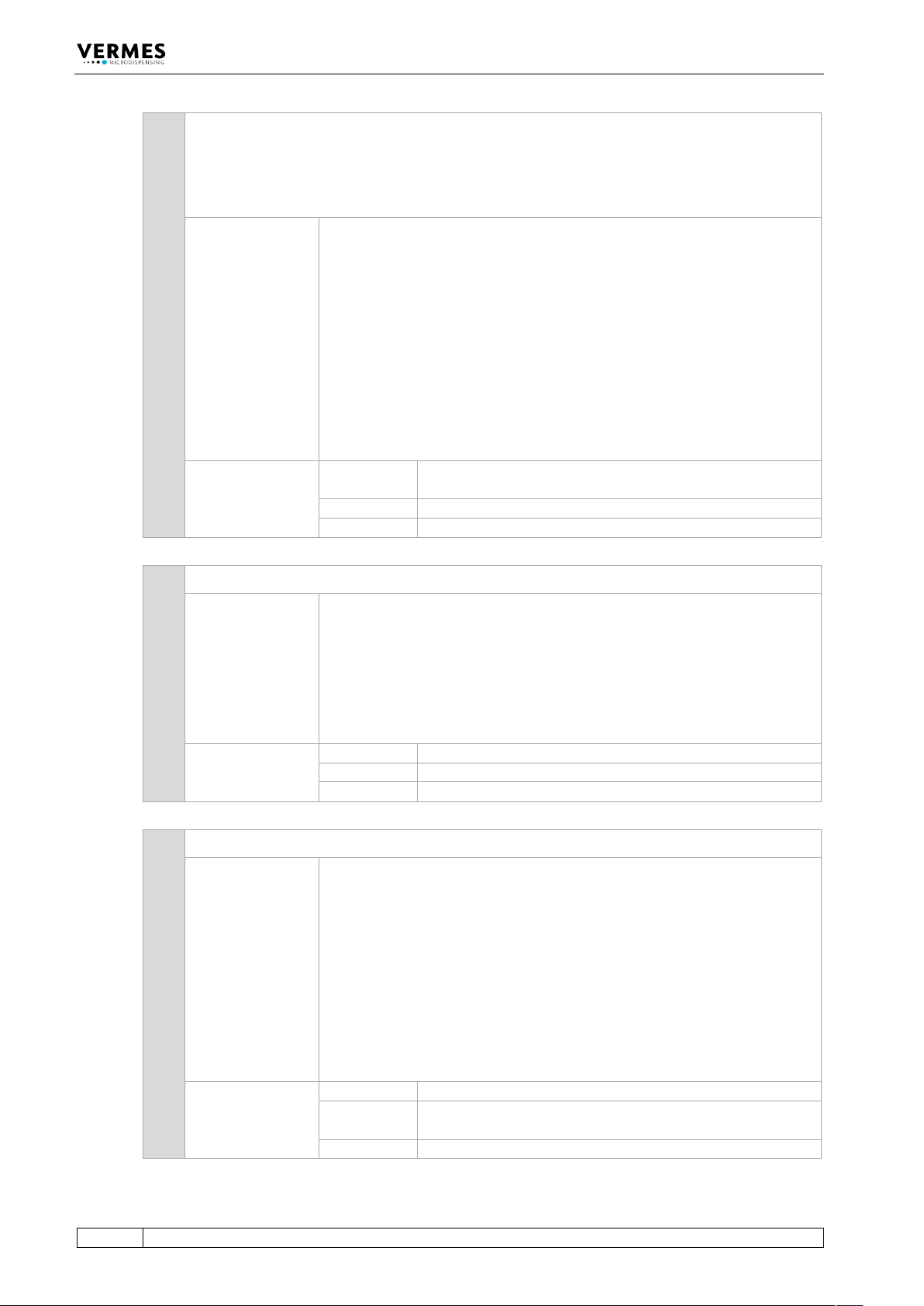
69 SCENARIO:SAVE:<Scenario no.>:<Segment 1 Setup, Segment 1 Number of Pulses,
Segment 1 Scenario-Delay, Sg. 2 Setup, Sg. 2 NP, Sg. 2 Dl., Sg. 3 Setup, Sg. 3 NP, Sg. 3 Dl.,
Sg. 4 Setup, Sg. 4 NP, Sg. 4 Dl., Sg. 5 Setup, Sg. 5 NP, Sg. 5 Dl., Sg. 6 Setup, Sg. 6 NP, Sg. 6
Dl., Sg. 7 Setup, Sg. 7 NP, Sg. 7 Dl., Sg. 8 Setup, Sg. 8 NP, Sg. 8 Dl., Sg. 9 Setup, Sg. 9 NP, Sg.
9 Dl., Sg. 10 Setup, Sg. 10 NP, Sg. 10 Dl.>
Description:
This command saves the parameters of the given scenario. You only have
to enter parameters for the segments actually used. For every such
segment, you have to give the setup number, the number of pulses and
the scenario delay.
The parameters will be checked. Not enough parameters or illegal ones will
result in cancellation. Therefore, you always have to enter complete
segments with setup number, NP and Sc. delay. You can enter a maximum
of ten segments.
The scenario number can be 1, 2, 3 or 4, a setup number 0, 1, 2 or 3.
The NP can be between 1 and 32000 or 0, which would mean “infinite”.
The scenario delay will be given in 1/10 ms, i.e. 5 means 0.5 ms. The max
delay is 1000.0 ms, min delay is 0.1 ms.
To delete a scenario use the version SCENARIO:SAVE:<scenario no.>:-.
Example:
Input:
SCENARIO:SAVE:1:0,1,5,1,2,5,2,3,5,3,4,5,0,5,5,1,6,50,2,7,50,3,
8,50,0,9,50,1,10,50
Result:
The scenario parameters of scenario 1 are saved.
Return:
OK
70 SCENARIO:READ:<scenario no.>
Description:
This command gives you the scenario parameters of the named scenario
via the serial interface. The response follows the scheme “setup no. of
segment 1, number of pulses of segment 1, scenario delay of segment 1,
setup no. of segment 2, NP of segment 2, sc. delay of segment 2, …, sc.
delay of segment 10”. The scenario delay is given in 1/10 ms. The value 50
e.g. represents 5 ms.
Only the used segments of the scenario are given, the others are left out in
the output.
Example:
Input:
SCENARIO:READ:1
Result:
Gives the scenario parameters of scenario 1.
Return:
0,1,5,1,2,5,2,3,5,3,4,5,0,5,5,1,6,50,2,7,50,3,8,50,0,9,50,1,10, 50
71 SETUP:ASAVE:<setup no.>:<RI>,<OT>,<FA>,<NL>,<NP>,<DL>
Description:
This command saves the given parameters in a setup. You always have to
provide the number of the setup and all six setup parameters.
All parameters will be checked. Not enough parameters, delay too short
with activated heater or incorrect values will lead to cancellation.
Parameters relating to time have to be specified in 1/10 ms, except for
“Falling” and “Rising”, which have to be entered in 1/100 ms. Values lower
than “1” are not admissible, only the open time can be “0”. Therefore, the
minimum falling value amounts to 0.01 ms, the minimum rising value is
0.01 ms. But the minimum values for Falling and Rising also always depend
on the current Needle Lift % (see paragraph 7.4 "Minimum and Maximum
Parameter Limits", page 66).
Specified values must be integer and positive
Example:
Input:
SETUP:ASAVE:1: 30,10,15,80,20,8
Result:
The parameters will be saved in the given setup and
checked.
Return:
OK
Communication Interfaces
VTK-TR-BA-072e-1 - User Manual MDS 358X Series
111
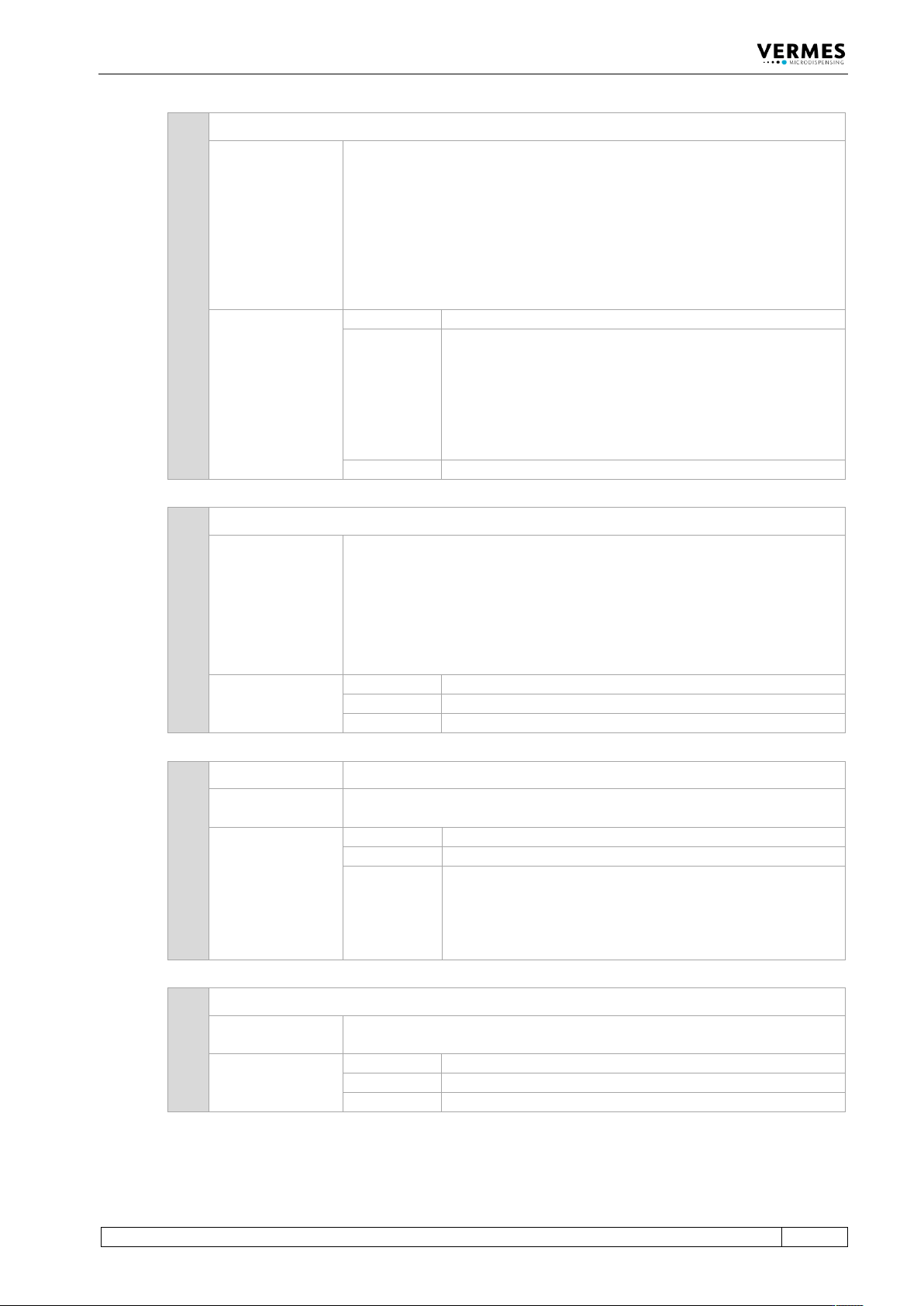
72 SETUP:AREAD:<setup no.>
Description:
This command reads the parameters of a given setup. As value you have to
enter its number.
All values relating to time, except “Falling” and “Rising”, are given in
1/10 ms (i.e. 10 ≙ 1 ms). Falling and rising are given in 1/100 ms (i.e. 100 ≙
1.00 ms).
Therefore, the minimum falling value amounts to 0.01 ms, the minimum
rising value is 0.01 ms. But the minimum values for Falling and Rising also
always depend on the current Needle Lift % (see paragraph 7.4 "
Minimum
and Maximum Parameter Limits", page 66).
Example:
Input:
SETUP:AREAD:1
Result:
Displays the parameters of the given setup.
Rising: 30 ≙ 0.3 ms (ms = Milliseconds)
Open Time: 10 ≙ 1.0 ms
Falling: 15 ≙ 0.15 ms
Needle Lift: 80 %
Number of Pulses: 20
Delay: 8 ≙ 0.8 ms
Return:
30,10,15,80,20,8
73 BAUDRATE:0/1/2/3/4
Description:
This command changes the baud rate of the serial interface. There are five
possible baud rates (9600, 19200, 38400, 57600 and 115200),
corresponding with the parameters in this order (0, 1, 2, 3 or 4).
Important Note:
After reading the “OK”, the sender has to switch his baud rate as well;
otherwise, the communication will break down.
Example:
Input:
BAUDRATE:1
Result:
The baud rate is switched to 19200.
Return:
OK
74 GETTD GETTD = Get time and date
Description:
This command tells you the current time (UTC) and date in the format
“hour, minute, second, year, month, day”.
Example:
Input:
GETTD
Result:
The time (UTC) is given, including the date.
Return:
10,07,00,2019,02,17
or
No Clock (if the RTC of the MDC is defect)
75 MDC:RESTART
Description:
This command tells the MDC to shut down (without shutting down the
power) and then to restart.
Example:
Input:
MDC:RESTART
Result:
The MDC is shut down and then restarts.
Return:
OK