M20_Ope_E.pdf - 第120页
Chapter 2 Creating and Editing a Program 2-76 2-7-6-6 Reduce the number of nozzle for use Menu: Program>DataEditUtilities > Reduce_the_number_of_nozzle_for_use For a program with multiple-pickup process by seve ral he…
Chapter 2 Creating and Editing a Program
2-75
Head, needs to be skipped
Specify a non-usable head. It is not possible to specify two or more
heads at the same time. If you want to specify two or more heads,
disable all the non-usable heads first in the system parameters, and
then execute the head substitution function for each of non-usable
heads repeatedly.
Note: To cancel them, select System > System Parameter > Parameter > Head/ANC Setup from the main
menu.
Substitute Placement The placement steps for which heads selected in “Head, needs to be
skipped” are designated will be deleted from the corresponding cycle
and assigned to another cycle. Here, select the priority condition to be
given when creating an alternative step instead of the deleted step.
(Priority to Multiple Pickup (Postpone) / Priority to Placement Order
(Next Cycle))
Note : In either case, if non-used heads having the same nozzle are
present within the same cycle, the program will be modified so that
substitute placement is performed using those heads.
● Priority to Multiple Pickup (Postpone)
The deleted placement steps are assigned collectively at the
end of the program. Multiple pickup is performed as much as
possible to reduce the placement tact time. Some restrictions
will apply to the postpone processing. Refer to [NOTE].
● Priority to Placement Order (Next Cycle)
If a head that uses the same nozzle as that of the non-usable
head is designated in the same cycle, the deleted placement
steps are inserted before the next cycle. This enables placement
with the placement order specified in the program taken into
account. However, if there is no head with the same nozzle in
the cycle, the deleted placement steps will be postponed to the
end of the program (multiple pickup). Some restrictions will
apply to the postpone processing. Refer to [NOTE].
Note: Postpone processing for substitute placement are restricted in the following cases.
① If two or more pairs of non-grouped fiducial marks are present, postpone processing will be
performed within the effective range of those fiducial marks.
② If two or more non-grouped bad marks are present, postpone processing will be performed
within the effective range of those bad marks.
③ In the case of repeat data, postpone processing will be performed within the repeat range.
④ If the program handles components exceeding 10.5mm in height, postpone processing will
not be performed in any cases, and the deleted placement steps are inserted before the next
cycle. In this case, if there is no head using the same nozzle, nozzle change will be performed.

Chapter 2 Creating and Editing a Program
2-76
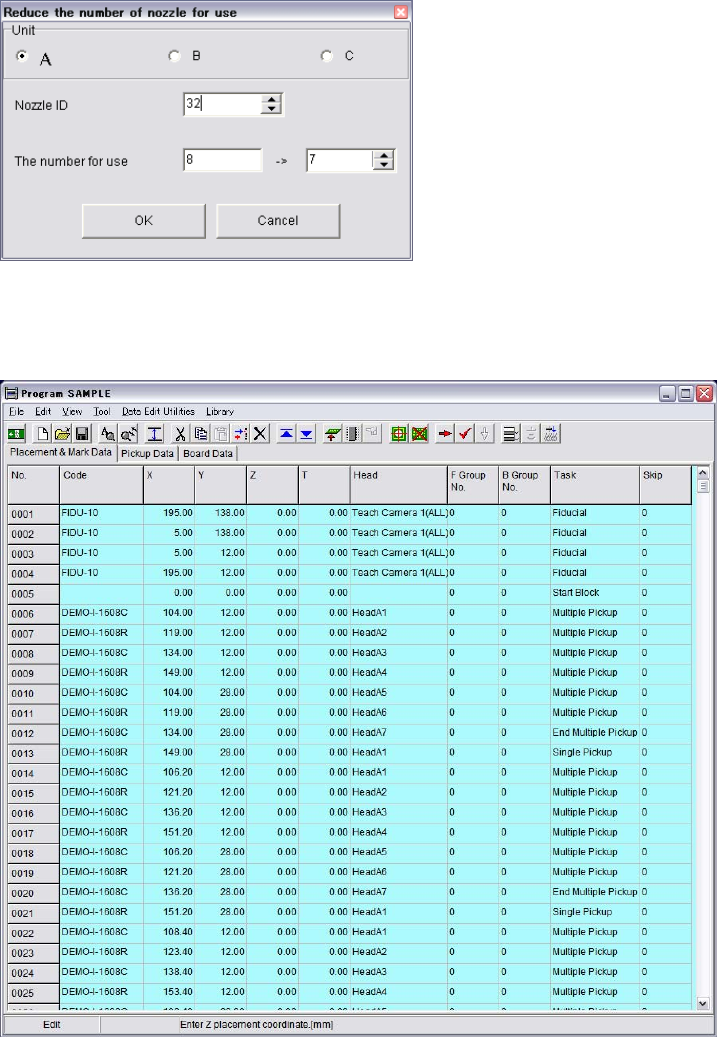
2-7-6-6 Reduce the number of nozzle for use
Menu: Program>DataEditUtilities>Reduce_the_number_of_nozzle_for_use
For a program with multiple-pickup process by several heads, this function converts the program
so that it needs less number of nozzles. This is convenient when you cannot prepare the necessary
amount of nozzle.
Note: This function cannot be used if a data check error is present.
Items:
Nozzle ID: Select a Nozzle ID to reduce the number for use.
The number for use: Current amount of nozzle for use is shown on the left, and specify the
reduced number on the right.
Example:
1) The original program has multiple-pickup process by Head 1 to 8 using ID-32 nozzles. 8 pieces
of ID-32 nozzle should be prepared for this program.
Chapter 2 Creating and Editing a Program
2-77
2) If you have only seven of ID-32 nozzles, change the program to reduce the use of ID-32 nozzle
from “8” to “7” by this function.
3) Click OK button to perform the function.
Following shows the result program which needs max. 7 pieces of ID-32 nozzle.
Note: Once the [Reduce the number of nozzle for use] function is performed, the original program
would be lost. It is recommended to save it as a new file name after performing the function in
order to keep the original program.