M20_Ope_E.pdf - 第170页
Chapter 5 Libraries 5-20 ■ Fixed Camera Illumination ( M6 ) Three kinds of illumination are available for fixe d cameras: “Coaxial”, “Diffused” and “Side”. “Coaxial” acts as direct light, “Diffused” as di ffused light an…
Chapter 5 Libraries
5-19
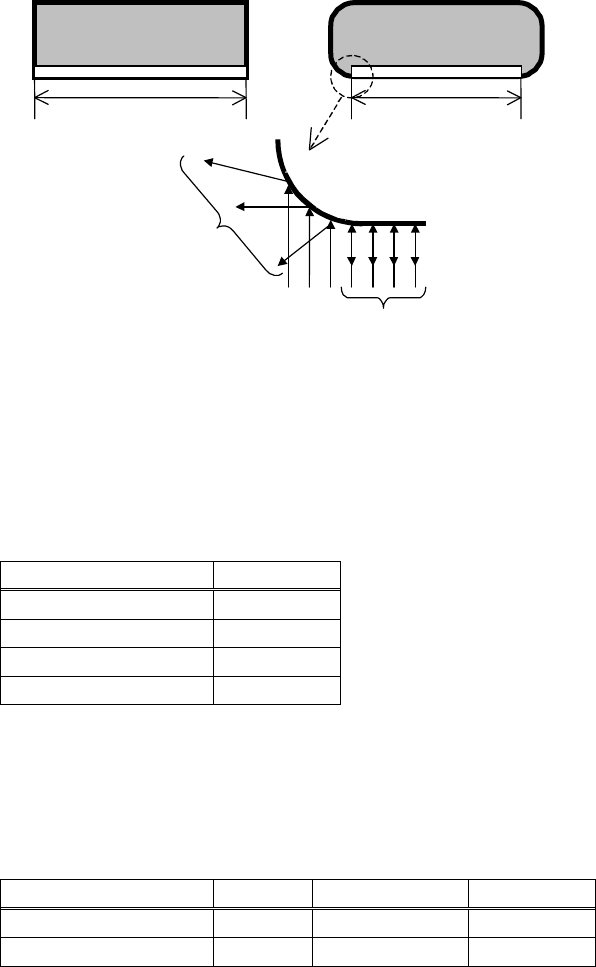
Chip Capacitor Size Viewed by the Scan Camera
Chip resisto
r
Chip capacito
r
Vision-recognized size Vision-recognized size
Reflected light doesn’t fall upon the
camera.
Reflected light fall upon the
camera.
Chip capacitors, unlike chip resistors, have round corners to make the measured size smaller
than the actual one. In many cases, the apparent size of the component is 90% of the actual size.
Specify 90% of the actual size at "Overall X" and "Overall Y".
After specifying the size, be sure to execute the image test and make sure that the component
sizes displayed on the monitor are proper.
Example: (Unit: mm)
Actual component size Size setting
3.20 × 1.60 2.88 × 1.44
2.00 × 1.25 1.80 × 1.13
1.60 × 0.80 1.44 × 0.72
1.00 × 0.50 0.90 × 0.45
Melf Size Viewed by the Scan Camera
MELF components have cylindrical shape to make the measured size smaller than the actual
one. When using MELF nozzles, subtract 0.5mm from the actual component thickness.
Example: (Unit: mm)
Actual component size Thickness
Size setting Thickness
1.40 × φ3.5diam.
3.5
1.40 ×3.15diam.
3.0
2.00 × φ6.0diam.
6.0
2.00 ×5.40diam.
5.5
Notes on Using the Scan Camera Illumination
If the lustrous mold gives white reflection in some components with plastic mold, set the main
lighting at 2 or less. If such components can not be processed successfully using the scan
camera, use a fixed camera.
Note: If any dust or dirt is sticking to the surface of the mirror of the indirect scan camera, the
captured image may become dark.
Unlike the household mirror, the surface of this mirror is very vulnerable to scratch. So, be sure
to use a blower brush to clean the mirror.
Chapter 5 Libraries
5-20
■ Fixed Camera Illumination (M6)
Three kinds of illumination are available for fixed cameras: “Coaxial”, “Diffused” and “Side”.
“Coaxial” acts as direct light, “Diffused” as diffused light and “Side” as sideways slit light.
Normally, these three illuminations are used together to provide diffused light consisting of
light from various directions. For BGA and CSP components, only “Side” must be used.
■ Fixed Camera Illumination (M6ex/M6ez)
Three kinds of illumination are available for fixed cameras: “In”, “Out” and “Side”. “In” acts as
direct light, “Out” as diffused light and “Side” as sideways slit light.
Normally, these three illuminations are used together to provide diffused light consisting of
light from various directions. For BGA and CSP components, only “Side” must be used.
■ Beam Camera Illumination (M7)
Three kinds of illumination are available for beam cameras: “Coaxial”, “Diffused” and “Side”.
“Coaxial” acts as direct light, “Diffused” acts as diffused light, and “Side” acts as sideways slit
light.
For standard components, use “Diffused” as major light and “Coaxial” as subsidiary light.
Normally, use “Coaxial” and “Diffused”. (recommended to set the same value for both.)
For components with J-leads(SOJ and PLCC etc.), these three illuminations are used together to
provide diffused light consisting of light from various directions. For BGA and CSP
components, only “Side” must be used.
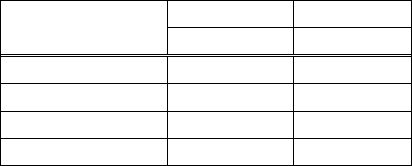
● Beam camera illumination settings for registers and capacitors
E.g.)
Component Size
Resistor Capacitor
Coaxial Diffused
1005 6 10
1608 6 10
2125 6 10
3126 6 10
■ Teach Camera Illumination
Two kinds of illumination are available for teach cameras: “In” and “Out”. “In” acts as direct
light and “Out” dose as diagonal diffused light.
● “Gain” and “Offset” for Fiducial mark and Bad mark
An original image outputted by a camera is processed for better and stable one by adjusting
“Gain” and “Offset” value.
Increasing “Gain” value clears the contrast and increasing “Offset” value intensifies the entire
brightness.
Specify the value in “Gain”/”Offset” for fiducial mark and bad mark. Increase “Gain” value to
clear the contrast and decrease the “Offset” value for fine adjustments.
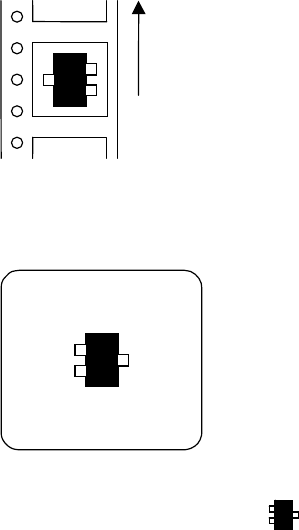
Scanning Direction
Teach cameras look downward. Scan cameras, fixed cameras and beam cameras look upward.
The operator, when watching components and a board in the machine, looks downward. The
operator and the teach camera face in the same direction, however scan cameras, fixed cameras
and beam cameras in the opposite direction to provide a mirror image.
Chapter 5 Libraries
5-21
Example:
When a transistor is fed in the arrow direction in the feeder set on the front bank,
Feed direction
the picked transistor, viewed from a fixed camera or a beam camera, is seen as shown on the
monitor as the figure blow.
Select "Transistor-Right" mode ( ) in the image library.