1OPERATION_.pdf - 第138页
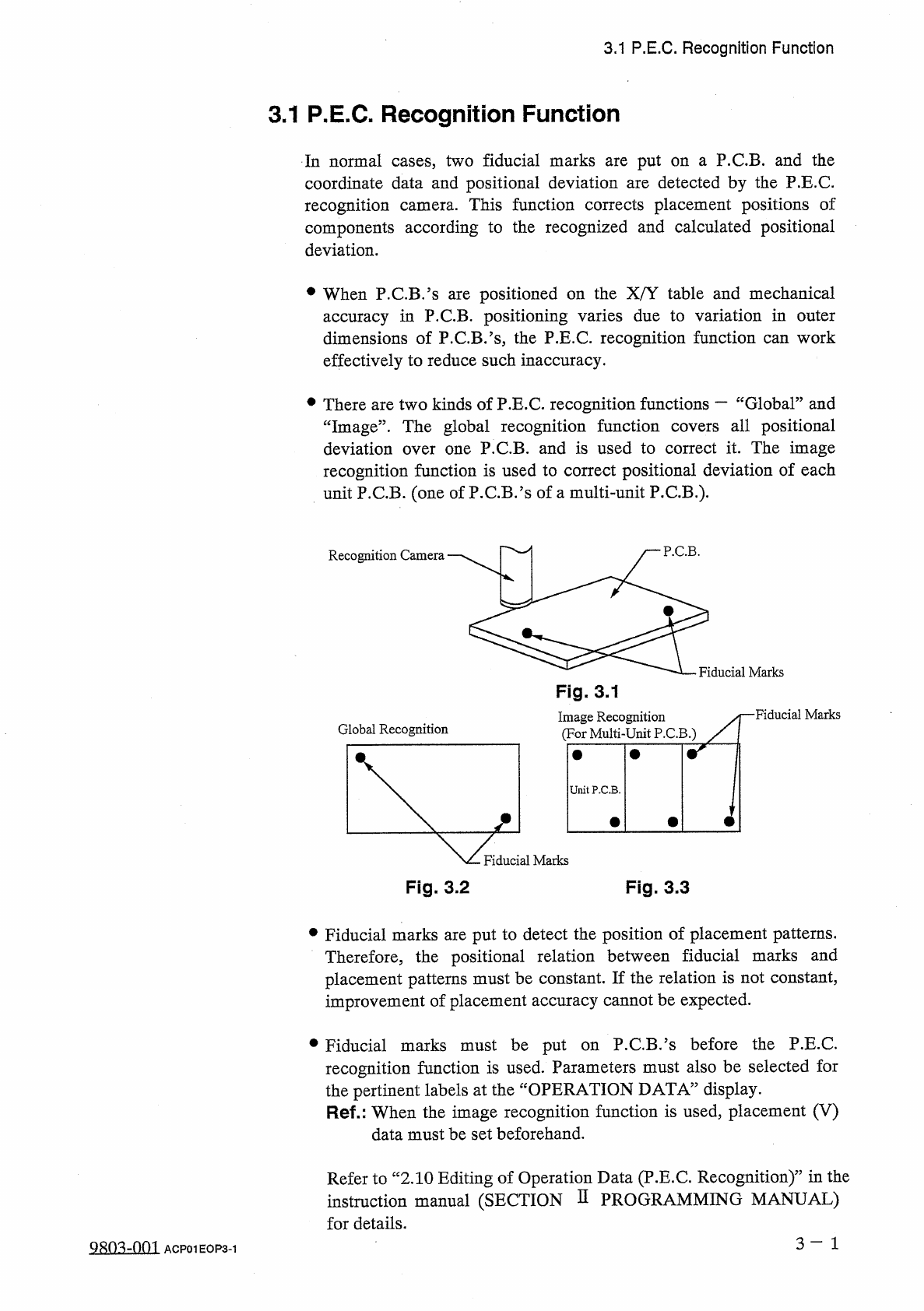
3.1 P . E . C . Recognition Function 3.1 P . E . C . Recognition Function In normal cases , two fiducial marks are put on a P . C . B . and the coordinate data and positional deviation are detected by the P . E . C . rec…
Page
3
-
1
3.1
P
.
E
.
C
.
Recognition
Function
3.2
Equivalent
Repetitive
Pattern
Function
3.3
Differential
Repetitive
Pattern
Function
for
Mixed
Programs
3.4
Priority
Sorting
Function
3.5
Component
Shortage
Detection
Function
3.6
Automatic
Recovery
Function
3.7
Alternate
Mode
3.7
.
1
Alternate
Feeder
Axis
Data
3.7
.
2
Alternate
Feeder
Function
3.8
One
-
Touch
Jump
Function
(
Jump
to
Substitute
“
AUTO
OPN
.
MODE
<
PLACEMENT
>
>
,
Display
)
3.9
Device
Information
3.10
Simplified
Packaging
Direction
Change
Function
(
Editing
of
Component
Carriage
Data
)
3.11
Bad
Board
Reject
Function
3.12
Automatic
Offset
Teaching
Function
3.13
Warm
and
Cold
Start
Functions
3.14
HDD
/
FDD
Function
3.15
Maintenance
Warning
Function
3.16
Trash
Box
Fill
-
Up
Warning
Function
3.17
Data
Save
Function
(
Saving
the
displayed
data
on
floppy
disks
)
3
-
2
3
-
3
3
-
4
3
-
6
3
-
6
3
-
8
3
-
8
3
-
12
3
-
16
3
-
18
3
-
26
3
-
28
3
-
29
3
-
30
3
-
31
3
-
32
3
-
33
3
-
34
9902
-
002
ACP
01
EOPC
3
3.1
P
.
E
.
C
.
Recognition
Function
3.1
P
.
E
.
C
.
Recognition
Function
In
normal
cases
,
two
fiducial
marks
are
put
on
a
P
.
C
.
B
.
and
the
coordinate
data
and
positional
deviation
are
detected
by
the
P
.
E
.
C
.
recognition
camera
.
This
function
corrects
placement
positions
of
components
according
to
the
recognized
and
calculated
positional
deviation
.
•
When
P
.
C
.
B
.
’
s
are
positioned
on
the
X
/
Y
table
and
mechanical
accuracy
in
P
.
C
.
B
.
positioning
varies
due
to
variation
in
outer
dimensions
of
P
.
C
.
B
.
’
s
,
the
P
.
E
.
C
.
recognition
function
can
work
effectively
to
reduce
such
inaccuracy
.
•
There
are
two
kinds
of
P
.
E
.
C
.
recognition
functions
—
“
Global
”
and
all
positional
“
Image
”
.
The
global
recognition
function
deviation
over
one
P
.
C
.
B
.
and
is
used
to
correct
it
.
The
image
recognition
function
is
used
to
correct
positional
deviation
of
each
unit
P
.
C
.
B
.
(
one
of
P
.
C
.
B
.
’
s
of
a
multi
-
unit
P
.
C
.
B
.
)
.
covers
P
.
C
.
B
.
Recognition
Camera
Fiducial
Marks
Fig
.
3.1
■
Fiducial
Marks
Image
Recognition
(
For
Multi
-
Unit
P
.
C
.
B
.
)
Global
Recognition
UnitP
.
C
.
B
.
Fiducial
Marks
Fig
.
3.2
Fig
.
3.3
•
Fiducial
marks
are
put
to
detect
the
position
of
placement
patterns
.
Therefore
,
the
positional
relation
between
fiducial
marks
and
placement
patterns
must
be
constant
.
If
the
relation
is
not
constant
,
improvement
of
placement
accuracy
cannot
be
expected
.
P
.
C
.
B
,
’
s
before
the
P
.
E
.
C
.
•
Fiducial
marks
must
be
put
recognition
function
is
used
.
Parameters
must
also
be
selected
for
the
pertinent
labels
at
the
Ref
.
:
When
the
image
recognition
function
is
used
,
placement
(
V
)
on
display
.
OPERATION
DATA
”
data
must
be
set
beforehand
.
Refer
to
“
2.10
Editing
of
Operation
Data
(
P
.
E
.
C
.
Recognition
)
'
5
in
the
instruction
manual
(
SECTION
D
PROGRAMMING
MANUAL
)
for
details
.
3
-
1
QRO
^
-
001
ACP
01
EOP
3
-
1
Fig
.
3.4
•
Refer
to
“
2.18
.
2
Repetitive
Placement
Data
(
when
P
.
E
.
C
.
recognition
function
is
not
implemented
on
each
repetitive
pattern
)
’
’
and
“
2.18
.
3
Repetitive
Placement
Data
(
when
P
.
E
.
C
recognition
function
is
implemented
instruction
manual
(
SECTION
H
PROGRAMMING
MANUAL
)
for
detailed
information
on
how
to
create
pattern
program
data
in
which
the
equivalent
repetitive
pattern
function
can
be
used
.
each
repetitive
pattern
)
”
in
the
on
3
一
2
QRO
^
-
001
ACP
01
EOP
3
-
2
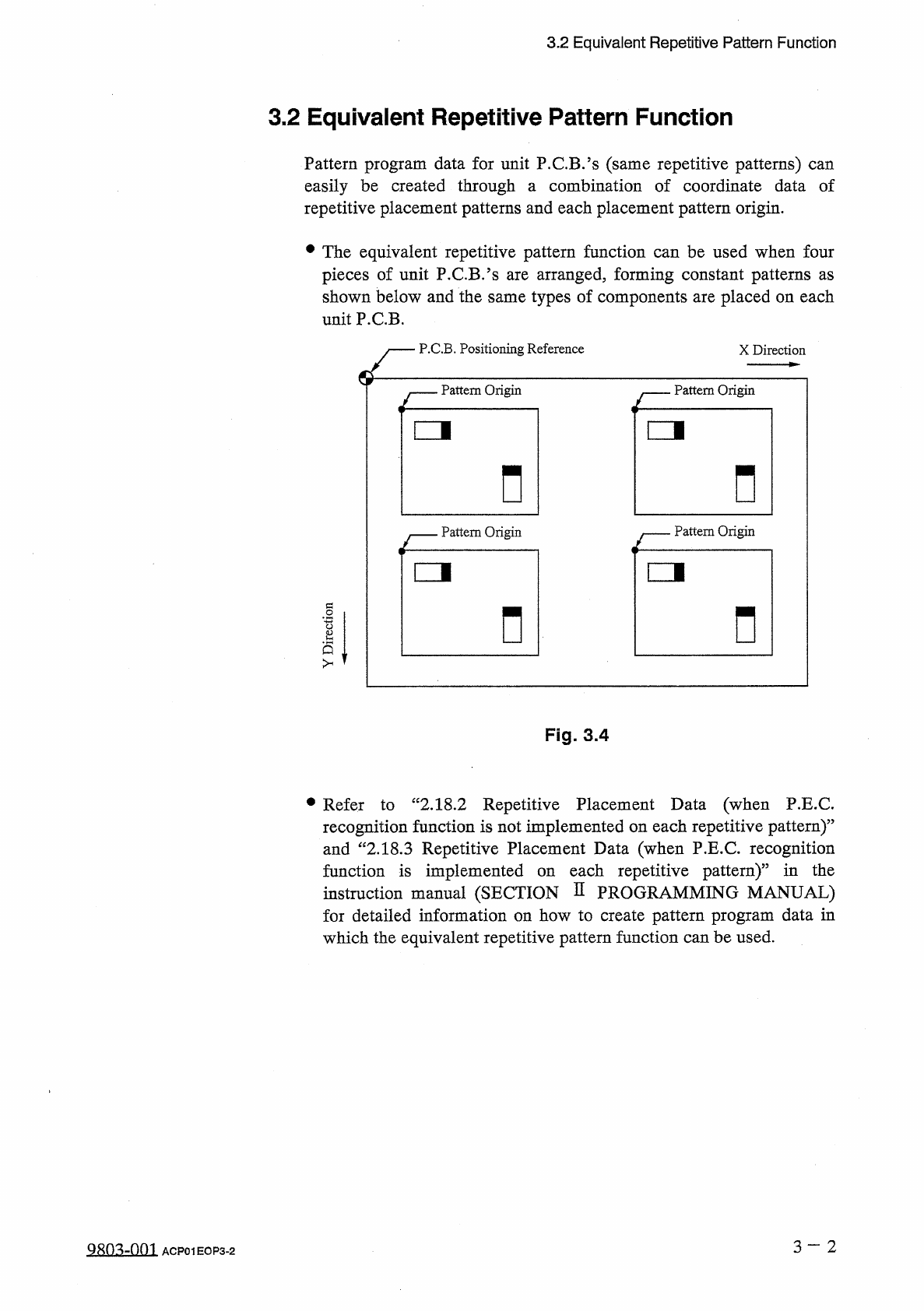
3.2
Equivalent
Repetitive
Pattern
Function
3.2
Equivalent
Repetitive
Pattern
Function
Pattern
program
data
for
unit
P
.
C
.
B
.
’
s
(
same
repetitive
patterns
)
can
easily
be
created
through
a
combination
of
coordinate
data
of
repetitive
placement
patterns
and
each
placement
pattern
origin
.
•
The
equivalent
repetitive
pattern
function
can
be
used
when
four
pieces
of
unit
P
.
C
.
B
.
'
s
are
arranged
,
forming
constant
patterns
as
shown
below
and
the
same
types
of
components
are
placed
on
each
unit
P
.
C
.
B
.
P
.
C
.
B
.
Positioning
Reference
X
Direction
Pattern
Origin
Pattern
Origin
CU
a
n
n
Pattern
Origin
Pattern
Origin
a
□
i
n
n
uola
A