1OPERATION_.pdf - 第141页
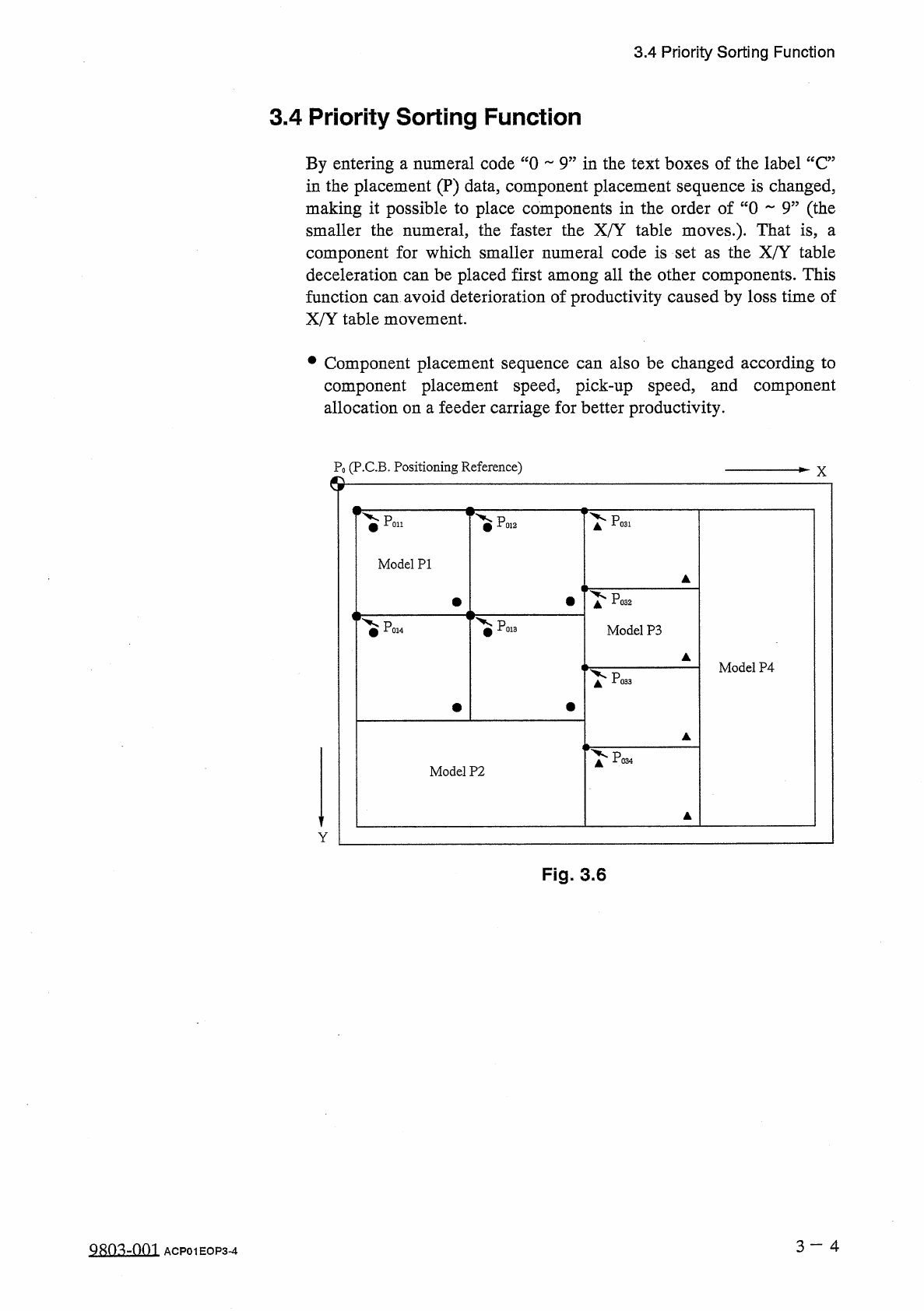
3.4 Priority Sorting Function 3.4 Priority Sorting Function By entering a numeral code “ 0 9 ” in the text boxes of the label “ C ” in the placement ( P ) data , component placement sequence is changed , making it possib…
3.3
Differential
Repetitive
Pattern
Function
for
Mixed
Programs
3.3
Differential
Repetitive
Pattern
Function
for
Mixed
Programs
By
creating
several
placement
data
in
one
pattern
program
data
,
components
for
different
patterns
can
easily
be
placed
on
unit
P
.
C
.
B
/
s
of
a
multi
-
unit
P
.
C
.
B
.
•
Because
several
placement
data
can
be
set
in
one
pattern
program
,
the
related
operation
and
component
data
can
be
used
commonly
.
•
Each
placement
data
pattern
,
making
it
possible
efficiently
.
be
set
independently
for
a
repetitive
create
pattern
program
data
can
to
•
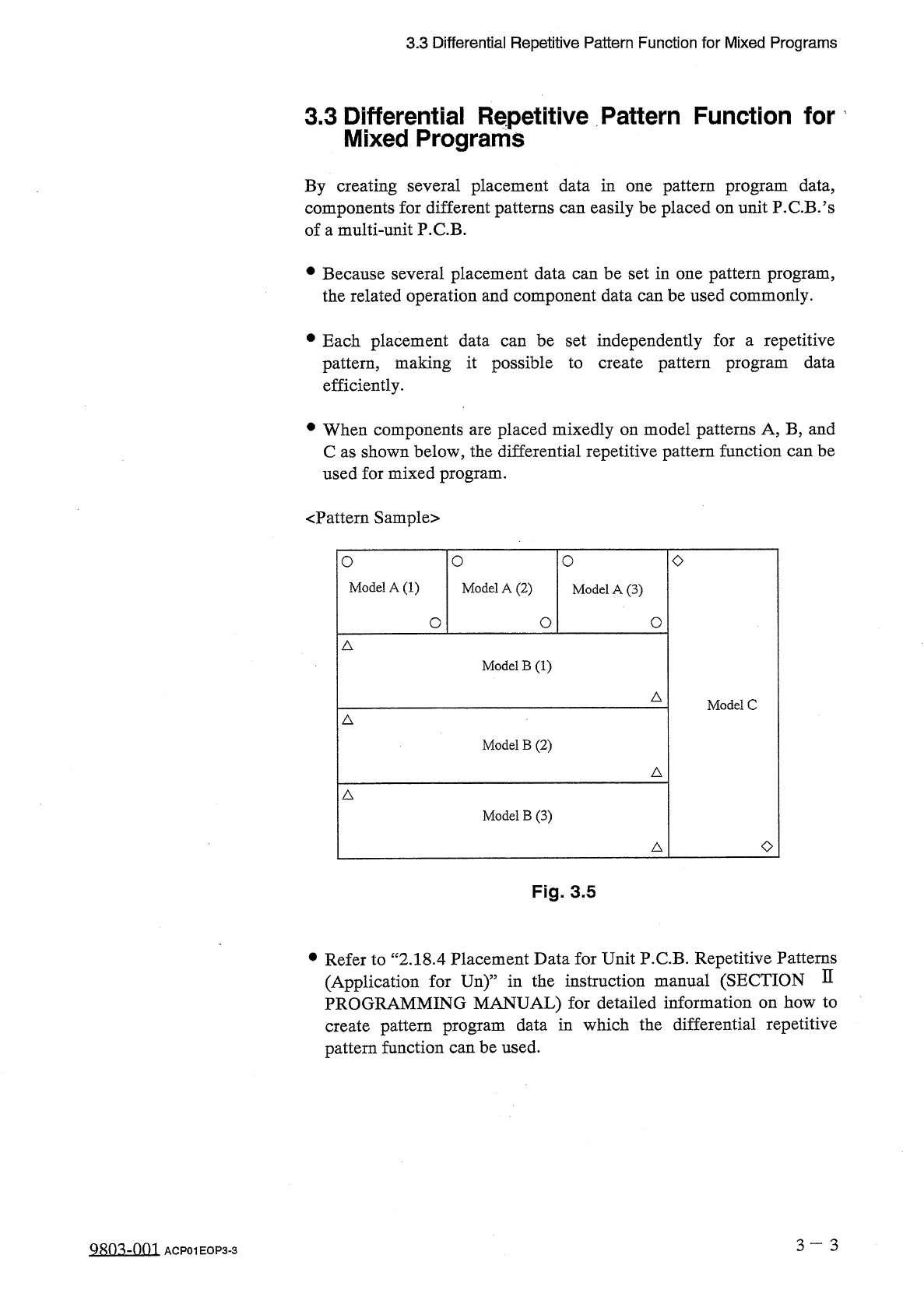
When
components
are
placed
mixedly
on
model
patterns
A
,
B
,
and
C
as
shown
below
,
the
differential
repetitive
pattern
function
can
be
used
for
mixed
program
.
〈
Pattern
Sample
>
O
O
O
o
Model
A
(
1
)
Model
A
(
2
)
Model
A
(
3
)
O
O
O
A
Model
B
(
l
)
A
Model
C
A
Model
B
(
2
)
A
A
Model
B
(
3
)
◊
A
Fig
.
3.5
•
Refer
to
“
2.18
.
4
Placement
Data
for
Unit
P
.
C
.
B
.
Repetitive
Patterns
(
Application
for
Un
)
”
in
the
instruction
manual
(
SECTION
PROGRAMMING
MANUAL
)
for
detailed
information
on
how
to
create
pattern
program
data
in
which
the
differential
repetitive
pattern
function
can
be
used
.
n
3
一
3
9
^
0
^
-
001
ACP
01
EOP
3
-
3
3.4
Priority
Sorting
Function
3.4
Priority
Sorting
Function
By
entering
a
numeral
code
“
0
9
”
in
the
text
boxes
of
the
label
“
C
”
in
the
placement
(
P
)
data
,
component
placement
sequence
is
changed
,
making
it
possible
to
place
components
in
the
order
of
“
0
9
”
(
the
smaller
the
numeral
,
the
faster
the
X
/
Y
table
moves
.
)
.
That
is
,
component
for
which
smaller
numeral
code
is
set
as
the
X
/
Y
table
deceleration
can
be
placed
first
among
all
the
other
components
.
This
function
can
avoid
deterioration
of
productivity
caused
by
loss
time
of
X
/
Y
table
movement
.
a
•
Component
placement
sequence
can
also
be
changed
according
to
component
placement
speed
,
pick
-
up
speed
,
and
component
allocation
on
a
feeder
carriage
for
better
productivity
.
P
0
(
P
.
C
.
B
.
Positioning
Reference
)
X
©
Poi
.
Pp
31
Poi
2
Model
PI
^
P
02
PO
!
Model
P
3
Model
P
4
Po
33
^
P
03
Model
P
2
Y
Fig
.
3.6
3
一
4
QRO
^
-
nm
ACP
01
EOP
3
-
4
3.4
Priority
Sorting
Function
Placement
Data
P
1
Placement
Data
P
2
Placement
Data
P
3
Placement
Data
P
4
Placement
Order
Placement
Order
Placement
Order
Placement
Order
Step
No
.
C
Step
No
.
C
Step
No
.
Step
No
.
CC
P
0001
P
0002
P
0003
POOCH
P
0005
P
0006
P
0007
P
0008
P
0009
P
0010
POOH
P
0012
P
0013
POOH
P
0001
P
0002
P
0003
P
0004
P
0005
P
0006
P
0007
P
0008
P
0009
P
0010
POOH
P
0012
P
0013
P
0014
P
0001
P
0002
P
0003
P
0004
P
0005
P
0006
P
0007
P
0008
P
0009
P
0010
POOH
P
0012
P
0013
P
0014
P
0001
P
0002
P
0003
POOCH
P
0005
P
0006
P
0007
P
0008
P
0009
P
0010
POOH
P
0012
P
0013
POOH
9
1
①
②
④
7
2
0
⑩
1
⑥
③
4
5
5
⑦
P
E
Q
E
00001
00002
00003
00004
00005
00001
00002
00003
00004
00005
E E
Fig
.
3.6
-
1
•
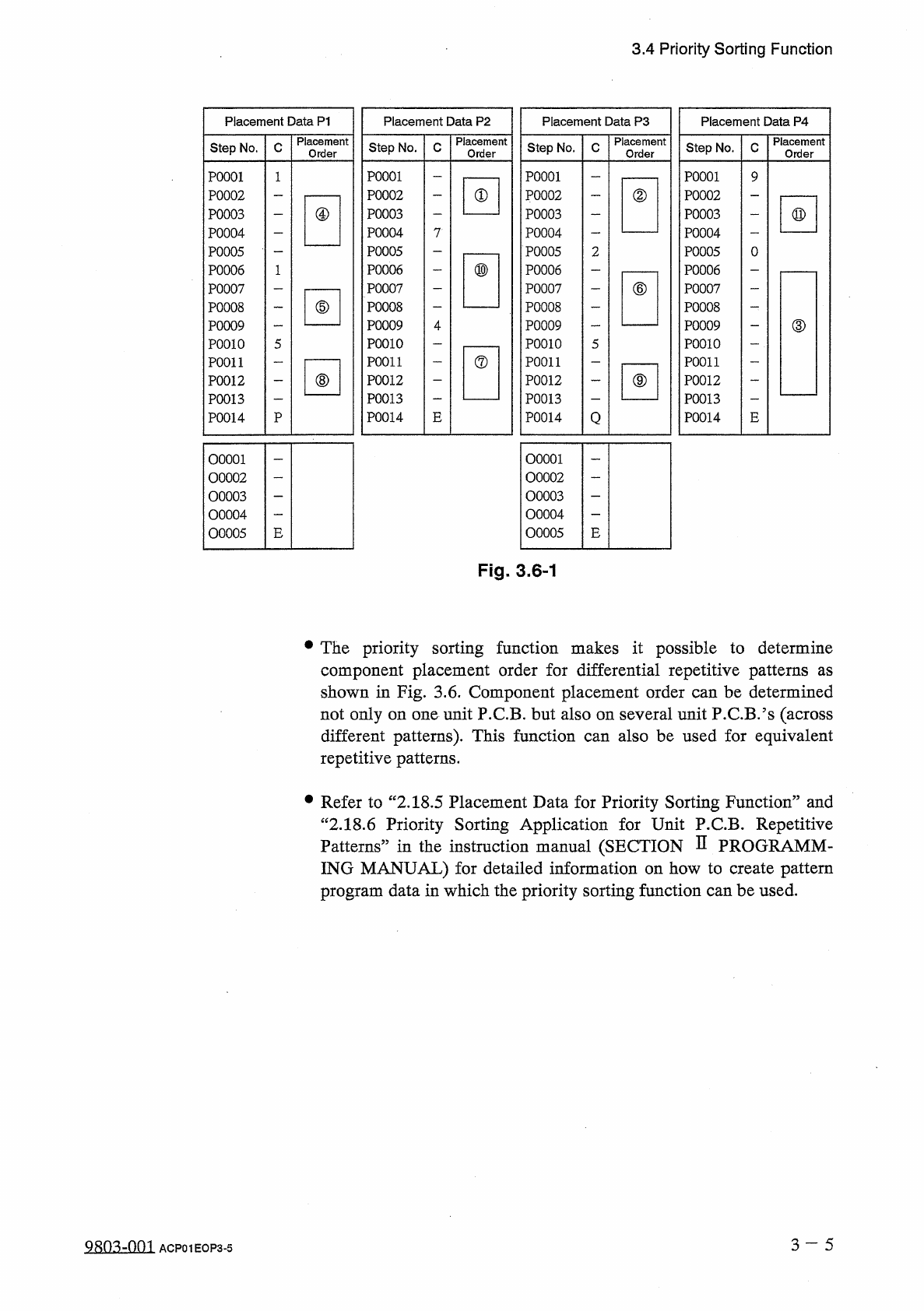
The
priority
sorting
function
makes
it
possible
to
determine
component
placement
order
for
differential
repetitive
patterns
shown
in
Fig
.
3.6
.
Component
placement
order
can
be
determined
not
only
on
one
unit
P
.
C
.
B
.
but
also
on
several
unit
P
.
C
.
B
/
s
(
across
different
patterns
)
.
This
function
repetitive
patterns
.
as
also
be
used
for
equivalent
can
•
Refer
to
“
2.18
.
5
Placement
Data
for
Priority
Sorting
Function
”
and
“
2.18
.
6
Priority
Sorting
Application
for
Unit
P
.
C
.
B
.
Repetitive
Patterns
”
in
the
instruction
manual
(
SECTION
D
PROGRAMM
-
ING
MANUAL
)
for
detailed
information
on
how
to
create
pattern
program
data
in
which
the
priority
sorting
function
can
be
used
.
3
~
~
5
QRO
^
-
nm
ACP
01
EOP
3
-
5