80S-2080F480F5.pdf - 第99页
SIPLACE 80S-20/F4/F5 User M anual 2 Introduction and Basic Concepts 05/99 Issue from Software Version SR.405.xx 2.2 Principles and Structure of the User Interface 2 - 15 2.2.2.5 Symbol and S tat us Stri ps The sym bol st…
2 Introduction and Basic Concepts SIPLACE 80S-20/F4/F5 User Manual
2.2 Principles and Structure of the User Interface 05/99 Issue from Software Version SR.405.xx
2 - 14
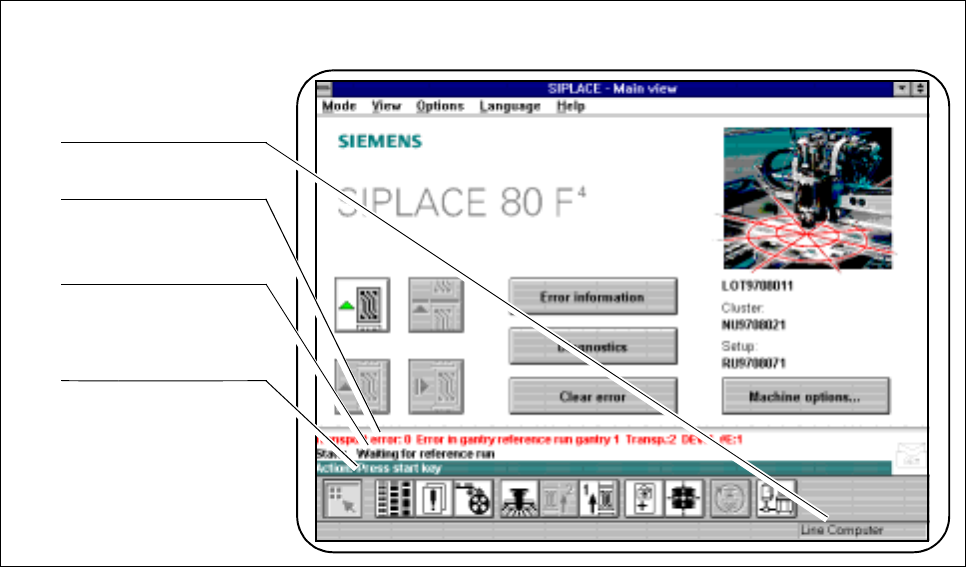
2.2.2.4 Status Window
The status window shows the last fault, the control mode of the machine (Stand alone, line computer, GEM)
and an action which the operator has been asked to carry out.
Fig. 2.2.4 Example of the status window
- Key to Fig. 2.2.4
1 Machine control mode 2 Last fault to occur (red bar)
3 State of the machine 4 Action for the operator (green bar)
1
2
3
4
SIPLACE 80S-20/F4/F5 User Manual 2 Introduction and Basic Concepts
05/99 Issue from Software Version SR.405.xx 2.2 Principles and Structure of the User Interface
2 - 15
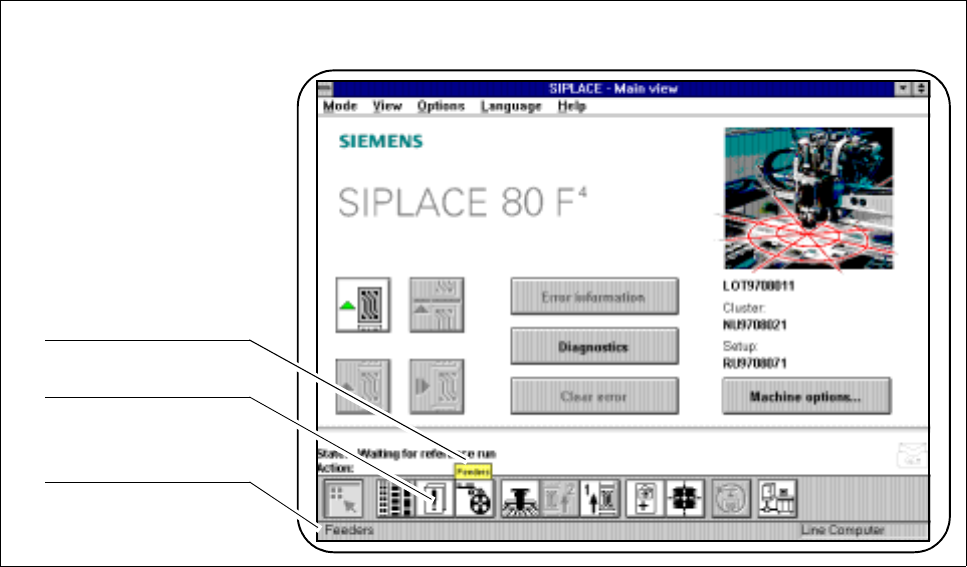
2.2.2.5 Symbol and Status Strips
The symbol strip contains icons (buttons) which are used for selecting the view or an object.
When the trackball pointer is positioned over an icon the corresponding help text will appear within a bubble.
Fig. 2.2.5 Example of symbol strip and status strip
- Key to Fig. 2.2.5
1 Bubble help text 2 Icons (buttons) for submenus
3 Information concerning menu entries and icons
The status strip displays some brief information concerning menu entries and icons when these have been
selected with the trackball or finger but not actually executed.
1
2
3
2 Introduction and Basic Concepts SIPLACE 80S-20/F4/F5 User Manual
2.2 Principles and Structure of the User Interface 05/99 Issue from Software Version SR.405.xx
2 - 16
2.2.3 Screen Displays
Once menus have been selected and actions executed, various messages and input fields may appear.
These are explained in more details in the following text.
In the following user’s manual, the finger in the screen menus indicates where actions are to be car-
ried out or inputs are to be made.
NOTE
Message boxes, input boxes and the like can be shifted on the screen to allow hidden text to be read.
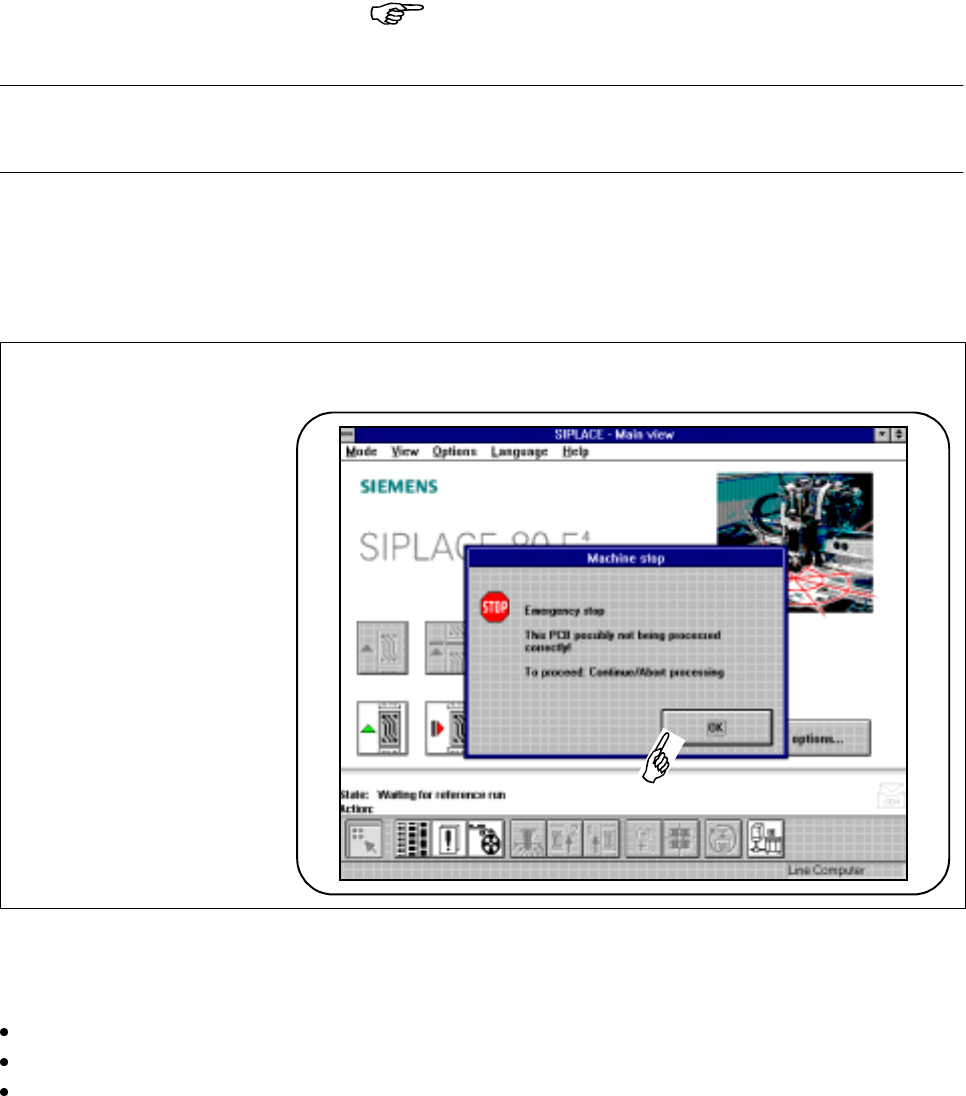
2.2.3.1 Warning and Message Boxes
Fig. 2.2.6 Example of warning and message box
Warning and message boxes show which action has been carried out with the machine and which action is
required of the operator.
Read and comply with the message in the warning and message box.
Click on the OK button.
Carry out the action which you have been asked to perform.