Portal-Operation-Manual-REV-I.pdf - 第106页
PVA Portal Manual Revision I / Janua ry 2022 Page 106 of 106 Appendix B – Serial Com munication 21.1 Ser ial Commun ication The workcell c an comm unicate with a computer using the EIA RS-232C sta ndard. This is used for…
PVA Portal Manual
Revision I / January 2022
Page 104 of 106
Appendix A – Definitions
Auto Cycle: Machine state where cycles are running.
Auto Purge: A machine function that automatically purges material after a predefined
period of time or during solvent cups procedures.
Calibration Position: The location in the workspace where the X, Y, Z and W locations for
the needle(s) is normalized.
Cycle Stop: Machine state where no action is occurring, and the machine is at the standby
position.
Depress: Push and hold for the duration of the operation.
Dispense/Spray Path: A continuous motion profile. The valve is on (dispense/spray)
during the entire motion profile. This is also known as a Path or Motion Sequence.
DMC: Language used to program the motion controller in the workcell.
End Effector: The dispense/spray head assembly. The end effector is moved by the axes.
Head: Dispensing/spraying valve.
Home Position: The (0, 0, 0, 0) location of the workspace. This position is determined by
the location of the home sensors. It is NOT the same as the Standby Position.
Jog: Moving any combination of axes continuously at a set rate of speed until commanded
to stop.
Light Tower: The light tower consists of three stacked lights: red, amber, and green (top to
bottom, respectively). It is used to indicate the status of the machine.
Main Program File: A text file containing the code that runs the workcell during normal
operations.
Motion Sequence: A continuous motion profile. The valve is on (dispense/spray) during
the entire motion profile. This is also known as a Dispense/Spray Path or Path.
Path: A continuous motion profile. The valve is on (dispense/spray) during the entire
motion profile. This is also known as a Dispense/Spray Path or Motion Sequence.
PathMaster®: Windows®-based programming software. This software is used to create,
maintain, and download program files for the workcell.
Push: Push and release.

PVA Portal Manual
Revision I / January 2022
Page 105 of 106
Program: A collection, or series, of motion sequences.
Project: A file containing the code for one or more programs (typically 30 programs).
Purge Position: The location in the workspace where the head moves to perform all auto
purge operations.
PVA: Precision Valve & Automation, Inc.
Solvent Cups: Reservoirs containing a compatible solvent used to maintain the
dispense/spray valves when the workcell is not processing product.
Solvent Position: The location in the workspace where the head moves to rest in a solvent
solution to maintain the dispense/spray valves when the workcell is not processing
product.
Standby Position: The rest position for the end effector. The machine moves here after
homing and after each cycle. This position is usually located near the start point for the
program(s). It is NOT the same as the Home Position.
Terminal: A program used as a communication link between the motion controller and the
operator.
Teach: A process by which the workcell registers its current gantry location with
PathMaster® to create a motion sequence.
Workcell: A model PVA250™, PVA250E™, PVA350™, PVA550™, PVA650™, PVA650-FT™,
PVA750™, PVA1000™, PVA2000™, PVA2000C™, PVA3000™, Delta 6, Delta 8, or Flex Cell
automated system.
PVA Portal Manual
Revision I / January 2022
Page 106 of 106
Appendix B – Serial Communication
21.1 Serial Communication
The workcell can communicate with a computer using the EIA RS-232C standard. This is
used for debug purposes. The computer is the Data Terminal Equipment (DTE) Device,
and the motion controller is the Data Communications Equipment (DCE) Device. The
table below gives a brief overview of the connections required to communicate between
the DTE and DCE devices.
Note: The computer must be at the same ground potential as the workcell. Damage to
the workcell or computer may result if the ground potentials are different. If
provided, use the workcell service outlet for computer power.
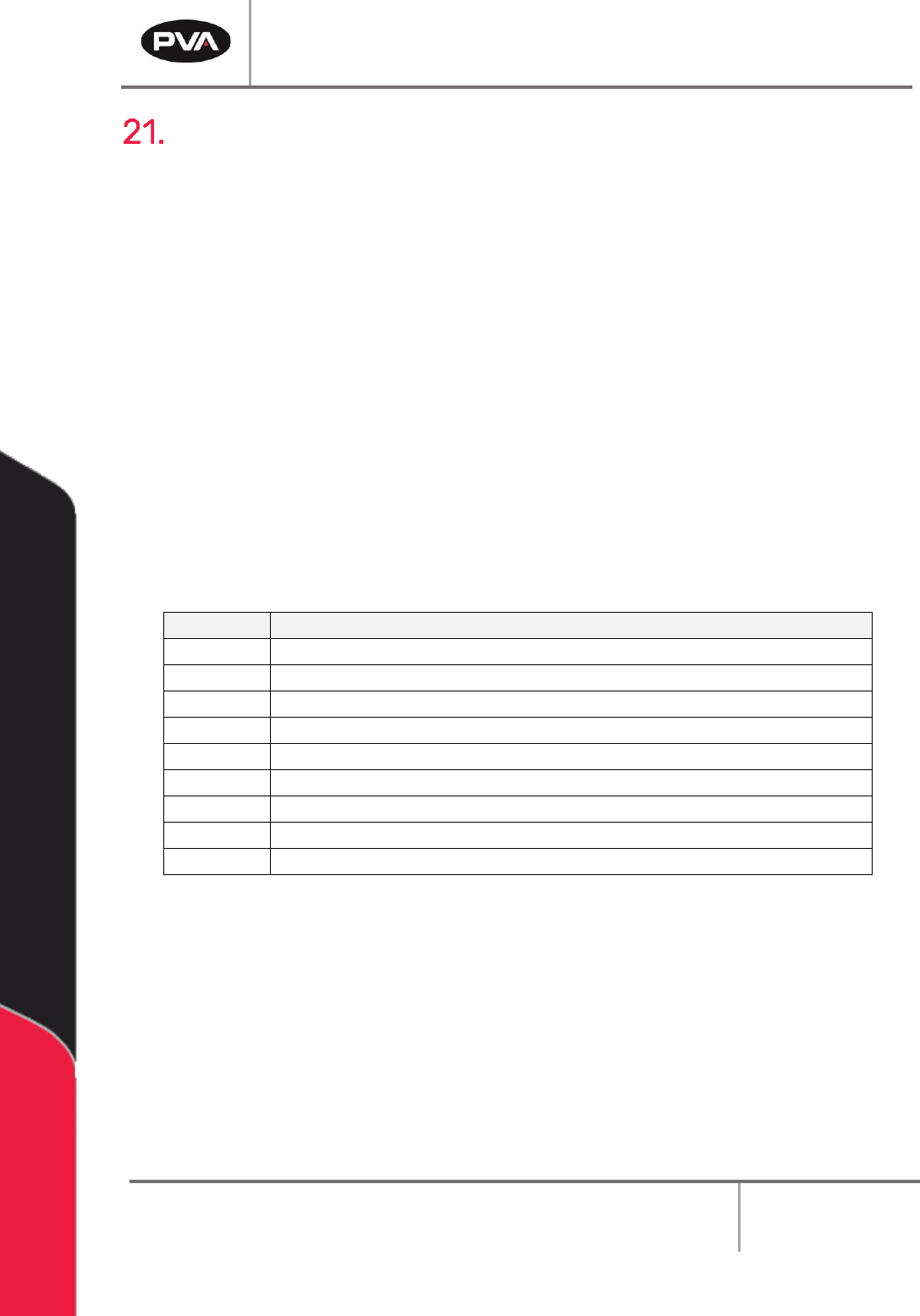
21.2 9 Pin Serial Connector
Error! Reference source not found. describes the pin configuration for standard serial
ports found on most portable computers.
Pin
Description
1
Carrier Detect (CD)
2
Received Data (RD)
3
Transmitted Data (TD)
4
Data Terminal Ready (DTR)
5
Signal Ground
6
Data Set Ready (DSR)
7
Request to Send (RTS)
8
Clear to Send (CTS)
9
Ring Indicator (RI)
Table 3: DTE 9 Pin Serial Connector