MD600 Series Compact AC Drive Hardware Guide-EN-B06.PDF - 第97页
Technical Data ‑ 96 ‑ 11.4 General Specifications Item Technical specifications Motor control perform ance Applicable motor type Asynchronous induction motor (IM) and permanent magnet synchronous motor (PMSM) Control mod…
Technical Data
‑95‑
Three-phase 380 V to 480 V
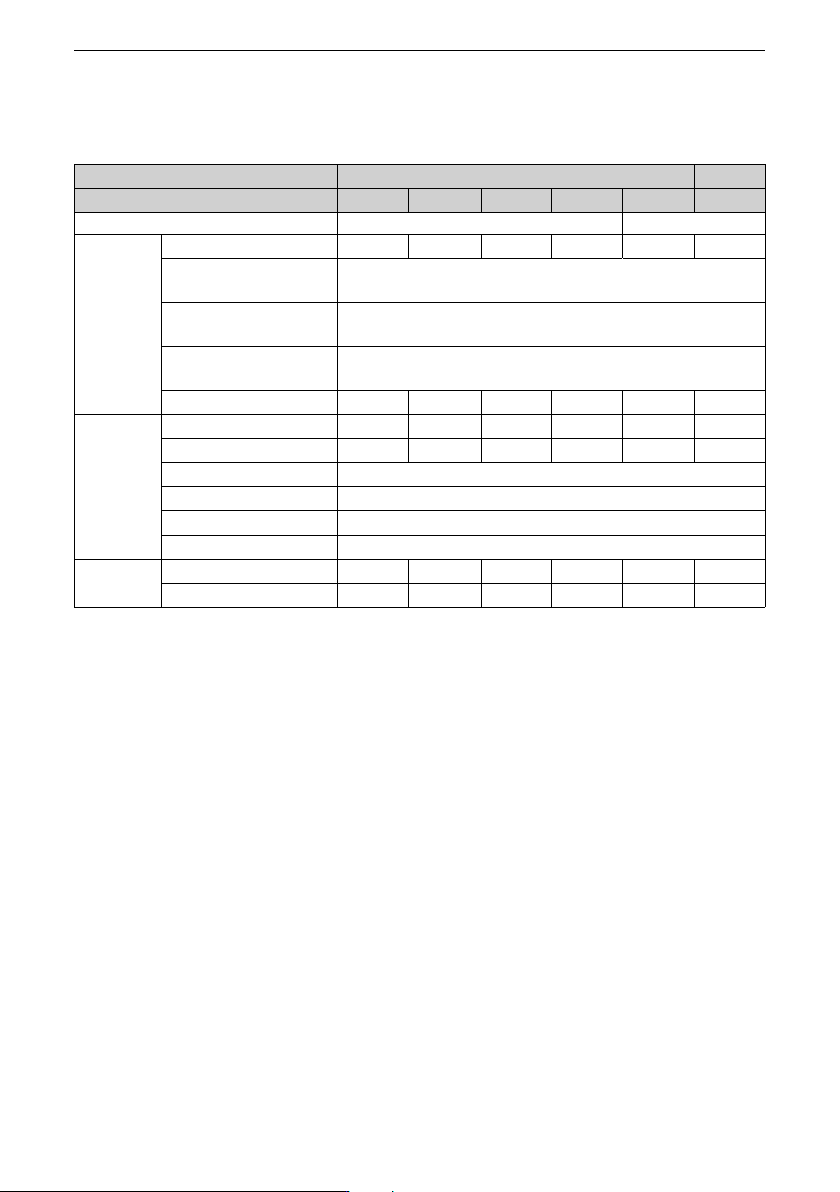
Table 11–3 Electrical specifications for T1 to T2 models (three-phase 380 V to 480 V)
Item
Specification
Model: MD600S/A-4Txxxxx(B)
1R6 2R3 4R8 5R5B 9R5B
013B
Structure T1 T2
Input Rated input current (A) 1.9 2.8 5.9 6.7 11.6 15.8
Rated voltage/Rated
frequency
Three-phase 380 VAC to 480 VAC, 50/60 Hz
Allowable voltage
fluctuation range
–15% to +10%; allowed voltage range: 323 VAC to 528 VAC
Allowable frequency
fluctuation range
±5%; actual allowable range: 47.5 Hz to 63 Hz
Power capacity (kVA) 1.6 2.3 4.9 5.6 9.6 13.1
Output Power (kW) 0.37 0.75 1.5 2.2 4 5.5
Rated output current (A) 1.6 2.3 4.8 5.5 9.5 13
Output voltage Three-phase 0 V to input voltage
Maximum output frequency
599 Hz
Carrier frequency 0.5 kHz to 16.0 kHz (automatically adjusted according to the load)
Overload capacity overload: 60s at 150% of the rated current continuously
Thermal
design
Thermal Loss (W) 25 31 57 65 100 149
Exhaust flow (CFM) ‑ ‑ 12 12 19 19

Technical Data
‑96‑
11.4 General Specifications
Item Technical specifications
Motor
control
perform
ance
Applicable motor type Asynchronous induction motor (IM) and permanent magnet synchronous
motor (PMSM)
Control mode Sensorless vector control (SVC), and voltage/frequency (V/f) control
Asynchronous
motor (V/f)
Functions
available
Energy-saving control, overvoltage suppression, overcurrent
suppression, undervoltage suppression (voltage dip suppression),
oscillation suppression, torque boost, slip compensation, V/f curve
selection, decoupled V/f, DC braking, random PWM, fast deceleration
upon over-excitation, and droop control
Asynchronous
motor (SVC)
Functions
available
Energy-saving control, inertia auto-tuning, acceleration feedforward,
adaptive speed loop parameters, droop control, free programming and
self-adaption of speed loop parameters, load observer, overvoltage
suppression, undervoltage suppression (voltage dip suppression), over-
excitation fast deceleration, automatic voltage adjustment, flying start,
and DC braking
Speed
regulation
range
1:500
Starting torque 200%
Torque step
response
Within 2 ms
Torque control
accuracy
±3% at frequencies above 5 Hz
Speed stability
accuracy
Within 10% of the rated slip value
Field
weakening
ratio
6 x field weakening
Permanent
magnet
synchronous
motor
Functions
available
Speed tracking, electronic star connection, fast deceleration upon over-
excitation, MTPA maximum torque-to-current ratio control, inertia auto-
tuning and acceleration feedforward, droop control, adaptive speed loop
parameter programming, overvoltage suppression, undervoltage
suppression, DC braking, I/F control in SVC
Speed
regulation
range
1:200
Starting torque 200%
Torque step
response
Within 2 ms
Speed stability
accuracy
0.05% (without motor defects)
Torque control
accuracy
±3% at frequencies above 5 Hz

Technical Data
‑97‑
Item Technical specifications
Basic
func
tions
Resolution of input frequency Digital setting: 0.01 Hz
Analog setting: maximum frequency x 0.025%
Operation Operation
command
Independent dual channel and dual channel, which can be switched
freely
Provides different start/stop sources (terminal, operating panel,
communication, custom, connector).
Provides standard control word.
Frequency
reference
Independent dual channel and dual channel, which can be switched
freely
Provides various sources (communication, operating panel, analog,
connector, and so on).
Supports main frequency, auxiliary frequency, and various operations
(addition, subtraction, multiplication, Max., and Min.).
Supports additional frequency.
Supports multi-level frequency limits.
Auxiliary
frequency
reference
Supports various auxiliary frequency references and allows fine-tuning of
the auxiliary frequencies and frequency synthesis.
Standard
command
word
Normal start/stop (OFF1)
Emergency stop (OFF2)
Quick stop, stop with maximum capability (OFF3)
Operation enable, operation pause
Torque
reference
Multiple torque reference sources: digital reference, analog voltage
reference, analog current reference, pulse reference, multi-reference,
PID, simple PLC, and communication, which can be switched through
multiple ways
Start/Stop
mode
Dual channel, which can be switched freely
Supports six different start/stop modes (single-wire mode, two-wire
mode 1, two-wire mode 2, two-wire mode 3, three-wire mode 1, three-
wire mode 2)
Acceleration/
Deceleration
time
Linear acceleration/deceleration and S-curve acceleration/deceleration
4 sets of acceleration/deceleration time
7-segment S-curve can be independently configured.
Automatic switchover between acceleration/deceleration
Multi-speed Supports up to 16 multi-speed references.
Supports different unit settings (Hz, rpm, rated %, maximum speed %).
Supports free per-unit conversion.
Supports custom limit.
Ramp transition function When speed references are sent through communication cyclically,
automatic interpolation is supported to rectify command discontinuity
caused by communication intervals, ensuring smooth operation.
Output limit Torque limit, power limit, current limit, maximum/minimum torque limit,
and speed limit